




We may not have the course you’re looking for. If you enquire or give us a call on 01344203999 and speak to our training experts, we may still be able to help with your training requirements.
Principles of Management: Henri Fayol’s 14 Principles Explained
ByThe Knowledge AcademyLast updated on: 02 October 2026
Principles of management provide guidelines for organising work, managing authority, coordinating teams, and achieving organisational goals. Explore Henri Fayol’s 14 principles, their importance, and how they apply to modern management.

Effective management requires clear responsibilities, coordinated activities, appropriate authority, and fair treatment of employees.
Henri Fayol's principles of management provide an influential framework for understanding these responsibilities. This blog explains his 14 principles, their importance, and their relevance to modern organisations.
What are the Principles of Management?
Principles of management are general guidelines that help managers organise work, coordinate people, distribute responsibilities, make decisions, and direct resources towards organisational goals.
Rather than prescribing one fixed management style, they provide a framework for thinking about how an organisation should function. Fayol's principles address areas such as specialisation, authority, communication, employee treatment, organisational structure, and shared direction.
Managers can apply these ideas according to the size, structure, culture, and requirements of their organisation.

Henri Fayol's 14 Principles of Management
Henri Fayol developed 14 principles to explain important aspects of organisational management. The following principles cover structure, authority, coordination, and people management:
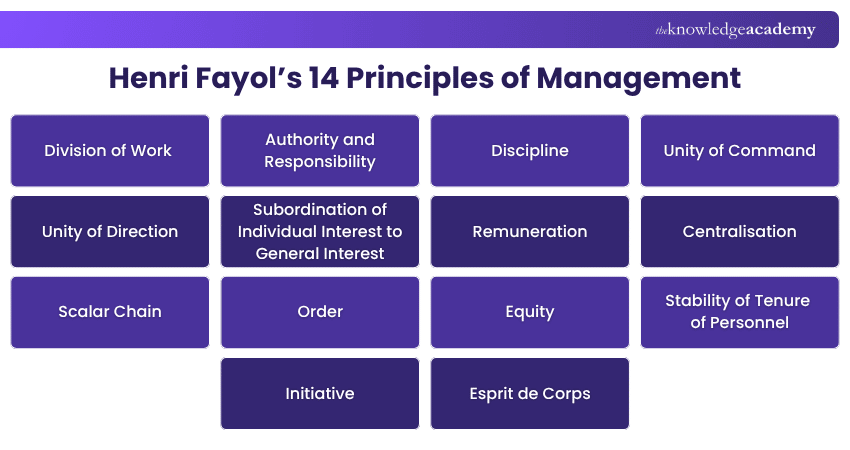
1) Division of Work
Division of Work encourages tasks to be assigned according to specialised skills and responsibilities. Specialisation can improve efficiency, expertise, and clarity while reducing unnecessary duplication.
2) Authority and Responsibility
Authority is the right to make decisions and direct work, while responsibility involves accountability for assigned duties. Fayol argued that managers should maintain an appropriate balance between the two.
Trainer's Tip:
When delegating responsibility, check whether the employee also has enough authority to complete the task. Accountability without appropriate decision-making authority can create delays, unnecessary approvals, and unclear ownership.
3) Discipline
Discipline involves respecting organisational rules, agreements, responsibilities, and expected standards of behaviour. Clear expectations and consistent management help maintain an orderly working environment.
4) Unity of Command
Unity of Command means employees should have clear direction regarding who gives them instructions. This helps reduce conflicting priorities and unclear accountability.
Build critical thinking skills with our expert-led Problem Solving Training – Join now!
5) Unity of Direction
Unity of Direction means activities pursuing the same objective should follow a coordinated plan. It helps align teams, resources, and priorities around shared goals.
6) Subordination of Individual Interest to General Interest
This principle states that individual interests should not undermine wider organisational objectives. Managers should balance collective priorities with legitimate employee needs and development.
Quick Check: Unity of Command or Unity of Direction?
A marketing employee receives conflicting instructions from two different managers.Which principle is affected?A) Unity of DirectionB) Unity of CommandC) Division of WorkD) Scalar ChainAnswer: B) Unity of CommandUnity of Command focuses on having clear authority over who gives an employee instructions. Unity of Direction focuses on coordinating activities that share the same objective.
7) Remuneration
Remuneration means employees should receive fair compensation for their work. This can include salary, benefits, incentives, and other rewards appropriate to their responsibilities.
8) Centralisation
Centralisation concerns how much decision-making authority remains with senior management. Organisations should find an appropriate balance between central control and delegated authority.
9) Scalar Chain
Scalar Chain refers to the formal line of authority running through an organisation. It supports clear reporting relationships, although direct communication may sometimes be appropriate when unnecessary delays can be avoided.
10) Order
Order focuses on placing people and resources where they are most useful. Clear roles, organised resources, and efficient workflows help reduce confusion and delays.
11) Equity
Equity emphasises fairness, justice, and respectful treatment. Managers should apply expectations consistently while using appropriate judgement when circumstances differ.
12) Stability of Tenure of Personnel
This principle recognises the value of retaining employees long enough to develop knowledge and experience. Excessive turnover can disrupt operations and increase recruitment and training requirements.
13) Initiative
Initiative encourages employees to contribute ideas, solve problems, and take appropriate action within their responsibilities. Managers can support this through trust, autonomy, and clear boundaries.
14) Esprit de Corps
Esprit de Corps refers to team spirit and unity. Strong cooperation, communication, and shared objectives can help teams work more effectively together.
Management Decision Challenge
A regional manager needs senior approval for every small customer-service decision, causing unnecessary delays.What would you review first?A) RemunerationB) Division of WorkC) Degree of CentralisationD) Esprit de CorpsBest Answer: C) Degree of CentralisationThe organisation may need to delegate appropriate decision-making authority while maintaining clear accountability.
Let's check your knowledge!
Match each workplace situation with the most relevant Fayol principle:
|
Workplace Situation
|
Principle
|
|
Employees are encouraged to propose solutions independently
|
Initiative
|
|
Teams working on the same project follow one shared objective
|
Unity of Direction
|
|
Employees understand the formal reporting structure
|
Scalar Chain
|
|
Managers apply workplace policies fairly
|
Equity
|
Quick Challenge: Think of one management issue in your workplace. Which of Fayol's principles could help you examine it differently?
Importance of the Principles of Management
Fayol's principles provide useful guidance for organising responsibilities, coordinating teams, and managing authority consistently.
The following areas show why they remain valuable:
1) Clarify roles and responsibilities
2) Improve communication and coordination
3) Support consistent decision-making
4) Balance authority with accountability
5) Encourage fair employee treatment
6) Strengthen teamwork and cooperation
7) Align activities with organisational objectives
Rather than applying every principle rigidly, managers can use them as reference points when reviewing how their organisation operates.
Did You Know?
Gallup's State of the Global Workplace 2026 reported that only 22% of managers globally were engaged at work in 2025, compared with 79% of managers in best-practice organisations. This reinforces the importance of management practices that support clear responsibilities, effective leadership, and employee engagement.
How Fayol's Principles Apply to Modern Management?
Modern organisations often use flatter structures, remote teams, digital collaboration, and greater employee autonomy. Fayol's principles can therefore be adapted rather than followed exactly as originally interpreted.
The following examples show how selected principles translate into current management practices:
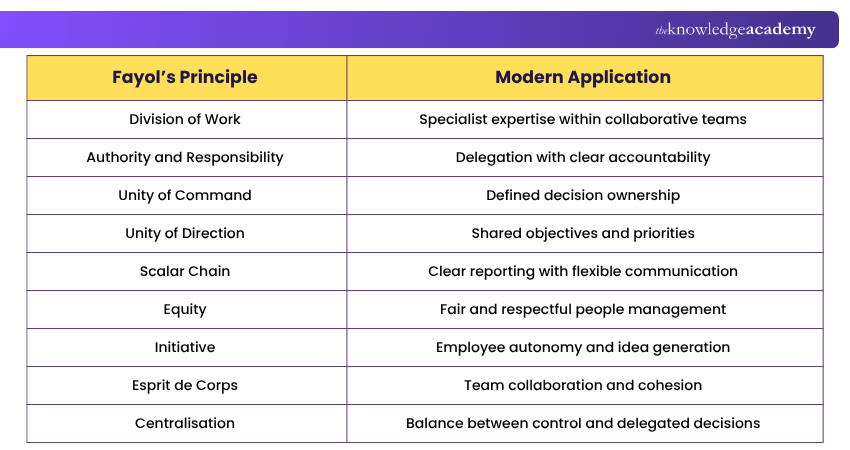
These applications show how Fayol's framework can remain useful while adapting to contemporary ways of working.
Improve communication, negotiation, and workplace relationships effectively with our Conflict Management Training – Join now!

The Knowledge Academy develops accessible learning content across Project Management, IT, Cybersecurity, Data Science, Business Analysis, HR, Accounting and Finance, Leadership and Health and Safety. Its resources combine subject research with clear explanations to help professionals build practical knowledge across a wide range of disciplines.
View Detail

 If you wish to make any changes to your course, please


