


 Top Rated Course

We may not have the course you’re looking for. If you enquire or give us a call on +44 20 4538 6376 and speak to our training experts, we may still be able to help with your training requirements.
What is Business Sustainability? A Complete Guide
James Smith 13 February 2026Business Sustainability is about balancing profit with social, environmental, and economic responsibility for long-term organisational success. It involves adopting ethical practices, reducing environmental impact and helps organisation build trust, drive innovation, and ensure resilience in a rapidly changing world.

Training Outcomes Within Your Budget!
We ensure quality, budget-alignment, and timely delivery by our expert instructors.
Table of Contents

What if a business could make money and make the world better at the same time? That’s the big idea behind Business Sustainability. It’s not just about being “green” anymore, it’s about running a company in a way that’s good for profits, people, and the planet. From cutting down on waste to supporting employee wellbeing and creating lasting value, sustainability touches every part of a modern business.
In this blog, we’re breaking down what Business Sustainability actually means, why it matters more than ever, and how forward-thinking companies are making it work. Whether you’re a business leader, student, or curious reader, this is your starting point for understanding the evolving landscape of sustainable enterprise.
Table of Contents
1) What is Business Sustainability?
2) Why Business Sustainability is Important?
3) Types of Sustainability
4) How to Create a More Sustainable Business Strategy?
5) Challenges with Sustainability in Business
6) Examples of Business Sustainability
7) What is the Key Business Sustainability?
8) The Future of Business Sustainability
9) Conclusion
What is Business Sustainability?
Business Sustainability refers to the practice of operating a company in a way that balances profitability with social, environmental, and economic responsibilities. It means creating long-term value for stakeholders while ensuring that the organisation’s activities do not harm the planet or society.
Sustainable businesses aim to minimise environmental impact by reducing waste, conserving energy, and using eco-friendly materials. They also support ethical labour practices, promote diversity and inclusion, and engage in fair governance. Economically, they focus on steady growth that benefits shareholders, employees, and the broader community.

Why Business Sustainability is Important?
Business Sustainability is vital because it ensures long-term organisational success while safeguarding people, the planet, and profit. In today’s world, where environmental degradation, social inequality, and economic instability pose growing challenges, businesses can no longer operate in isolation from these global issues.
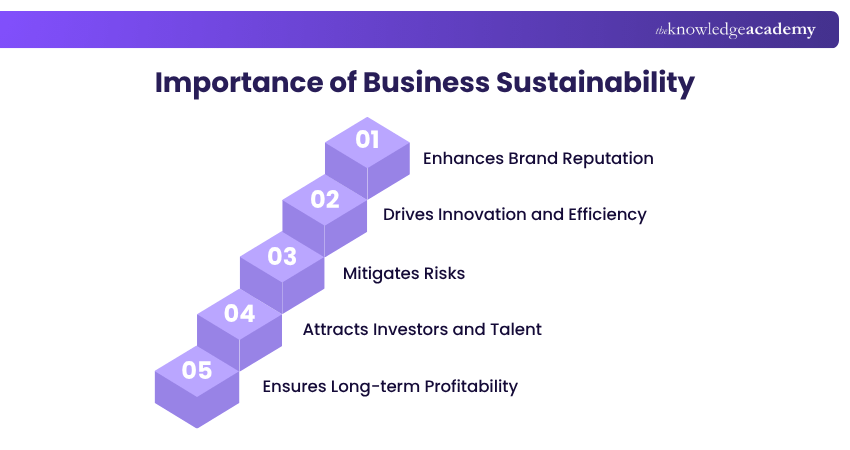
Enhances Brand Reputation
Companies that commit to sustainable practices build stronger reputations. Consumers are more likely to support brands that show genuine concern for the environment and society, leading to increased customer loyalty and trust.
Drives Innovation and Efficiency
Sustainability often encourages businesses to adopt smarter technologies and processes that reduce waste and cut costs. This drive for efficiency fosters innovation and helps companies stay competitive.
Mitigates Risks
Sustainable businesses are better equipped to manage risks related to environmental regulations, resource scarcity, and shifting stakeholder expectations. They are more resilient to market disruptions and reputational damage.
Attracts Investors and Talent
ESG (Environmental, Social, and Governance) performance is becoming a key criterion for investors. Similarly, top talent prefers working for responsible and purpose-driven organisations, making sustainability a powerful tool for attraction and retention.
Ensures Long-term Profitability
By aligning with sustainable goals, businesses can reduce operational costs, uncover new market opportunities, and secure long-term profitability without exploiting resources or communities.
Acquire the key competencies for successful communication, teamwork, and leadership, accessible from any location – join our Managing Remote Teams Course today!
Types of Sustainability
Sustainability in business goes beyond just being environmentally friendly. It’s about creating a balanced approach that considers the impact a company has on the environment, society, and the economy. Let’s take a closer look at the three main types of sustainability and how they work in real life.

1) Environmental Sustainability
This type focuses on protecting the environment and using resources responsibly so future generations can also benefit. It includes actions like reducing pollution, saving energy, recycling, and using renewable resources.
Example: A company installing solar panels and using eco-friendly packaging to reduce its environmental impact.
2) Social Sustainability
Social sustainability is about looking after people’s well-being, both within the company and in the wider community. It includes fair wages, safe working conditions, diversity, and community involvement.
Example: A business offering equal opportunities, supporting local charities, and ensuring safe and healthy working environments.
3) Economic Sustainability
This means running a business in a way that is financially stable and supports long-term growth without harming people or the planet. It involves making smart investments and responsible financial decisions.
Example: A company that controls costs, reinvests profits into staff training, and chooses ethical suppliers to build a strong, future-proof business.
How to Create a More Sustainable Business Strategy?
Creating a sustainable business strategy involves integrating environmentally friendly practices and long-term planning into your business operations. Start by assessing your current environmental impact and setting clear sustainability goals.
1) Assess the Problem and Define Objectives
Initiating change begins with understanding the significance of sustainability for your team, organisation, sector, and clientele. Reflect on the major issues that each stakeholder group deems critical.
To navigate this evaluation, you might ponder the following inquiries:
a) What volume of waste is being generated by our organisation?
b) Is there a challenge with the current company culture?
c) Do our recruitment strategies draw in a variety of job applicants?
d) Does our product cater to the needs of a specific demographic?
e) What kind of influence does our business exert on the community?
Addressing these queries can aid in formulating your firm’s sustainability goals. If you are struggling to pinpoint your sustainability goals, employ the SMART Goals during this phase. Ensuring that your objectives are Specific, Measurable, Achievable, Relevant, and Time-bound at this initial stage can streamline your efforts down the line.
2) Establish Your Mission
Once your team has reached a consensus on specific goals, the next step is to articulate your company’s mission. A clear and compelling mission statement is a vital component of a business’s journey towards greater sustainability.
A well-crafted mission statement should reflect your company’s commitment to action. It encapsulates the core values and mission of your organisation, acting as a beacon that illuminates the reasons behind your activities. Essentially, your mission statement should clarify the five Ws of your company:
a) Who you are?
b) What do you do?
c) When do you operate?
d) Where are you located?
e) Why do you exist?
As your company grows, your mission statement should be adaptable enough to evolve alongside it. It should support your business’s ability to adapt to market changes and maintain its capacity for innovation and disruption. Ensure that your mission statement is broad enough to encompass your objectives, yet specific enough to remain meaningful.
Here are two examples of effective mission statements from well-known businesses:
a) REI: “To inspire, educate and outfit for a lifetime of outdoor adventure and stewardship.” This statement from Recreational Equipment Incorporated (REI) not only highlights the quality of their outdoor products but also their commitment to environmental stewardship and customer engagement.
b) American Express: “To become essential to our customers by providing differentiated products and services to help them achieve their aspirations.” American Express’s mission statement emphasises their goal to be indispensable to their customers through unique offerings that support their customers’ dreams.
These examples demonstrate how a mission statement can succinctly convey a company’s essence, values, and commitment to its customers and the broader community.
3) Craft Your Strategy
Formulating a strong mission statement is the precursor to aligning your organisation with a sustainable business approach.

In devising such a strategy, it’s essential to balance the imperative of remaining profitable with the pursuit of sustainability. After all, your business must thrive to make a difference. Evidence suggests that sustainability can indeed bolster profitability.
Reflect on the triple bottom line concept, which assesses a company’s influence on profit, people, and the planet. This framework guides the development of a business strategy that is both sustainable and economically sound.
Even modest initiatives can spark significant change. For example, consider the potential savings if your company were to turn off electricity and heating overnight when the office is empty. Implementing timers or motion sensors could lead to substantial cost and energy conservation.
Consumer behavior also supports sustainability; a Unilever study indicated that 33% of consumers prefer to purchase from brands that contribute to social or environmental welfare, signaling a market for sustainably produced goods.
Explore industry-specific strategies that boost operational efficiency while creating social and internal value. Understanding the Benefits of Sustainability for Business can help guide your efforts in developing a robust sustainability strategy that delivers lasting advantages for both your organization and the environment.
4) Implement Strategy and Assess Results
Moving from a renewed commitment to excellence and benevolence to taking actionable steps, making public commitments, and delivering measurable outcomes marks a significant transition. With a clear mission and strategy in place, you’re poised to advance toward your goals.
As you put your strategy into action, It’s important to regularly review and adjust your approach to ensure that your goals, mission, and achievements stay in sync. If you’re uncertain about how to begin, identify areas where your mission can make an immediate, significant impact. Sustainability is Important in Business as it helps guide these efforts, and collaborating with an organisation that shares your values can accelerate progress. Such partnerships can also lend additional credibility to your efforts.
Tap into your untapped capabilities and soar to new heights in your career with our comprehensive Management Courses, Join today!
Challenges with Sustainability in Business
In this section, we’ll explore the common hurdles companies encounter on their sustainability journey and why overcoming them is crucial for lasting success.
1) Customer preparedness
As attitudes towards sustainability evolve, businesses must navigate the Challenges of Sustainability in Business by neither lagging behind nor surging too far ahead of their customers’ demand for sustainable products. Crafting a sustainable future is a collaborative effort that necessitates a profound comprehension of customer needs and the cultivation of partnerships that can support this transition.
2) Expense
Adopting sustainable practices often entails significant initial investments. In the short term, maintaining current operations may seem more cost-effective. Organisations may require assistance in demonstrating how early investments can lead to sustained, long-term profitability.
3) Structural Resistance
Sustainability, while a noble objective, may not always be prioritised over immediate, short-term gains. Businesses that plan on a decadal basis may find that distant commitments, such as those set for 2050, do not incite adequate action in the present decade. The key lies in reinterpreting risks as opportunities and advocating that immediate action on sustainability is crucial for enduring business viability.
4) Absence of Tools, Knowledge, and Expertise
The absence of necessary tools, insights, and expertise poses a significant risk for companies attempting to forge a sustainability vision, strategy, and framework. As the landscape of sustainability continues to shift, businesses must seek out innovative partners to assist in navigating this evolving terrain and in shaping a sustainable future.
Elevate your career trajectory with our Personal & Organisational Development Course– sign up now to begin a path of personal and professional advancement!
Examples of Business Sustainability
Below are three real-world-inspired examples that show how businesses can lead with purpose, align with social and environmental needs, and make sustainability a core part of their mission.
Example 1: Considering Indigenous Worldviews in Phone Service
A telecom company wanted to expand into rural and Indigenous areas. Instead of using a one-size-fits-all plan, they spoke with community leaders to understand local needs.
They found that good service meant more than strong signal—it was also about protecting sacred land, teaching native languages, and helping young people stay connected to their culture. This showed that real sustainability also means respecting social and cultural values.
Example 2: Building a Circular Food Economy
In a medium-sized city, people worked together to reduce food waste and support the local economy. They set up gardens, food-sharing apps, and gave support to small farmers.
Leftover food became compost, and unsold produce was shared with families in need. This project helped the environment, supported jobs, and showed how different goals can be met together through teamwork and smart planning.
Example 3: Asking the Right Questions
Many business leaders and students are now asking new questions, such as how companies can solve social issues or help the environment instead of only making money.
Some startups now focus on things like eco-friendly farming or carbon-free production, even if profits come more slowly. This shows a big shift in thinking, where businesses are starting to focus on long-term good for people and the planet.
What is the Key Business Sustainability?
The key to Business Sustainability lies in achieving a balance between profitability, environmental responsibility, and social impact. It’s about creating long-term value without compromising future generations' ability to meet their needs. Businesses must adopt ethical practices, innovate continuously, and engage stakeholders meaningfully.
Leadership commitment, transparency, and a strong sustainability strategy are essential. When companies embed sustainability into their core values and operations, they not only reduce risks but also unlock new opportunities for growth and resilience.
The Future of Business Sustainability
The future of Business Sustainability is driven by innovation, collaboration, and purpose. As climate change, resource scarcity, and social inequalities become more urgent, businesses will need to adopt regenerative practices. Technology, such as AI and data analytics, will play a big role in tracking impact and driving smarter decisions.
Consumers and investors are also becoming more conscious, pushing companies to prove their sustainability credentials. Ultimately, the businesses that thrive will be those that think long-term, act responsibly, and contribute positively to a more sustainable world.
Conclusion
In conclusion, Business Sustainability is essential for long-term success, balancing profitability with environmental and social responsibilities. By adopting sustainable practices, businesses can reduce risks, improve their reputation, and ensure future growth. Embracing sustainability is not just an option anymore but a necessity in today’s evolving economic landscape.
Harness the collective power of your team with our tailored Performance Management Training – secure your place today!
Frequently Asked Questions
What Challenges do Businesses Face in Pursuing Sustainability Goals?

Businesses face challenges in pursuing sustainability goals, including high implementation costs, regulatory compliance, supply chain complexities, and balancing short-term profits with long-term sustainability. Overcoming these obstacles requires strategic planning, innovation, and stakeholder collaboration.
How can Businesses Communicate Their Sustainability Efforts to Stakeholders Effectively?
Businesses can communicate sustainability efforts effectively by being transparent, using clear metrics, engaging through various media channels, sharing success stories, and involving stakeholders in sustainability initiatives, thus building trust and demonstrating commitment to responsible practices.
What are the Other Resources and Offers Provided by The Knowledge Academy?
The Knowledge Academy takes global learning to new heights, offering over 3,000+ online courses across 490+ locations in 190+ countries. This expansive reach ensures accessibility and convenience for learners worldwide.
Alongside our diverse Online Course Catalogue, encompassing 19 major categories, we go the extra mile by providing a plethora of free educational Online Resources like Blogs, eBooks, Interview Questions and Videos. Tailoring learning experiences further, professionals can unlock greater value through a wide range of special discounts, seasonal deals, and Exclusive Offers.
What is The Knowledge Pass, and How Does it Work?
The Knowledge Academy’s Knowledge Pass, a prepaid voucher, adds another layer of flexibility, allowing course bookings over a 12-month period. Join us on a journey where education knows no bounds.
What are the Related Courses and Blogs Provided by The Knowledge Academy?
The Knowledge Academy offers various Management Courses, including the Business Sustainability Course, Senior Management Training, and Event Management Course. These courses cater to different skill levels, providing comprehensive insights into Business Process Improvement Tools.
Our Business Skills Blogs cover a range of topics related to Sustainability Practices in Business, offering valuable resources, best practices, and industry insights. Whether you are a beginner or looking to advance your Business skills, The Knowledge Academy's diverse courses and informative blogs have got you covered.

James Smith


Digital Marketing Manager and Trainer
James Smith is a digital marketing professional with over a decade of experience in SEO, content strategy, paid media and analytics. He has supported both SMEs and global brands in transforming their digital presence. James’s writing and training are rooted in results-driven tactics and the latest marketing trends.
View Detail
Upcoming Business Skills Resources Batches & Dates
Date
 Business Sustainability Course
Business Sustainability Course
Fri 24th Jul 2026
Business Sustainability Course
Fri 16th Oct 2026

 If you wish to make any changes to your course, please


