


 Top Rated Course

We may not have the course you’re looking for. If you enquire or give us a call on +64 98874342 and speak to our training experts, we may still be able to help with your training requirements.
Personal Development Goals: A Guide with Examples
The Knowledge Academy 15 July 2026Personal Development Goals focus on improving skills, habits, emotional intelligence, and productivity to help you grow and reach your full potential. These goals provide clear direction for continuous learning, boosting your confidence, enhancing career growth, and supporting long-term personal and professional success.

Training Outcomes Within Your Budget!
We ensure quality, budget-alignment, and timely delivery by our expert instructors.
Table of Contents
As industries evolve and workplace expectations continue to change, relying solely on experience is no longer enough. Personal Development Goals provide a clear roadmap for building new skills, improving performance, and staying competitive. By setting meaningful goals, you can unlock new opportunities, increase confidence, and create a strong foundation for long-term career success.
Whether you want to enhance your leadership skills, improve productivity, or prepare for future roles, having well-defined development goals keeps your growth on track. In this blog, you'll discover why Personal Development Goals matter, how to set them effectively, and practical examples to help you achieve lasting professional success. So, read on!
Table of Content
1) What are Personal Development Goals?
2) 12 Examples of Personal Development Goals for Work
3) Importance of Personal Development Goals
4) How to Set Personal Development Goals for Work?
5) Benefits of Setting Personal Development Goals for Work
6) Conclusion
What are Personal Development Goals?
Personal Development Goals act as a compass, directing you toward professional growth and success. They represent a form of self-improvement and are strategic objectives designed to elevate your skills, knowledge, and capabilities in the workplace. Understanding the importance of personal development helps reinforce how these goals extend beyond routine job duties, showcasing your dedication to continuous growth and self-discipline.
While setting Personality Development Goals for Work, you should focus on enhancing specific aspects of your work life, be it time management skills, technical skills, or communication abilities. Setting these goals requires analysing your capabilities and identifying key areas that can be improved to maximise your potential.

12 Examples of Personal Development Goals for Work
Personal Development Goals can certainly benefit your career. You may not notice it immediately, but over time, you will come to recognise the value you put into enhancing your development skills. Here are some Personal Development Goals examples to begin with:
Title: Personal Development Goals Examples
1) Learn New Things Every Day
Nobody is perfect at everything. This means even in your job, you won't know everything. There will always be room for learning and growth. Keep an open mind to explore different things and stay curious about trying new experiences. You can attend creative workshops, courses and take advantage of learning resources available on the web.
2) Meet New People
Meeting new people and networking is an important aspect of career advancement. It's important to create and nurture positive connections with colleagues and fellow professionals. So, work on your networking abilities, and you will see a great impact and growth in your career. Moreover, networking can open doors for sharing ideas and gaining knowledge from others. By setting this goal, you're committing to broadening your network and engaging with various perspectives.
3) Improve your Time-management Skills
In your career, meeting deadlines and completing tasks on time is a common thing. And for the majority, this is the most hectic part of the job, but if you learn how to use your time efficiently, you can reduce your workload. So, work on improving your Time Management Skills. It will eventually increase your productivity, reduce work-related stress, and allow you to focus on your priorities. This is one of the most powerful Personal Development Goals. So, start by creating a morning to-do list and adopting time-tracking techniques.
4) Become an Active Communicator
Effective communication is key as it facilitates teamwork and collaboration among co-workers. Often, such skills are required when clarifying tasks to fellow team members and Managers. This is why employees who work from the office seem to be more engaged and active than those working remotely or from home. Try talking with friends and family when you go out. Listen to public speaking podcasts and videos and get better at communication.
Make sure every new skill is a stepping stone toward bigger career achievements. Sign up for our Career Development Course now!
5) Develop a Growth and Positive Mindset
Having a positive and growth-oriented mindset is essential for getting ahead and being successful. A growth mindset is simply a way of thinking that justifies dedication and hard work. It encourages you to accept mistakes and failures as learning opportunities and motivates you to overcome challenges. Further, a positive mindset also allows you to set ambitious goals and enhance your overall performance at the workplace.
6) Create a Reading Habit
Building a habit of reading is the best strategy for Personal Development. Reading allows you to grasp a lot of information and knowledge in your spare time. Most importantly, reading exposes you to diverse perspectives on the world, empowering you to make decisions on your own. There are thousands of books on diverse topics related to the professional field. Invest in them and nurture a consistent reading habit.
7) Improve your Creativity
Regardless of the position, creativity is another essential component for professional development. When you use your brain for creativity, your problem-solving skills also improve. It further encourages collaboration and teamwork. Working on your favourite hobby, playing carroms or puzzles, and going for a mini walk are some of the ways to enhance your creativity.
8) Build Resilience
While success and accomplishments sound great in your work life, there are certain unexpected situations you may face. This includes rejections and setbacks from the employer's side. Being able to handle and overcome such rejections and challenges is crucial for today's workers. It not only helps you grow but also prepares you to be a stronger leader at your workplace.
9) Practice Mindfulness
Being mindful is basically about focusing on the present moment and being aware of your body, thoughts, and current situation. Being mindful promotes a healthy environment. When you come across an overwhelming situation, the ability to step back and analyse the situation and your emotional response from the goal's perspective is helpful. There are several methods for practising mindfulness, such as breathing exercises, light yoga, etc.
10) Develop Emotional Intelligence
Emotional intelligence is the skill to comprehend, utilise, and manage emotions for effective stress management, communication, empathy, problem-solving, and conflict resolution. Strengthening emotional intelligence leads to better relationships, professional success, and achieving personal and career goals. It fosters self-awareness, turning intentions into actions, and prioritising what matters most to an individual.
Learn how understanding emotions can transform teamwork and your leadership in our comprehensive Emotional Intelligence Training - Sign up now!
11) Become a Team Player
A team player is an individual who collaborates effectively within a group, fulfilling assigned roles to achieve collective goals. They actively contribute to group tasks and support fellow members. Team players prioritise the team's interests over their own, demonstrating commitment to shared objectives. This involves effective collaboration, consistency, and reliability in their contributions to foster a cooperative and cohesive team environment.
12) Develop Self-confidence
Self-confidence is the belief in one's abilities, qualities, and decisions. Maintaining a positive level of self-confidence is instrumental in achieving success in one's professional life. It significantly influences motivation to pursue personal development objectives and shapes one's outward image. This quality enables individuals to acknowledge the achievements of others, maintain a positive mindset, and take accountability for their actions.
Importance of Personal Development Goals
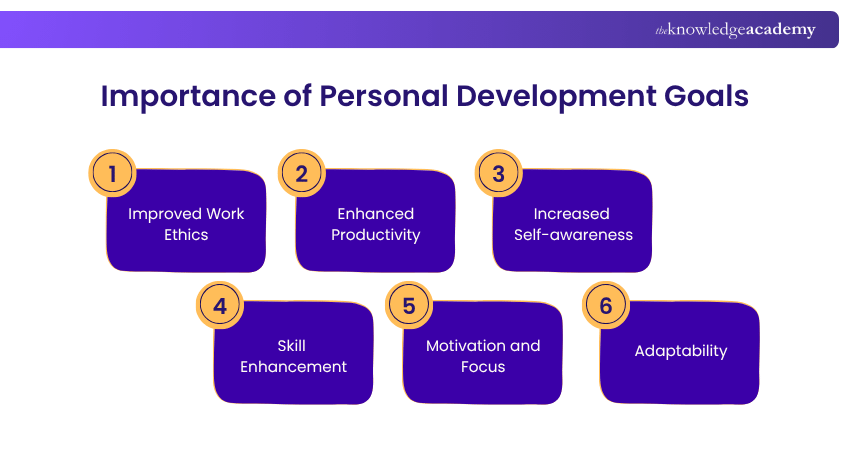
Personal Development plays a vital role in every aspect of life, and when it comes to work, its influence on your long-term career is significant. Exploring personal development topics can further highlight why setting Personal Development Goals for Work is essential to truly maximise your potential.
1) Improved Work Ethics
Setting goals for Personal Development ensures that you approach tasks with dedication and be productive throughout the work. Improved work ethics means behaving responsibly, being punctual, and showing professionalism at work.
Individuals who set Personal Development Goals are more likely to cultivate a strong work ethic. Furthermore, employees who set goals to improve their work ethics are more devoted to keeping a positive attitude toward their work and co-workers.
2) Enhanced Productivity
Not being productive is a major challenge in many workplaces. Setting goals is a way to enhance productivity by promoting a clear sense of direction. Individuals are more likely to remain organised and engaged when they create SMART goals: ones that are Specific, Measurable, Achievable, Relevant, and Time-bound. This approach helps with task prioritisation, efficient time management, and avoiding distractions. All of this adds up to better productivity over time.
3) Increased self-awareness
Self-reflection and self-awareness are all-important for reaching Personal Development Goals. Employees get a better grasp of themselves when they analyse their strengths, weaknesses, values, and interests. This self-awareness helps them make smart career decisions, find areas to improve, and set goals that match their personal and professional ambitions. Self-awareness also improves one’s Emotional Intelligence.
4) Skill Enhancement
Personal Development Goals often focus on getting better at specific skills. As individuals identify areas where they need to develop or enhance their skills, they actively look for opportunities for learning and growth. This could involve:
a) Attending workshops
b) Taking certification courses
c) Finding mentors
d) Engaging in self-paced learning
Acquiring new skills not only makes employees multi-talented but also enhances their value within their organisation and the overall job market.
5) Motivation and Focus
Goals serve as powerful motivators. When people set specific and challenging goals, they feel compelled to work hard and do their best. These targets give them a sense of direction to follow and a reason to put in their best efforts. This determination leads to focused and purposeful work, which in turn boosts job satisfaction and overall engagement.
6) Adaptability
Incorporating adaptability into Personal Development Goals ensures that employees remain agile and well-prepared to handle the evolving demands of the workplace. By setting goals that encourage adaptability, employees can foster a growth mindset that empowers them to see problems as opportunities for learning.
Moreover, through personal development activities, individuals become more comfortable with stepping outside their comfort zones and exploring new technologies and problem-solving methods. As a result, they are better prepared to thrive in challenging work environments and contribute effectively to the success of their teams and companies.
Enhance your organisational skills with our specialised Personal and Organisational Training Course now.
How to Set Personal Development Goals for Work?
Creating Personal Development Plans for Work sounds like an intimidating and time-consuming process, but it’s pretty simple. All it takes is dedication and willingness to follow. Use this step-by-step plan to start setting your goals:
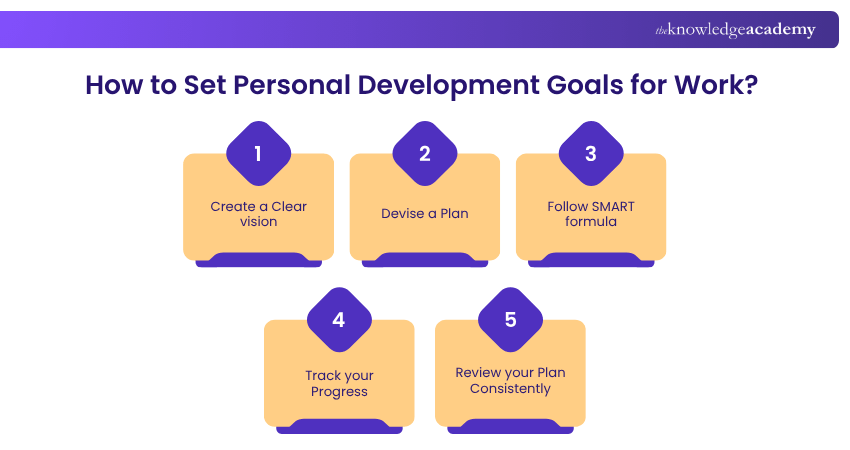
1) Create a Clear vision
Start by having a clear picture of what, where, and who you want to be. Ask yourself questions like:
a) What kind of role do I see myself in?
b) What skills do I need to excel in that role?
c) How will achieving these goals impact my career and personal growth?
Assess your skills, performance, and long-term aspirations to figure out what your Personal Development Goals are. Think of them as your source of motivation and move progressively. For example, instead of aiming for a promotion at work, think about the exact position you have in mind.
2) Devise a plan
Once you have your vision, break it down into actionable steps. Outline the specific areas you need to improve or develop to reach your goals. Figure out the resources you'll need, like courses, workshops, mentors, or books. Break down your journey into smaller milestones that mark your progress.
3) Follow SMART formula
Following the SMART technique is a popular way of setting personal goals. SMART goals add clarity and focus to your plan. Smart goals are objectives that are Specific, Measurable, Achievable, Relevant, and Time-bound .A common theme in SMART Goals Examples is how each of these elements contributes to making goals more structured and achievable. Here’s what each of these elements means:
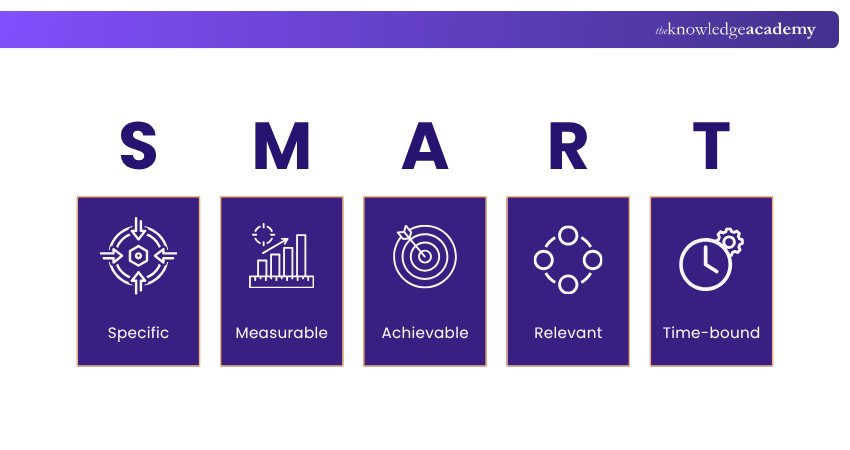
a) Specific: Your goals should be well-defined and purposeful so that you know what exactly you are aiming for before planning them.
b) Measurable: This step in the SMART technique allows you to measure your progress toward achieving a specific goal. It helps you identify whether you have achieved them or how far you came towards reaching them.
c) Achievable: Ensure that your goals are attainable and challenging yet within your capabilities. Setting goals that feel impossible can demotivate you and hinder your growth. It's important to have the time and resources to work on your goals. So, keep yourself motivated by setting realistic goals.
d) Relevant: Your goals must be reasonable to you. That means they must be aligned with your overall vision and long-term career ambitions. Setting relevant goals ensures that your actions directly contribute to achieving positive results.
e) Time-bound: Set a timeline for every goal you set to keep track of your progress. Identify if your goal is short-term or long-term and schedule your tasks to meet deadlines. Your timeline should also be realistic and allow you opportunities to make adjustments to your goal regarding its specificity, relevancy, and achievability.
4) Track your progress
Keep a record of your progress as you work on your goals. Note down the changes you make and the effect they bring on your career. By doing so, you'll identify effective strategies to speed up your goal achievement. Make use of software tools and planners like ClickUp to regularly document your progress. You might also consider using a vision board with your central goal surrounded by smaller ones, adding images of your plans. Place the vision board where you can see it daily for motivation.
5) Review your plan consistently
It's important to check and review your progress regularly to see if the path you are on is fruitful and worthwhile. Evaluate what you have learned and achieved so far and decide if the plan is still applicable and relevant. Depending on your progress, you can modify your timeline and create space to include new goals.
Invest in yourself and unlock your true potential with our range of Personal Development Courses - Sign up now!
Benefits of setting Personal Development Goals for Work
Some concrete benefits of setting Personal Development Goals for Work are as follows:
1) Clarity
Setting personal goals gives your work clear direction and purpose, thus making it easier to prioritise tasks and manage time effectively. Clear objectives also help you improve your performance, work more efficiently, and stay focused on meaningful outcomes.
2) Increased Motivation
Personal Development Goals make work more engaging by giving you something meaningful to strive for beyond daily tasks. They encourage continuous learning, build new skills, and create a stronger sense of purpose, helping you stay motivated and committed to long-term growth.
3) Provide direction for your career
Personal Development Goals provide clear direction for your career by aligning daily tasks with long-term aspirations. Achieving these goals builds valuable skills, tracks your progress, and prepares you for greater responsibilities and future career opportunities.
Amplify your ability to see the bigger picture and build winning strategies with our Strategic Planning and Thinking Course - Sign up now!
How to Achieve Your Personal Development Goals?
Achieving Personal Development Goals requires more than motivation; it calls for a clear plan, consistent effort, and regular reflection. Byaligning yourself with a structured approach, you can stay focused, track your progress, and continuously improve both personally and professionally.
1) Define What You Want to Achieve
Start by identifying the skills, knowledge, or behaviours you want to develop. Having a clear objective gives you direction and helps ensure your efforts align with your personal or career aspirations.
2) Set SMART Goals
Make your goals Specific, Measurable, Achievable, Relevant, and Time-bound (SMART). Well-defined goals are easier to track and increase your chances of staying committed throughout the development process.
3) Create an Action Plan
Break your goal down into smaller and more manageable tasks with realistic deadlines. A structured action plan makes progress more achievable and prevents larger goals from becoming overwhelming.
4) Monitor Your Progress
Review your progress regularly to narrow down what is working and where improvements are needed. Tracking milestones helps maintain motivation and allows you to adjust your approach when necessary.
5) Seek Feedback and Support
Ask colleagues, mentors, or Managers for constructive feedback on your development. External perspectives can highlight strengths, identify improvement areas, and keep you accountable to your goals.
6) Stay Flexible and Keep Improving
Personal development is an ongoing journey. As your priorities, responsibilities, or career goals evolve, review and update your objectives to ensure they remain relevant and continue supporting your long-term growth.
Conclusion
Setting Personal Development Goals for Work is a crucial factor. Having well-defined goals will encourage employees to enhance their efforts and focus and help them prioritise tasks. If a person does not have an aim for work, they will struggle to achieve any growth throughout their career due to a lack of motivation. Yes, you won’t achieve these goals overnight, but the Importance of Setting Career Goals lies in having a clear direction to guide your journey toward success.
Master the art of goal setting with our world-class training. Register now for our Motivation and Goal Setting Training to achieve your career aspirations.
Frequently Asked Questions
What are the Five Points of Personal Development?

Personal development is the continuous process of improving your mental, emotional, social, spiritual, and physical well-being. Developing these key areas helps you build resilience, strengthen relationships, enhance career growth, and achieve long-term personal and professional success.
What are the Three Most Important Areas of Development Professionally?
The three most crucial areas of professional development include skill enhancement, continuous learning, and effective communication. Strengthening skills ensures competence in one's field, ongoing learning fosters adaptability, and effective communication is vital for collaboration and career advancement.

The Knowledge Academy


Global Training Provider
The Knowledge Academy is a world-leading provider of professional training courses, offering globally recognised qualifications across a wide range of subjects. With expert trainers, up-to-date course material, and flexible learning options, we aim to empower professionals and organisations to achieve their goals through continuous learning.


 If you wish to make any changes to your course, please


