


 Top Rated Course

We may not have the course you’re looking for. If you enquire or give us a call on +31 208081674 and speak to our training experts, we may still be able to help with your training requirements.
What is Programming? Basics, Uses, and How to Start
The Knowledge Academy 16 July 2026Programming is the process of writing instructions that a computer can understand and execute to perform specific tasks or solve problems. It involves using Programming languages like Python, Java, or C++ to create software, applications, and systems. Programming enables innovation and digital transformation across industries.

Training Outcomes Within Your Budget!
We ensure quality, budget-alignment, and timely delivery by our expert instructors.
Table of Contents

You’ve probably heard the term “Programming” tossed around in conversations about apps, websites, or tech jobs, but What is Programming really? Think of it as the behind-the-scenes magic that brings your favourite digital tools to life. Whether you're ordering food online, setting a reminder on your phone, or bingeing a series, Programming is working quietly in the background.
And no, it’s not just for tech wizards or maths geniuses. It’s a skill anyone can learn with a bit of curiosity and the right guidance. In this blog, we’ll explore What is Programming, where it shows up in your everyday life, and how you can take your very first steps into the world of code.
Table of Contents
1) What is Programming?
2) How Does Programming Function?
3) Utilisations of Programming
4) Significance of Programming for Organisations
5) Understanding Programming Languages
6) Types of Programming Paradigms
7) The Diversity of Programming Languages
8) Logical Structures Within Programming
9) Tools and Technologies in Programming
10) Getting Started in Computer Programming
11) Difference Between Coding and Programming
12) Challenges Faced by New Programmers
13) Future of Programming
14) What are the 5 pillars of Programming?
15) What is the Difference Between OOP and OOD?
16) Conclusion
What is Programming?
Programming is the art of instructing a computer on what tasks to perform. More specifically, it involves the process of writing code in various Programming languages like Python, Java, and C++ to develop software applications, systems, and tools. While exploring the Advantages and Disadvantages of R Programming, it’s important to understand that Programming is a creative journey—from the birth of an idea to its realisation as a functional system.

Why Programming is Needed?
Programming is essential because it powers the technology we use every day — from smartphones to cars to the internet. Without Programming, we wouldn’t have:
1) Websites
2) Mobile Applications
3) Video Games
4) Online Banking
5) Automated Manufacturing
It also enables us to solve complex problems and automate repetitive tasks, enhancing efficiency and enabling innovation and technological advancements.
How Does Programming Function?
Programming works by following these general steps:
1) Problem Identification: Recognising and defining the problem or the task to be completed.
2) Planning: Outlining a solution, usually through algorithms or pseudocode.
3) Coding: Writing code in a Programming language.
4) Testing: Running the program to find and fix bugs or errors.
5) Deployment and Maintenance: Implement the program in a live environment and update it as needed.
Through these steps, Programming translates logical solutions into a language that computers can understand.
Utilisations of Programming
Programming has a myriad of applications across different fields and industries. Here are some key utilisations:
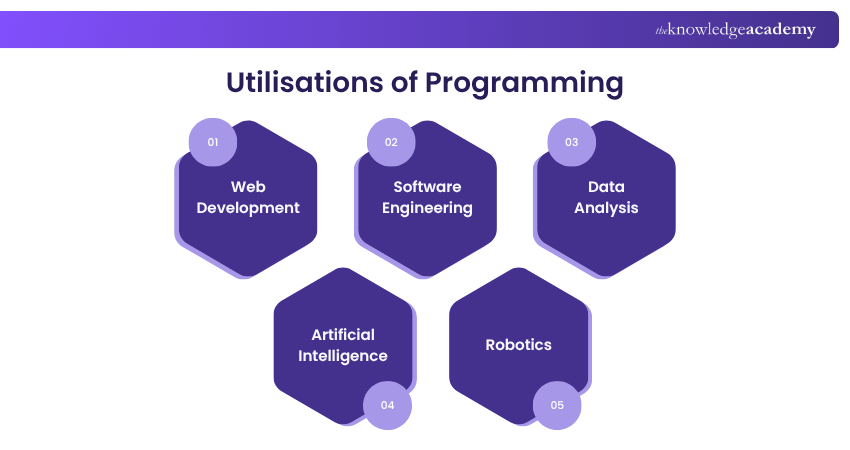
1) Web Development: Creating and maintaining websites.
2) Software Engineering: Designing and developing software.
3) Data Analysis: Processing and analysing large data sets to find patterns or make predictions.
4) Artificial Intelligence: Building systems that can mimic human intelligence and perform tasks such as recognising speech images or making decisions.
5) Robotics: Developing algorithms that control the behaviour of robots.
Significance of Programming for Organisations
For businesses, Programming is invaluable. It helps in:

1) Automation of Operations: Streamlining business processes through software, reducing cost and increasing efficiency.
2) Data Management: Efficient handling, storage, and analysis of data to enhance decision-making.
3) Customer Engagement: Programming enables better customer service and interaction through apps and websites.
4) Innovation: Staying competitive by adopting the latest technologies and trends like Internet of Things (IoT),Blockchain, and more.
Master text like a pro – join our Basic Perl Programming Training today!
Understanding Programming Languages
Programming languages are essential tools that enable developers to communicate instructions to a computer efficiently, with the Go Programming Language being a popular choice for its simplicity and performance. They are categorised based on their level of abstraction and the control they offer over hardware.
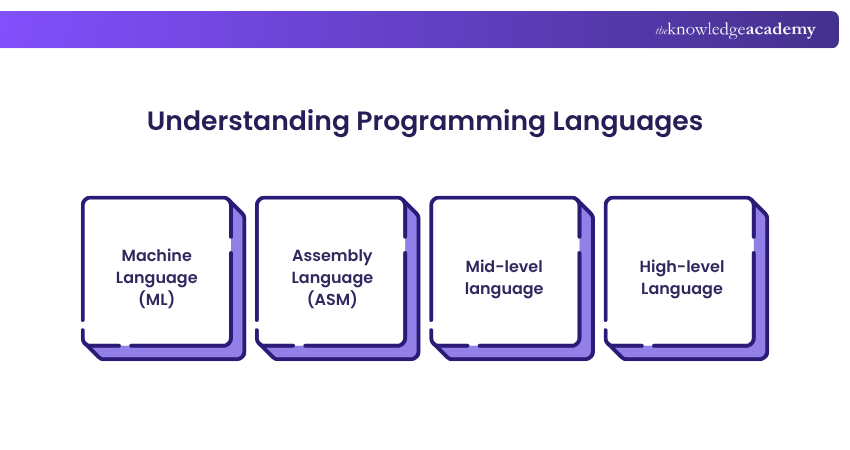
1) Machine Language (ML)
Machine Language is the lowest level of Programming language. It is made up of 0s and 1s; binary code, hence running directly through the Central Processing Unit (CPU) of a computer. In a sense, machine language Programming is thus very hardware-specific because every type of CPU has its own machine language.
2) Assembly Language (ASM)
Assembly language is a level above Machine Language and contains mnemonics that are symbolic representations of various machine code instructions; these instructions are far easier for humans to understand and write. Each statement in a program written in assembly language corresponds exactly to one in machine language. An assembler is a program that converts an assembly code program into executable machine code.
3) Mid-level language
Mid-level languages serve as a bridge between the low-level control of assembly languages and the high-level abstraction of advanced Programming languages. C is the most prominent example of a mid-level language, offering both the high-level functionalities necessary for developing complex programs and low-level features that allow detailed manipulation of hardware.
4) High-level Language
High-level languages abstract the details of the computer hardware from the process of Programming, therefore allowing the developer to focus more on the logic of the application and less on the mechanics of the hardware. For instance, Python, Java, and C++. They are easy to use, flexible, and easily applied in all kinds of Programming, from software engineering to web development.
Types of Programming Paradigms
When you dive into the world of Programming, you’ll quickly realise that there isn’t just one way to think about writing code. Just like chefs have different styles in the kitchen, Programmers use various approaches. Let’s walk through the most popular Programming paradigms that shape how developers around the world write clean, maintainable, and effective code.

1) Imperative Programming
Imperative Programming is like giving a recipe to a robot, you tell it exactly what to do, step by step. This paradigm focuses on how a program should achieve its goal through explicit commands.
For example, if you wanted to filter out numbers greater than 5 from an array, you’d write a loop that checks each number and adds the ones that pass the test to a new list. You’re in full control of the flow.
This style is simple and close to how computers operate, but it can get messy with larger or more complex systems. Still, it’s widely used and forms the foundation for many other paradigms.
2) Procedural Programming
Procedural Programming is a structured extension of imperative Programming. Instead of having one long list of instructions, you break them down into smaller reusable blocks called procedures or functions.
Imagine you’re baking a cake. Rather than listing out every single action, you create functions like pourIngredients(), mixAndBake(), and coolDownCake(). Each function handles a specific task, making the overall program easier to understand and maintain.
This modular approach promotes code reuse and reduces redundancy, which is a huge plus in larger projects.
3) Functional Programming
Functional Programming takes the concept of functions to a new level. Here, functions are treated like building blocks that can be passed around, nested, or returned — just like variables.
One key principle in functional Programming is using pure functions. These functions always produce the same output for the same input and don’t mess with anything outside their own scope. No side effects, no surprises.
Let’s say you want to filter numbers again. Instead of using a loop, you wrap everything inside a neat function and return the result, without touching external variables. This style promotes clean, predictable code and is great for applications where reliability and testability are critical.
4) Declarative Programming
Declarative Programming flips the script. Instead of focusing on how to get something done, you tell the computer what you want; and let it figure out the rest.
It’s like saying, “I want all numbers greater than 5 from this list,” and letting the machine handle the process behind the scenes. No loops, no explicit instructions.
In JavaScript, using filter() is a good example. You declare the condition and leave the iteration to the system. This makes your code easier to read, cleaner to write, and often less error-prone.
Declarative Programming is the driving force behind modern tools like Structured Query Language (SQL), Hypertext Markup Language (HTML), and frameworks like React; all designed to simplify your code by hiding the complexity under the hood.
5) Object Oriented Programming (OOP)
Object Oriented Programming is perhaps the most well-known paradigm, and for good reason. It mirrors real-world entities in your code; think of cars, users, or even cakes, as objects with attributes (data) and behaviours (methods).
At its core, OOP is about creating classes (blueprints) and then building instances (actual objects) from those classes. This makes your code more organised and easier to manage, especially as projects grow in size.
For example, you might create a Cook class and an AssistantCook class, each with their own methods like mixAndBake() or pourIngredients(). You then assign tasks to each and let them handle their part. This separation of concerns leads to cleaner, more maintainable code.
OOP is used in many mainstream languages like Java, Python, and C++, and it's especially valuable in large-scale systems and team-based projects.
Create real-world projects with ease – sign up for our Python Course today!
The Diversity of Programming Languages
There’s no one-size-fits-all when it comes to programming languages. Here are a few you’ve probably heard of:
a) Python: Super beginner-friendly and great for data science, AI, and web development.
b) JavaScript: Perfect for making websites interactive, and it works on both the front and back end.
c) Java: A solid all-rounder used in Android apps and big enterprise systems.
d) C++: Great if you need speed and control; think video games or high-performance software.
e) Ruby: Clean, elegant, and ideal for web development with the Rails framework.
f) Go (Golang): Built by Google, it's fast, simple, and perfect for cloud and network-heavy apps.
g) Swift: If you’re building apps for iPhones or Macs, Swift is the go-to language.
Logical Structures Within Programming
Logical structures are the fundamental elements of Programming that enable the control of flow within programs. These include:
1) Sequences: The default mode of operation where instructions are executed in order, one after another.
2) Decisions: Structures that involve choosing between different paths based on conditions, typically implemented using if-else or switch-case statements.
3) Loops: Used to iterate a block of code multiple times until a particular condition changes, common constructs include for, while, and do-while loops.
Understanding these structures is crucial for Programming because they enable developers to dictate not just what a computer should do but how it should handle different situations dynamically. These concepts also frequently appear in Programming Interview Questions.
Tools and Technologies in Programming
The field of Programming is diverse, with various tools and technologies that cater to different Programming needs. Understanding these tools is a step towards mastering Programming:
1) Programming Languages: These are the core tools for any programmer. Popular languages include Python, Java, JavaScript, C#, and Ruby. Each language has specific uses, such as web development, software engineering, data analysis, and more. If you’re deciding between these options, especially Ruby and Python, exploring a detailed Ruby vs Python comparison can help you choose the right fit.
2) Integrated Development Environments (IDEs): IDEs like Visual Studio, Eclipse, and PyCharm provide Programmers with tools to write, test, and fix their code in a single application.
3) Version Control Systems (VCS): Tools like Git help manage changes to source code, facilitating collaboration among Programming teams.
4) Databases: Knowledge of databases is crucial. SQL databases like MySQL and PostgreSQL and NoSQL databases like MongoDB are widely used. The Difference between MongoDB and MySQL lies in their structure, with MongoDB being schema-less and MySQL using structured tables.
5) Frameworks and Libraries: These are sets of pre-written code that programmers can apply to solve common problems or perform common tasks in a more standardised way. For example, React is used for front-end development, and Django is used for Python-based web applications.
Elevate your coding game with our D Programming Language Training – master a modern, efficient language and unleash your Software Development potential today!
Getting Started in computer Programming
Beginning your journey in computer Programming involves a structured approach. Here’s how you can start:
1) Define Your Programming Objectives
Understanding what you want to achieve with Programming can guide your learning process. Whether it’s developing web applications, analysing data, or creating games, your objectives will determine the path you take.
2) Register in an Introductory Programming Course
Look for courses that suit your learning style. Options include online platforms or more structured settings like university courses or coding boot camps.
3) Develop Fundamental Programming Competencies
Start with the basics of your desired Programming language. Understand variables, control structures, data structures, syntax, and semantics. Building a strong foundation is crucial.
Craft clean code – get trained by our Ruby Programming Course team!
4) Engage With Fellow Programmers
Join Programming communities online (such as Stack Overflow, GitHub, or Reddit) or offline. Networking with other Programmers can provide support, insights, and opportunities to collaborate on projects.
5) Accomplish Coding Projects
Use what you’ve learned by working on projects. Start with small tasks and gradually take on complex projects. This will build your confidence and enrich your problem-solving skills.
6) Explore Potential Career Paths in Programming
As you gain skills, consider what career paths align with your interests. Programming opens doors to roles like software developer, web developer, systems analyst, and many others.
Difference Between Coding and Programming
While often used interchangeably, coding and Programming are distinct concepts:
1) Coding is the process of translating logic and algorithms into a language that a machine can understand. It is essentially writing the code that tells the computer what to do, offering numerous Benefits of Coding such as problem-solving skills and creativity.
2) Programming involves a more holistic approach. It includes not only coding but also planning, designing, testing, and maintaining applications. A Programmer thinks about the algorithm, writes the code, and solves problems that arise during development.
Prepare for success by reviewing the top Software developer interview questions and learn how to impress hiring managers during your interview!
Challenges Faced by New Programmers
Starting out in Programming can feel both exciting and overwhelming. New Programmers often step into a world full of possibilities but quickly realise that learning to code is not just about memorising syntax. It’s about problem-solving, logical thinking, and patience. Here are a few challenges face by new Programmers:
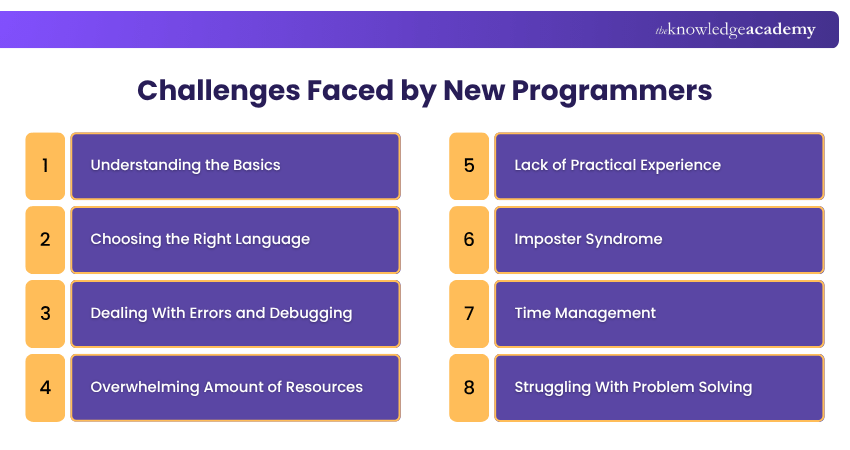
1) Understanding the Basics
Grasping core concepts like loops, conditionals, and variables can be tricky at the start, especially without a strong mathematical or logical background.
2) Choosing the Right Language
With so many Programming languages out there, beginners often feel confused about which one to learn first or which one suits their goals.
3) Dealing With Errors and Debugging
Encountering frequent bugs is common but learning how to read error messages and fix code without frustration takes practice and patience.
4) Overwhelming Amount of Resources
The internet is full of tutorials and advice, but not all of it is helpful. Figuring out what to follow can lead to confusion and wasted time.
5) Lack of Practical Experience
Many new Programmers spend too much time watching tutorials without applying what they learn. Building real projects is key but often overlooked.
6) Imposter Syndrome
Beginners often compare themselves to more experienced Programmers and start doubting their skills, which affects motivation and confidence.
7) Time Management
Balancing coding with studies, work, or other responsibilities can be tough, especially without a structured learning schedule.
8) Struggling With Problem Solving
Writing code is not just about syntax, it’s about solving problems. Developing this mindset takes time and is often one of the hardest transitions.
Future of Programming
The future of Programming is evolving rapidly, and it’s shaping up to be more exciting than ever. As technology continues to advance, the way we write code and the roles developers play are changing in fascinating ways.
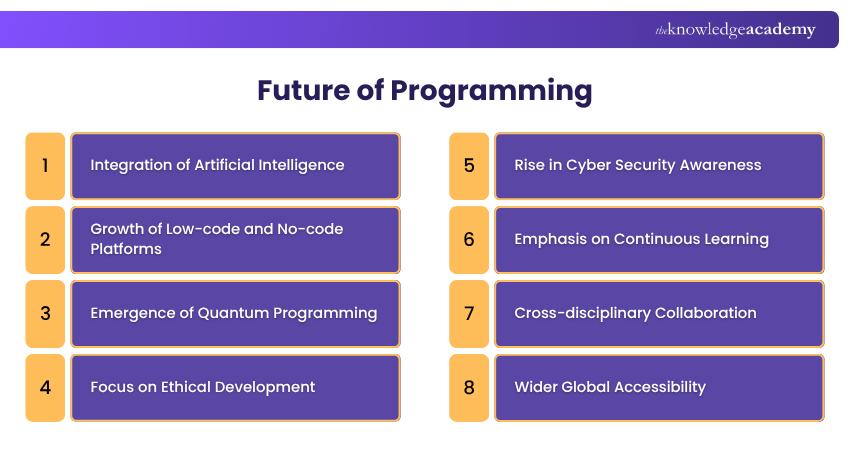
1) Integration of Artificial Intelligence
AI-powered tools like code generators and auto-completion are reshaping how developers work, making coding faster and more efficient.
2) Growth of Low-code and No-code Platforms
These platforms are allowing non-programmers to build applications, expanding access to software development while changing traditional roles.
Convert data into insights – join our R Programming Course today!
3) Emergence of Quantum Programming
As quantum computing advances, new Programming languages and skills will be needed to interact with quantum systems, offering unique career paths.
4) Focus on Ethical Development
Future Programmers will be expected to consider ethics in their work, from user privacy to the impact of algorithms on society.
5) Rise in Cyber Security Awareness
As data breaches and cyberattacks increase, secure coding practices will become a mandatory part of the Programming skillset.
6) Emphasis on Continuous Learning
With constant updates in technology, Programmers will need to regularly update their knowledge to stay competitive in the job market.
7) Cross-disciplinary Collaboration
Developers will work more closely with designers, analysts, and business teams, making soft skills and collaboration just as important as coding.
8) Wider Global Accessibility
As the internet reaches more corners of the world, Programming education and job opportunities will become accessible to a broader audience.
What are the 5 Pillars of Programming?
The five pillars of Programming often include logic, syntax, algorithms, data structures, and debugging. These elements help Programmers write efficient, error-free code and build scalable, maintainable software systems that solve real-world problems.
What is the Difference Between OOP and OOD?
OOP (Object-Oriented Programming) is the actual implementation of code using objects and classes. OOD (Object-Oriented Design) is the planning phase where you structure and organise the system's objects before coding. OOD shapes how OOP is written.
Conclusion
Think about the apps you use, the games you love, or even how your phone responds to a tap that's all because of Programming. It's not just for techies; it's for anyone curious about how things work and how to build something new. Once you get What is Programming really means, you're already one step closer to creating something of your own.
Move ahead in the tech race with our Swift Training – register today and future-proof your career!
Frequently Asked Questions
What is the First Programming Language?

The first Programming language is widely considered to be Ada, created by Ada Lovelace in the 1840s to program Charles Babbage’s Analytical Engine. In the modern sense, Assembly and Fortran were among the earliest practical languages used for coding electronic computers.
What is the Role of Algorithm in Programming?
An algorithm acts as a step-by-step guide to solving a problem in Programming. It outlines the logic and flow needed to perform a task, making code more efficient and reliable. Without algorithms, programs would lack structure and consistency in handling data or achieving results.

The Knowledge Academy


Global Training Provider
The Knowledge Academy is a world-leading provider of professional training courses, offering globally recognised qualifications across a wide range of subjects. With expert trainers, up-to-date course material, and flexible learning options, we aim to empower professionals and organisations to achieve their goals through continuous learning.


 If you wish to make any changes to your course, please


