


 Top Rated Course

We may not have the course you’re looking for. If you enquire or give us a call on +31 208081674 and speak to our training experts, we may still be able to help with your training requirements.
What is Computer Vision, and How Does it Work?
Lily Turner 22 June 2026Explore the fundamentals of Computer Vision, a powerful branch of Artificial Intelligence (AI) that enables machines to understand and analyse images and videos. Learn how Computer Vision supports technologies like Facial Recognition, Autonomous Vehicles, Medical Imaging, Smart Surveillance, and Augmented Reality (AR).

Training Outcomes Within Your Budget!
We ensure quality, budget-alignment, and timely delivery by our expert instructors.
Table of Contents
Vision is a concept that's not limited to living organisms anymore. Even computers possess this feature now in their own unique, digital way. Welcome to the world of computer vision, where machines can “see” and make sense of images just like we do. From spotting faces in photos to guiding self-driving cars, this technology is transforming the way machines interact with the world. If you want a deeper observation into this concept, this blog is here for you exploring What is Computer Vision and how it functions. So read on and embrace the future of image and video recognition!
Table of Contents
1) What is Computer Vision?
2) Evolution of Computer Vision
3) The Importance of Computer Vision
4) Applications of Computer Vision in Various Industries
5) How Does Computer Vision Work?
6) Computer Vision Tasks
7) Difference Between Computer Vision and Image Processing
8) Conclusion
What is Computer Vision?
Computer vision is a technology used by machines to recognise images and describe them accurately. Modern computer systems can access many images and video data from numerous sources, including smartphones, security systems and traffic cameras. Applications pertaining to Computer Vision utilise Artificial Intelligence (AI) and Machine Learning (ML) to accurately process data for tasks such as:
1) Object identification
2) Facial Recognition
3) Classification
4) Recommendation
5) Monitoring
6) Detection

Evolution of Computer Vision
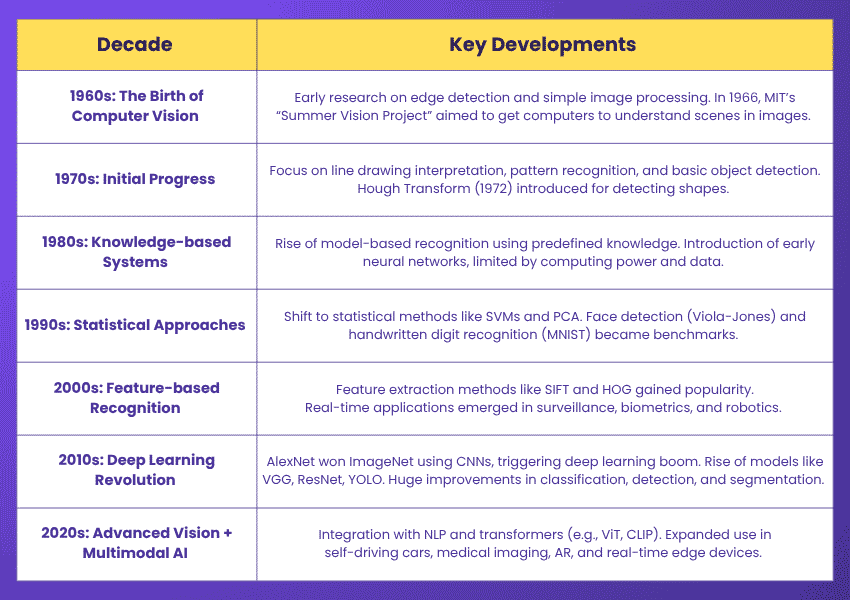
Here’s a timeline of how Computer Vision has evolved through the years:
The Importance of Computer Vision
Here’s why Computer Vision is important:
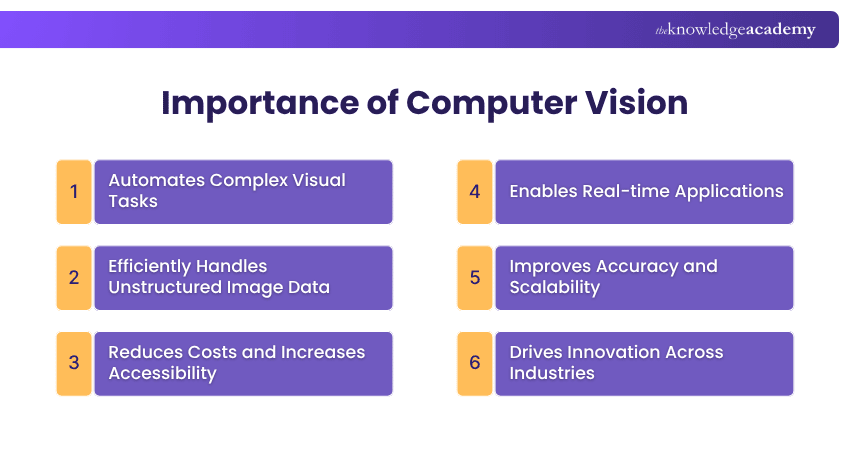
1) Automates Complex Visual Tasks: Computer vision eliminates the need for manual image tagging and analysis. Tasks such as facial recognition that previously required developers to label thousands of image features can now be simply automated.
2) Efficiently Handles Unstructured Image Data: Image data is unstructured and difficult for machines to interpret; traditional methods struggle with organisation and analysis. Today’s computer vision systems efficiently process this complexity using advanced algorithms.
Craft tomorrow's digital brilliance with today's innovation in our Artificial Intelligence Tools Training - Sign up now!
3) Reduces Costs and Increases Accessibility: Previously, vision applications were expensive and only available to big organisations. Advances in Cloud Computing have made powerful computer vision tools affordable for everyone.
4) Enables Real-time Applications: With increased computational power, modern computer vision enables real-time applications. This includes live video analysis, streaming content moderation, instant identity verification, improving responsiveness and decision-making.
5) Improves Accuracy and Scalability: Computer vision systems now offer high accuracy at scale. This allows organisations to analyse vast volumes of image or video data quickly.
6) Drives Innovation Across Industries: From healthcare to manufacturing and retail, computer vision transforms industries by providing deeper visual insights and automating visual inspection tasks.
Craft tomorrow's digital brilliance with today's innovation in our Artificial Intelligence Tools Training - Sign up now!
Applications of Computer Vision in Various Industries
Computer vision's applications span various industries, where it improves efficiency and enables new capabilities. Below are key applications of computer vision across different sectors
Healthcare
Computer vision helps doctors read X-rays, MRIs, and other scans to detect problems such as tumours or fractures. It can also track patient movements or behaviours at home or in hospitals to alert caregivers in case something is wrong.
Retail
Stores use computer vision to let people buy items without needing a cashier. Essentially, you can just grab and go. It also watches store shelves and tells staff when items run low or get misplaced.
Deepen your understanding of machines with our comprehensive Deep Learning Course - Sign up now!
Automotive Industry
Computer vision ensures safe driving by helping cars understand the road, signs, people, and other vehicles. It alerts drivers if they’re drifting from their lane or getting too close to other vehicles.
Smart Cities
Cameras and computer vision can help manage traffic lights based on the number of cars on the road. They’re also used in security cameras to spot suspicious activities or unattended objects in public places.
Social Media
Computer vision is extremely adept at automatically finding and removing harmful or offensive images. It can recognise and tag faces or objects in photos for easier searching and sharing.
Manufacturing
Computer Vision checks products on the factory line to ensure they aren’t broken or missing parts. It also examines machines to spot early signs of trouble and prevent breakdowns.
Agriculture
Drones use computer vision to check if plants are healthy or need water or treatment. Robots use it to pick ripe fruits and vegetables which saves significant time and effort.
Become a pro at text wrangling and cleansing of raw data with our Natural Language Processing (NLP) Fundamentals With Python Training - Sign up now!
How Does Computer Vision Work?
Computer Vision systems use Artificial Intelligence (AI) technology to mimic the human brain's object recognition and classification capabilities. Here are the core components of Computer Vision:
Deep Learning
a) Deep learning refers to a kind of Machine Learning that employs neural networks.
b) It relies on layers of software modules known as artificial neurons.
c) These neurons work together inside the computer to process data.
d) Deep learning employs mathematical calculations to understand image data.
e) It analyses different parts of the image automatically and, over time, builds a complete understanding of the image.
Convolutional Neural Networks
a) Convolutional Neural Networks (CNNs) use a proper labelling system to categorise the visual data.
b) They analyse images as a collection of pixels, giving each pixel a label value for processing.
c) These values are used in a mathematical operation called convolution.
d) CNNs make predictions based on patterns found in the image. They first detect outlines and basic shapes, similar to how humans recognise objects.
e) Gradually, they identify finer details like colour, texture, and internal patterns.
f) The prediction process is repeated over multiple iterations to improve accuracy.
Recurrent Neural Networks
a) Recurrent Neural Networks (RNNs) are similar to Convolutional Neural Networks (CNNs).
b) Instead of just one image, RNNs can process a series of images.
c) They are designed to find connections or patterns across multiple images.
d) RNNs are better suited for analysing videos.
e) They help understand the relationships and sequences between images.
Empower machines to learn, adapt, and innovate - Sign up for our Machine Learning Course now!
Computer Vision Tasks
From object detection and object tracking to image classification and content-based image retrieval, Computer Vision can handle many tasks. Let’s explore them in detail:
Object Detection
a) Through object detection, computer vision can detect and locate objects in images.
b) It involves classification to identify, sort and organise visual data.
c) It's commonly employed in industrial and manufacturing settings.
d) Object detection helps you control autonomous systems and monitor production lines.
e) Home security camera systems are a prominent example of this as they use object detection to process live video streams.
f) It detects people and objects in real-time and sends alerts to users.
Object Tracking
a) Object tracking uses deep learning models to identify and follow specific items.
b) It starts with object detection, where a bounding box is drawn around the item.
c) Each object is assigned an ID to help with tracking across multiple frames.
d) It's used in traffic monitoring to track vehicle movement in cities.
e) Object tracking serves a big purpose as human surveillance for safety and security.
f) It's also applied in medical imaging to follow the movement of specific areas or markers.
Image Classification
a) Image classification enables computers to identify and categorise images into specific classes.
b) It helps computer vision recognise and label objects like trees, planes, or buildings.
c) The system assigns a class label based on visual patterns in the image and enables automated understanding of different image types.
d) A typical example of this is a camera recognising faces in a photo. The camera can then focus on the detected faces for clearer images.
Content-based Image Retrieval
a) Image classification allows computers to categorise images into specific classes.
b) Computer vision can recognise and label objects like trees, planes or buildings.
c) The system assigns a class label based on visual patterns in the image.
d) It enables an automated understanding of different image types.
e) A typical example of this is a camera recognising faces in a photo. The camera can then focus on the detected faces for clearer images.
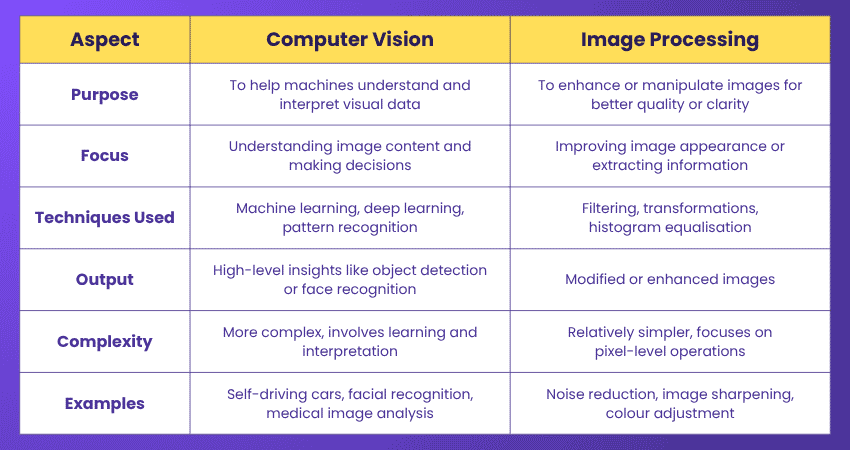
Difference Between Computer Vision and Image Processing
Here are the main differences between Computer Vision and image processing:
Conclusion
Computer Vision allows machines to see, understand, and act on visual data. From healthcare to smart cities, it’s transforming industries quickly and more precisely than ever before. As technology evolves, the possibilities of computer vision are endless. Understanding What is Computer Vision will help you appreciate the future we’re already stepping into.
Juggle productivity, time and money like never before with the power of AI and ML - Sign up for our Artificial Intelligence & Machine Learning Courses now!
Frequently Asked Questions
What are the Limitations of Computer Vision?

Here are some limitations of Computer vision:
a) Privacy concerns regarding its widespread use.
b) Bias and inaccuracy can negatively affect Computer Vision outputs.
c) Dependence on a consistently strong infrastructure.
d) Vulnerability to adversarial attacks.
e) Ethical Considerations about Computer Vision's impact on society.
What Programming Languages are Used in Computer Vision?
Python is the most widely used programming language in Computer Vision because of libraries like OpenCV, TensorFlow, and PyTorch. Other commonly used languages include C++, Java, MATLAB, and R for tasks such as image processing, machine learning, and real-time visual applications.
What are the Other Resources and Offers Provided by The Knowledge Academy?
The Knowledge Academy takes global learning to new heights, offering over 3,000+ online courses across 490+ locations in 190+ countries. This expansive reach ensures accessibility and convenience for learners worldwide.
Alongside our diverse Online Course Catalogue, encompassing 17 major categories, we go the extra mile by providing a plethora of free educational Online Resources like Blogs, eBooks, Interview Questions and Videos. Tailoring learning experiences further, professionals can unlock greater value through a wide range of special discounts, seasonal deals, and Exclusive Offers.
What is The Knowledge Pass, and How Does it Work?
The Knowledge Academy’s Knowledge Pass, a prepaid voucher, adds another layer of flexibility, allowing course bookings over a 12-month period. Join us on a journey where education knows no bounds.
What are the Related Courses and Blogs Provided by The Knowledge Academy?
The Knowledge Academy offers various Artificial Intelligence & Machine Learning Courses, including the Introduction to Artificial Intelligence Course, Deep Learning With TensorFlow Training and the Deep Learning Course. These courses cater to different skill levels, providing comprehensive insights into What is a Neural Network.
Our Data, Analytics & AI Blogs cover a range of topics related to Computer Vision, offering valuable resources, best practices, and industry insights. Whether you are a beginner or looking to advance your Computer Vision skills, The Knowledge Academy's diverse courses and informative blogs have got you covered.

Lily Turner


Senior AI/ML Engineer and Data Science Author
Lily Turner is a data science professional with over 10 years of experience in artificial intelligence, machine learning, and big data analytics. Her work bridges academic research and industry innovation, with a focus on solving real-world problems using data-driven approaches. Lily’s content empowers aspiring data scientists to build practical, scalable models using the latest tools and techniques.
View Detail
Upcoming Data, Analytics & AI Resources Batches & Dates
Date
 Deep Learning Course
Deep Learning Course
Fri 24th Jul 2026
Deep Learning Course
Fri 27th Nov 2026

 If you wish to make any changes to your course, please


