


 Top Rated Course

We may not have the course you’re looking for. If you enquire or give us a call on +31 208081674 and speak to our training experts, we may still be able to help with your training requirements.
What is Automatic Call Distribution? Explained
The Knowledge Academy 16 July 2026Automated Call Distribution is a telephony system which routes incoming calls to the most suitable agent or department and boosts customer service efficiency. ACD offers various features such as intelligent call routing, call queuing, IVR integration, real-time reporting and analytics and Computer Telephony Integration (CTI).

Training Outcomes Within Your Budget!
We ensure quality, budget-alignment, and timely delivery by our expert instructors.
Table of Contents
In an era of ubiquitous digital connectivity, the world of customer service must stay on its toes. Every second counts and failing to connect to the right agent at the right time can spell disaster. That’s where Automatic Call Distribution (ACD) steps in. It's like a smart traffic controller for phone calls, directing each one to the right agent with pitch-perfect timing.
Essentially, ACD systems are the heroes behind seamless call centre operations that ensures customers aren’t left waiting and agents aren’t overwhelmed. In this blog, we'll take a deep dive into what is Automatic Call Distribution, how it works and why it’s a game-changer for modern communication. So read on and understand this engine behind seamless call handling!
Table of Contents
1) What is Automatic Call Distribution?
2) Features of Automatic Call Distribution (ACD) Systems
3) The Importance of Automatic Call Distribution
4) The Evolution of ACD Technology
5) How Does Automatic Call Distribution Work?
6) Common ACD Call Distribution Methods
7) Business Use Cases for Automatic Call Distribution
8) Detailed Examples of ACD in Action
9) Key Considerations When Choosing an ACD System
10) Conclusion
What is Automatic Call Distribution?
Automatic Call Distribution (ACD) is a telephony system that helps call centres handle incoming calls smoothly. It automatically sends calls to the right agent or department, using preset rules such as who’s available, their skills, or caller history. This reduces waiting time and improves customer support. ACD often works with Interactive Voice Response (IVR) systems, which collect caller details to guide the call to the right place.
Modern ACD systems do more than just route calls. They include advanced features like real-time analytics, call monitoring, and links to Customer Relationship Management (CRM) tools. These help supervisors monitor performance, manage staffing better and improve the overall customer experience.

Features of Automatic Call Distribution (ACD) Systems
Modern ACD systems come with advanced features that streamline call centre operations and improve service quality. Here are its most exciting features:
1) Intelligent Call Routing: It directs calls to the most suitable agent based on their availability, skills or customer preferences.
2) Skills-based Routing: ACD matches callers with agents who possess the relevant expertise. This enables faster issue resolution on the first call.
3) Call Queuing: It handles high call volumes by placing callers in a queue and updating them on wait times.
4) IVR Integration: ACD works with Interactive Voice Response (IVR) systems to collect caller details and offer self-service options before connecting to an agent.
5) Real-time Reporting and Analytics: ACD tracks key stats such as call volume and agent performance. It helps managers optimise processes like staffing and operations.
6) Priority Routing: It also flags important calls, such as those from VIP customers, so that they are handled promptly.
7) Computer Telephony Integration (CTI): ACD connects phone systems with tools like CRM and workforce Management to amplify agent productivity and customer satisfaction.
Be the first and most trusted responder in tech emergencies. Sign up for our Certified Helpdesk Support Technician now!
The Importance of Automatic Call Distribution
Using an Automatic Call Distribution system offers key advantages for contact centres. Here are the most prominent ones:
1) Higher Customer Satisfaction: Calls are quickly routed to the right agent, leading to faster, more personalised service and happier customers.
2) Shorter Wait Times: ACD evenly distributes calls to available agents. This reduces hold times and prevents call drop-offs.
3) Improved Agent Efficiency: With smart routing and real-time data, agents can focus on solving issues instead of handling call flow.
4) Smarter Resource Use: When linked with workforce tools, ACD helps match agent availability with call demand for better coverage.
5) Live Monitoring and Insights: Supervisors gain access to detailed analytics, helping them track performance and make informed improvements.
The Evolution of ACD Technology
Automated Call Distribution (ACD) systems have experienced remarkable evolution over five decades. Here's a look at how ACD systems have transformed over the decades:
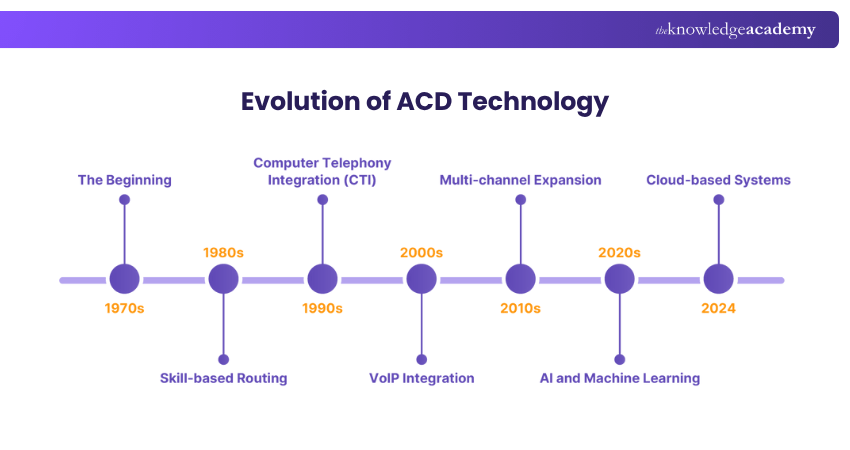
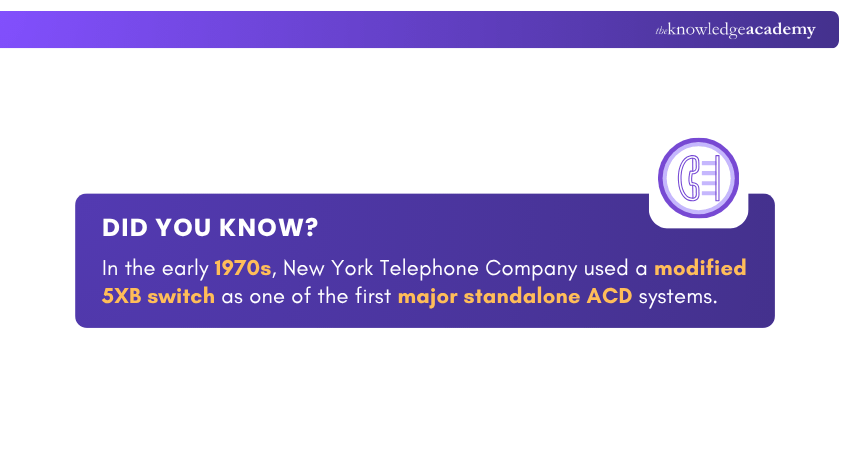
1) 1970s (The Beginning): ACD systems were first introduced to replace manual switchboards, automatically routing calls to available agents.
2) 1980s (Skill-based Routing): Systems began matching callers with agents based on specific skills, improving response quality and operational efficiency.
3) 1990s (Computer Telephony Integration (CTI)): ACDs started integrating with computer systems. This enables better data handling and a more personalised service through caller insights provided by CTI.
4) 2000s (VoIP Integration): With the rise of Voice over IP, ACD systems became more cost-effective and supported remote agent work more easily.
5) 2010s (Multi-channel Expansion): Support for email, live chat, and social media was introduced. This lets businesses manage all customer interactions through a single system.
6) 2020s (AI and Machine Learning): Advanced ACDs now use AI for intelligent call routing and predictive analytics to boost agent performance and customer satisfaction.
7) 2024 (Cloud-based Systems): Cloud-based ACDs offer easy CRM integration, real-time data, high scalability, and flexible operations. This ideal for modern contact centres.
Step beyond support and into strategy with the skills to drive IT Service excellence. Sign up for our SDI Training now!
How Does Automatic Call Distribution Work?
The Automatic Call Distribution (ACD) process generally unfolds in three key stages: caller identification, call queuing, and call routing. Each stage ensures that customers are connected quickly and efficiently to the most suitable agent.
Step 1: Caller Identification
The process begins by gathering essential details about the caller. This is typically done through an Interactive Voice Response (IVR) system, which may ask the caller to select from menu options or provide basic information such as their reason for calling. Caller ID and customer databases may also be used to identify the caller’s location, language preference, or service history.
This information allows the ACD system to determine the most suitable agent or department. For example, if a customer selects “Billing” and their location is detected as French-speaking, the ACD can route them to a bilingual billing specialist.
Step 2: Call Queuing
If no agent is immediately available, the system places the caller in a virtual queue. Unlike a simple first-come, first-served model, ACD queues are dynamic and prioritise based on several factors, such as:
1) Caller status (e.g. VIP customers or returning clients)
2) Wait time (who’s been waiting the longest)
3) Nature of the query (urgent issues may be escalated)
4) Agent availability (matching queries with agents who are best suited)
During this time, callers may hear hold music, estimated wait times or self-service options while they wait.
Step 3: Call Routing
The final and most critical step is the call routing which involves connecting a caller to the best available agent. The way calls are routed depends on your chosen distribution strategy, which can be adjusted based on business goals. Common routing methods include:
1) Round-robin Routing: Distributes calls evenly among all agents.
2) Least-occupied Routing: Sends the call to the agent who’s had the fewest recent calls.
3) Skills-based Routing: Matches the call to the agent whose skills best match the caller’s needs.
4) Priority-based Routing: Ensures high-value or VIP callers are connected more quickly.
Become the go-to brain for all tech troubles. Sign up for our Certified Service Desk Support Technician Training and ensure uninterrupted IT Support excellence!
Common ACD Call Distribution Methods
ACD distribution methods determine how incoming calls are assigned to agents. The right call centre software will allow you to choose from various routing strategies. Below are the most common methods:
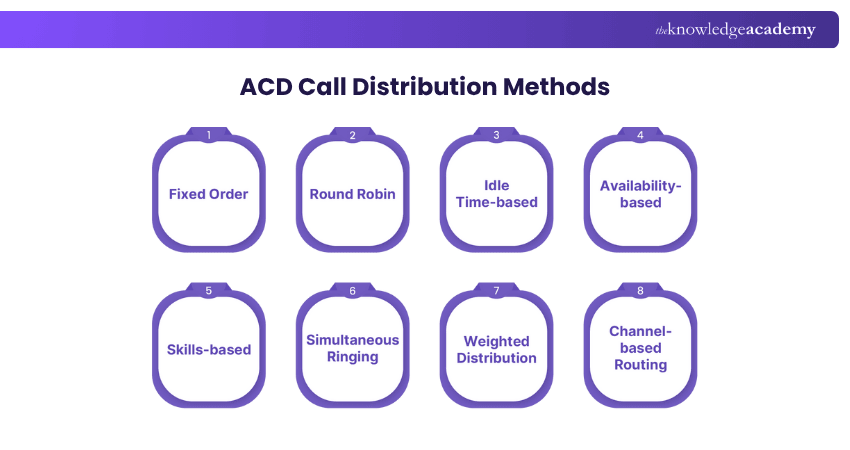
1) Fixed Order
In this method, calls are sent to agents in a set order. Consider these points:
1) You rank your agents (for example, by skill or seniority).
2) The system always tries the first agent on the list.
3) If they’re busy, the call moves to the next agent, and so on.
4) Once the top agent is free again, they get the next call.
2) Round Robin
This strategy helps distribute calls more evenly. Here are the steps:
1) Like fixed order, agents are listed in sequence.
2) The first call goes to Agent #1, the next goes to Agent #2, and so on.
3) The system rotates through the list so every agent gets a turn before it cycles back.
4) It balances workloads more fairly across the team.
3) Idle Time-based
This method sends calls to the agent who has been idle the longest. These are the points to be considered:
1) The system tracks how long each agent has been free.
2) Calls are routed to whoever hasn’t had a call in the longest time.
3) It helps ensure all agents stay active and workloads are balanced.
4) Availability-based
This method is best for remote or global teams working across different time zones. Consider these points:
1) The system checks each agent’s availability based on their schedule.
2) The calls go only to agents who are currently active and ready to take calls.
3) It’s ideal for 24/7 or international support setups.
5) Skills-based
This approach is used in larger call centres to ensure quality and quick resolution. Here’s how it works:
1) The agents are scored based on specific skills, such as language fluency, technical expertise, or product knowledge.
2) The system matches the caller’s needs (gathered via IVR) with the agent best suited to handle them.
3) For example, Spanish-speaking customers get routed to Spanish-fluent agents.
6) Simultaneous Ringing
This is a speed-first method which is ideal for urgent response environments. Here are the key points:
1) All available agents receive the incoming call at once.
2) The first one to answer takes the call.
3) It ensures the shortest possible wait time for customers.
7) Weighted Distribution
This is a more controlled method that balances both skill and workload. Here’s how it works:
1) You assign each agent a percentage of incoming calls.
2) For example:
a) Agent #1: 35%
b) Agent #2: 26%
c) Agent #3: 19%
d) Agent #4: 11%
e) Agent #5: 9%
3) It’s useful when you want your top agents to handle more calls or when training new staff.
8) Channel-based Routing
This method is employed in contact centres that handle more than just voice calls. Here's how it works:
1) Calls, chats, SMS, and emails are routed to agents based on the channel used.
2) For example, voice calls go to one team, live chat to another, and SMS to a third.
3) It ensures agents handle the channels they’re most comfortable or trained in.
Business Use Cases for Automatic Call Distribution
Here are three use cases of an Automatic Call Distribution system for businesses:
1) Customer Support Centres:
a) Use Case: A retail company handles high volumes of customer queries related to orders, returns, and product information.
b) How ACD Helps: The calls are routed based on issue type and agent expertise which ensures that billing queries are directed to finance-trained agents and product questions reach tech support. This leads to quicker resolutions and higher customer satisfaction.
2) IT Helpdesks:
a) Use Case: A tech firm provides 24/7 IT support to clients across different time zones.
b) How ACD Helps: Availability-based routing ensures that calls are always directed to agents who are currently online and working. It reduces response times and provides smooth, uninterrupted support globally.
3) Financial Services:
a) Use Case: A bank receives calls from VIP clients, general customers, and loan applicants.
b) How ACD Helps: Priority-based and skills-based routing directs VIP clients to senior agents while loan applicants are routed to specialists. This personalisation improves service quality and client trust.
From managing tickets to managing teams, make CSDM your leadership launchpad. Sign up for our Certified Service Desk Manager (CSDM) Course now!
Detailed Examples of ACD in Action
These real-world examples show how ACD operates in different setups and helps manage incoming calls efficiently.
1) Direct Calls to a Specific Extension
Calls can be routed straight to a specific extension without needing an IVR menu. For example, if a particular phone number is set up to connect directly to a team member’s extension, the ACD system will automatically handle this routing.
2) Ring Groups
Ring groups let calls be shared among a set of extensions or agents. You can choose different ringing methods depending on your setup. The most common are:
1) Prioritised Hunt: Calls go to agents in a specific order.
2) Ring All: All group members' phones ring at once, and the first to answer takes the call.
3) Least Talk Time Routing
In this approach, the ACD system monitors which agents have spent the least total time on calls. The next incoming call is routed to those agents, ensuring fair distribution of workload. Real-time tracking helps prevent burnout and maintains consistent performance across the team.
4) Hunt by Threes (Random)
This method helps evenly distribute calls and is ideal for large teams. The system selects three agents from a list and rings them for a specified duration. If no one answers, it moves to the next three, continuing until someone picks up. This spreads the workload across the team.
Key Considerations When Choosing an ACD System
Here are the things to consider when choosing an ACD system for your contact centre:
1) Current Call Volumes: Evaluate how many calls your centre handles daily, including seasonal peaks or high-demand periods. The system should manage your busiest times without lagging or crashing.
2) Future Growth and Expansion: Choose a system that can scale as your business grows. Consider potential increases in call volume, customer interactions, agent count, and support across new communication channels.
3) Essential Features: List the must-have features for your operations such as skills-based routing or support for multiple communication channels. Choose a system that meets these needs out of the box.
4) Ease of Use and Integration: Make sure the system is easy to use and works well with your existing tools like CRM or ticketing software. This reduces setup time and helps agents get up to speed quickly.
5) Cost vs Value: Don't just go for the cheapest option. Look at what the system offers in terms of long-term value, productivity gains, and return on investment.
6) Security and Reliability: Choose a cloud-based ACD system known for reliable uptime and strong cybersecurity measures. This keeps your contact centre running smoothly and your data safe.
7) Customer Support: Even with a great system, support matters. Check if the provider offers strong technical support to help you resolve any issues quickly when they arise.
Conclusion
More than just routing calls, Automatic Call Distribution is about creating smarter, faster and more personalised customer experiences. From managing queues to matching skills, ACD systems ensure smooth functioning for contact centres. Whether you're scaling your business or improving support, choosing the right ACD system can transform your communication game.
Command the chaos of IT Support and step up your game with our Service Desk Senior Analyst Training - Sign up now!
Frequently Asked Questions
What is the Difference Between ACD and PBX?

PBX and ACD are two distinct types of phone systems commonly used in businesses. Private Branch Exchange (PBX) systems are traditionally used by businesses to manage internal phone calls. ACD systems are used to manage and route customer calls.
Are Automated Calls Illegal?
Automated calls are not illegal in the UK. However, they are subject to the same regulations as live marketing calls. Suppose the automated call is unsolicited and does not clearly indicate that it is automated. In that case, it may still be considered a marketing call and could be subject to the same rules as live calls.

The Knowledge Academy


Global Training Provider
The Knowledge Academy is a world-leading provider of professional training courses, offering globally recognised qualifications across a wide range of subjects. With expert trainers, up-to-date course material, and flexible learning options, we aim to empower professionals and organisations to achieve their goals through continuous learning.


 If you wish to make any changes to your course, please


