


 Top Rated Course

We may not have the course you’re looking for. If you enquire or give us a call on +44 1344 203 999 and speak to our training experts, we may still be able to help with your training requirements.
What is Corporate Entrepreneurship: Importance & Benefits
The Knowledge Academy 14 February 2026Explore this comprehensive blog on What is Corporate Entrepreneurship to easily navigate cutting-edge methods for well-established businesses. Uncover the strategies and practices employed by established companies to foster innovation and drive growth. This comprehensive blog explores the concept of Corporate Entrepreneurship.

Training Outcomes Within Your Budget!
We ensure quality, budget-alignment, and timely delivery by our expert instructors.
Table of Contents

Imagine a well-established company launching a game-changing product with the agility of a startup—that’s Corporate Entrepreneurship in action. But What is Corporate Entrepreneurship, and why does it matter? It’s all about fostering innovation, encouraging risk-taking, and creating a startup mindset within large organisations. Companies that embrace this approach don’t just keep up with change; rather they drive it.
Be it tech giants disrupting industries or traditional businesses reinventing themselves, understanding What is Corporate Entrepreneurship can be their key to staying competitive. But how can organisations build this culture, and what are the real benefits? Let’s dive in and explore.
Table of Contents
1) What is Corporate Entrepreneurship?
2) The Importance of Corporate Entrepreneurship
3) Types of Corporate Entrepreneurship
4) Four Models of Corporate Entrepreneurship
5) How to Promote Corporate Entrepreneurship Success?
6) Benefits and Drawbacks of Corporate Entrepreneurship
7) Corporate Entrepreneurship Examples
8) Conclusion
What is Corporate Entrepreneurship?
Corporate Entrepreneurship, also called intrapreneurship, is a term that describes a blend of entrepreneurial perspectives within the bounds of an established corporation. A method that is the adoption of startup-like activity but in an established corporation, aiming to bring forth new business models, products, or services that further the significant growth and innovation in the firm.
Corporate Entrepreneurship is all about making use of a company's resources, market position, and capabilities in the pursuit of risky but possibly rewarding opportunities. It presents the very means through which companies remain relevant in an ever-turbulent business environment since it fuels creativity and agility. The Objectives of Entrepreneurship within a corporate setting focus on innovating and adapting to shifts in the market, ensuring business longevity and sustainability.

The Importance of Corporate Entrepreneurship
Corporate entrepreneurship, also known as intrapreneurship, is a vital component for the sustained success and growth of modern organisations. It involves encouraging employees to think and act like entrepreneurs within the corporate structure, fostering innovation and new business ventures while aligning with Corporate Governance Best Practices to ensure strategic and ethical decision-making.
1) Drives Revenue and Organisational Growth
Embracing entrepreneurial practices within a corporation isn't just about creating new products or services. That is, it means rethinking the incumbent procedure, markets, and customers to open different revenue sources and increase market shares. Companies that inculcate an entrepreneurial culture encourage risks and innovativeness, leading directly to growth.
2) Boosts Employee Morale and Productivity
When employees are inculcated with entrepreneurship thinking, they tend to feel that they are part and parcel of the process. This increases morale and productivity. Those teams depicting high entrepreneurial zeal are dynamic and creative, with more effective problem-solving and handling of projects.
3) Increases Employee Recruitment and Retention
A vibrant entrepreneurial culture makes a company more attractive to ambitious, innovative talent. Prospective employees are drawn to environments that promise growth and learning opportunities. Furthermore, fostering this culture helps retain top talent who are eager to contribute to impactful projects and see their ideas come to fruition.
Types of Corporate Entrepreneurship
Corporate Entrepreneurship can be structured and implemented in various ways, depending on the organisation’s goals and resources. These models range from integrating entrepreneurial activities into daily operations to creating separate units dedicated to innovation. Here are the four primary models of Corporate Entrepreneurship:

1) Corporate Venturing
Corporate venturing involves new business creation within an existing organisation. It is followed by a company to meet the objectives of new market entry or product development but outside regular operations. Investment in innovative ventures provides companies with the agility and creativity of a startup company along with the resources and capabilities of a well-established parent company.
Boost your workplace efficiency with our Organisational Skills Course– join today!
2) Intrapreneuring
Intrapreneuring, in other words, refers to internal entrepreneurship. The model provides a way that an employee in a corporation can act as an entrepreneur. This model encourages the staff to develop their idea and turn it into a project or project that can have the potential to help the company with the support, and in some cases, with a budget. It allows staff to innovate, feel motivated, and be entrepreneurial in spirit because of the aura that their spirit is thriving within a corporate structure.
3) Organisational Transformation
This model radically transforms the way an organisation operates, its culture, and its mindset toward the development of sustainable growth and innovation. Organisational transformation means the combination of holistic change management, which may lead to possible restructuring and new strategic directions, with the inclusion of new technologies. This model is critical for those organisations that require an entire overhaul to remain relevant and competitive.
4) Industry Rule Bending
Industry rule bending involves innovating in ways that change industry standards and practices. Companies adopting this model challenge the status quo and introduce new business models or products that redefine existing categories. This is often seen in industries ripe for disruption, where traditional methods are no longer effective or relevant. To ensure that your team can successfully navigate such changes, it’s important to ask the right Corporate Trainer Interview Questions to find someone capable of equipping your employees with the skills needed for success in these evolving environments.
Four Models of Corporate Entrepreneurship
An established organisation can achieve innovation and new business development through Corporate Entrepreneurship Models. Corporate Entrepreneurship includes four main models which vary based on their structural elements together with their support systems and implementation procedures.
Corporate entrepreneurial models assist organisations to drive innovation through strategies that harmonise with their business.
1) Opportunist
Under the Opportunist Model employees search for new business opportunities through spontaneous action since the organisation lacks established structures for innovation. Corporate innovation happens spontaneously, and single individuals steer through internal procedures to achieve their innovative goals.
Ordinary creativity flourishes in this model but its ability to expand depends on insufficient structured support and funding systems.
2) Enabler
Through its Enabler Model the company gives employee’s necessary tools and financial support along with instructions to develop innovative ideas while sustaining decentralisation. Company leadership supports employee entrepreneurial behaviours through organised programmes that include funding opportunities and speed competitions.
The Enabler Model delivers both independence and assistance to employees yet needs leadership approval along with open-minded organisational culture to thrive.
Start your journey towards a more confident, skilled and successful you – join our Personal Development Courses now!
3) Advocate
A dedicated team or department functions under The Advocate Model so it can facilitate and champion corporate innovation while staying away from project execution tasks. The support group enables workers to access frameworks while getting funding through established pathways and building connections.
This model enables innovation strategies to match organisational objectives but runs the risk of facing opposition from conventional departments and demands robust internal collective support.
4) Producer
The Producer Model organises new business development through an innovation unit that both drives and executes corporate ventures. Specific programmes such as incubators, accelerators along with corporate venture capital receive heavy financial commitments from businesses.
Sustained innovation is supported through this model, yet it demands substantial funding commitments and potentially results in an innovation division distancing itself from mainstream business operations.
How to Promote Corporate Entrepreneurship Success?
Here the following are the several ways to promote Corporate Entrepreneurship Success:
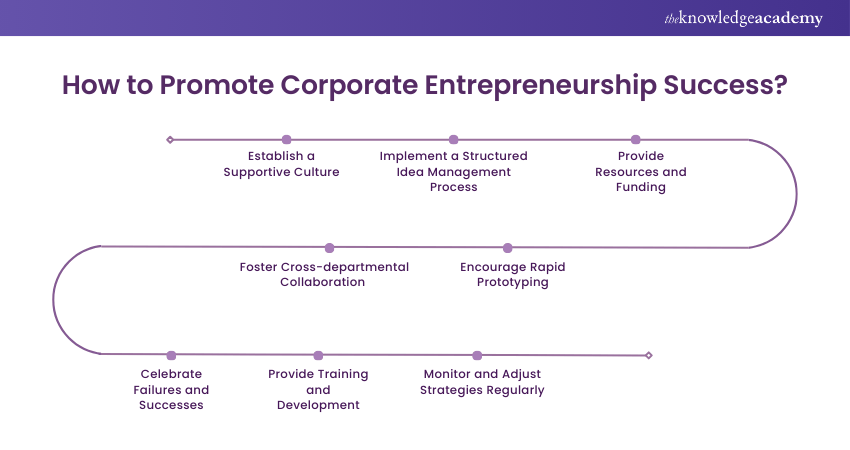
1) Establish a Supportive Culture
A culture that supports entrepreneurial thinking really is top-down. The leadership has to be committed to creating an environment in which new ideas are welcome, and taking risks is not only fine but encouraged. This kind of support includes resources and the freedom to experiment for employees.
2) Implement a Structured Idea Management Process
To effectively capture and evaluate innovative ideas, establish a structured process that encourages employees to submit their proposals. This should include clear criteria for assessment and a transparent process for how ideas are reviewed and progressed.
3) Provide Resources and Funding
For Corporate Entrepreneurship to thrive, businesses need to provide not just moral support but also financial backing and resources. This could be in the form of a dedicated budget for developing new ideas or access to expert advice and tools necessary for bringing an idea to fruition.
4) Foster Cross-departmental Collaboration
Encourage collaboration across different departments to break down silos and enhance creativity. This can lead to unexpected innovations as diverse perspectives and skills merge to create unique solutions.
5) Encourage Rapid Prototyping
Speed is crucial in innovation. Encourage teams to develop prototypes and iterate quickly based on feedback. This approach helps refine ideas and quickly determine their viability without substantial upfront investment.
6) Celebrate Failures and Successes
A critical aspect of promoting entrepreneurship within a company is to destigmatise failure. Celebrate both successes and learning experiences from failed projects. This will reinforce a culture of experimentation without fear of repercussions.
7) Provide Training and Development
Invest in training sessions that enhance your employees' entrepreneurial skills, such as creative thinking, problem-solving, and risk management. Regular workshops and seminars can keep the entrepreneurial spirit alive and kicking.
8) Monitor and Adjust Strategies Regularly
Finally, keep a close eye on the outcomes of your Corporate Entrepreneurship efforts. Regularly monitor and adjust strategies to ensure they are yielding the desired results and make changes where necessary.
Benefits and Drawbacks of Corporate Entrepreneurship
The following are the benefits and drawbacks of Corporate Entrepreneurship:
Benefits of Corporate Entrepreneurship
Corporate Entrepreneurship, sometimes known as intrapreneurship, refers to new ideas and project development within a large organisation for the purpose of increasing innovation, revenue growth, and maintaining an edge in the market. The major advantages include the following:
a) Growth Through Innovation: Encourages innovation as employees are given a chance to implement new ideas that can lead to breakthrough products and services.
b) Employee Engagement: By providing employees with more opportunities to be creative and take initiative, they tend to feel more engaged and motivated. This leads to increased job satisfaction and a reduction in the rate of turnover.
c) Agility: The entrepreneurial practices in the corporation enable it to become agile in adaptation and respond quickly to market and opportunity changes.
d) Risk Mitigation: Through Corporate Entrepreneurship, the companies can go for new ventures with a balanced risk approach, as failures can really be absorbed by the broader organisation without much effect.
Enhance your relationship-building skills with our Building Business Relationship Course – join today!
Drawbacks of Corporate Entrepreneurship
While Corporate Entrepreneurship offers numerous benefits, it also presents several challenges that organisations must navigate. Implementing intrapreneurial strategies can lead to resource allocation conflicts, as new ventures often compete with existing projects for funding and attention, highlighting a challenge in Types of Entrepreneurship within established organizations.
a) Resource Allocation: Allocating needed resources to a new venture strains a company's budget, especially when the new project does not bring the expected return in a timely manner.
b) Cultural Resistance: Within the organisation, especially in the culturally designed ones, change might face scepticism in the innovation initiatives.
c) Management Challenges: The effective management of core business activities, as well as innovation attempts, requires a balancing act that does not cause a deficit.
d) Failure Rates: Not all Entrepreneurship projects are successful. The rates of failure sometimes escalate, so ensuring that morale is kept high and that failures are learned from is really important.
Corporate Entrepreneurship Examples
Big companies can use their current operating framework to nurture innovation which results in launching new ventures or market transformations. Various famous corporate Entrepreneurship initiatives exist across different business sectors as illustrated below:
1) Google – “20% Time” & Google X:
Through its "20% Time" policy Google enables staff members to devote work hours toward different projects outside their standard responsibilities. Through this Program Developers manufactured successful projects including Gmail and Google Maps.
Google X maintains operation under its current name X The Moonshot Factory to serve as an internal incubator which developed technologies such as Waymo's self-driving cars and Google Glass.
2) Amazon – AWS & Alexa:
The original internal improvement project at Amazon Web Services eventually grew into a leading cloud computing business model. Amazon adopted voice technology to develop the smart home device revolutionising platform known as Alexa.
Within its corporate infrastructure Amazon promotes entrepreneurial innovation which serves as a mechanism to launch new business segments.
3) Apple – App Store & Wearables:
Apple demonstrates it entrepreneurial mindset through activities that enhance its product development programme. Through the App Store Apple enabled third-party developers to build iOS app solutions which led to the establishment of an applications ecosystem that produced billions in profit.
The Apple Watch along with AirPods showcases how Apple transforms itself while entering fresh market opportunities.
4) Tesla – Gigafactories & Energy Solutions:
Corporate Entrepreneurship defines Tesla as the company extends its presence from electric cars to renewable energy sector development. Through its Gigafactories Tesla revolutionised the way batteries are made, and energy is stored.
The company demonstrates industry-breaking capabilities by uniting various markets through its intrapreneurial developments which include Solar Roof and Powerwall.
Conclusion
To wrap up, embracing innovation is a necessity for businesses that want to thrive. By exploring What is Corporate Entrepreneurship, you can foster breakthrough ideas, continuous growth, and long-term success. By fostering a culture of creativity, agility, and risk-taking, organisations can stay ahead in an ever-evolving market.
Learn how to exceed customer expectations every time – join our Exceptional Customer Service Training now!
Frequently Asked Questions
What Role Do Leaders Play in Promoting Corporate Entrepreneurship?

Leaders play a crucial role in promoting Corporate Entrepreneurship by fostering an environment that encourages innovation and risk-taking. They provide resources, support, and autonomy necessary for entrepreneurial projects, while also championing these initiatives at higher levels of management to secure backing and visibility.
Why is Corporate Entrepreneurship Important for Businesses?
Corporate Entrepreneurship is important for businesses because it fosters innovation and adaptability, allowing companies to develop new products, services, and processes that can lead to competitive advantages. This can lead to increased efficiency and potentially open new revenue streams, ensuring the long-term sustainability of the business.
What are the Other Resources and Offers Provided by The Knowledge Academy?
The Knowledge Academy takes global learning to new heights, offering over 3,000+ online courses across 490+ locations in 190+ countries. This expansive reach ensures accessibility and convenience for learners worldwide.
Alongside our diverse Online Course Catalogue, encompassing 19 major categories, we go the extra mile by providing a plethora of free educational Online Resources like Blogs, eBooks, Interview Questions and Videos. Tailoring learning experiences further, professionals can unlock greater value through a wide range of special discounts, seasonal deals, and Exclusive Offers.
What is The Knowledge Pass, and How Does it Work?
The Knowledge Academy’s Knowledge Pass, a prepaid voucher, adds another layer of flexibility, allowing course bookings over a 12-month period. Join us on a journey where education knows no bounds.
What are the Related Courses and Blogs Provided by The Knowledge Academy?
The Knowledge Academy offers various Personal Development Courses including Entrepreneurship Course, Organisational Skills Course and Building Business Relationships Course. These courses cater to different skill levels, providing comprehensive insights into the Resource Planning Template.
Our Business Skills Blogs cover a range of topics related to Entrepreneurship, offering valuable resources, best practices, and industry insights. Whether you are a beginner or looking to advance your Entrepreneur skills, The Knowledge Academy's diverse courses and informative blogs have you covered.

The Knowledge Academy


Global Training Provider
The Knowledge Academy is a world-leading provider of professional training courses, offering globally recognised qualifications across a wide range of subjects. With expert trainers, up-to-date course material, and flexible learning options, we aim to empower professionals and organisations to achieve their goals through continuous learning.

Upcoming Business Skills Resources Batches & Dates
Date
 Entrepreneurship Course
Entrepreneurship Course
Fri 17th Apr 2026
Entrepreneurship Course
Fri 17th Jul 2026
Entrepreneurship Course
Fri 9th Oct 2026

 If you wish to make any changes to your course, please


