


 Top Rated Course

We may not have the course you’re looking for. If you enquire or give us a call on +39 800580270 and speak to our training experts, we may still be able to help with your training requirements.
BPMN vs UML: A Detailed and Comprehensive Comparison
The Knowledge Academy 16 July 2026UML is primarily used in Software Development to model system structures and behaviours, while BPMN focuses on business processes. UML offers diagram types for designing and documenting systems and BPMN offers communication. Choosing the right one depends on whether you're focusing on business processes or software as both are powerful.

Training Outcomes Within Your Budget!
We ensure quality, budget-alignment, and timely delivery by our expert instructors.
Table of Contents
In a world where clarity is king, diagrams rule the kingdom. But not all diagrams serve the same purpose. BPMN vs UML tell very different stories, but they serve different purposes. One is crafted for business minds, the other for developers. If you’ve ever wondered when to use which or how they compare, you’re in the right place.
Understanding BPMN vs UML offers powerful ways to visualise ideas, but choosing the right one depends on your goal. Want to map a business process? BPMN is your guide. Building a system blueprint? UML has your back. In this blog, we’ll show you when and why to use each. Let’s decode the visual language of workflows and systems once and for all.
Table of Contents
1) What is BPMN (Business Process Model and Notation)?
2) What is Unified Modelling Language (UML)
3) BPMN vs UML
4) BPMN vs UML: What's the Difference?
5) BPMN vs UML: Which is Right for your Needs?
6) When to use BPMN vs UML?
7) What are the Two Main Types of UML Diagrams?
8) Conclusion
What is Business Process Model and Notation (BPMN)?
BPMN (Business Process Modelling Notation) is a graphical notation style used to describe and optimise business processes. As a visual language, BPMN allows for the clear mapping of complex business practices. It enables a comprehensive understanding of processes from start to finish.
Developed and maintained by The Open Management Group (OMG), BPMN is a vendor-neutral standard. This ensures that the meaning of its graphical elements and relationships is precisely defined in its specification.
BPMN is specifically designed to map out business processes by creating visual representations. These representations help identify both the strengths and weaknesses of existing or planned processes. As a process-oriented modelling language, BPMN diagrams depict all activities involved in a process.

These diagrams clearly illustrate the flow of actions but do not show the specific objects involved in the process. For example, in a simple BPMN diagram that outlines the steps of purchasing a ticket, the process is clearly depicted, but the objects involved are not specified.
What Makes BPMN Essential?
BPMN is essential as it provides a standardised way to visualise complex business processes. This makes them easier to understand and analyse. Its graphical notation helps stakeholders from different departments communicate effectively. This ensures everyone has a clear understanding of the process.
BPMN also helps in identifying inefficiencies. This allows businesses to optimise their workflows and improve overall performance. Additionally, as a vendor-neutral standard, BPMN ensures consistency across different platforms and tools. This makes it a reliable choice for businesses looking to streamline their processes.

The Benefits of BPMN
BPMN offers numerous benefits that make it a valuable tool for organisations. It is mostly useful for those who want to improve their business processes. BPMN provides a clear and standardised way to represent complex workflows. It also helps businesses enhance communication, efficiency, and overall performance. Here are some key benefits of using BPMN:
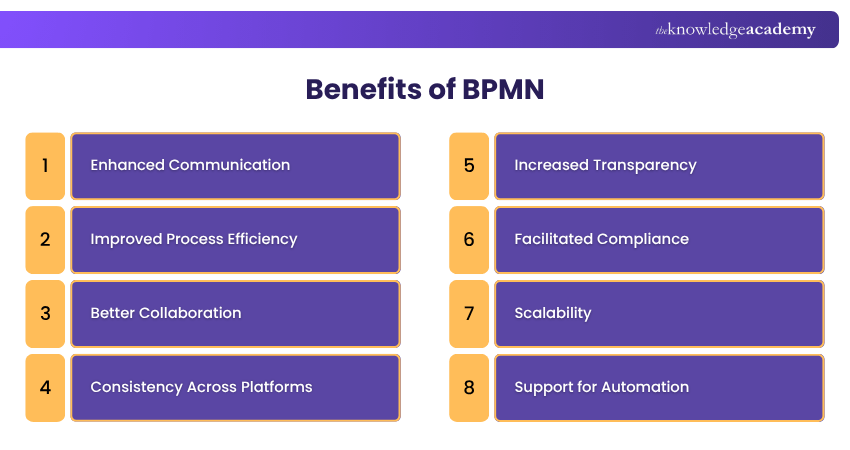
1) Enhanced Communication: BPMN's standardised graphical notation ensures that all stakeholders can understand business processes effectively. This allows for clear and productive discussions, regardless of their technical expertise.
2) Improved Process Efficiency: By visualising processes from start to finish, BPMN helps identify bottlenecks, redundancies, and inefficiencies. This enables businesses to make informed improvements for greater efficiency and effectiveness.
3) Better Collaboration: BPMN promotes collaboration between different teams by providing a common language. This helps bridge the gap between business and IT departments, creating better communication and understanding.
4) Consistency Across Platforms: As a vendor-neutral standard, BPMN ensures that processes are consistently represented across various tools and platforms. This consistency helps easier integration and scalability.
5) Increased Transparency: BPMN diagrams offer a clear view of all activities within a process. This clarity helps increase transparency and accountability within an organisation.
6) Facilitated Compliance: BPMN helps companies ensure that their processes meet regulatory requirements. It does so by providing a clear and traceable representation of workflows.
7) Scalability: BPMN is flexible enough to model processes of any size or complexity. This makes it suitable for both small businesses and large enterprises.
8) Support for Automation: BPMN diagrams can be used as a foundation for process automation. This helps businesses streamline operations and reduce manual errors.
Enhance your design skills with our Analysis & Design Using UML Course - Master the tools you need for effective software modelling today.
What is Unified Modelling Language (UML)?
UML (Unified Modelling Language) is a standardised visual language used. It provides a set of diagrams and notations that help developers, architects, and stakeholders represent the structure, behaviour, and interactions of a system.
UML is widely used in Software Engineering to visualise, specify, construct, and document the components and relationships within a system. It supports a variety of diagram types, such as class diagrams in uml, use case diagrams, sequence diagrams, and activity diagrams.
Each of these diagram types serves a specific purpose in the software development process. By offering a unified approach, UML facilitates clear communication among team members. This ensures that everyone involved has a shared understanding of the system’s design.
What Makes UML Essential?
UML is necessary as it offers a standardised method for modelling and designing intricate software systems. It enables developers, architects, and stakeholders to visualise the system's structure and behaviour prior to construction. This initial visualisation assists in uncovering possible problems throughout the development stage.
UML offers a range of diagram styles tailored to various facets of system design. This feature allows it to be flexible and able to meet various project requirements. UML guarantees that all team members share a uniform comprehension of the system by promoting clear communication. This regularity results in more effective progress and a superior final outcome. Understanding the difference between Composition and Aggregation UML ensures that the appropriate relationships are properly represented, leading to more accurate diagrams.
The Benefits of UML
UML provides many advantages in software development and system design, making it a valuable tool. Teams can work more effectively and efficiently thanks to its standardised approach to modelling complex systems. Below are a few main advantages of utilising UML:

1) Standardised Communication: UML serves as a universal language that connects developers, designers, and stakeholders. This standardisation guarantees that everyone possesses a distinct and consistent comprehension of the system.
2) Early Issue Identification: UML helps in pinpointing possible problems by visualising the system's structure and behaviour at the start of development. This enables teams to deal with issues before they become expensive to resolve.
3) Versatile Diagrams: UML provides various diagram types, each created to depict various elements of a system. This adaptability makes it appropriate for different stages of the Software Development Cycle, from initial planning to execution.
4) Improved Collaboration: UML promotes improved collaboration within the team by offering a precise and cohesive system model. This guarantees that all individuals are in agreement, resulting in improved team unity.
5) System Documentation: UML acts as an in-depth documentation tool, capturing all elements of the system’s design. This documentation is important for future reference, maintenance, and training reasons.
6) Adaptability to Different Projects: UML can be used in projects of different sizes and complexities due to its flexibility. Whether you're developing a small program or a big corporate system, UML can be customised to suit your requirements.
7) Enhanced Quality of the Final Product: UML aids in ensuring the final product meets specifications by offering a detailed and accurate system model. This leads to a software product of greater quality that is also more dependable and easier to maintain.
Boost your skills with UML Training - Register today to master the essential tools for effective system design.
BPMN vs UML
BPMN (Business Process Model and Notation) and UML (Unified Modeling Language) are both diagramming standards, but they serve different purposes. BPMN is used to visually model business processes, making it easy for both business and technical users.
UML, on the other hand, is primarily used in software engineering to model system architecture, object interactions, and functional behaviour through various diagram types like class diagrams, sequence diagrams, and use case diagrams.
BPMN vs UML: What's the Difference?
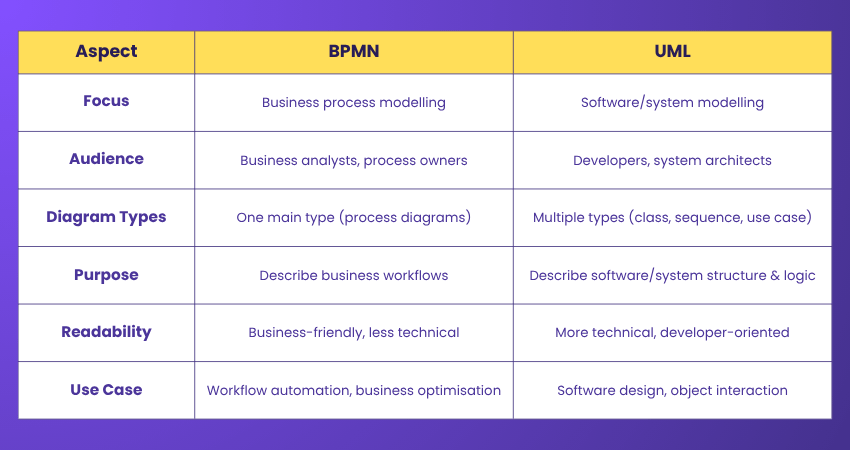
BPMN and UML are commonly used modelling languages in the realms of Business Process Management and software development. Although they both aim to visualise processes and systems, they vary in their utilisation, diagrams, and functions. Here is a comparison of the major differences between BPMN and UML:
Utilisation
BPMN is primarily used to model business processes. This makes it ideal for visualising workflows and understanding the sequence of activities within a business context. It’s commonly used by business analysts and process managers to map out and optimise processes.
On the other hand, UML is more versatile, used broadly in software engineering to model software systems, their structure, and behaviour. Developers, system architects, and engineers typically use UML to design and document software systems.
Diagrams
BPMN focuses on process-oriented diagrams, with its primary diagram being the BPMN diagram. This diagram represents the flow of activities in a process, showing tasks, decision points, and the sequence in which actions occur.
UML, however, offers a wide variety of diagram types, including class diagrams, sequence diagrams, use case diagrams, and activity diagrams, among others. Each UML diagram serves a specific purpose, whether it’s illustrating the relationships between classes, the interactions between objects, or the overall system architecture.
Purpose and Emphasis
The purpose of BPMN is to provide a clear, standardised way to represent business processes, making them easy to understand and optimise. Its emphasis is on clarity and simplicity, ensuring that even non-technical stakeholders can grasp the process flow.
UML, on the other hand, is more focused on the technical aspects of system design. It emphasises precision and detail, helping developers and architects to thoroughly plan and document every aspect of a software system.
Sphere of Application
BPMN is primarily applied to Business Process Management (BPM) and operations. It’s widely used in industries where understanding and optimising workflows is critical, such as finance, manufacturing, and healthcare.
UML, however, is used in software development and system engineering. Its application is broader, spanning various industries and types of software projects, from small applications to large, complex systems.
Primary Usage Scenarios
BPMN is best suited for scenarios where the goal is to model, analyse, and improve business processes. It’s particularly useful in environments where processes need to be streamlined, standardised, or automated.
UML is used in scenarios where there’s a need to design, visualise, and document software systems. Whether it’s outlining the structure of an application or modelling the interactions between system components, UML is the go-to tool for detailed software design.
Abstraction Levels
BPMN operates at a higher level of abstraction, focusing on the flow of activities within a business process. It’s more concerned with the "what" and "how" of process execution.
UML, however, can operate at multiple levels of abstraction. It ranges from high-level conceptual models, such as use case diagrams, to low-level, detailed models, like class diagrams, which delve into the specific structure of the software.
Depiction of Processes
In BPMN, processes are depicted through a series of flow elements, including events, activities, gateways, and sequence flows. These elements help to clearly illustrate the flow of a process from start to finish.
UML, while capable of depicting processes, typically does so through activity diagrams. These diagrams show the flow of control between activities but are often more focused on logic.
BPMN vs UML: Which is Right for your Needs?
Choosing between BPMN (Business Process Model and Notation) and UML (Unified Modeling Language) depends on your goals, your audience, and the kind of system or process you're working with.
If your focus is to map out business workflows, such as how tasks move between departments or how customers interact with a service, BPMN is the right choice. It’s simple, intuitive, and designed for business professionals and analysts who need to understand and improve internal operations without diving into technical details.
On the other hand, if you're working in software development or system architecture, and need to define how a system is structured or behaves, UML is a better fit. It offers a variety of diagram types to visualise classes, components, interactions, and user flows, making it ideal for developers, architects, and technical teams.
In short: BPMN is business-focused, UML is tech-focused. Choose based on what you’re trying to communicate and to whom.
When to use BPMN vs UML?
Use BPMN when you need to model business processes, workflows, or organisational tasks clearly for both business and technical stakeholders. Use UML when designing software systems, defining system architecture, or modelling technical components like classes, objects, and interactions.
What are the Two Main Types of UML Diagrams?
The two main types of UML diagrams are Structural and Behavioural diagrams. Structural diagrams show the static parts of a system like classes and components. Behavioural diagrams focus on how the system behaves, including workflows and user interactions, such as use case and sequence diagrams.
Conclusion
BPMN vs UML highlights their distinct roles. BPMN excels in modelling business processes with clarity. Meanwhile, UML is more versatile, which is ideal for detailed software design and system modelling. Understanding the difference between BPMN vs UML helps you choose the right tool for your specific needs. This ensures effective process and system management.
Start mastering UML to bring clarity to your system designs. Join our Introduction to UML Training and explore the fundamentals of this essential modelling language.
Frequently Asked Questions
Why is BPMN Useful for Process Models?

BPMN is helpful for process modelling as it offers a standardised, intuitive method to visually represent and document intricate business processes. Enhancing communication among stakeholders facilitates the recognition of inefficiencies, streamlining workflows, and guarantees a comprehensive understanding of the process.
Are BPM and BPMN the Same?
No, BPM (Business Process Management) and BPMN (Business Process Model and Notation) are not the same. BPM is a broader discipline focused on managing and improving business processes, while BPMN is a specific tool within BPM. BPMN is used to model and visualise processes within the BPM framework.

The Knowledge Academy


Global Training Provider
The Knowledge Academy is a world-leading provider of professional training courses, offering globally recognised qualifications across a wide range of subjects. With expert trainers, up-to-date course material, and flexible learning options, we aim to empower professionals and organisations to achieve their goals through continuous learning.


 If you wish to make any changes to your course, please


