




We may not have the course you’re looking for. If you enquire or give us a call on +918037244591 and speak to our training experts, we may still be able to help with your training requirements.
14 Types of Interview Explained With Key Examples for 2026
By Sophia EllisLast updated on: 08 April 2026
Types of interviews vary depending on their purpose and format, focusing on skills, experience, personality or cultural fit. Common Types of Interviews include one-to-one, structured, unstructured, panel and video interviews, each serving different recruitment and assessment purposes. Understanding each type helps you prepare effectively.
Ever walked into an interview expecting simple questions, only to face a surprise panel or group discussion instead? That moment of surprise can instantly shake your confidence, even when you are well prepared. The truth is, interviews are no longer limited to basic question-and-answer sessions. Nowadays, recruiters use different Types of Interviews to evaluate candidates.
Some interviews focus on technical knowledge, while others test communication skills, teamwork, or leadership potential. The format itself often determines how you should respond and present your strengths. In this blog, we will explore 14 Types of Interviews, helping you prepare strategically and perform with greater confidence. Let’s dive in!
Table of Contents
1) What is an Interview?
2) Types of Interviews
3) Types of Interview Formats
4) Advantages and Disadvantages of Different Interview Types
5) Common Interview Mistakes to Avoid
6) Conclusion
What is an Interview?
An interview is a formal conversation between a potential employer and a candidate, designed to help the candidate secure their dream job. It evaluates whether the candidate has the necessary skills, personality traits, experience, and industry knowledge. This discussion helps employers identify and select the most suitable candidate to fill the vacant position in their company.
Key Points to Consider:
a) Assessment of Skills: Employers check if the candidate has the relevant skills for the job.
b) Personality and Traits: The interview gauges the candidate’s personality and character traits.
c) Industry Knowledge: Employers assess the candidate’s understanding of the industry.
d) Information Gathering: Employers ask questions to gather detailed information about the candidate.
e) Candidate Inquiries: Candidates can ask about job responsibilities and salary expectations.
f) Verification: Interviews serve to verify the claims made in the candidate’s application.

Types of Interviews
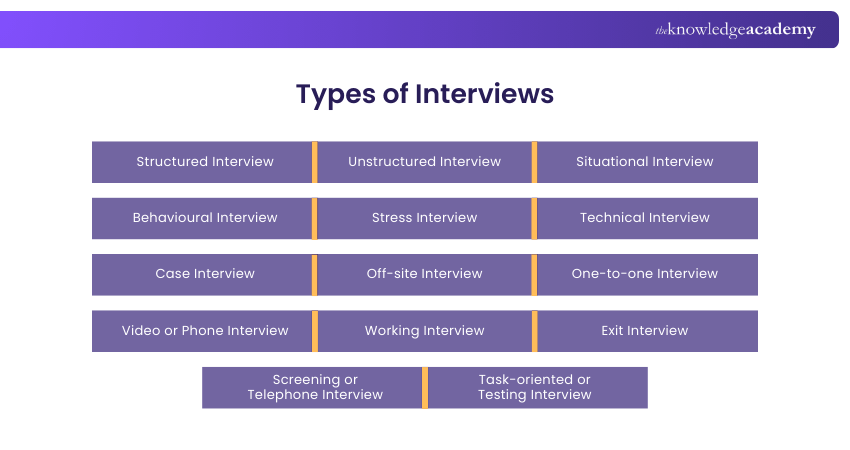
There are different Types of Interviews, and each type serves a specific purpose in the hiring process. Employers choose different interview formats to evaluate technical knowledge, soft skills, behaviour, and overall suitability for a role.
Understanding the various Types of Interviews helps candidates prepare strategically and adapt their responses effectively. Below are those common types:
1) One-to-one Interview
A one-to-one interview is the most traditional and commonly used format, where a single interviewer interacts directly with a candidate. This format allows for more personal conversation, giving candidates the opportunity to build rapport and clearly explain their skills. It is often used in both the early and final stages of recruitment.
a) Single interviewer engages with the candidate.
b) Mix of general, technical, situational, and behavioural questions.
c) Candidate has the opportunity to ask questions.
2) Structured Interview
A structured interview follows a predefined set of questions prepared in advance. Each candidate is asked the same questions to ensure fairness and consistency in evaluation. It is commonly used in large organisations where maintaining transparency and equal opportunity in hiring is essential.
a) Fixed set of questions for all candidates.
b) Responses recorded and graded against a scoring system.
c) Eliminates bias in the recruitment process.
3) Unstructured Interview
An interview style where questions evolve based on the candidate’s responses. It is more informal and conversational, allowing flexibility and deeper exploration of a candidate’s personality and thought process. It is often used to assess cultural fit and communication style in a more relaxed setting.
a) Spontaneous questions are asked based on the candidate’s responses.
b) No fixed format; questions can vary widely.
c) Interviewer adapts questions as the interview progresses.
4) Behavioural Interview
A behavioural interview focuses on assessing a candidate’s past behaviour to predict future performance. Candidates are asked to describe real situations where they demonstrated specific skills or handled challenges. Questions often begin with phrases like “Tell me about a time when…” in this interview.
a) Promotes objective evaluation through different situations.
b) Predicts future performance based on past experiences.
c) Open-ended questions compared against a rating scale.
Empower yourself with tools that drive professional growth with our Personal Development Courses – Explore now!
5) Situational Interview
In a situational interview, candidates are presented with hypothetical scenarios related to the job role. They need to explain how they would respond in those situations. Using your response, employers evaluate your decision-making skills, critical thinking, and the ability to handle potential workplace challenges.
a) Presents job-related hypothetical scenarios to assess practical thinking.
b) Tests how candidates prioritise tasks and manage challenging situations.
c) Measures adaptability and the ability to respond calmly under uncertainty.
6) Stress Interview
A stress interview is designed to assess how a candidate reacts under pressure. Interviewers may ask challenging, unexpected, or rapid-fire questions to observe emotional control and resilience. This format is commonly used in roles such as sales, customer service, and high-pressure environments where staying composed is essential.
a) Evaluates how candidates handle pressure.
b) Assesses confidence, composure, and problem-solving under tension.
c) Observes body language and tone of voice during difficult moments.
7) Technical Interview
A technical interview assesses a candidate’s job-specific knowledge and practical skills. Candidates may be asked to solve problems, write code, explain technical concepts, or demonstrate practical expertise. It is common in Information Technology (IT), engineering, finance, and other specialised fields.
a) Evaluates role-specific technical knowledge and practical skills.
b) Tests logical thinking and analytical ability.
c) Assesses understanding of tools, software, frameworks, or industry standards.
8) Video or Phone Interview
Video or phone interviews are conducted remotely when in-person meetings are not feasible. It can be a full interview round, including technical or behavioural questions, conducted remotely. Candidates are expected to ensure a stable internet connection, clear audio, and a distraction-free environment while undergoing this interview process.
a) Used to screen potential candidates before face-to-face interviews.
b) Evaluates digital professionalism and virtual presence in video interviews.
c) Can include technical, behavioural, or situational questions depending on the role.
Boost your self-belief and unlock your true potential with our Confidence Building Training – Join now!
9) Exit Interview
An exit interview takes place when an employee leaves an organisation. Its purpose is not recruitment but gathering feedback about their workplace experience. Employers use these insights from exit interviews to improve the organisation’s policies, culture, and employee wellbeing.
a) Conducted when an employee is leaving the company.
b) Provides insights into why the employee is departing.
c) Helps identify areas for improvement within the company’s workflow.
10) Screening or Telephone Interview
A screening or telephone interview is typically the first step in the hiring process. It is a brief process, within 15 to 30 minutes of conversation, and focuses on verifying basic qualifications, availability, and salary expectations. This stage helps employers shortlist candidates before moving to further interview rounds.
a) Conducted over the phone by a recruiter or hiring manager.
b) Clarifies job role expectations and candidate interest.
c) Assesses basic communication and clarity of speech.
11) Task-oriented or Testing Interview
In this type of interview, candidates are given specific tasks or tests related to the role to assess their knowledge and skills. These may include written assessments, technical assignments, or skill-based exercises. It allows employers to evaluate practical ability rather than relying solely on verbal responses.
a) Measures real-time performance and job-related competencies.
b) Assesses accuracy, efficiency, and attention to detail.
c) Commonly used in technical, creative, and analytical roles.
12) Working Interview
A working interview allows candidates to perform actual job tasks for a short period. This method helps employers observe candidates’ real-time performance and work ethic. It is commonly used in roles where practical skills and hands-on experience are essential.
a) Allows employers to evaluate practical skills in a real work environment.
b) Employer assesses the actual performance of the candidate.
c) Candidate showcases practical skills over theoretical knowledge.
13) Case Interview
In this interview type, candidates are presented with a scenario to solve, evaluating their problem-solving skills and abilities. It also evaluates analytical thinking and business understanding skills. Here, candidates may be required to present their solution clearly and justify their reasoning.
a) Presents real or hypothetical business problems for analysis.
b) Assesses structured thinking and logical reasoning skills.
c) Evaluates the ability to interpret data and draw meaningful conclusions.
14) Off-site Interview
An off-site interview takes place outside the company’s main office, such as at a neutral venue or branch location. It may also include informal meetings over meals or events. It allows employers to observe how candidates behave in social or less formal settings. These interviews are commonly used for senior roles or positions requiring strong client interaction skills.
a) Conducted outside the organisation’s primary office location.
b) Observes how candidates interact beyond a formal office environment.
c) Helps determine overall cultural fit within the organisation.
Learn how to practice good gestures, expressions, and posture with our Understanding Body Language Training – Sign up soon!
Types of Interview Formats
When preparing for an interview, researching different formats can enhance your readiness. Here are various interview formats:
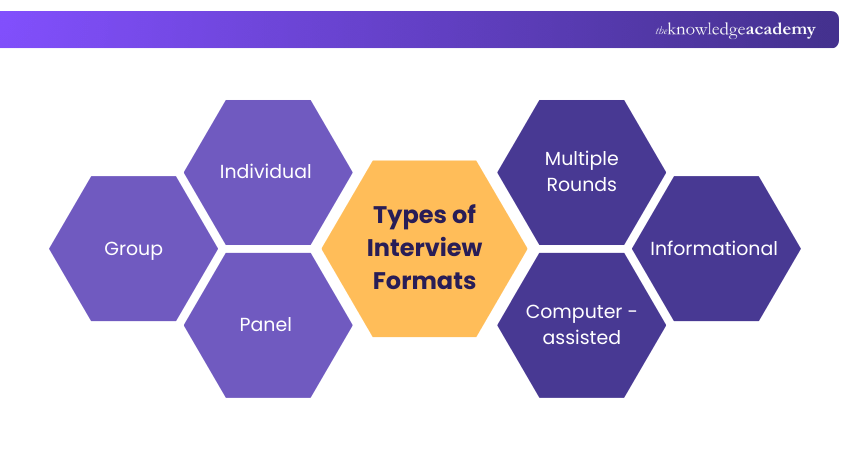
1) Individual
This format involves one interviewer and one candidate. Employers may ask situational or behavioural questions, job-specific questions to gauge fit, and general questions about experience, background, strengths, and qualifications. Highlight your relevant skills and solve problems for the company, using examples from past experiences.
2) Group
Multiple applicants are interviewed simultaneously. The interviewer may provide a discussion topic and an observer rates performance. This format helps employers understand candidates’ interpersonal and communication skills and how they apply their strengths and qualifications in group interviews settings.
3) Panel
Several interviewers assess a single candidate on skills, qualifications, and experience. The panel typically includes a Hiring Manager, a colleague, or a Team Manager. Interviewers ask questions in succession, allowing the panel to evaluate how well the candidate fits the company’s values and culture. Maintain eye contact with everyone and share your successes.
4) Multiple Rounds
Common for technical roles, this format includes several interview rounds. Initial rounds may focus on technical skills, while the final round often involves a Hiring Manager discussing the role and salary expectations. Success requires strong communication and interpersonal skills to highlight your abilities.
5) Informational
Candidates interact with professionals from the company they are interested in. These interviews help understand the company’s work culture and environment. Professionals answer questions about job roles and potential growth. Prepare a list of questions about the company and its culture.
6) Computer-assisted
These are often video interviews, where employers provide questions on-screen. This method speeds up hiring but may not assess emotional intelligence, communication, or interpersonal skills effectively. It’s useful for screening a large number of candidates.
Advantages and Disadvantages of Different Interview Types
Different Types of Interviews have their own advantages and limitations for both employers and candidates. Some methods focus on fairness and clear evaluation, while others highlight flexibility or practical skills. Knowing their pros and cons helps companies select the right method and allows candidates to prepare better.
Advantages of Different Interview Types
Different interview types offer distinct advantages depending on the goals of the hiring process. Structured interviews promote fairness by asking all candidates the same set of questions, making comparison easier and reducing bias.
Behavioural and situational interviews help employers understand how candidates think and act in real scenarios, improving the accuracy of hiring decisions. Technical and task-based interviews are especially useful for assessing practical knowledge and job-specific skills.
Modern formats such as video and phone interviews increase efficiency by saving time and reducing travel costs. Likewise, each type is designed with lots of advantages.
Disadvantages of Different Interview Types
Despite their benefits, different interview types also have disadvantages. For example, structured interviews may restrict natural conversation and flexibility, while unstructured interviews can result in inconsistency or bias.
Similarly, stress interviews can make candidates feel pressured, and panel interviews may feel overwhelming when several interviewers are present. Video or phone interviews may face technical issues or connectivity problems, which can disrupt communication. These highlight the importance of choosing the right interview format for a comfortable hiring process.
Common Interview Mistakes to Avoid
Here are some of the most common mistakes that you need to avoid while appearing for any interview:
a) Attending the interview without researching the company or job role
b) Giving vague or generic answers without clear examples
c) Arriving late or appearing unprepared
d) Dressing inappropriately for the interview setting
e) Speaking too much or giving very short, unclear responses
f) Interrupting the interviewer or not listening carefully to questions
g) Showing poor body language, such as a lack of eye contact or slouching
h) Focusing too early on salary and benefits instead of skills and value
i) Speaking negatively about previous employers or colleagues
j) Failing to ask thoughtful questions at the end of the interview
Conclusion
Every interview is a chance to prove your potential. You get an opportunity to showcase your skills, mindset, and professionalism. The key is to understand how to present it effectively in different interview settings. When you are aware of the various Types of Interviews, you reduce uncertainty and increase confidence. With the right practice and attitude, you can turn every interview into a valuable step toward achieving your career goals.
Develop stronger self-awareness and better relationship skills with Emotional Intelligence Training – Begin now!

 If you wish to make any changes to your course, please


