


 Top Rated Course

We may not have the course you’re looking for. If you enquire or give us a call on +918037244591 and speak to our training experts, we may still be able to help with your training requirements.
What is MarTech (Marketing Technology): All You Need to Know
Scarlett Adams 23 May 2026MarTech or marketing technology refers to tools and platforms that help businesses plan, execute, manage, and measure marketing campaigns effectively. It enables organisations to automate daily tasks, analyse customer data, personalise communication, and improve overall marketing performance while supporting smarter decision-making.

Training Outcomes Within Your Budget!
We ensure quality, budget-alignment, and timely delivery by our expert instructors.
Table of Contents
Marketing today is about using the right technology to turn ideas into real results. Whether it is personalised emails, targeted ads, or tracking customer behaviour, businesses depend on digital tools more than ever. If you are wondering What is MarTech, it refers to the technologies that help marketers plan, manage, and improve their campaigns with greater accuracy and efficiency.
As competition grows and customer expectations keep rising, relying on manual efforts is no longer enough. MarTech enables organisations to automate tasks, use data to make better decisions, and deliver relevant experiences. In this blog, you will learn What is MarTech, its importance, categories, trends, and more. Let's get started!
Table of Contents
1) What is MarTech (Marketing Technology)?
2) Why is MarTech Important?
3) Major Categories in MarTech Solutions
4) What is a MarTech Stack?
5) Building an Effective MarTech Stack
6) Common Challenges in MarTech
7) Marketing and Artificial Intelligence
8) MarTech vs AdTech vs RevOps Tech
9) Top MarTech Trends to Stay Competitive
10) The Future of MarTech: 2026 and Beyond
11) Conclusion
What is MarTech (Marketing Technology)?
MarTech or Marketing Technology refers to the software, platforms, and digital tools that marketers use to plan, run, manage, and measure campaigns. It sits at the intersection of marketing, data, and automation to improve how businesses operate. This helps organisations enhance targeting, streamline workflows, personalise customer experiences, and make better decisions using connected systems and insights.
MarTech turns scattered marketing activities into one connected ecosystem. Tools such as Content Management Systems (CMS), analytics software, marketing automation tools, and AI-powered solutions work together to support campaign execution and performance tracking. This helps businesses deliver more consistent and data-driven marketing outcomes.

Why is MarTech Important?
MarTech is essential for managing modern, data-driven marketing effectively. As marketing becomes more complex and digital-first, MarTech enables businesses to streamline operations, enhance customer experiences, and drive measurable results. Let’s explore the core reasons for its importance below:
1) Supports Personalised Customer Engagement: MarTech helps businesses use customer data, segmentation, and automation to deliver more relevant content and experiences across different channels. This makes marketing more targeted and meaningful.
2) Improves Efficiency and Saves Time: Marketing technology automates repetitive tasks like email workflows, lead nurturing, reporting, and campaign management. This reduces manual effort and helps teams work faster and more effectively.
3) Enables Data-driven Decision-making: MarTech platforms provide dashboards, analytics, and performance reports in one place. This helps marketers track results, understand what is working, and make informed decisions based on real data.
4) Connects Tools and Teams Through Integrated Systems: A strong MarTech setup improves the flow of data between marketing, sales, service, and CRM platforms. This creates better alignment across teams and supports more consistent marketing performance.
5) Helps Businesses Scale Marketing Efforts: As campaigns grow more complex, MarTech allows organisations to manage larger volumes of data, channels, and customer interactions without increasing manual work.
6) Strengthens Marketing Performance and ROI: By combining automation, analytics, and personalisation, MarTech helps marketers improve campaign outcomes, optimise spending, and demonstrate stronger business impact.
Key Categories of MarTech Solutions
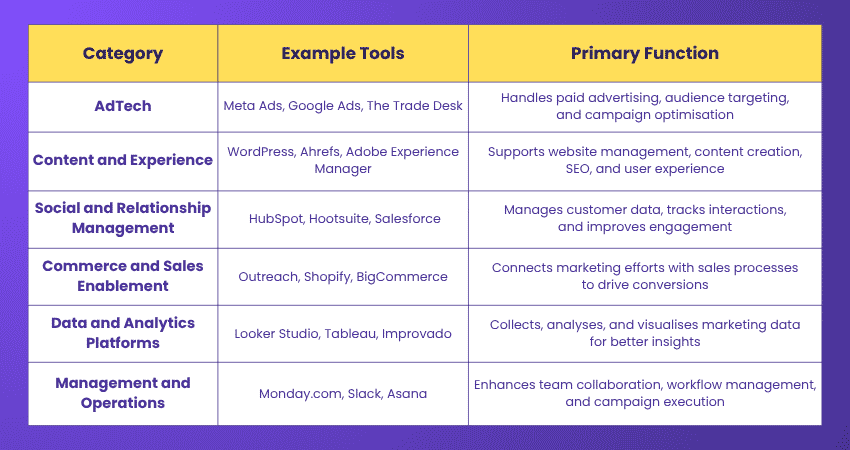
The MarTech ecosystem can appear complex, but most tools fall into a few key categories that support different stages of the marketing lifecycle. Understanding these categories helps organisations build an effective and well-integrated MarTech stack.
1) AdTech (Advertising Technology)
Tools like Google Ads and Meta Ads help businesses run paid campaigns, target the right audiences, and optimise ad performance across digital channels. These platforms are essential for increasing brand visibility, driving traffic, and generating leads effectively.
2) Content and Experience Platforms
Solutions such as WordPress and Adobe Experience Manager support website creation, content management, and SEO. They help deliver consistent, engaging, and user-friendly digital experiences across websites and customer touchpoints.
3) Social and Relationship Management
Platforms like Salesforce and HubSpot centralise customer data, track interactions, and support personalised communication. This helps businesses build stronger relationships and improve customer retention.
4) Commerce and Sales Enablement
Tools such as Shopify and BigCommerce connect marketing with sales by enabling product management, transactions, and lead conversion. They play a crucial role in turning marketing efforts into measurable revenue outcomes.
5) Data and Analytics Platforms
Platforms like Tableau and Looker Studio help collect, analyse, and visualise data from multiple sources. This enables marketers to track performance, understand customer behaviour, and make data-driven decisions.
6) Management and Operations Tools
Tools such as Asana and Slack improve internal collaboration, streamline workflows, and ensure smooth campaign execution across teams. They help teams stay organised, monitor progress in real time, and maintain better coordination across marketing activities.
Streamline operations and automate workflows to improve business performance with the AI Automation Course For Operations – Join now!
What is a MarTech Stack?
A MarTech Stack is the collection of tools, platforms, and software that businesses utilise to plan, execute, manage, and measure their marketing activities. It brings together different technologies into one system, helping marketers streamline processes, coordinate campaigns, and track performance effectively.
A MarTech Stack can include both ready-made software and customised solutions built for specific business needs. These stacks range from simple setups with a few tools to complex systems with integrated platforms, depending on the size and organisational requirements.
Building an Effective MarTech Stack
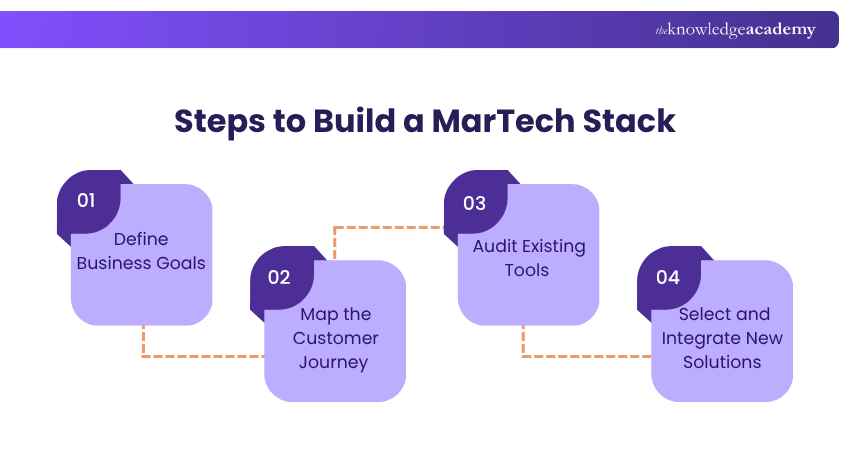
Building a successful MarTech stack requires a strategic approach that aligns technology with business goals. A well-designed stack not only improves marketing performance but also ensures seamless integration, scalability, and better customer experiences. Let’s look at the steps below:
Step 1: Define Business Goals
Start by clearly identifying what your marketing team wants to achieve, such as lead generation, brand awareness, customer retention, or revenue growth. Each goal should be linked to measurable metrics like customer lifetime value or campaign performance. This clarity ensures that every tool in your MarTech stack directly supports specific business objectives and delivers measurable outcomes.
Step 2: Map the Customer Journey
Understand how customers move from initial awareness to final conversion. Identify key touchpoints where automation, personalisation, and data collection can make the biggest impact. This ensures that your MarTech tools are aligned to enhance the overall customer experience.
Step 3: Audit Existing Tools
Review your current tools to identify gaps, overlaps, and inefficiencies. Analyse how effectively each tool is being used, check for integration issues, and remove duplicate or underperforming platforms. This step helps reduce unnecessary costs, improve efficiency, and create a more streamlined and effective technology ecosystem.
Step 4: Select and Integrate New Solutions
Select tools that integrate easily with your existing systems, can scale your business growth, and meet data governance and compliance requirements. Also, it is important to invest in training and ensure teams understand how to use these tools effectively to maximise their value.
Build smarter products with AI automation and drive product success with the AI Automation Course For Product Management – Join today!
Common Challenges in MarTech
While MarTech offers many benefits, implementing and managing it brings a set of challenges. Without the right strategy, businesses may struggle to get the full value from their marketing technology investments. Let's look at the challenges below:
1) Data Overload: With multiple tools generating dashboards, reports, and metrics, teams can quickly feel overwhelmed. Focusing on the most important KPIs is essential to avoid confusion and make meaningful decisions.
2) Integration Difficulties: Connecting different MarTech platforms can be complex, especially when systems do not integrate smoothly. This can lead to data silos, making it harder to get a unified view of marketing performance.
3) Budget Constraints: Many MarTech tools come with high costs, making it difficult for organisations to invest in the right solutions. Balancing cost with value is crucial to ensure long-term sustainability.
4) Measuring ROI: It can be challenging to link marketing activities directly to revenue. Without clear attribution, businesses can struggle to measure the effectiveness of their MarTech investments.
5) Adoption Issues: Even the best tools are ineffective if teams do not use them properly. Ensuring proper training and encouraging adoption across the organisation is crucial for maximising the benefits of MarTech.
Marketing and Artificial Intelligence
Artificial Intelligence (AI) is an important part of modern MarTech, helping businesses automate processes, analyse data, and improve marketing performance. It works across multiple platforms to enhance personalisation, optimise campaigns, and support smarter decision-making. Let's learn more about it below:
1) Generative AI in Marketing
Generative AI is used to create content, such as text, images, and videos, by analysing large datasets and predicting outcomes. In marketing, it helps produce campaign content, automate messaging, and speed up creative processes. This makes it easier for teams to deliver consistent and engaging experiences.
2) Agentic AI in Marketing
Agentic AI refers to more advanced systems that can act independently and manage complex tasks. In marketing, these AI agents can optimise campaigns, forecast results, and personalise content at scale. This helps businesses improve efficiency and respond quickly to changing market needs.
Optimise campaigns with AI-driven insights and maximise performance with the AI Tools In Performance Marketing Training now!
MarTech vs AdTech vs RevOps Tech
As marketing technology continues to evolve, terms like MarTech, AdTech, and RevOps Tech are used interchangeably. However, each serves a different purpose within an organisation. Let’s look at their differences in the table below:
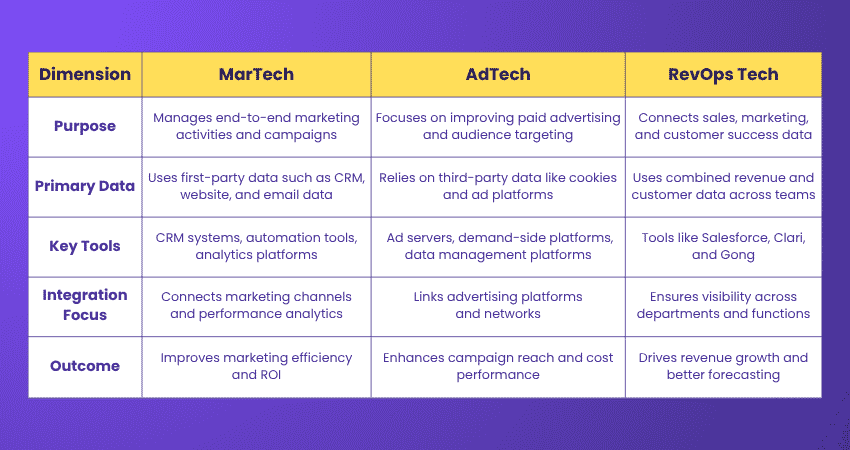
MarTech focuses on managing the full marketing lifecycle, from planning campaigns to analysing results. It relies on first-party data and integrates tools like CRM, automation, and analytics platforms to improve customer engagement and overall marketing performance.
In contrast, AdTech is centred on paid advertising and audience targeting. It uses third-party data and specialised tools to optimise ad placements, improve reach, and ensure cost-effective campaign execution across digital channels.
On the other hand, RevOps Tech brings together data from marketing, sales, and customer success teams to create a unified view of revenue operations. It helps organisations improve forecasting, align teams, and make better strategic decisions that drive business growth.
Top MarTech Trends to Stay Competitive
To stay competitive, businesses must keep up with the latest MarTech trends. As marketing becomes more data-driven and technology-focused, understanding where to invest is essential for organisations. Let's look at some popular trends below:
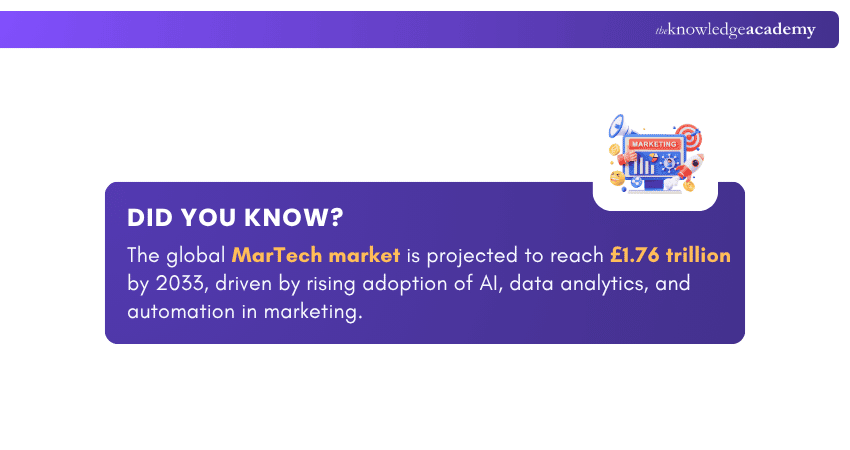
1) AI-enabled Solutions: AI is transforming MarTech with predictive analytics, personalised recommendations, and intelligent chatbots. It supports lead scoring, automation, and customer interactions, making marketing more efficient and scalable.
2) Data-driven Strategies: Marketing decisions are increasingly based on data. Analytics, attribution models, and performance tracking help businesses understand results and optimise campaigns for better outcomes.
3) Audio Marketing: With the growth of voice search and smart devices, optimising content for audio platforms and voice assistants is becoming essential to reach users in new ways.
4) Highly Personalised Experiences: MarTech enables businesses to create unified customer profiles and deliver tailored content across touchpoints, improving engagement and customer satisfaction.
5) Omnichannel Communication: Customers expect seamless interactions across multiple channels. MarTech helps integrate communication across platforms, ensuring a consistent and connected experience.
6) Privacy-centric Marketing: With rising data privacy concerns, businesses must focus on transparency and consent. MarTech tools support secure data management and help build customer trust.
7) Virtual and Immersive Marketing: Technologies like VR and AR enable interactive and engaging campaigns, offering new ways for brands to connect with their audience.
Deliver faster support with AI automation by joining the AI Automation Training For Customer Services today!
The Future of MarTech: 2026 and Beyond
The future of MarTech is shifting towards smarter, more integrated, and accountable systems. Let’s look more at what the future holds for MarTech below:
1) AI-powered Decisioning: AI and machine learning will drive data analysis, predictive insights, and automated decision-making. From audience segmentation to campaign optimisation, AI will power adaptive marketing strategies.
2) Unified Data Ecosystems: Fragmented tools are being replaced by centralised data platforms. These systems provide a single source of truth, improving collaboration across marketing, sales, and finance teams.
3) Privacy-first Architecture: With stricter regulations and the decline of third-party cookies, MarTech will focus on first-party data, consent management, and secure identity solutions, reshaping targeting and customer relationships.
4) Composable and API-first Platforms: MarTech stacks will become more modular and API-driven, allowing seamless integration, flexibility, and scalability while maintaining strong governance.
5) Revenue-centric Measurement: Marketing success will be measured by revenue impact rather than clicks or impressions, with platforms connecting performance directly to business outcomes.
6) Human and Machine Collaboration: Automation will enhance, not replace, marketers. As routine tasks are automated, teams can focus more on strategy, creativity, and decision-making.
Conclusion
Understanding What is MarTech is crucial for businesses aiming to succeed in today’s digital landscape. By using the right tools, strategies, and data-driven approaches, organisations can improve efficiency, deliver better customer experiences, and drive measurable results. This will help businesses remain competitive and achieve long-term growth.
Turn manual work into intelligent automation and let AI handle the heavy lifting with the AI Automation Training – Sign up now!
Frequently Asked Questions
Is CRM Part of MarTech?

Yes, Customer Relationship Management (CRM) is a part of MarTech. CRM systems like Salesforce and HubSpot store customer data, track interactions, and help marketing, sales, and service teams manage leads and enhance customer experience.
What are the Top MarTech Platforms?
Some top MarTech platforms include:
1) HubSpot: CRM and automation for managing leads and campaigns
2) Salesforce: Enterprise CRM for customer data and engagement
3) Adobe Creative Cloud: Content creation and design tools
4) Google Analytics: Tracks and analyses website performance
5) Hootsuite: Manages social media and engagement
What are the Other Resources and Offers Provided by The Knowledge Academy?
The Knowledge Academy takes global learning to new heights, offering over 3,000+ online courses across 490+ locations in 190+ countries. This expansive reach ensures accessibility and convenience for learners worldwide.
Alongside our diverse Online Course Catalogue, encompassing 17 major categories, we go the extra mile by providing a plethora of free educational Online Resources like Blogs, eBooks, Interview Questions and Videos. Tailoring learning experiences further, professionals can unlock greater value through a wide range of special discounts, seasonal deals, and Exclusive Offers.
What is The Knowledge Pass, and How Does it Work?
The Knowledge Academy’s Knowledge Pass, a prepaid voucher, adds another layer of flexibility, allowing course bookings over a 12-month period. Join us on a journey where education knows no bounds.
What are the Related Courses and Blogs Provided by The Knowledge Academy?
The Knowledge Academy offers various AI Automation Training, including the AI Automation Course For Marketing, AI Automation Course For Operations, and AI Automation Course For Product Management. These courses cater to different skill levels, providing comprehensive insights into What is Grok AI.
Our Data, Analytics & AI Blogs cover a range of topics related to What is MarTech, offering valuable resources, best practices, and industry insights. Whether you are a beginner or looking to advance your AI and Marketing skills, The Knowledge Academy's diverse courses and informative blogs have got you covered.
Upcoming Data, Analytics & AI Resources Batches & Dates
Date
 AI Automation Course for Marketing
AI Automation Course for Marketing
Fri 17th Jul 2026
AI Automation Course for Marketing
Fri 16th Oct 2026

 If you wish to make any changes to your course, please


