


 Top Rated Course

We may not have the course you’re looking for. If you enquire or give us a call on +918037244591 and speak to our training experts, we may still be able to help with your training requirements.
What is Iteration in Programming? Definition, Types & Examples
The Knowledge Academy 06 February 2026Iteration in programming is the process of repeating instructions or steps, known as loops allowing a computer to execute actions repeatedly within an algorithm. It automates repetitive tasks, boosts efficiency, and reduces manual effort. Iteration is essential for building scalable, reliable software and improving development consistency.

Training Outcomes Within Your Budget!
We ensure quality, budget-alignment, and timely delivery by our expert instructors.
Table of Contents
Related Courses
Let’s face it; computers are brilliant at doing the same thing over and over without complaining. That’s where iteration comes in. It’s the secret sauce behind loops, helping machines repeat tasks like checking every item in a list or running a process until it’s just right. So, what is iteration in programming? It’s time to dive in and find out how this clever concept keeps your code ticking smoothly!
Table of Contents
1) What is Iteration in Programming?
2) Importance of Iteration
3) Different Types of Loops in Programming
4) Three Basic Programming Constructs
5) Examples of Iteration in Programming
6) Key Differences Between Recursion and Iteration
7) Advantages and Disadvantages of Iteration
8) Can Iteration be Replaced with Recursion?
9) Conclusion
What is Iteration in Programming?
Iteration in Programming consists of executing a series of instructions repeatedly until a certain condition is satisfied. Efficiency in dealing with tasks that are repeated is crucial. By utilising Iteration, manual Coding of individual steps is replaced with automated loops, resulting in time savings and error reduction. Different needs are fulfilled by 'for,' 'while,' and 'do-while' loops, which are common types.
Comprehending Iteration in Programming assists in breaking complex problems into smaller parts. It also enhances code efficiency by streamlining repeated tasks. Becoming adept at Iteration is crucial for every Programmer who wants to create neat, effective, and scalable code that can adjust to different inputs and circumstances.

Importance of Iteration
Looping is one of the most important concepts in Programming, which we can perform repetitive tasks. Loops allow Programmers to chunk intrinsic tasks into smaller, more handleably pieces. This way, code readability is enhanced.
Iterating in Programming allows the program to adapt itself in real-time given different possible inputs and circumstances, which makes it all around a more flexible code. In the case of data simulation and algorithm development, Iteration plays a more crucial. It provides developers a superior command over various functionalities, and Programmers can then write in an efficient smarter way.
It is of utmost importance to realise the value and Importance of Iteration in Programming, especially when one aspires to improve codes or create solutions that are robust.
Jump into Python today and start turning your ideas into code with our Python Course. Your future self will thank you!
Different Types of Loops in Programming
Loops are features used in code to implement Iteration. The two main loop types found in most Programming languages are the 'for' loop and the 'while' loop. A different type of loop called 'do-while' is like the 'while loop' but is not widely supported.
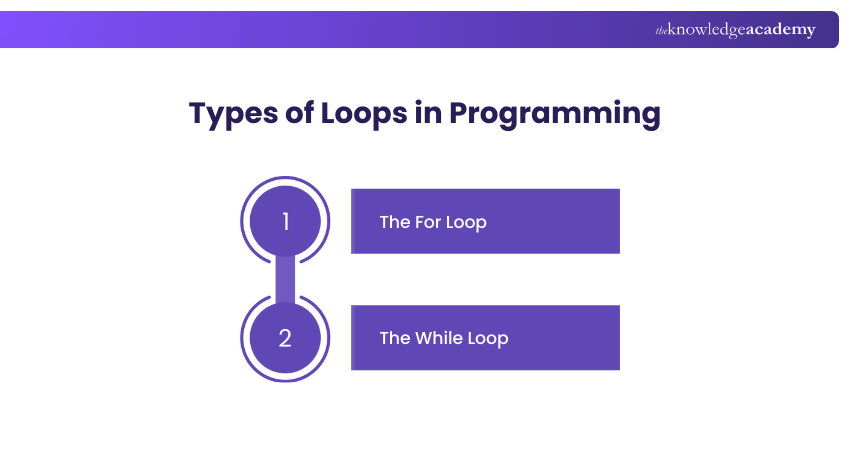
1) The For Loop
The 'for' loop runs a group of code over and over until a certain condition is satisfied. The way it is written is:
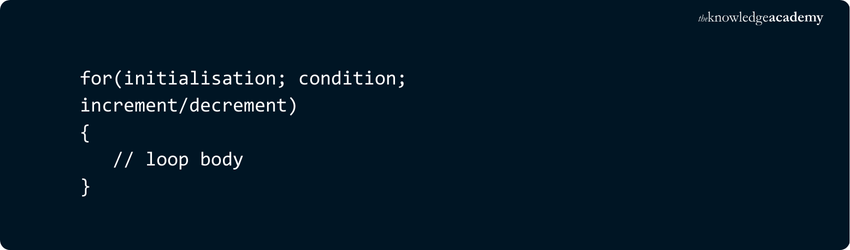
Initialisation is the act of declaring variables at the beginning of a loop, such as setting i = 1. It is not always necessary. The condition determines if the loop should keep going; if it is true, the loop executes. Incrementing or decrementing the variable is done after each loop, which continues until the condition is met.
2) The While Loop
The 'while' loop continues executing a code block while its condition remains true. The structure of it is:
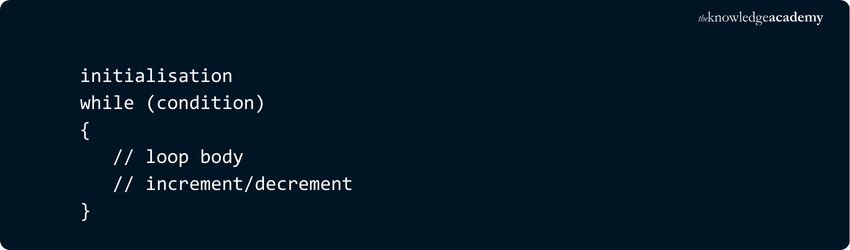
Initialisation takes place prior to the loop commencing. The variable is checked by the Condition; if it is true, the loop will be executed. If not true, control is passed to the next step. Incrementing or decrementing alters the variable's value until the condition becomes false.This process is a key aspect of a Python While Loop.
Three Basic Programming Constructs
There are three fundamental constructs that programming is based on that impact the structure of the instructions and how the list of instructions is carried out. These constructs are sequence, selection, and iteration, and they are critical to how a program acts.

1) Sequence
Sequence is a simple teacher where the instructions are followed in an ordered list. The program will follow the instructions in the order or sequence you provided.
2) Selection
Selection gives a program a choice about what action to take depending on whether certain conditions exist; this is often done with the use of the if, else, or switch statements.
3) Iteration
Iteration is used when certain instructions need to be repeated. Different types of loops, like for loops or while loops, help implement this type of repeated action.
Examples of Iteration in Programming
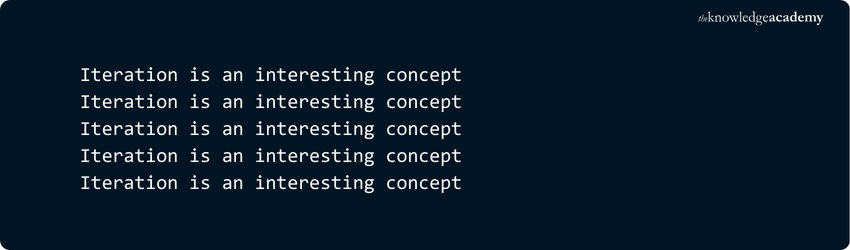
Let’s see some examples to better comprehend the concept of Iteration:
Code:

Output:
Example 2:
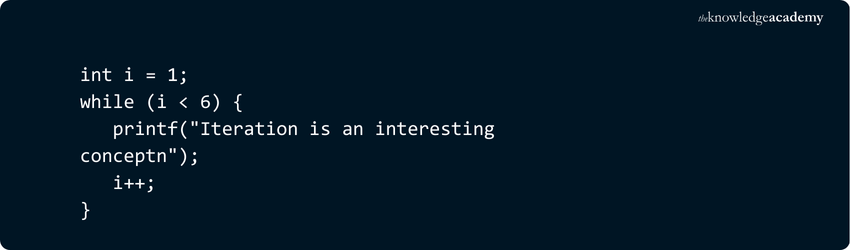
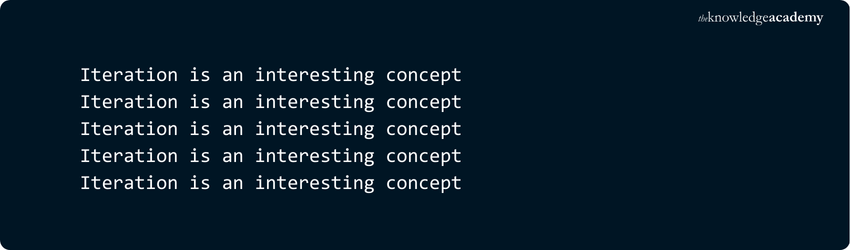
The 'while' loop is used here to print the given statement five times.
Code:
Output:
Start coding with Visual Basic Course today—learn fast, build smart!
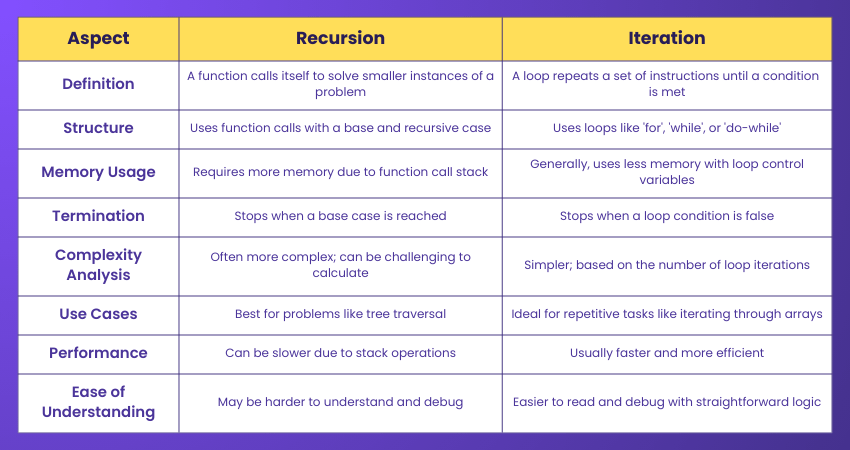
Key Differences Between Recursion and Iteration
Recursion and Iteration are two fundamental approaches in Programming, each with unique characteristics and uses. Here's a key difference between both:
Advantages and Disadvantages of Iteration
In programming, Iteration provides a useful utility with both advantages and disadvantages. As with anything in programming, understanding the advantages and disadvantages will help you use iteration more effectively.
1) Advantages
1) Improves code efficiency by reducing repetition and making programs more compact and readable.
2) Supports scalability, allowing processes to adapt easily to different data volumes.
3) Offers flexibility, enabling dynamic adjustments based on intermediate results.
4) Enhances precision in numerical applications through gradual refinement.
5) Facilitates problem solving by approximating solutions to complex problems.
6) Enables automation of repetitive tasks, saving time and resources.
2) Disadvantages
1) Risk of infinite loops if termination conditions are not correctly defined.
2) Performance bottlenecks may occur with inefficient iteration over large datasets.
3) Increased complexity in nested or multi-layered loops, making code harder to maintain.
4) Higher error potential due to incorrect loop logic or variable updates.
5) Heavy resource consumption in long-running or data-intensive iterative processes.
6) Convergence issues in numerical methods where results may not stabilise or take too long to do so.
Can Iteration be Replaced With Recursion?
It is true that recursion can generally replace Iteration and vice versa. They are both simply methods of repeating some steps, but they act differently. Recursion works through a function calling upon itself, whereas Iteration uses loops such as for loops or while loops.
In many applications, you can easily convert recursive algorithms to be iterative in order to accommodate performance needs and memory. The reason that Iteration is often more efficient than recursion is that the recursive function call overhead and stack are avoided. Even so, in some cases, recursion offers a cleaner and easier-to-understand solution to a problem when traversing a tree or graph.
Ultimately, you should choose based upon the specific problem, readability requirements and considerations for performance.
Conclusion
Iteration is an important concept that will help you write code more cleanly and efficiently. Understanding and using iteration techniques like for and while loops will allow you to automate repetitive tasks and solve complicated problems easily. It's just one of those practical skills that make your programming life easier. The more you practice producing code with iteration techniques, the better your programming knowledge will become.
Take the next step in programming with Object Oriented Programming Course, Sign-up Now!
Frequently Asked Questions
What is the Difference Between Iteration and Repetition in Programming?

Iteration refers to the process of executing a set of instructions repeatedly using loops like for or while. Repetition is a broader term that simply means doing something again. In programming, iteration is a structured form of repetition controlled by logic.
What is the Difference Between Pre-test and Post-test Iteration?
Pre-test iteration checks the condition before executing the loop (e.g., while loop), so the code may not run at all if the condition is false. Post-test iteration checks the condition after executing the loop once (e.g., do-while loop), ensuring the code runs at least once regardless of the condition.
What are the Other Resources and Offers Provided by The Knowledge Academy?
The Knowledge Academy takes global learning to new heights, offering over 3,000+ online courses across 490+ locations in 190+ countries. This expansive reach ensures accessibility and convenience for learners worldwide.
Alongside our diverse Online Course Catalogue, encompassing 19 major categories, we go the extra mile by providing a plethora of free educational Online Resources like Blogs, eBooks, Interview Questions and Videos. Tailoring learning experiences further, professionals can unlock greater value through a wide range of special discounts, seasonal deals, and Exclusive Offers.
What is The Knowledge Pass, and How Does it Work?
The Knowledge Academy’s Knowledge Pass, a prepaid voucher, adds another layer of flexibility, allowing course bookings over a 12-month period. Join us on a journey where education knows no bounds.
What are the Related Courses and Blogs Provided by The Knowledge Academy?
The Knowledge Academy offers various Programming Training, including Python Course, PHP Course, and ReactJS Course. These courses cater to different skill levels, providing comprehensive insights into Data Discrepancy.
Our Programming & DevOps Blogs cover a range of topics related to Iteration in Programming, offering valuable resources, best practices, and industry insights. Whether you are a beginner or looking to advance your Programming & DevOps skills, The Knowledge Academy's diverse courses and informative blogs have got you covered.

The Knowledge Academy


Global Training Provider
The Knowledge Academy is a world-leading provider of professional training courses, offering globally recognised qualifications across a wide range of subjects. With expert trainers, up-to-date course material, and flexible learning options, we aim to empower professionals and organisations to achieve their goals through continuous learning.

Upcoming Programming & DevOps Resources Batches & Dates
Date
 Object Oriented Programming (OOPs) Course
Object Oriented Programming (OOPs) Course
Fri 24th Jul 2026
Object Oriented Programming (OOPs) Course
Fri 23rd Oct 2026

 If you wish to make any changes to your course, please


