


 Top Rated Course

We may not have the course you’re looking for. If you enquire or give us a call on +918037244591 and speak to our training experts, we may still be able to help with your training requirements.
What is Forex Day Trading: A Beginner’s Guide to Forex Trading
Sienna Roberts 04 February 2026Forex Day Trading involves buying and selling currency pairs within a day to profit from short-term price changes, requiring focus, skill, and Risk Management. This approach demands careful analysis of market trends and technical indicators, along with strict Risk Management, to make informed trading decisions.

Training Outcomes Within Your Budget!
We ensure quality, budget-alignment, and timely delivery by our expert instructors.
Table of Contents
Related Courses

One of the biggest skills of Traders is the ability to turn tiny price moves into big profits. Capturing quick profits from the world’s most dynamic financial market, the foreign exchange, all in a single day is a much-revered skill. This is the art of Forex Day Trading. Unlike long-term trading, it’s all about precision, speed and timing.
Essentially, Traders open and close positions within the same day, seizing small price movements that can add up to big rewards. This blog explores What is Forex Day Trading in detail. So read on and learn how this fast-paced approach is an exciting entry point for beginners eager to explore the global stage of currency trading!
Table of Contents
1) What is Forex Day Trading?
2) What Must You Comprehend When Engaging in Forex Day Trading?
3) Top Forex Day Trading Strategies
4) How to Get Started Forex Day Trading?
5) Advantages of Day Trading Forex Options
6) Disadvantages of Day Trading Forex Options
7) Why do 90% of Forex Traders Lose Money?
8) Is Forex a Skill or Luck?
9) Conclusion
What is Forex Day Trading?
Forex Day Trading involves buying and selling currencies within the same trading day. This ensures that all positions are closed before the market session ends. Instead of holding trades overnight, day traders aim to capture the small price movements throughout the day to secure regular gains.
However, this style of trading demands strong focus, discipline, and time commitment, as traders must monitor price action closely during active hours. Tools such as guaranteed stops, advanced trading platforms and instant alerts support effective day-trading execution.

What Must You Comprehend When Engaging in Forex Day Trading?
To succeed in Forex Day Trading, you need to grasp:
a) Market Volatility: Understand how prices can change rapidly.
b) Leverage and Risk: Leverage increases both potential profits and losses.
c) Technical and Fundamental Analysis: Know how to use charts and follow market news.
d) Risk Management: Protect your capital with stop-loss orders and proper position sizing.
e) Trading Psychology: Stay disciplined and stick to your plan.
From wallets to winning trades, learn strategies for profitable Cryptocurrency trading with our Cryptocurrency Trading Training - join today!
Top Forex Day Trading Strategies
Day traders who aim to maximise intraday profits often rely on a combination of the following strategies:
1) Trend Trading
This approach focuses on identifying the market’s overall direction using longer timeframes, then switching to shorter charts to find trade entries in line with that trend. Indicators help determine precise entry points. Once the trend is confirmed, traders open positions that follow its momentum.
2) Countertrend Trading
This strategy seeks opportunities opposite to the current trend, aiming to catch early reversals. It’s riskier but can offer high rewards when timed well. Traders analyse when an ongoing trend is losing strength and place trades in anticipation of a reversal.
3) Range Trading
Range Trading also known as channel trading, this method identifies consistent highs and lows in price movement. Traders buy near support and then sell near resistance, thus capitalising on repeated price swings. Stop-loss and limit orders are used to manage risk and secure profits within the range.

4) Breakout Trading
Breakout traders focus on price ranges and prepare to enter when the market breaks above resistance or below support. Tight ranges often signal an upcoming strong move, so traders place entry orders on both sides to catch the breakout’s momentum.
5) News Trading
This strategy revolves around reacting to economic announcements, market reports, or breaking news that can move prices sharply. Successful news traders understand how markets interpret data such as interest rates or employment figures and act quickly to profit from sudden volatility.
How to Get Started Forex Day Trading?
Forex Trading Software or tools like Forex Factory can be valuable for day traders, providing real-time market data, advanced charting tools, and automated trading features to assist in making quick and informed trading decisions. Getting started with Forex Day Trading includes certain steps. Let's have a look at them:
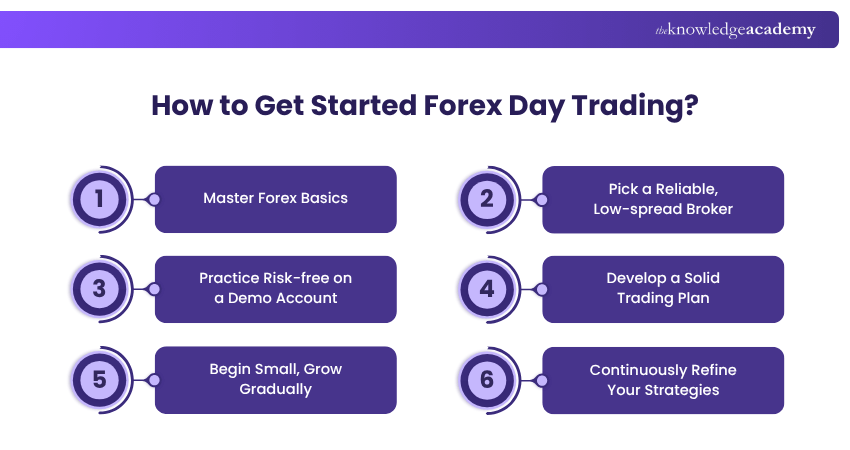
a) Learn the Basics of Forex Trading: Start by understanding key concepts like currency pairs, pips, leverage and margin. A strong foundation helps in making informed trading decisions.
b) Choose a Reliable Broker with Competitive Spreads: Select a regulated broker offering low spreads, fast execution, and robust trading platforms to ensure transparency and fair trading conditions.
c) Open a Demo Account to Practise Risk-free: Use a demo account to test strategies, explore trading tools and build confidence without risking real money.
d) Create a Detailed Trading Plan: Define entry and exit points, position sizes, risk limits, and profit targets. A clear plan keeps trading disciplined and consistent.
e) Start Small and Gradually Increase Your Capital: Begin with modest investments and scale up as experience and confidence grow. Avoid over-leveraging early in your journey.
f) Keep Learning and Improving Your Strategies: Stay updated on market trends, global news and trading tools. Continuous learning refines skills and improves long-term profitability.
Advantages of Day Trading Forex Options
Day trading Forex options, when considering the broader context of the Pros And Cons of Day Trading, comes with several advantages:
a) No Overnight Fees: All trades are opened and closed within the same day. This eliminates the overnight financing charges that brokers often apply to positions held beyond market hours.
b) No Gapping Risk: Since no positions are carried overnight, traders avoid losses caused by price gaps between market closing and reopening.
c) Access to Leverage: Day traders can use leveraged instruments like Contracts for Difference (CFDs). This allows them to control bigger positions with less capital and potentially amplify profits.
d) Profit in Any Market Direction: CFDs allows traders to speculate on the rising as well as falling currency values. This offers profit opportunities in both bullish and bearish conditions.
e) Reduced Exposure to Volatility: As positions are short-term, the impact of major price swings is limited. This lowers the risk of large losses on single trades.
Disadvantages of Day Trading Forex Options
Despite the benefits, there are some risks and drawbacks you must consider:
a) High Transaction Costs: Frequent trading throughout the day can lead to accumulating transaction fees. This may gradually reduce overall profits.
b) Leverage Risk: While leverage can amplify gains, it also magnifies losses. A small market movement against your position can result in significant financial loss.
c) Limited Volatility: Lower market volatility can slow profit growth, and an unexpected sharp move may quickly erase multiple small gains.
d) Time-intensive: Successful day trading demands continuous market monitoring and quick decision-making. This requires a high level of focus, time and commitment.
Master the art of currency exchange in our comprehensive Foreign Exchange Training - Sign up now!
Why do 90% of Forex Traders Lose Money?
Here are the best-known reasons why Forex Traders lose money:
a) Unrealistic Risk-to-Reward Ratio: Many traders fail by risking too much for minimal potential gain. Entering trades without a logical balance between risk and reward leads to recurring emotional trading cycles.
b) Improper Stop Loss Placement: Setting stop losses too tight or too wide, driven by fear or greed, causes premature exits or major losses.
c) Lack of Trading Knowledge: Many beginners enter Forex expecting quick profits without understanding market fundamentals. This results in poor strategies and rapid capital loss.
d) No Trading Journal: Without documenting trades, traders miss patterns and repeat mistakes. A journal helps analyse performance and refine strategies over time.
e) Ignoring Economic News: Relying only on technical analysis leaves traders exposed to sudden moves from major economic announcements.
f) Misuse of Leverage: Overusing leverage magnifies both profits and losses. A single wrong move can wipe out an account if risk isn’t controlled.
g) Poor Risk Management: Focusing solely on profits without planning for losses can lead to disaster. Professional traders prioritise limiting risk before chasing returns.
h) Trading Like Gambling: Trading without analysis or a defined strategy is essentially gambling. Random trades may feel exciting but lead to long-term losses.
Is Forex a Skill or Luck?
Unlike gambling, Forex trading relies far more on skill than luck. Although short-term market fluctuations can be about chance, long-term success depends on knowledge, strategy, discipline, and Risk Management. Traders who chase after quick profits without structure often face disappointment, while those who study and refine their techniques can build a genuinely rewarding trading career.
Conclusion
Forex Day Trading is a thrilling yet challenging endeavour that requires discipline, Risk Management, and continuous learning. Understanding What is Forex Day Trading and the Best Indicators for Day Trading can significantly boost your ability to make informed decisions. By mastering strategies, managing risks effectively, and staying disciplined, you can thrive in this fast-paced environment.
Quick trades and smart moves can deliver big potential in a day. Learn more in our Day Trading Course - Sign up now!
Frequently Asked Questions
Is Forex Day Trading Profitable?

Yes, but success depends on careful analysis, discipline, and effective Risk Management. It’s important to approach with caution and keep realistic expectations in mind.
Is Forex Easier than Stocks?
Forex offers more flexibility, with 24/5 trading and higher liquidity. However, it requires a deep understanding of currency markets and can be risky without proper knowledge.
What are the Other Resources and Offers Provided by The Knowledge Academy?
The Knowledge Academy takes global learning to new heights, offering over 3,000+ online courses across 490+ locations in 190+ countries. This expansive reach ensures accessibility and convenience for learners worldwide.
Alongside our diverse Online Course Catalogue, encompassing 19 major categories, we go the extra mile by providing a plethora of free educational Online Resources like Blogs, eBooks, Interview Questions and Videos. Tailoring learning experiences further, professionals can unlock greater value through a wide range of special discounts, seasonal deals, and Exclusive Offers.
What is The Knowledge Pass, and How Does it Work?
The Knowledge Academy’s Knowledge Pass, a prepaid voucher, adds another layer of flexibility, allowing course bookings over a 12-month period. Join us on a journey where education knows no bounds.
What are the Related Courses and Blogs Provided by The Knowledge Academy?
The Knowledge Academy offers various Investment and Trading Courses, including the Forex Trading Course, Stock Trading Course and the Binary Options Trading Course. These courses cater to different skill levels, providing comprehensive insights into Bonds.
Our Business Skills Blogs cover a range of topics related to Forex Day Trading, offering valuable resources, best practices, and industry insights. Whether you are a beginner or looking to advance your Stocks and Trading skills, The Knowledge Academy's diverse courses and informative blogs have got you covered.
Upcoming Business Skills Resources Batches & Dates
Date
 Day Trading Course
Day Trading Course
Fri 15th May 2026
Day Trading Course
Fri 14th Aug 2026
Day Trading Course
Fri 6th Nov 2026

 If you wish to make any changes to your course, please


