


 Top Rated Course

We may not have the course you’re looking for. If you enquire or give us a call on +44 1344 203 999 and speak to our training experts, we may still be able to help with your training requirements.
SQL vs. MySQL: Critical Differences You Need to Know
Richard Harris 15 April 2026SQL vs. MySQL: Are they rivals or the perfect duo? SQL is the language used to manage databases, while MySQL is a popular system for storing and organising data. Together, they form the backbone of countless applications. Dive into this blog to uncover their unique features, differences, and tips to choose the right tool for your database goals.

Training Outcomes Within Your Budget!
We ensure quality, budget-alignment, and timely delivery by our expert instructors.
Table of Contents

Despite the commonality in the terms, SQL and MySQL differ vastly in regard to their roles. One is a language, the other a full-fledged system. SQL is a powerful language that helps you communicate with databases, while MySQL is one of the most popular systems that speaks it fluently.
Essentially, if SQL is the language and grammar, then MySQL can be viewed as one of its most popular storytellers. This blog dives into the key distinctions between SQL vs MySQL, and sheds light on their strengths, and how they complement each other. So read on and choose the right tool for your next data-driven journey!
Table of Contents
1) Understanding Database
2) Difference Between SQL and MySQL
3) What is SQL Server?
4) What are the Similarities Between SQL and MySQL?
5) SQL vs MySQL: Which one Should You Use and Why?
6) Is MySQL a Language or Database?
7) What Programs use SQL and MySQL?
8) Conclusion
Understanding Database
A database is an ordered collection of data stored electronically on a computer system. It allows for efficient storage, retrieval, and management of information. Databases are essential for handling large datasets, especially in today’s digital world where data is the sole driver of business decisions.
From storing customer profiles to tracking sales and inventory, databases help organisations keep critical information organised and secure. Tools like SQL are used to interact with these databases, making data handling simple, fast, and reliable.

What is SQL?
The SQL language is an industry standard for Database Management and maintenance, according to The American National Standards Institute (ANSI). The query language retrieves adds and manipulates database data. Developed by IBM in 1970, the language has been used to manage Relational Databases like SQL Server, Oracle and MS Access. Databases can be created and altered, and schema structures can also be made using SQL.
Queries in SQL are declarative and can be written with various clauses to define the purpose of execution. Here are some of the basic clauses used for SQL queries:
a) CREATE DATABASE: This clause creates a new Database.
b) DELETE: This clause deletes data from a dataset.
c) ALTER TABLE: This clause alters the table.
d) INSERT INTO: This clause allows new data entry into the database.
e) UPDATE: This clause updates the data in the Database.
f) FROM: This clause retrieves the data from specific columns in a table.
g) WHERE: This clause filters records in a table based on user-defined conditions.
Furthermore, the format of an SQL query is case-sensitive. For example, the query format for retrieving all the data from a table named ‘types_synthesisers’ will be written as:

The following guidelines will help make the query structure perfect:
a) Begin the statement with a command.
b) The query will end with a semicolon.
c) The ‘*’ symbol defines all the data.
Additionally, SQL has keywords like AS, BETWEEN and LIMIT for other functions, such as Alias creation and selective data extraction from a range and a defined number of rows. These guidelines form the general protocol to be followed by Database Engineers and Administrators.
They can thus ensure that they maintain faster query processing and efficiently manage Databases. Database Administrators must note that SQL, on the other hand, allows them to alter or trim their queries during execution, letting the whole execution process occur peacefully.
What is MySQL?
My Structured Query Language (MySQL) is an industry-standard RDBMS software developed by the Swedish company MySQL AB in 1995 and acquired later by Oracle Corporation in 2010. This software is designed to be compatible across all primary operating systems and is the core of a web-based software known as ‘LAMP’, a software stack for Linux, Apache, MySQL, and Python/PHP/Perl.
Although MySQL is a free-of-cost open-source software, Oracle offers extra support services to its users that they can purchase through a commercial license. More importantly, it is cross-platform and compatible with operating systems like Linux, UNIX, and Windows. It offers Database Administrators various storage engines such as MongoDB, Merge, Archive, CSV, MyISAM, etc.
The CSV storage engine saves data in a .csv file. This is helpful when moving data to other tools like spreadsheet software. Each storage engine has its own good and bad points. So database admins should pick the one that works best for their tables to get better performance.
MySQL has two versions: Community Server and Enterprise Server. One thing to remember is that MySQL does not let you stop a query once it has started.
Learn methods to improve database performance and data integrity. Join our PostgreSQL Administration Training now!
Difference Between SQL and MySQL
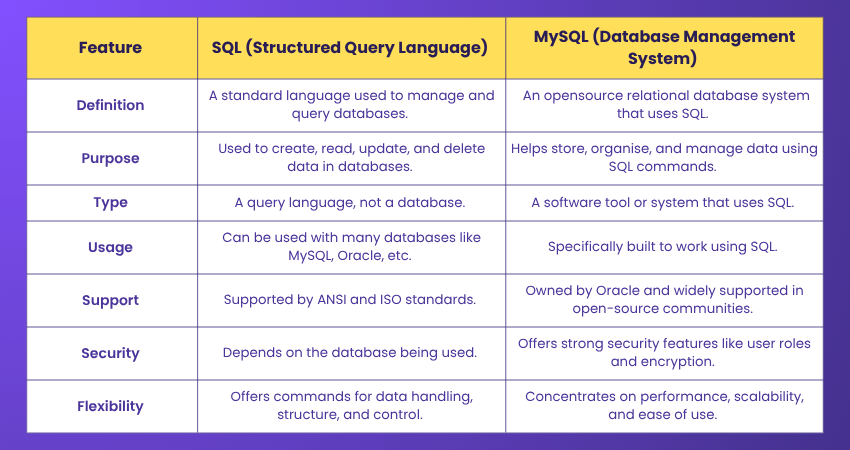
Wondering what is the difference between SQL and MySQL? SQL is a language for handling databases, while MySQL is software that uses SQL to store and handle data. These are the differences between SQL and MySQL:
What is SQL Server?
SQL Server is a relational database management system (RDBMS) developed by Microsoft, designed to store, retrieve, and manage data efficiently for a wide range of applications. It utilises SQL as its primary language for interacting with databases and supports advanced features like Data Warehousing, Business Intelligence, and Analytics.
Understand how to create, manage, and query databases effectively. Join our Introduction To MySQL Course now!
What are the Similarities Between SQL and MySQL?
While SQL and MySQL share a name and a common domain, their similarities lie mainly in their connection to Relational Database Systems. Both are essential tools for working with structured data stored in rows and tables, enabling efficient querying and data management.
SQL, born from a 1970s paper by Edgar F. Codd and later developed by Boyce and Chamberlin, is the language itself. MySQL, introduced in 1995 by Ulf Michael Widenius, is a database system built on SQL and named after his daughter, My. Today, both remain foundational in the world of relational databases.
Use of SQL with MySQL
Database engineers must install MySQL and a client application supporting SQL on their systems. They can then interact with MySQL by executing SQL commands through the MYSQL command line or a compatible GUI like MySQL Workbench. Various operations can then be performed on data using SQL commands, such as INSERT, SELECT, UPDATE, and DELETE.
SQL vs MySQL: Which one Should you Use and Why?
When considering the choice between SQL and MySQL, it's essential to grasp that MySQL is essentially an implementation of SQL. SQL is a standardised means for managing and manipulating data in Relational Databases. MySQL, on the other hand, functions as a specific RDBMS that employs SQL as its primary query language.
Ultimately, the selection hinges on your unique requirements and the functionalities desired from your Database System. For instance, if you're developing a web application necessitating a swift and scalable Database solution, MySQL is a sound option.
However, exploring alternative SQL-based Databases might be advisable if your needs entail more intricate features or interoperability with other systems. Each option offers distinct advantages and considerations, and the decision should be made after thoroughly evaluating your specific use case and requirements.
Is MySQL a Language or Database?
MySQL falls under the category of a Database Management System that holds and organises data in structured tables. It is not a language but uses Structured Query Language (SQL) to query and handle data. MySQL enables efficient data storage and retrieval, making it essential for many applications.
What Programs use SQL and MySQL?
Many popular web applications use MySQL, including WordPress, Facebook, YouTube, and Joomla. SQL is widely used by relational database systems like Oracle, Sybase, Microsoft Access, SQL Server, and Ingres for managing and querying data efficiently.
Conclusion
Knowing the difference between SQL vs MySQL helps you choose the right tool for working with data. SQL is a language used to handle databases. MySQL is a system that uses SQL to store and handle data safely and efficiently. Both are popular and useful. The best choice depends on your project type your needs and your goals.
Acquire skills to write efficient queries and optimise database performance. Join our Advanced SQL Course now!
Frequently Asked Questions
What are the key Advantages and Disadvantages of SQL and MySQL?

The advantages of SQL include its standardised language for managing data in Relational Databases. MySQL, as a specific implementation of SQL, offers ease of use, scalability, and compatibility. However, disadvantages may include limited support for complex queries and less robust features compared to other SQL-based databases.
How can I Learn SQL and MySQL, and What Skills do I Need?
To learn SQL and MySQL, start with online tutorials, courses, and practice exercises. Basic computer literacy and problem-solving skills are helpful. Familiarity with data manipulation concepts and Database structures will aid in understanding and applying SQL and MySQL effectively.
What are the Other Resources and Offers Provided by The Knowledge Academy?
The Knowledge Academy takes global learning to new heights, offering over 3,000+ online courses across 490+ locations in 190+ countries. This expansive reach ensures accessibility and convenience for learners worldwide.
Alongside our diverse Online Course Catalogue, encompassing 17 major categories, we go the extra mile by providing a plethora of free educational Online Resources like Blogs, eBooks, Interview Questions and Videos. Tailoring learning experiences further, professionals can unlock greater value through a wide range of special discounts, seasonal deals, and Exclusive Offers.
What is The Knowledge Pass, and How Does it Work?
The Knowledge Academy’s Knowledge Pass, a prepaid voucher, adds another layer of flexibility, allowing course bookings over a 12-month period. Join us on a journey where education knows no bounds.
What are the Related Courses and Blogs Provided by The Knowledge Academy?
The Knowledge Academy offers various SQL Courses, including the Introduction to MySQL Course, Advanced SQL, and the SQL Server Reporting Services (SSRS) Training. These courses cater to different skill levels, providing comprehensive insights into Operational Database.
Our Programming & DevOps Blogs cover a range of topics related to SQL, offering valuable resources, best practices, and industry insights. Whether you are a beginner or looking to advance your SQL skills, The Knowledge Academy's diverse courses and informative blogs have got you covered.

Richard Harris


Senior Full Stack Developer and Technology Educator
Richard Harris is a highly experienced full-stack developer with deep expertise in both frontend and backend technologies. Over his 12-year career, he has built scalable web applications for startups, enterprises and government organisations. Richard’s writing combines technical depth with clear explanations, ideal for developers looking to grow in modern frameworks and tools.

Upcoming Programming & DevOps Resources Batches & Dates
Date
 Introduction to SQL
Introduction to SQL
Fri 19th Jun 2026
Introduction to SQL
Fri 31st Jul 2026
Introduction to SQL
Fri 2nd Oct 2026

 If you wish to make any changes to your course, please


