


 Top Rated Course

We may not have the course you’re looking for. If you enquire or give us a call on +33 805638382 and speak to our training experts, we may still be able to help with your training requirements.
Top 34 Types of Programming Languages: A Complete Overview
Richard Harris 03 February 2026Explore the fascinating world of Programming Languages - from procedural to object-oriented. This blog reviews 34 different Types of Programming Languages, diving into major paradigms, Web Development, and unique syntax styles. Discover how each language shapes our digital world and find the perfect one to spark your coding creativity!

Training Outcomes Within Your Budget!
We ensure quality, budget-alignment, and timely delivery by our expert instructors.
Table of Contents
Related Courses

In a world driven by innovation, programmers serve as the storytellers of the technological era. They use different Types of Programming Languages, each with its own set of purposes, to create applications ranging from basic calculations to advanced Artificial Intelligence (AI) systems and solutions.
Over the years, these languages have evolved rapidly, encountering new challenges and industry transformations. This blog explores 34 different Types of Programming Languages and their roles in shaping the technology we use in our day-to-day lives.
Table of Contents
1) Major Programming Languages
2) Compilation and Interpretation Languages
3) System-level and Low-level Languages
4) Domain-Specific Languages (DSLs)
5) Web Development Languages
6) Special-Purpose Languages
7) Unique and Experimental Languages
8) Programming Language Syntax Styles
9) Conclusion
Major Programming Languages
These languages are widely used across the tech industry, powering a majority of software applications and systems. Here are some of the most prominent major Programming Languages:
1) Procedural Languages
Procedural programming follows a linear approach, using procedures, functions, and loops to execute instructions. These languages are widely used for structured and modular programming.
Examples: C, Pascal

2) Functional Languages
Functional programming focuses on pure functions, immutability, and avoiding side effects. It supports higher-order functions, recursion, and mathematical computation, making it ideal for AI, scientific research, and Data Analysis.
Examples: Haskell, Lisp
3) Object-Oriented Languages
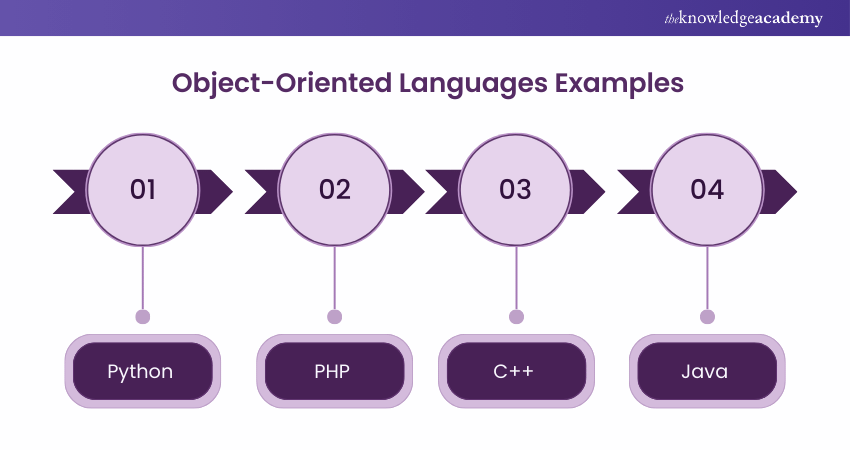
Object-Oriented Programming (OOP) is based on the concepts of objects and classes, promoting encapsulation, inheritance, and polymorphism. It serves to enhance code reusability, scalability, and modularity, making it popular in software development. Understanding OOP and POP helps developers choose the right paradigm for building efficient and maintainable applications.
Examples: Java, C#
4) Declarative Languages
Logic Programming Languages use formal logic rules and inference mechanisms to derive solutions automatically. They are widely used in Artificial Intelligence, expert systems, and automated reasoning applications.
Examples: Prolog, SQL,
5) Logic Programming Languages
Machine Programming Languages operate using binary codes—0s and 1s. All instructions or text are written in binary format, forming the foundation of computation, much like how the Go Programming Language is compiled into machine code for efficient execution.
Examples: Prolog, Mercury
6) Imperative Languages
Imperative languages describe computations through sequences of commands that directly manipulate program states. They follow a structured execution flow and are commonly used in legacy systems and embedded software.
Examples: FORTRAN, COBOL
7) Concurrent Languages
Concurrent programming supports multiple execution threads or processes running simultaneously, enhancing performance in distributed computing and parallel processing applications.
Examples: Erlang, Go
8) Constraint Programming Languages
Constraint programming focuses on defining relationships and constraints between variables rather than explicit instructions. It is commonly used in optimisation, scheduling, and AI applications.
Get ready for your Haskell interview with our top Haskell Interview Questions!
Examples: MiniZinc, ECLiPSe
Compilation and Interpretation
Programming Languages can be classified based on how they are executed, either through compilation or interpretation. Here are the key languages in these categories:
9) Compiled Languages
Compiled languages translate source code into machine code before execution, optimising performance. They are widely used in high-performance applications, operating systems, and embedded systems.
Examples: C, C++
10) Interpreted Languages
Interpreted languages execute code line-by-line at runtime, providing flexibility and faster development cycles but often at the cost of execution speed.
Examples: Python, Ruby
Learn Ruby’s powerful syntax and enhance your Coding skills- Join our Ruby Programming Course today!
11) Just-in-Time (JIT) Compiled Languages
JIT compilation combines interpretation and compilation, translating code at runtime for greater efficiency. It balances execution speed with flexibility in modern applications.
Examples: Java, .NET languages
12) Macro Languages
Macro languages automate repetitive tasks by defining scripts that execute prewritten sequences of commands. They are commonly used in automation and preprocessing.
Examples: C Preprocessor, M4
Uncover the Key Differences Between Java vs JavaScript – Read More!
System-level and Low-level Languages
These languages are closely related to the hardware, offering control over system resources and performance. Here are some examples of system-level and low-level languages:
13) Machine Languages
Machine language consists of binary code directly executed by the CPU. It is the lowest-level programming language, offering maximum efficiency but is extremely difficult to write and debug.
Example: x86 Machine Code, ARM Machine Code
14) Assembly Languages
Assembly language provides a human-readable representation of machine code, using mnemonics to manage CPU operations. It is used in system programming, firmware, and performance-critical applications.
Examples: x86 Assembly, ARM Assembly
15) System Programming Languages
System Programming Languages enable low-level interaction with hardware, memory, and operating systems, making them essential for writing kernels, device drivers, and embedded systems.
Examples: Rust, C
16) Hardware Description Languages (HDLs)
HDLs define digital circuit behaviour, describing hardware structure and logic using high-level abstractions.
Examples: VHDL, Verilog
Discover the Key Differences: Lua vs Python — Which Suits Your Needs Best?
Domain-Specific Languages (DSLs)
Domain-specific languages are designed for specific tasks or industries, providing specialized tools for developers. Here are some well-known domain-specific languages:
17) Embedded and Embeddable Languages
Designed for integration into larger software systems, these languages enable extensibility and customisation in applications like game engines and IoT devices.
Examples: Lua, TCL
18) Scripting Languages
Scripting languages automate tasks, process text, and control software applications dynamically. They are widely used in DevOps, Web Development, and system administration.
Examples: Bash, PowerShell
19) Dataflow Languages
Dataflow programming models computations as directed graphs of data transformations, commonly used in signal processing, automation, and visual programming.
Examples: LabVIEW, Max/MSP
20) Numerical Analysis Languages
Designed for mathematical computation, numerical analysis languages facilitate scientific research, simulations, and data visualisation.
Examples: MATLAB, Julia
21) Database Programming Languages
Database Programming Languages allow interaction with databases, enabling efficient data storage, retrieval, and manipulation.
Examples: SQL, PL/SQL
Web Development Languages
Web Development relies on a variety of Programming Languages to build and manage websites and online applications. Here are the essential Web Development languages:
22) Front-End Languages
Front-end languages power the visual interface and user experience of websites and applications. They serve as the bridge between design aesthetics and interactive functionality, ensuring seamless engagement for users across various devices and platforms.
Examples: HTML, CSS, JavaScript
23) Back-End Languages
Back-end programming languages, including Ruby Methods, handle server-side logic, data management, and API integration. They ensure the seamless processing of requests, secure data handling, and robust communication between databases and front-end interfaces.
Examples: PHP, Python and Ruby
2) XML-Based Languages
These languages are used for structured data representation, transformations, and configurations in web applications and APIs, enabling accurate data exchange and integration between systems. Exploring XML Interview Questions can further enhance your understanding of how to maintain consistency and readability across diverse platforms.
Examples: XSLT, XPath
Unlock R’s power for Data Science and Machine Learning (ML) - Sign up for our R Programming Course today!
Special-Purpose Languages
These languages are designed to address specific needs or problems, offering specialized features and functionality. Here are some examples of special-purpose languages:
25) Algorithmic Languages
Algorithmic languages focus on computational problem-solving and structured programming, essential in theoretical computer science.
Examples: ALGOL, Scheme
26) Rule-Based Languages
Rule-based programming uses condition-action rules to define system behaviour, commonly applied in AI and expert systems.
Examples: Drools, Jess
27) Interactive Mode Languages
Designed for real-time user interaction, these languages enable interactive scripting and programming exploration.
Examples: REBOL, Jupyter Notebook
28) Visual Programming Languages
Visual languages enable programming using graphical elements, often for educational or domain-specific applications.
Examples: Scratch, Blockly
29) Fourth-Generation Languages (4GLs)
4GLs simplify programming with high-level abstractions, primarily used in database management and reporting tools.
Examples: SQL, ABAP
Discover the power of Unique Interview Questions and leave a memorable mark on your next hiring manager!
Unique and Experimental Languages
Some Programming Languages are unique or experimental, pushing the boundaries of conventional coding paradigms, highlighting the Benefits of Coding by encouraging innovation and new approaches. Here are some of these intriguing languages:
30) Esoteric Languages
Designed for experimentation or humour, esoteric languages challenge conventional programming paradigms.
Examples: Brainfuck, Malbolge
31) Reflective and Metaprogramming Languages
These languages support runtime code generation and modification, enabling dynamic program execution and allowing developers to adapt program behaviour on the fly based on changing requirements or environments.
Examples: Lisp, Smalltalk
32) Non-English-Based Languages
These languages are developed using non-English syntax to accommodate different linguistic conventions, making programming more accessible to non-English speakers and fostering inclusivity in software development.
Examples: Qalb, ChineseScript
Programming Language Syntax Styles
Different Programming Languages adopt various syntax styles, affecting how code is written and understood. Here are some of the key syntax styles found in Programming Languages:
33) Curly-Bracket Languages
Languages that use curly braces `{}` for code blocks are common in C-like syntax structures, providing clear boundaries for code execution and promoting readability and structure in programming logic.
Examples: C, Java, JavaScript
Choosing between two powerful languages? Read our Python vs. Java comparison!
34) Off-Side Rule Languages
Languages that use indentation instead of brackets for block structure rely on whitespace to define code hierarchy, ensuring clean and visually consistent formatting while eliminating the need for additional symbols like curly braces.
Examples: Python, Haskell Programming Language.
Learn C Programming to build efficient and powerful software - Join our C# Programming (C Sharp) Training today!
Conclusion
Programming Languages form the backbone of modern technology, enabling developers to build everything from websites to AI systems. With diverse Programming Languages serving unique purposes, understanding these 34 different Types of Programming Languages is crucial. One such language, Haskell, offers a variety of powerful Uses of Haskell, especially for tasks that demand high-level computations and code reliability. They play a significant role in shaping the digital world and offer opportunities for both beginners and experienced developers to innovate and grow.
Start Coding with C and create efficient system solutions - Register for our C Programming Training today!
Frequently Asked Questions
What are Examples of Computer Programming Languages?

Examples of computer Programming Languages include Python, Java, C++, Ruby, and JavaScript. These languages are used to create websites, software applications, and systems. Each offers unique features tailored to different types of development, ranging from web programming to data science and AI.
Is HTML a Coding Language?
No, HyperText Markup Language (HTML) is not considered a coding language but rather a markup language. It is used to structure web content, defining elements like headings, paragraphs, and links. Unlike coding languages, HTML doesn't include logic or programming functions like loops or conditionals.
What are the Other Resources and Offers Provided by The Knowledge Academy?
The Knowledge Academy takes global learning to new heights, offering over 3,000+ online courses across 490+ locations in 190+ countries. This expansive reach ensures accessibility and convenience for learners worldwide.
Alongside our diverse Online Course Catalogue, encompassing 19 major categories, we go the extra mile by providing a plethora of free educational Online Resources like Blogs, eBooks, Interview Questions and Videos. Tailoring learning experiences further, professionals can unlock greater value through a wide range of special discounts, seasonal deals, and Exclusive Offers.
What is The Knowledge Pass, and How Does it Work?
The Knowledge Academy’s Knowledge Pass, a prepaid voucher, adds another layer of flexibility, allowing course bookings over a 12-month period. Join us on a journey where education knows no bounds.
What are the Related Courses and Blogs Provided by The Knowledge Academy?
The Knowledge Academy offers various Programming Training, including Object Oriented Programming (OOPs) Course, Ruby Programming Course, and C Programming Course. These courses cater to different skill levels, providing comprehensive insights into Floor Division in Python.
Our Programming & DevOps Blogs cover a range of topics related to Software Development Management, offering valuable resources, best practices, and industry insights. Whether you are a beginner or looking to advance your Programming skills, The Knowledge Academy's diverse courses and informative blogs have got you covered.

Richard Harris


Senior Full Stack Developer and Technology Educator
Richard Harris is a highly experienced full-stack developer with deep expertise in both frontend and backend technologies. Over his 12-year career, he has built scalable web applications for startups, enterprises and government organisations. Richard’s writing combines technical depth with clear explanations, ideal for developers looking to grow in modern frameworks and tools.

Upcoming Programming & DevOps Resources Batches & Dates
Date
 Object Oriented Programming (OOPs) Course
Object Oriented Programming (OOPs) Course
Fri 24th Jul 2026
Object Oriented Programming (OOPs) Course
Fri 23rd Oct 2026

 If you wish to make any changes to your course, please


