


 Top Rated Course

We may not have the course you’re looking for. If you enquire or give us a call on 0800 446148 and speak to our training experts, we may still be able to help with your training requirements.
What is Customer Service and Why Is It Important for Businesses?
The Knowledge Academy 05 March 2026Customer service refers to the support a business delivers before, during, and after a purchase, including guidance, problem resolution, and answering queries. Strong customer service builds trust and strengthens long-term relationships, helping businesses retain customers, enhance brand reputation, and drive sustainable growth.

Training Outcomes Within Your Budget!
We ensure quality, budget-alignment, and timely delivery by our expert instructors.
Table of Contents

A single interaction can shape how customers see your entire brand. Whether it’s a quick response to a query or effective support during a problem, these moments define trust, loyalty, and reputation.
Understanding What is Customer Service goes beyond answering questions. This blog explores its meaning, key elements, and why delivering consistent, high-quality service is essential for businesses aiming to grow, retain customers, and stand out in competitive markets.
Table of Contents
1) What is Customer Service?
2) Why is Customer Service Important?
3) How does Customer Service work?
4) Components of Good Customer Service
5) Types of Customer Service
6) How to Improve Customer Service Skills?
7) Difference Between Customer Service and Customer Experience
8) How Will You Handle an Angry Customer?
9) Key Customer Service Skills
10) Conclusion
What is Customer Service?
Customer service refers to the support, help and guidance given by a business to customers before, during, and after a purchase. It also makes sure that customers are able to use the products or services well, as well as solve the problems quickly. Understanding what is customer service, highlights its role in improving satisfaction, building loyalty, and supporting long-term business growth.

Why is Customer Service Important?
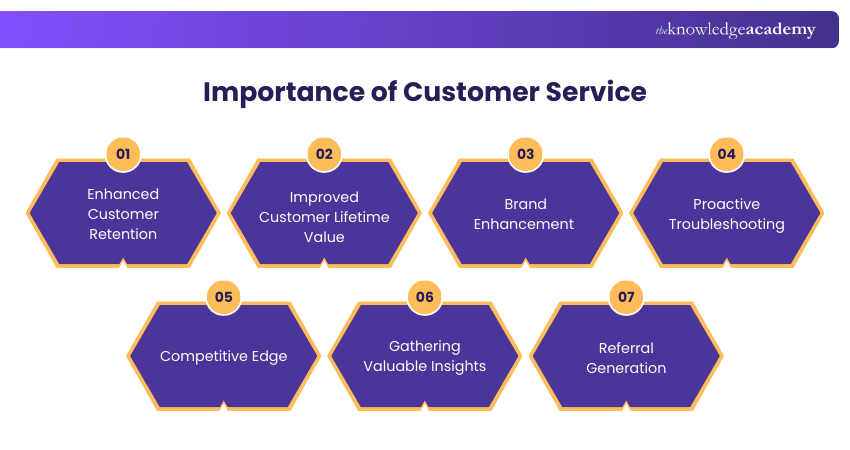
Now, that you know What is Customer Services, it’s time to understand why learning about the topic and understanding the Importance of Customer Service is crucial. Investing in excellent Customer Service is imperative for businesses, yielding numerous advantages. Here are some of the key reasons why Customer Service is important for businesses:
1) Enhanced Customer Retention
Implementing a Customer Service program ensures customer satisfaction, addresses product-related concerns, payments, returns, and technical support, and fosters loyalty, all of which are key responsibilities outlined in the Customer Service Representative Job Description.
2) Improved Customer Lifetime Value
Quality Customer Service establishes and strengthens long-term customer relationships, increasing Customer Lifetime Value through loyalty and repeated purchases.
3) Brand Enhancement
Businesses that prioritise Customer Service enhance their brand equity, setting them apart and leading to increased referrals and sales.
4) Proactive Troubleshooting
Proactively addressing customer issues before they escalate demonstrates a company's commitment to a seamless customer experience, showcasing care and dedication.
5) Competitive Edge
A robust Customer Service differentiates a company, elevating its reputation and brand value. It signals to consumers and competitors the importance placed on customer relationships.
6) Gathering Valuable Insights
Customer service offers direct insight into customer feedback and preferences. It helps identify pain points and emerging trends, supporting informed product improvements and targeted Marketing strategies.
7) Referral Generation
Positive customer experiences lead to referrals, whether through word-of-mouth, reviews, or social media. This contributes to new sales opportunities for businesses.
Enhance your communication and truly understand your customers with our Active Listening Training – Join today!
How does Customer Service work?
Behind the scenes at most companies, there exist individuals who may never directly encounter the consumers purchasing their products. Customer Service representatives, being the frontline contact for buyers, significantly influence their perceptions of the company and its offerings. This impact extends to both Customer Service vs Customer Experience, where companies invest efforts in elevating satisfaction levels to improve the overall customer experience.
Successful small business owners inherently grasp the importance of effective Customer Service Process. Larger enterprises delve into the subject extensively and draw the following fundamental conclusions:
a) Timely Issue Resolution: Swift attention to customer concerns is paramount. Forcing customers to endure long waits or extended hold times tarnishes the interaction from the outset.
b) Streamlined Customer Service: Customer Service should be a seamless, one-step process for consumers. Representatives, whenever possible, should see an issue thoroughly to offer resolution after customer requests assistance.
c) Follow-up and Resolution: If a customer necessitates a transfer to another department, the initial representative should proactively follow up to ensure the problem was effectively addressed. This holistic approach contributes to overall customer satisfaction.
Discover the key to unlocking your potential and achieving personal growth with our comprehensive Personal Development Training!
Components of Good Customer Service
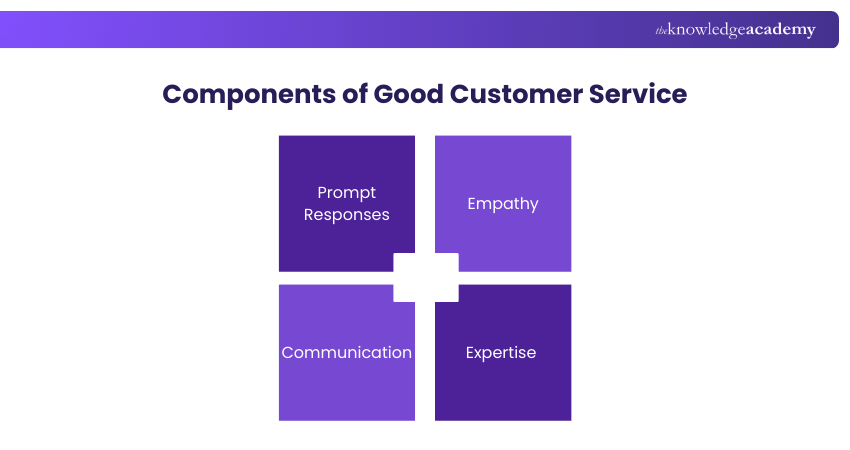
We've emphasised the significance of effective Customer Service, but what constitutes "good" Customer Service? So, let’s delve into key components that make Customer Service exemplary:
1) Prompt Responses
The cornerstone of good Customer Service lies in timely query responses across all communication channels. Customers expect immediate solutions for product or service issues, necessitating swift and responsive assistance.
2) Empathy
Understanding and empathising with customers' needs and concerns is crucial in defusing potentially challenging situations. Expressing empathy when addressing complaints demonstrates a customer-focused approach, conveying a genuine effort to understand and resolve issues, safeguarding your reputation.
3) Communication
Effective communication is paramount, especially in Customer Service. Providing comprehensive information to clients before a purchase enhances satisfaction. Developing expertise in active listening enables your staff to discern customer inquiries and complaints swiftly, ensuring a prompt and efficient resolution.
4) Expertise
To guarantee excellent Customer Service, ensure that your staff undergoes thorough training and attains expertise in your products and services. Equipping them with accurate information enables them to provide informed answers, reducing the likelihood of dissatisfied customers and returns.
Types of Customer Service
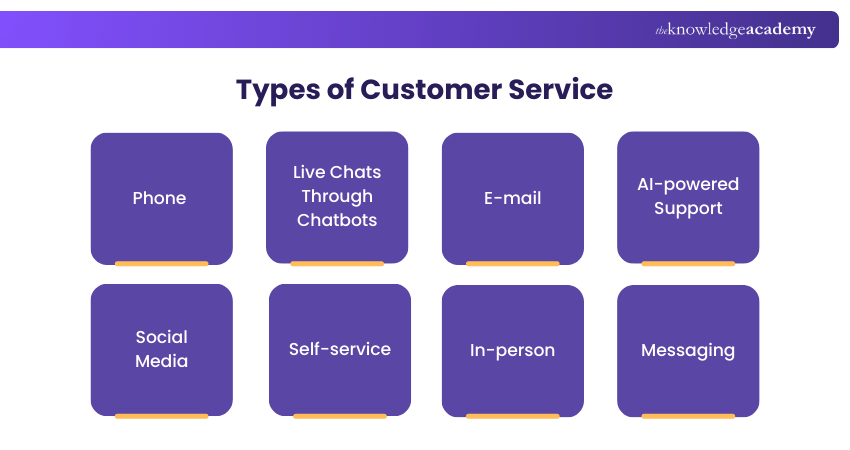
There are several platforms where businesses provide services to their customers, covering different Types of Customer Service. Let us have a look at them:
1) Phone
Phone support gives a customer an opportunity to talk to trained representatives, be heard on issues, and be given instant solutions. Even though the use has decreased, it is still useful for complex or urgent queries.
2) Live Chats Through Chatbots
Chatbots rely on AI to provide real-time 24/7 customer support for frequent questions. The system is supported by human agents in order to achieve personalised assistance whenever necessary.
3) E-mail
Email customer care offers a written platform of questions and answers, which is best suited for detailed issues or step-by-step concerns. It is time-saving and does not entail lengthy waiting periods unlike calls.
4) AI-powered Support
AI-based support utilises automation and intelligent tools to communicate with customer inquiries. It helps the service teams to enhance speed, consistency and cost-effective customer interactions.
5) Social Media
Social media customer service enables businesses to interact with their customers on websites which they are already familiar with. It assists in responding in time, engaging in socialising, and increasing brand interest.
6) Self-service
Customers can use knowledge bases and frequently asked questions (FAQs) to locate answers on their own via self-service. It provides real-time access to information without waiting for agents to respond.
7) In-person
In-person customer service is provided in physical stores, hotels, or restaurant facilities. It provides a personal, in-person experience that helps to develop trust and resolve customer inquiries.
8) Messaging
Messaging services are provided in SMS and social media direct message formats, which provide fast and easy communication. With platforms such as WhatsApp, customers can find help within seconds.
Master the art of creating memorable customer journeys with our Customer Experience Training – Sign up now!
How to Improve Customer Service Skills?
Your Customer Service skills can be improved by incorporating the following steps into your work:
1) Listen to the Customer
Adopting the perspective of customers is an effective approach to anticipate their needs and offer tailored solutions. Whether their main focus is on cost or time constraints, attentive listening to their feedback is crucial. Understanding the reasons behind their concerns fosters empathy and contributes to making customers feel valued and appreciated. This reflects the Compassion and Communication elements of the 7 C’s of Customer Service.
2) Use Positive Language
When addressing customer issues, employing positive language effectively alleviates tension. The choice of words holds significant power in building trustworthy relationships with customers.
Utilising positive verbs is essential; for instance, opt for "the green button is the best option" instead of "don't hit the red button." Embracing the future tense focuses on positive outcomes, avoiding dwelling on past issues. Expressions like "Great question, I'll find that out for you!" and "I'd love to understand more about..."
Keep the customer engaged in the present moment. Authenticity, positivity, and a composed demeanor are key when interacting with customers, even in challenging situations.
3) Know Your Products and Services
To assist customers effectively, it's essential to possess a comprehensive understanding of your products and their functionalities. Each Customer Service agent should undergo onboarding sessions with experienced product specialists.
This enables agents to ask questions and thoroughly understand the product's intricacies. Such knowledge equips them to aid customers during troubleshooting, offering valuable tips and tricks to enhance the product's usability.
4) Motivate Others
Implementing a culture of exceptional Customer Service can be effectively realised by recognising and rewarding team members who consistently demonstrate outstanding service. Beyond the intrinsic satisfaction of delivering exceptional service, providing tangible rewards serves as a powerful motivator, fostering a positive environment.
Consider simple incentives like vouchers or financial bonuses for staff garnering positive customer reviews; these can notably drive performance, particularly within sales teams. Additionally, non-monetary forms of recognition, such as the "Employee of the Month" award, serve to acknowledge and celebrate the dedication and commitment of staff members, further contributing to a culture of excellence within the team.
Difference Between Customer Service and Customer Experience
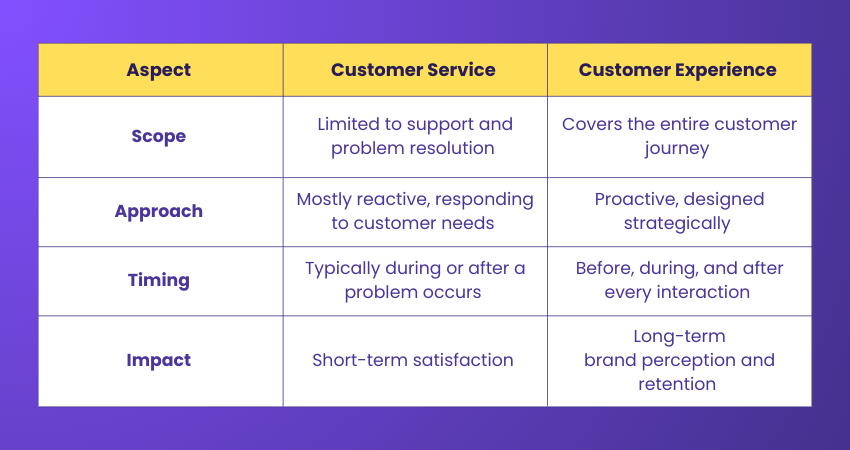
Although customer experience and customer service have the same objective of customer satisfaction, they are different in scope, as well as focus. Customer service involves helping customers who have problems with a certain issue to be resolved after they make a purchase, compared to customer experience, which involves all communication a customer has with a brand throughout the journey. Some of the key differences are as given in the table;
How Will You Handle an Angry Customer?
When one has to handle an angry customer, one needs to stay calm, patient and express oneself so that the negative encounter can be transformed into a positive one. This is an essential part of What is Customer Service, aiming at trying to understand the concern, calming down emotions, and coming up with a solution that would repair trust.
Actions to be taken when dealing with angry customer are:
1) Be understanding and allow them to express themselves and consider their emotional side
2) Stay in your tone so as not to extend the situation further
3) Although it may not be your fault, a sincere apology would be a sign that you understand they are going through it
4) Make sure that you have elaborated on the problem and then propose solutions
5) Give them practical measures or options in order to address their issue
6) Follow up to get the customer satisfaction with the result
Learn strategies to manage conflicts and transform challenging interactions with our Dealing with Difficult People Training- Sign in now!
Key Customer Service Skills
Good customer service is based on a combination of both interpersonal and practical skills. Such skills allow businesses to evoke trust, solve problems effectively, and produce positive experiences with customers. While understanding What is Customer Service, learn these key customer service skills for excelling in the role:
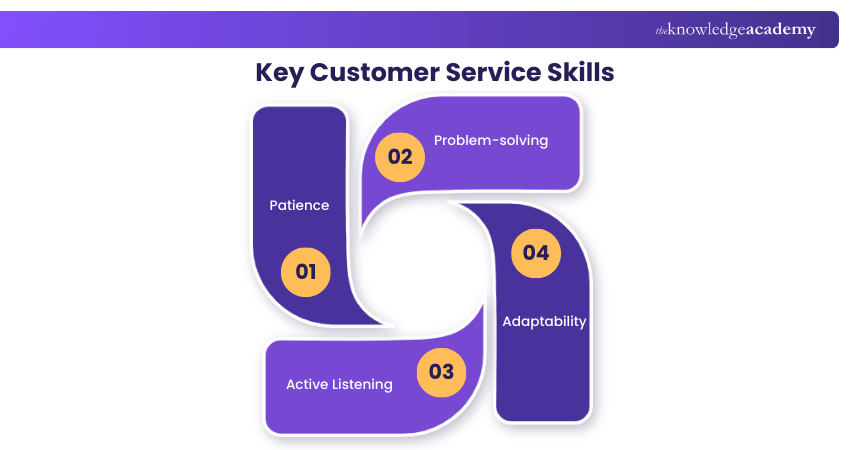
1) Patience
When handling angry or difficult customers, patience is vital because it helps to avoid a situation where the conflicts grow out of proportion and harm your brand image. Compassion can make one come out of a bad experience.
2) Problem-solving
The problem-solving process is aimed at finding problem areas and providing efficient solutions. It is time-consuming, technical, and logical. Good problem-solving minimises repeat grievances and will enhance brand trust.
3) Active Listening
Active listening refers to listening attentively without any distractions to the concerns of the customers. It is about explaining information and ensuring that there is no misunderstanding. This would provide the correct solutions and make the customers feel heard.
4) Adaptability
Adaptability means that the customer service can be provided to a customer in a variety of platforms and communication styles. With the assistance of such tools as CRM systems, it is possible to manage the inquiries effectively and personalise the support.
Conclusion
Delivering exceptional service is at the heart of What is Customer Service. Handling angry customers with patience, empathy, and clear solutions not only resolves issues but builds trust. Each positive interaction strengthens relationships and enhances brand reputation. Mastering these skills ensures long-term customer loyalty and business success.
Unlock your potential and accelerate your growth with our Personal Development Courses – Join today!
Frequently Asked Questions
What are Common Customer Service Challenges?

Customer service teams are under pressure; they have numerous communication mediums and a lack of staff, which results in stress and incongruity. Wearing it is a challenge to maintain efficiency, data protection, and quality service and retain customers simultaneously.
What is the Future of Customer Service?
Smart technology and changing customer demands define the future of customer service and automation, and AI can improve the speed and quality of support. A combination of digital tools and human understanding will help companies provide a more personalised, proactive and efficient scale experience in the future.
What are the Other Resources and Offers Provided by The Knowledge Academy?
The Knowledge Academy takes global learning to new heights, offering over 3,000+ online courses across 490+ locations in 190+ countries. This expansive reach ensures accessibility and convenience for learners worldwide.
Alongside our diverse Online Course Catalogue, encompassing 17 major categories, we go the extra mile by providing a plethora of free educational Online Resources like Blogs, eBooks, Interview Questions and Videos. Tailoring learning experiences further, professionals can unlock greater value through a wide range of special discounts, seasonal deals, and Exclusive Offers.
What is The Knowledge Pass, and How Does it Work?
The Knowledge Academy’s Knowledge Pass, a prepaid voucher, adds another layer of flexibility, allowing course bookings over a 12-month period. Join us on a journey where education knows no bounds.
What are Related Courses and Blogs Provided by The Knowledge Academy?
The Knowledge Academy offers various Personal Development Courses, including the Dealing with Difficult People Training, Building Business Relationships, and Customer Experience Training. These courses cater to different skill levels, providing comprehensive insights into Customer Service Best Practices.
Our Business Skills Blogs cover a range of topics related to Customer Service, offering valuable resources, best practices, and industry insights. Whether you are a beginner or looking to advance your Customer Engagement skills, The Knowledge Academy's diverse courses and informative blogs have got you covered.

The Knowledge Academy


Global Training Provider
The Knowledge Academy is a world-leading provider of professional training courses, offering globally recognised qualifications across a wide range of subjects. With expert trainers, up-to-date course material, and flexible learning options, we aim to empower professionals and organisations to achieve their goals through continuous learning.

Upcoming Business Skills Resources Batches & Dates
Date
 Exceptional Customer Service Training
Exceptional Customer Service Training
Fri 17th Jul 2026
Exceptional Customer Service Training
Fri 16th Oct 2026

 If you wish to make any changes to your course, please


