


 Top Rated Course

We may not have the course you’re looking for. If you enquire or give us a call on +358 942454206 and speak to our training experts, we may still be able to help with your training requirements.
ITIL Problem Management - A Complete Guide
John Davies 06 February 2026ITIL Problem Management is not about fixing IT issues quickly but about finding and resolving the root cause to prevent future problems. It reduces downtime and boosts efficiency. By following a structured process, IT teams can analyse problems, apply solutions and improve service quality. This ensures better IT performance.

Training Outcomes Within Your Budget!
We ensure quality, budget-alignment, and timely delivery by our expert instructors.
Table of Contents
Imagine fixing the same IT problem over and over—frustrating, right? That’s where ITIL Problem Management comes in. Instead of just fixing problems quickly, it focuses on finding the real cause and stopping it from happening again. This helps businesses reduce downtime, improve IT systems, and avoid repeated issues. By following a step-by-step process, IT teams can solve problems efficiently and make services more reliable.
In this blog, we will discuss what ITIL Problem Management is, processes, key roles, and benefits. Whether you’re in IT or just curious, this blog will help you understand how it works!
Table of Contents
1) What is ITIL Problem Management?
2) Objectives of Problem Management in ITIL
3) What are the Types of ITIL Problem Management?
4) Process Flow for Problem Management
5) Problem Management Roles and Responsibilities
6) Benefits of Problem Management in ITIL
7) What is an Example of Problem Management?
8) What is the Difference Between an Incident and Problem Management?
9) Conclusion
What is ITIL Problem Management?
Problem Management is a critical process within IT Service Management, focusing on the life cycle management of “Problems.” Its effectiveness is measured by its ability to swiftly identify and implement solutions or temporary fixes, thereby reducing organisational impact and preventing future occurrences. This process involves pinpointing the faults within the IT infrastructure that lead to problems and, consequently, to user-reported Incidents. ITIL outlines key definitions pertinent to this process:
a) Problem: The origin of one or more Incidents, typically unidentified when initially recording the Problem.
b) Error: A defect or malfunction failing IT services or other configuration items.
c) Known Error: A Problem with an established root cause and a documented workaround.
d) Root Cause: The fundamental reason behind an incident or problem.
These definitions are foundational for understanding and executing Problem Management effectively.

Objectives of Problem Management in ITIL
Problem Management has three key objectives:
a) To identify and prevent problems (and resulting incidents) from happening
b) To eliminate repetitive Incidents and have control over problems
c) To minimise the impact of Incidents that cannot be prevented
What are the Types of ITIL Problem Management?
Organisations can benefit from the ITIL Problem Management process in two ways:
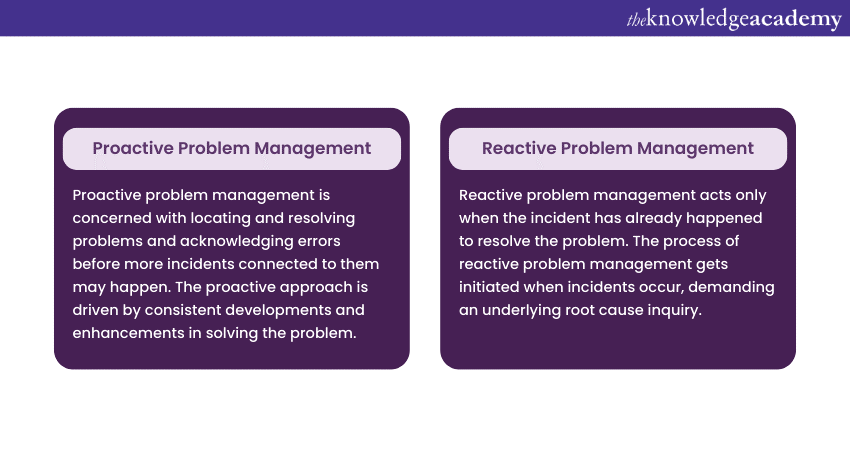
Proactive Problem Management
It focuses on preventing issues before they happen. IT teams analyse past incidents to find patterns and stop problems from recurring. They use monitoring tools to detect early warning signs of system failures. This helps businesses avoid downtime and improve service reliability.
a) Identifies risks and fixes them before they cause issues
b) Uses data from past incidents to prevent future problems
c) Helps reduce unexpected IT failures
d) Improves overall system stability and performance
Elevate your career: Join our ITIL Certification Course and learn more!
Reactive Problem Management
It deals with issues after they occur. IT teams investigate the root cause of incidents and work on long-term fixes. They log problems, analyse data, and find solutions to prevent similar issues. This approach ensures that recurring problems are properly addressed.
a) Focuses on solving problems after they happen
b) Finds and fixes the root cause of incidents
c) Helps prevent the same issue from happening again
d) Improves IT service by reducing repeated failures
Learn issue-solving techniques with our Root Cause Analysis Course – Join today!
Process Flow for Problem Management
The first step of the ITIL Problem Management process starts with identifying the problem and concludes with the team taking preventive measures to avoid a similar problem in the future. Here's a complete breakdown of the ITIL Problem Management lifecycle stages:
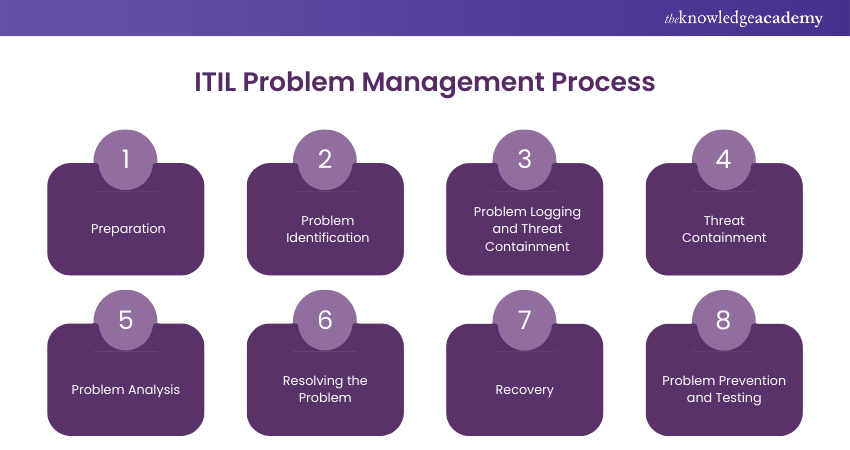
Preparation
The first response stage to an incident is planning and preparation. This time should be utilised meticulously to plan, prioritise, assign, and delegate roles and responsibilities for the team.
Setting up a response plan and implementing an effective strategy is the key to ensuring a consistent and timely response to any possible incidents. It is critical to be prepared for each day to handle any new threats and vulnerabilities, such as ransomware updates, new viruses, and other attacks emerging unexpectedly.
Problem Identification
The second stage in ITIL Problem Management is crucial: it involves identifying and detecting problems. The team aims to recognise issues early to manage, scrutinise, and eliminate potential threats. Incidents that recur or complaints from end-users often highlight these problems.
The team can ascertain if similar problems have occurred by consulting their issue logs. Organising these threats into categories helps prioritise them based on their criticality and frequency, setting the stage for subsequent resolution phases.
Problem Logging and Threat Containment
To effectively maintain a complete historical record of all incidents and problems, it’s essential to log pertinent details such as user information, timestamps, descriptions, related incidents, and resolution data. This comprehensive logging serves two key purposes:
a) Categorisation: By categorising each entry, teams can efficiently monitor, assign, and systematically escalate issues.
b) Prioritisation: Prioritising issues is vital for staff to comprehend and establish a resolution hierarchy.
Multiple issues often arise simultaneously, so prioritisation based on impact and urgency ensures that the most critical problems are addressed first. This strategy guarantees that the IT support team is organised and focused on high-priority issues, facilitating swift resolutions and segregating urgent matters.
Threat Containment
You must prioritise and immediately contain the incident based on the severity of critical threats. The foremost goal of containment is to isolate the hazard to minimise and prevent further damage to your system.
The antivirus can only quarantine the pre-defined threats. But other severe threats, such as data breaches, malicious malware, and undefined viruses, would require a sophisticated approach to handle.
Problem Analysis
Discovering the underlying root cause of an issue at this step in the ITIL Problem Management process is essential to repairing your system and preventing any such future attacks. To tackle the problem as quickly as possible, your team needs to plan the best course of action. You may enhance the overall availability of services and achieve better outcomes at this point by proactively detecting similar incidents that may influence business operations.
Resolving the Problem
Resolving the problem is one of the most crucial stages of the actual work. You need to initiate the most appropriate solution once you have identified the root cause of the problem.
After it has been resolved and tagged as closed, the problem no longer continues and cannot result in more incidents. You must confirm that the pertinent description of the issue and the measures your team took to fix it are included in your problem record.
Recovery
The recovery phase begins with post-incident analysis and threat neutralisation. The extent of damage dictates the duration of the recovery effort. For data breaches, deploying patches or replacing compromised servers is essential. If the incident involved unauthorised access, updating passwords is a straightforward fix.
Understanding the incident’s nature aids in preventing future issues and enhances incident response strategies, ensuring thorough and effective recovery. For instance, when trying to fix connection timed out errors, understanding the underlying issue can help prevent future connectivity disruptions. This process restores operations and strengthens security measures against potential future incidents, contributing to a resilient organisational infrastructure.
Problem Prevention and Testing
Problem prevention and testing are the final and most crucial steps in the ITIL Problem Management lifecycle. Your team will have a deeper understanding of Risk vs. Issue and be working nonstop to solve it. The foremost goal is to prevent similar issues or occurrences from happening again.
Problem Management roles and responsibilities
Having clear roles and responsibilities helps the Problem Management process work smoothly. The team includes key people who find, analyse, and fix problems in IT services. Here are the two main roles in Problem Management:

Problem Manager
The Problem Manager is responsible for leading the Problem Management process. They ensure problems are properly recorded, analysed, and resolved. Their goal is to prevent issues from happening again and improve IT services.
Key Responsibilities:
a) Keeps track of all reported problems
b) Works with IT teams to find and fix root causes
c) Ensures solutions are documented for future reference
Problem Solving Team
Problem Solving Team is made up of IT experts who investigate and fix technical issues. They work together to find the root cause of problems and create long-term solutions. Their job is to make sure the same issue does not happen again.
Key Responsibilities:
a) Analyses data to find the cause of problems
b) Tests and applies fixes to prevent future issues
c) Shares knowledge to improve IT service quality
Learn the basics of ITIL with our ITIL® 4 Strategist: Direct, Plan and Improve Training – Join today!
Benefits of Problem Management in ITIL
Now let us list out the benefits of Problem Management in ITIL:
a) Prepares you to tackle the anticipated attack incidents that might affect you.
b) Encourages consistent improvement and prevents incidents.
c) Can save time as you are pre-prepared to react and initiate countermeasures in case of an incident or attack.
d) Increases overall productivity and efficiently boosts the value of the organisation.
e) Avoids unnecessary costs, time, and effort by avoiding incidents of attacks.
Maintaining stability and preventing incidents will enhance the quality and performance of the service provided.

What is an Example of Problem Management?
A company’s server keeps crashing every few weeks, causing delays in work. The IT team investigates and finds that outdated software is causing the issue. They update the software and monitor the system to make sure the problem does not happen again.
What is the Difference Between an Incident and a Problem Management?
An incident is an unexpected issue that disrupts normal work, like a system crash. A problem is the underlying cause of one or more incidents, such as faulty software. Incident Management fixes issues quickly, while Problem Management finds long-term solutions.
Conclusion
We hope this blog has helped you understand ITIL Problem Management and its importance in IT Service Management. It helps businesses find and fix the root causes of IT issues, preventing them from happening again. This improves system stability and boosts productivity. By following the right process and best practices, organisations can manage problems effectively and keep IT services running smoothly.
Learn the best techniques in Service Management with our ITIL® 4 Foundation Certification – Join today!
Frequently Asked Questions
Where can Professionals Find Reputable Resources or Further Guidance for Mastering ITIL Problem Management Concepts and Practices?

Professionals can find reputable resources or guidance to master ITIL Problem Management practices from the following:
1) Official ITIL Certification Courses
2) Specialised training programs
3) Industry conferences
4) Online forums and communities
5) By following webinars and books
Are there Specific Tools or Software Commonly Used in ITIL Problem Management, and how do They Facilitate the Resolution Process?
There are some tools like ServiceNow, JIRA, Zendesk, etc., are commonly use in Problem Management. These tools help in issue tracking, root cause analysis, and incident management. They also facilitate software solutions by streamlining communication, providing data analytics, etc.
What are the other resources and offers provided by The Knowledge Academy?
The Knowledge Academy takes global learning to new heights, offering over 3,000 online courses across 490+ locations in 190+ countries. This expansive reach ensures accessibility and convenience for learners worldwide.
Alongside our diverse Online Course Catalogue, encompassing 19 major categories, we go the extra mile by providing a plethora of free educational Online Resources like News updates, Blogs, videos, webinars, and interview questions. Tailoring learning experiences further, professionals can maximise value with customisable Course Bundles of TKA.
What is The Knowledge Pass and How Does it Work?
The Knowledge Academy’s Knowledge Pass, a prepaid voucher, adds another layer of flexibility, allowing course bookings over a 12-month period. Join us on a journey where education knows no bounds.
What are Related Courses and Blogs Provided by The Knowledge Academy?
The Knowledge Academy offers various ITIL® Certification, including ITIL 4 Foundation Certification Course, ITIL 4 Specialist: Create Deliver and Support CDS, and ITIL 4 Specialist: Drive, Plan and Improve DPI. These courses cater to different skill levels, providing comprehensive insights into ITIL 4 Guiding Principles.
Our IT Service Management Blogs covers a range of topics related to ITIL 4, offering valuable resources, best practices, and industry insights. Whether you are a beginner or looking to advance your IT Service Management skills, The Knowledge Academy's diverse courses and informative blogs have you covered.

John Davies


Cyber Security Governance & Assurance Specialist
John Davies is a cybersecurity expert specialising in governance, risk management, and compliance. With over 15 years in the field, he has led enterprise-wide security programmes across finance, healthcare and public sector organisations. His content provides practical guidance on building secure environments, managing risk and aligning with regulatory frameworks.

Upcoming ISO & Compliance Resources Batches & Dates
Date
 ITIL® 5 Foundation Certification
ITIL® 5 Foundation Certification
Wed 18th Mar 2026
ITIL® 5 Foundation Certification
Mon 23rd Mar 2026
ITIL® 5 Foundation Certification
Wed 25th Mar 2026
ITIL® 5 Foundation Certification
Mon 30th Mar 2026
ITIL® 5 Foundation Certification
Wed 1st Apr 2026
ITIL® 5 Foundation Certification
Tue 7th Apr 2026
ITIL® 5 Foundation Certification
Wed 8th Apr 2026
ITIL® 5 Foundation Certification
Mon 13th Apr 2026
ITIL® 5 Foundation Certification
Wed 15th Apr 2026
ITIL® 5 Foundation Certification
Mon 20th Apr 2026
ITIL® 5 Foundation Certification
Wed 22nd Apr 2026
ITIL® 5 Foundation Certification
Mon 27th Apr 2026
ITIL® 5 Foundation Certification
Wed 29th Apr 2026
ITIL® 5 Foundation Certification
Tue 5th May 2026
ITIL® 5 Foundation Certification
Thu 7th May 2026
ITIL® 5 Foundation Certification
Mon 11th May 2026
ITIL® 5 Foundation Certification
Wed 13th May 2026
ITIL® 5 Foundation Certification
Mon 18th May 2026
ITIL® 5 Foundation Certification
Wed 20th May 2026
ITIL® 5 Foundation Certification
Tue 26th May 2026
ITIL® 5 Foundation Certification
Mon 1st Jun 2026
ITIL® 5 Foundation Certification
Wed 3rd Jun 2026
ITIL® 5 Foundation Certification
Mon 8th Jun 2026
ITIL® 5 Foundation Certification
Wed 10th Jun 2026
ITIL® 5 Foundation Certification
Mon 15th Jun 2026
ITIL® 5 Foundation Certification
Wed 17th Jun 2026
ITIL® 5 Foundation Certification
Mon 22nd Jun 2026
ITIL® 5 Foundation Certification
Wed 24th Jun 2026
ITIL® 5 Foundation Certification
Mon 29th Jun 2026
ITIL® 5 Foundation Certification
Wed 1st Jul 2026
ITIL® 5 Foundation Certification
Mon 6th Jul 2026
ITIL® 5 Foundation Certification
Wed 8th Jul 2026
ITIL® 5 Foundation Certification
Mon 13th Jul 2026
ITIL® 5 Foundation Certification
Wed 15th Jul 2026
ITIL® 5 Foundation Certification
Mon 20th Jul 2026
ITIL® 5 Foundation Certification
Wed 22nd Jul 2026
ITIL® 5 Foundation Certification
Mon 27th Jul 2026
ITIL® 5 Foundation Certification
Wed 29th Jul 2026
ITIL® 5 Foundation Certification
Mon 3rd Aug 2026
ITIL® 5 Foundation Certification
Wed 5th Aug 2026
ITIL® 5 Foundation Certification
Mon 10th Aug 2026
ITIL® 5 Foundation Certification
Wed 12th Aug 2026
ITIL® 5 Foundation Certification
Mon 17th Aug 2026
ITIL® 5 Foundation Certification
Wed 19th Aug 2026
ITIL® 5 Foundation Certification
Mon 24th Aug 2026
ITIL® 5 Foundation Certification
Wed 26th Aug 2026
ITIL® 5 Foundation Certification
Tue 1st Sep 2026
ITIL® 5 Foundation Certification
Mon 7th Sep 2026
ITIL® 5 Foundation Certification
Wed 9th Sep 2026
ITIL® 5 Foundation Certification
Mon 14th Sep 2026
ITIL® 5 Foundation Certification
Wed 16th Sep 2026
ITIL® 5 Foundation Certification
Mon 21st Sep 2026
ITIL® 5 Foundation Certification
Wed 23rd Sep 2026
ITIL® 5 Foundation Certification
Mon 28th Sep 2026
ITIL® 5 Foundation Certification
Wed 30th Sep 2026
ITIL® 5 Foundation Certification
Mon 5th Oct 2026
ITIL® 5 Foundation Certification
Wed 7th Oct 2026
ITIL® 5 Foundation Certification
Mon 12th Oct 2026
ITIL® 5 Foundation Certification
Wed 14th Oct 2026
ITIL® 5 Foundation Certification
Mon 19th Oct 2026
ITIL® 5 Foundation Certification
Wed 21st Oct 2026
ITIL® 5 Foundation Certification
Mon 26th Oct 2026
ITIL® 5 Foundation Certification
Wed 28th Oct 2026
ITIL® 5 Foundation Certification
Mon 2nd Nov 2026
ITIL® 5 Foundation Certification
Wed 4th Nov 2026
ITIL® 5 Foundation Certification
Mon 9th Nov 2026
ITIL® 5 Foundation Certification
Wed 11th Nov 2026
ITIL® 5 Foundation Certification
Mon 16th Nov 2026
ITIL® 5 Foundation Certification
Wed 18th Nov 2026
ITIL® 5 Foundation Certification
Mon 23rd Nov 2026
ITIL® 5 Foundation Certification
Wed 25th Nov 2026
ITIL® 5 Foundation Certification
Mon 30th Nov 2026
ITIL® 5 Foundation Certification
Wed 2nd Dec 2026
ITIL® 5 Foundation Certification
Mon 7th Dec 2026
ITIL® 5 Foundation Certification
Wed 9th Dec 2026
ITIL® 5 Foundation Certification
Sun 13th Dec 2026
ITIL® 5 Foundation Certification
Mon 14th Dec 2026
ITIL® 5 Foundation Certification
Mon 21st Dec 2026
ITIL® 5 Foundation Certification
Wed 23rd Dec 2026
ITIL® 5 Foundation Certification
Tue 29th Dec 2026

 If you wish to make any changes to your course, please


