


 Top Rated Course

We may not have the course you’re looking for. If you enquire or give us a call on +34 932716793 and speak to our training experts, we may still be able to help with your training requirements.
How to Measure Change Management? Explained in Detail
The Knowledge Academy 13 February 2026Measuring Change Management ensures that initiatives are effective and the organisation is progressing towards its goals. This blog explores How to Measure Change Management by detailing evaluation metrics, gathering feedback, analysing data, and creating actionable plans. Read on to gain a comprehensive understanding.

Training Outcomes Within Your Budget!
We ensure quality, budget-alignment, and timely delivery by our expert instructors.
Table of Contents

Let's explore effective ways to measure Change Management and ensure your initiatives are on the right track. From tracking employee engagement to assessing project outcomes, we'll delve into best practices that can make a real difference. In this blog, you'll discover key evaluation metrics, learn how to gather and interpret feedback and uncover strategies for analysing data. We'll also discuss how to create actionable plans based on your findings. Stay tuned for valuable insights on How to Measure Change Management and make your organisational transformations more successful!
Table of Contents
1) What is Change Management?
2) Why do you Need to Measure Change Management?
3) 3 Levels of Change Management
4) How to Measure Change Management?
5) Conclusion
What is Change Management?
Change Management is a structured approach to managing the transformation or transition of an organization’s goals, processes, or technologies. It encompasses the preparation, support, and guidance of individuals and teams through the change management process. The primary objective of Change Management is to improve organizational outcomes and performance by effectively managing the human aspects of change using various change management models.
It involves not only addressing the technical and procedural elements but also ensuring that employees are adequately equipped and motivated to embrace the new direction. By focusing on the people side of change, organisations can achieve smoother transitions, reduce resistance, and enhance overall productivity and success.
Why do you Need to Measure Change Management?
Applying change management principles provides a framework for navigating organizational transformations effectively. Here are a few key reasons why measuring Change Management is essential:
a) Tracking Progress: Regular measurement allows organisations to monitor the advancement of change initiatives, ensuring that they are moving towards their goals.
b) Identifying Challenges: By evaluating the effectiveness of change efforts, organisations can pinpoint obstacles and areas that require attention, facilitating proactive problem-solving.
c) Evaluating Impact: Assessing the impact of changes on both processes and people helps organisations understand the tangible and intangible benefits, ensuring that the change delivers value.
d) Informed Decision-making: Measurement provides the data needed for leaders to make evidence-based decisions, optimising strategies and resource allocation.
e) Enhancing Accountability: Clear metrics and evaluation criteria create accountability for all stakeholders involved, promoting commitment to the change process.
f) Continuous Improvement: Regular assessment fosters a culture of continuous improvement, enabling organisations to refine their change strategies and achieve better outcomes over time.
Gain insights into facilitating smooth organisational transformation with our Change Management Foundation – Join today!
3 Levels of Change Management
There are different levels where leaders can apply Change Management, including:

1) Change Management Performance
Change Management performance focuses on how well the change process itself is managed. This includes evaluating the change management plan, planning, implementation, and follow-through of change initiatives. Metrics such as adherence to timelines, budget compliance, and the effectiveness of communication strategies are used to assess performance at this level.
2) Individual Performance
Individual performance looks at how the change impacts employees on a personal level. It involves assessing whether individuals understand the change, are engaged with the process, and are adapting to new ways of working. Metrics might include employee feedback, training completion rates, and the level of support provided to staff.
3) Organisational Performance
Organisational performance measures the broader impact of change on the organisation as a whole. This includes evaluating whether the change has met its strategic objectives and how it has affected overall business performance. Metrics can include financial performance, customer satisfaction, and operational efficiency.
Enhance your change management strategies—download the Change Management Manual today!
How to Measure Change Management?
Here are the five steps to measure Change Management:
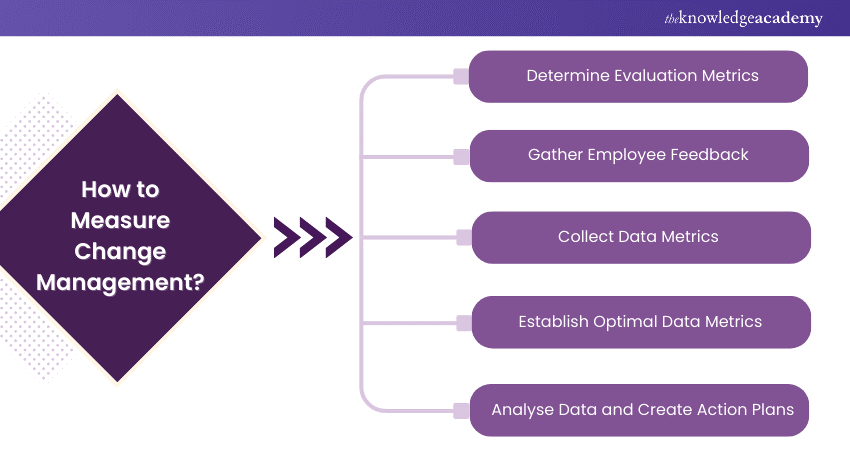
1) Determine Evaluation Metrics
The first step in measuring Change Management is to determine the evaluation metrics. These are the specific criteria that will be used to assess the effectiveness of the change initiative, often utilizing various change management tools.
Common metrics include project completion rates, employee engagement scores, and productivity levels. It is important to select metrics that are relevant to the specific goals of the change initiative.
2) Gather Employee Feedback
Employee feedback is a vital component of measuring Change Management. It provides insights into how the change is perceived by those who are directly affected by it. Surveys and interviews are common methods for gathering feedback. Change Management Interview Questions help understand how individuals adapt to change, offering valuable insights into the transition process.
This information helps identify areas of resistance, levels of understanding, and the overall sentiment towards the change.
3) Collect Data Metrics
Collecting data metrics involves tracking quantitative measures related to the change initiative. This can include data on project timelines, budget expenditures, and Key Performance Indicators (KPIs).
By collecting and analysing this data, organisations can gain a clearer picture of the progress and impact of the change.
4) Establish Optimal Data Metrics
Establishing optimal data metrics means identifying the most relevant and actionable metrics for your organisation. Not all metrics are equally valuable, so it is important to focus on those that provide the most meaningful insights.
This step involves prioritising metrics that align with the strategic objectives of the change initiative, and that can be reliably measured.
5) Analyse Data and Create Action Plans
The final step is to analyse the collected data and create action plans based on the findings. This involves looking for trends, identifying areas of success and areas needing improvement, and making informed decisions about the next steps. Action plans should be specific, actionable, and aligned with the overall goals of the change initiative.
Learn Change Management strategies with our Managing Organisational Change Effectively– Join today!
Conclusion
For those wondering How to Measure Change Management, these steps provide a comprehensive guide to ensure that your change initiatives are on the path to success. By understanding the importance of Change Management and following a systematic approach to measurement, organisations can navigate change more effectively. It involves not only addressing the technical and procedural elements but also ensuring that employees are adequately equipped and motivated to embrace the new direction. By incorporating Change Management Metrics into the process and focusing on the people side of change, organisations can achieve smoother transitions, reduce resistance, and enhance overall productivity and success.
Boost your Change Management skills with our Complete Change Management Assessments Training - Join today!
Frequently Asked Questions
What are the KPIs for Change Management?

KPIs for Change Management are specific metrics used to measure the effectiveness of change initiatives. Examples include project completion rates, employee engagement levels, and adherence to timelines and budgets.
What is the Scorecard for Change Management?
A scorecard for Change Management is a tool that tracks and reports the progress of change initiatives using various metrics. It helps organisations evaluate the success of their change efforts and identify areas for improvement.
What are the Other Resources and Offers Provided by The Knowledge Academy?
The Knowledge Academy takes global learning to new heights, offering over 3,000+ online courses across 490+ locations in 190+ countries. This expansive reach ensures accessibility and convenience for learners worldwide.
Alongside our diverse Online Course Catalogue, encompassing 19 major categories, we go the extra mile by providing a plethora of free educational Online Resources like Blogs, eBooks, Interview Questions and Videos. Tailoring learning experiences further, professionals can unlock greater value through a wide range of special discounts, seasonal deals, and Exclusive Offers.
What is the Knowledge Pass, and How Does it Work?
The Knowledge Academy’s Knowledge Pass, a prepaid voucher, adds another layer of flexibility, allowing course bookings over a 12-month period. Join us on a journey where education knows no bounds.
What are Related Courses and Blogs Provided by The Knowledge Academy?
The Knowledge Academy offers various Change Management Certification, including the Change Management Foundation Course, Change Management Practitioner Course and Risk Management for Change Training. These courses cater to different skill levels, providing comprehensive insights into the Enterprise Change Management.
Our Project Management Blogs cover a range of topics related to Change Management, offering valuable resources, best practices, and industry insights. Whether you are a beginner or looking to advance your Project Management skills, The Knowledge Academy's diverse courses and informative blogs have got you covered.

The Knowledge Academy


Global Training Provider
The Knowledge Academy is a world-leading provider of professional training courses, offering globally recognised qualifications across a wide range of subjects. With expert trainers, up-to-date course material, and flexible learning options, we aim to empower professionals and organisations to achieve their goals through continuous learning.

Upcoming Project Management Resources Batches & Dates
Date
 Change Management Foundation & Practitioner
Change Management Foundation & Practitioner
Sat 20th Jun 2026, Sun 21st Jun 2026
Change Management Foundation & Practitioner
Mon 29th Jun 2026
Change Management Foundation & Practitioner
Mon 6th Jul 2026
Change Management Foundation & Practitioner
Sat 11th Jul 2026, Sun 12th Jul 2026
Change Management Foundation & Practitioner
Mon 13th Jul 2026
Change Management Foundation & Practitioner
Mon 20th Jul 2026
Change Management Foundation & Practitioner
Sat 1st Aug 2026, Sun 2nd Aug 2026
Change Management Foundation & Practitioner
Mon 3rd Aug 2026
Change Management Foundation & Practitioner
Mon 10th Aug 2026
Change Management Foundation & Practitioner
Mon 17th Aug 2026
Change Management Foundation & Practitioner
Tue 1st Sep 2026
Change Management Foundation & Practitioner
Mon 7th Sep 2026
Change Management Foundation & Practitioner
Mon 14th Sep 2026
Change Management Foundation & Practitioner
Sat 19th Sep 2026, Sun 20th Sep 2026
Change Management Foundation & Practitioner
Mon 28th Sep 2026
Change Management Foundation & Practitioner
Mon 5th Oct 2026
Change Management Foundation & Practitioner
Mon 12th Oct 2026
Change Management Foundation & Practitioner
Sat 17th Oct 2026, Sun 18th Oct 2026
Change Management Foundation & Practitioner
Mon 19th Oct 2026
Change Management Foundation & Practitioner
Mon 2nd Nov 2026
Change Management Foundation & Practitioner
Mon 9th Nov 2026
Change Management Foundation & Practitioner
Sat 14th Nov 2026, Sun 15th Nov 2026
Change Management Foundation & Practitioner
Mon 16th Nov 2026
Change Management Foundation & Practitioner
Mon 30th Nov 2026
Change Management Foundation & Practitioner
Sat 5th Dec 2026, Sun 6th Dec 2026
Change Management Foundation & Practitioner
Mon 7th Dec 2026
Change Management Foundation & Practitioner
Mon 14th Dec 2026

 If you wish to make any changes to your course, please


