


 Top Rated Course

We may not have the course you’re looking for. If you enquire or give us a call on +34 932716793 and speak to our training experts, we may still be able to help with your training requirements.
Lean Six Sigma vs PMP: What’s the Difference?
William Brown 12 May 2026Dive into the comparison of Lean Six Sigma vs PMP. Gain a clear understanding of what Lean Six Sigma and PMP certifications entail. Explore the key differences, including their scope, methodology, tools, and focus on efficiency or quality. By the end, you'll be able to decide which certification aligns with your career goals.

Training Outcomes Within Your Budget!
We ensure quality, budget-alignment, and timely delivery by our expert instructors.
Table of Contents
In the world of Project Management, two certifications stand out: Lean Six Sigma and Project Management Professional (PMP). Each certification has its own unique approach and benefits, catering to different aspects of business. In this blog, we will expand on a detailed comparison of Lean Six Sigma vs PMP, helping you make a decision about which certification to pursue.
Table of Contents
1) What is Lean Six Sigma?
2) What is PMP?
3) Lean Six Sigma vs PMP: Key differences
a) Scope and application
b) Methodology and approach
c) Tools and techniques
d) Focus on efficiency vs focus on quality
4) Which certification should you choose?
5) Conclusion
What is Lean Six Sigma?
Lean Six Sigma is a methodology that seamlessly integrates the efficiency-focused principles of Lean with the quality-centric approach of Six Sigma. Rooted in data-driven decision-making, it strives to eliminate waste, enhance process flow, and minimise defects. Individuals with Lean Six Sigma Certification are highly sought after in various roles, including Lean Manager Jobs, where they can apply their expertise to drive process improvement initiatives.
By employing the structured DMAIC (Define, Measure, Analyse, Improve, Control) framework, the Lean Six Sigma Certification helps professionals optimise processes, boosts operational efficiency, and elevates product or service quality. This certification helps professionals empower organisations to achieve continuous improvement, increase customer satisfaction, and drive impactful, sustainable transformations across various industries and sectors.

Elevate your skills in Lean Six Sigma with our Lean Six Sigma Certification Training– join today for enhanced process excellence!
What is PMP?
The Project Management Professional (PMP) Certification stands as a prestigious credential in the realm of Project Management. PMP signifies a profound mastery of Project Management principles and practices. It equips professionals with a comprehensive skillset to lead projects successfully, encompassing diverse aspects like scope management, resource allocation, risk mitigation, and stakeholder engagement.
PMP-certified individuals navigate the intricacies of project lifecycles, ensuring projects are executed efficiently, within budget, and in alignment with business objectives. This certification empowers professionals across industries, enabling them to orchestrate projects with finesse, elevating their career prospects and contributing to organisational success.
Unlock your potential with our PMP® Training and excel in the art of Project Management
Lean Six Sigma vs PMP: Key differences
The dichotomy between the Lean Six Sigma Certification and the Project Management Professional (PMP) Certification remains a focal point of discussion. This section aims to dissect the intricacies of Lean Six Sigma and PMP, unravelling their distinctive attributes and enabling a comprehensive comparative analysis.
Scope and application
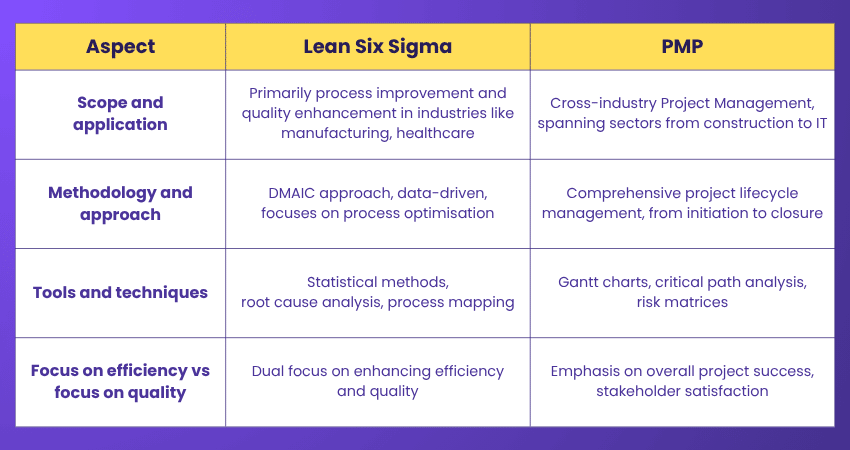
Lean Six Sigma and PMP cater to different spheres within the realm of Project Management and process enhancement. Lean Six Sigma primarily finds its footing in industries where process efficiency and quality improvement are paramount, such as manufacturing, healthcare, and finance.
Conversely, the PMP Certification transcends industry boundaries, serving as a guiding light for Project Managers in sectors spanning construction, IT, and marketing. Understanding the nature of your projects and the industry landscape can guide you in choosing the most relevant approach.
Methodology and approach
The Lean Six Sigma and PMP Certifications diverge significantly in their focus and approach. Lean Six Sigma hinges on a data-driven methodology, epitomi by the DMAIC framework, which involves meticulously analysing existing processes, identifying bottlenecks, and implementing solutions.
On the other hand, PMP adopts a holistic approach, encapsulating the entire project lifecycle – from initiation to closure. It equips professionals with a comprehensive toolkit to manage projects, embracing risk assessment, stakeholder engagement, and scope management effectively.
Tools and techniques
The tools and techniques championed by Lean Six Sigma and PMP Practitioners reflect their core objectives. Lean Six Sigma enthusiasts deploy statistical methods like root cause analysis, Pareto charts, and process mapping to uncover inefficiencies and enhance process flow.
Contrastingly, PMP professionals wield tools like Gantt Charts, critical path analysis, and risk matrices to ensure project timelines, allocate resources judiciously, and mitigate potential risks.
Build strong foundations in process improvement with Lean Six Sigma Yellow Belt Training – Sign up now!
Focus on efficiency vs focus on quality
One of the defining distinctions lies in the core emphasis of Lean Six Sigma on efficiency and quality improvement. This certification seeks to equip professionals to streamline processes, eliminate waste, and enhance customer satisfaction by reducing defects and variations.
In contrast, PMP places a paramount focus on overall project success. It encompasses the orchestration of resources, management of stakeholders, and adherence to project timelines and budgets, ultimately ensuring that project objectives are met with excellence.
Unlock the path to process excellence with our Lean Six Sigma Yellow Belt Training– join now!
Which certification should you choose?
The decision to embark on a journey with the Lean Six Sigma Certification or pursue the Project Management Professional (PMP) Certification is a pivotal choice that warrants careful consideration. Several factors come into play when determining which path aligns most harmoniously with your career aspirations, project preferences, and industry context.
Industry and career relevance
The first step in making this decision is to assess the industry landscape you find yourself in or aspire to join. Lean Six Sigma's strength lies in sectors where process efficiency and quality improvement are paramount, such as manufacturing, healthcare, and supply chain management.
On the other hand, the PMP Certification transcends industry boundaries, making it a coveted asset for professionals in fields ranging from construction and IT to marketing and finance. Understanding your industry's demands will guide you towards the methodology that holds greater relevance in your chosen domain.
Drive impactful process improvements with confidence by joining the Lean Six Sigma Green Belt Training now!
Project types and objectives
The nature of your projects plays a pivotal role in determining whether Lean Six Sigma or PMP aligns best with your career trajectory. If your inclination is towards delving deep into processes, identifying bottlenecks, and implementing data-driven solutions, the Lean Six Sigma Certification offers a tailored path.
Conversely, if orchestrating projects, managing resources, and ensuring project success resonate with you, the PMP Certification equips you with the tools to excel in these areas. Consider the projects you enjoy working on and those that resonate with your strengths when making this decision.
Personal career goals
An introspective evaluation of your personal career goals is crucial in steering your decision. If you're drawn towards becoming an expert in process improvement, enhancing quality, and being a catalyst for change within an organisation, Lean Six Sigma may be your calling.
Conversely, if your aspirations lie in spearheading projects, leading teams, and achieving project objectives within set constraints, Six Sigma vs PMP can help you determine whether PMP might be the compass guiding your professional journey. Aligning your career goals with the certification that resonates with your ambitions ensures a fulfilling and purpose-driven career path.
Learn Risk Management with this Program Management Professional (PgMP)® Certification - Join now!
Complementary or combined approach
It's worth noting that Lean Six Sigma and PMP are not mutually exclusive paths. In some cases, they can be complementary, enriching your skillset with a multifaceted approach. If you find yourself in a role that demands both quality improvement and Project Management skills, acquiring both certifications can set you apart as a versatile professional. This combined approach enables you to wield a broader spectrum of tools to tackle complex challenges, positioning you as an asset to any organisation.
Conclusion
Regardless of whether you lean towards process enhancement and quality with Lean Six Sigma or aspire to orchestrate projects with precision through PMP, both certifications promise valuable expertise. Understanding your industry, project preferences, and personal ambitions will guide you towards the path that resonates most with your unique strengths. Hope we could provide you with the detailed comparison of Lean Six Sigma vs PMP that you were looking for!
Unlock the power of Lean Six Sigma with our accredited Lean Six Sigma Black Belt Training – register now for enhanced process mastery and transformative results!
Frequently Asked Questions
How do Lean Six Sigma and PMP Differ in Career Outcomes?

Lean Six Sigma focuses on process improvement, helping professionals reduce waste and improve efficiency, making it ideal for operations roles. PMP focuses on managing projects successfully across scope, time, and cost, and opening opportunities in diverse Project Management roles across industries.
Which Certification is More Recognised Globally Lean Six Sigma or PMP?
Both Lean Six Sigma and PMP are globally recognised certifications but serve different goals. PMP is widely accepted as the standard for Project Management across industries, while Lean Six Sigma is highly valued for process improvement, quality control, and reducing defects in operations.
What are the Other Resources and Offers Provided by The Knowledge Academy?
The Knowledge Academy takes global learning to new heights, offering over 3,000+ online courses across 490+ locations in 190+ countries. This expansive reach ensures accessibility and convenience for learners worldwide.
Alongside our diverse Online Course Catalogue, encompassing 17 major categories, we go the extra mile by providing a plethora of free educational Online Resources like Blogs, eBooks, Interview Questions and Videos. Tailoring learning experiences further, professionals can unlock greater value through a wide range of special discounts, seasonal deals, and Exclusive Offers.
What is The Knowledge Pass, and How Does it Work?
The Knowledge Academy’s Knowledge Pass, a prepaid voucher, adds another layer of flexibility, allowing course bookings over a 12-month period. Join us on a journey where education knows no bounds.
What are the Related Courses and Blogs Provided by The Knowledge Academy?
The Knowledge Academy offers various Lean Six Sigma Certification, including the Lean Six Sigma Green Belt Training, Lean Six Sigma Black Belt Upgrade Training, and Lean Six Sigma Yellow Belt Training. These courses cater to different skill levels, providing comprehensive insights into Lean Process Improvement.
Our Business Improvement Blogs cover a range of topics related to Lean Six Sigma, offering valuable resources, best practices, and industry insights. Whether you are a beginner or looking to advance your Process Improvement skills, The Knowledge Academy's diverse courses and informative blogs have got you covered.

William Brown


Senior Business Analyst and Strategic Advisor
William Brown is a senior business analyst with over 15 years of experience driving process improvement and strategic transformation in complex business environments. He specialises in analysing operations, gathering requirements and delivering insights that support effective decision making. William’s practical approach helps bridge the gap between business goals and technical solutions.
View Detail
Upcoming Business Improvement Resources Batches & Dates
Date
 Lean Six Sigma Green Belt
Lean Six Sigma Green Belt
Mon 29th Jun 2026
Lean Six Sigma Green Belt
Mon 6th Jul 2026
Lean Six Sigma Green Belt
Mon 13th Jul 2026
Lean Six Sigma Green Belt
Mon 20th Jul 2026
Lean Six Sigma Green Belt
Mon 27th Jul 2026
Lean Six Sigma Green Belt
Mon 3rd Aug 2026
Lean Six Sigma Green Belt
Mon 10th Aug 2026
Lean Six Sigma Green Belt
Mon 17th Aug 2026
Lean Six Sigma Green Belt
Mon 24th Aug 2026
Lean Six Sigma Green Belt
Tue 1st Sep 2026
Lean Six Sigma Green Belt
Mon 7th Sep 2026
Lean Six Sigma Green Belt
Mon 14th Sep 2026
Lean Six Sigma Green Belt
Mon 21st Sep 2026
Lean Six Sigma Green Belt
Mon 28th Sep 2026
Lean Six Sigma Green Belt
Mon 5th Oct 2026
Lean Six Sigma Green Belt
Mon 12th Oct 2026
Lean Six Sigma Green Belt
Mon 19th Oct 2026
Lean Six Sigma Green Belt
Mon 26th Oct 2026
Lean Six Sigma Green Belt
Mon 2nd Nov 2026
Lean Six Sigma Green Belt
Mon 9th Nov 2026
Lean Six Sigma Green Belt
Mon 16th Nov 2026
Lean Six Sigma Green Belt
Mon 23rd Nov 2026
Lean Six Sigma Green Belt
Mon 30th Nov 2026
Lean Six Sigma Green Belt
Mon 7th Dec 2026
Lean Six Sigma Green Belt
Mon 14th Dec 2026
Lean Six Sigma Green Belt
Mon 21st Dec 2026
Lean Six Sigma Green Belt
Tue 29th Dec 2026

 If you wish to make any changes to your course, please


