


 Top Rated Course


We may not have the course you’re looking for. If you enquire or give us a call on +45 89870423 and speak to our training experts, we may still be able to help with your training requirements.
What is Day Trading? Everything You Need to Know
The Knowledge Academy 24 April 2026Day Trading is a strategy where Traders buy and sell stocks or currencies within a single day to profit from small price changes with careful risk control. Day Traders typically close all positions before the market closes to avoid overnight risks. High volatility can amplify both profits and losses, making it a high-risk activity.

Training Outcomes Within Your Budget!
We ensure quality, budget-alignment, and timely delivery by our expert instructors.
Table of Contents
Gone are the days when only those working for large institutions and brokerages could actively trade in the stock market. The advent of online trading has levelled the playing field and Day Trading currently stands as one of the most popular and exciting forms of investment. With just a laptop, an internet connection, and the right knowledge, anyone can now participate in the markets.
While Day Trading can transform into a lucrative career, it can be a big challenge for a beginner. If you are among those beginners, consider this blog your guiding light towards profitable Day Trading. So read on, gain a firm grasp on What is Day Trading and master this world driven by strategy, speed and sharp instincts!
Table of Contents
1) What is Day Trading?
2) How Does Day Trading Work?
3) How to Start Day Trading?
4) Strategies for Day Trading
5) Benefits of Day Trading
6) Drawbacks of Day Trading
7) Example of Day Trading
8) Is Day Trading Gambling?
9) Why is Day Trading so Hard?
10) Conclusion
What is Day Trading?
Day Trading is a short-term trading strategy where individuals buy and sell financial instruments such as stocks, currencies, options and futures within the same trading day. The aim is to profit from rapid price fluctuations rather than long-term growth.
Day Traders rely on different techniques, including studying price charts and patterns to forecast future movements and taking advantage of quick trends and reversals to secure fast profits. Day Traders prioritise short-term opportunities over fundamental valuations. They focus on speed, precision and timing to make their gains. Key aspects of Day Trading include:

1) Short-Term Trades
Day Traders open and close positions within the same trading day, avoiding overnight market risks. This approach allows them to react quickly to intraday price movements and take advantage of even the smallest fluctuations for potential profit.
2) Technical Analysis
They rely heavily on technical analysis, chart patterns, and real-time market data to make swift and informed decisions. Mastering these tools helps Traders identify precise entry and exit points, giving them an edge in fast-moving markets.
3) Leverage
Use of leverage to maximise potential returns, which also increases risk. While it can amplify gains, it can equally magnify losses, making effective Risk Management essential for long-term survival in volatile markets. Day trading demands a significant time commitment and a thorough understanding of market mechanics.
How Does Day Trading Work?
Day Trading thrives mainly in stock markets and the Foreign Exchange (forex) space, where Traders buy and sell assets within the same day to profit. Here are some key points to remember:
1) Successful Day Traders stay hyper-aware of events that trigger rapid price changes, often using news-based trading strategies to gain an edge.
2) Economic announcements, corporate earnings, and interest rate decisions are key catalysts that can significantly influence market sentiment.
3) When actual results exceed or fall short of expectations, markets react swiftly, often producing sharp price swings.
4) For example, a company beating earnings forecasts may see its stock price spike, while disappointing economic data can cause sudden currency drops.
5) Day Traders closely monitor these developments, interpret the implications in real time, and execute quick trades to capitalise on the volatility.
How to Start Day Trading?
Professional Day Traders are distinguished by their extensive market knowledge, established presence, and ability to earn a living through trading. You can reach this level by following these steps and utilising the rightDay Trading Platform to help you make informed decisions and execute trades efficiently.
1) Gain Lots of Market Knowledge and Experience
1) Jumping into Day Trading without a solid grasp of market fundamentals is a fast track to losses.
2) While technical analysis and chart reading are useful starting points, they can be misleading without a deeper understanding of how markets behave, and the risks involved.
3) It’s essential to research thoroughly and understand the nuances of the products you trade
4) Gain practical experience before committing significant capital.
2) Make Sure You Have Enough Capital
1) Smart Day Traders only risk money they can afford to lose.
2) This approach not only protects them from devastating losses but also helps keep emotions out of trading decisions.
3) Since intraday price changes are often small, having adequate capital allows Traders to make meaningful gains.
4) Those using margin accounts must be prepared for sudden market swings that can lead to margin calls, sometimes with little warning.
3) Learn Trading Discipline
1) Lack of discipline is one of the main reasons Day Traders fail.
2) The mantra “Plan the trade and trade the plan” is key.
3) Profitable Day Trading depends on volatility; identifying assets that make significant price moves throughout the day, whether due to earnings announcements, sentiment shifts or broader economic news.
4) Traders favour highly liquid stocks, which allow them to enter or exit positions quickly without drastically affecting prices.
5) Whether buying on upward movement or shorting on a decline, disciplined execution is what separates successful Traders from impulsive ones.
Invest in knowledge before you invest in stocks. Our Stock Trading Course will help you out - Sign up now!
Strategies for Day Trading
Strategies are the moves you make on the financial floor, and here are the key ones
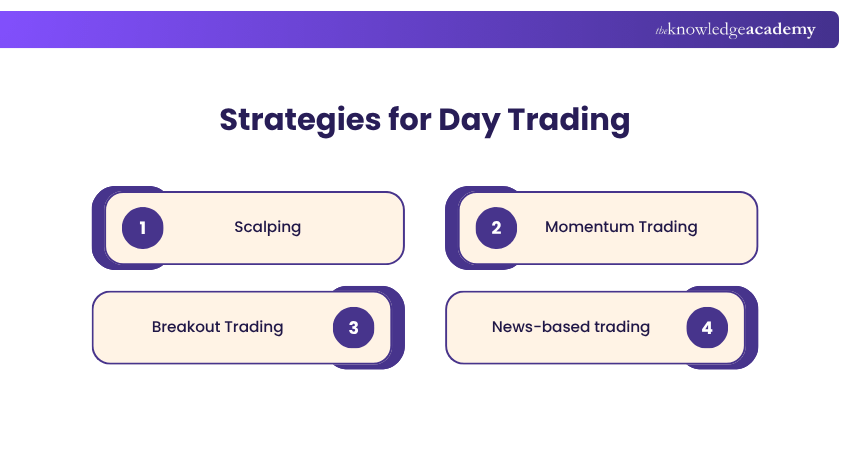
1) Scalping
This strategy focuses on capturing numerous small, quick gains from short-lived price movements that occur throughout the trading day. Traders make frequent trades with the goal of accumulating steady profits over time. A specialised form of scalping is arbitrage, where Traders exploit temporary pricing discrepancies in the market to generate quick, low-risk returns.
2) Momentum Trading
Momentum Traders follow trends and the 'bigger, the better' philosophy. When stocks surge, they hop on, hoping the momentum will carry them to profit. They rely on strong volume and rapid price movement to sustain the trend. Quick decision-making is key here, as momentum can shift suddenly, turning profitable trades into losses if not managed carefully.
3) Breakout Trading
Think of Breakout Traders as surfers who wait for that perfect wave of stocks to build up in the financial ocean. They ride the moment a stock breaks through a resistance level. This strategy depends on identifying consolidation zones and timing entries precisely. Breakout Traders often use stop-losses to protect against false breakouts that can quickly reverse direction.
4) News-based trading
This approach capitalises on the surges in market volatility that occur when major news breaks. Traders react quickly to events such as economic announcements, corporate updates or geopolitical developments to exploit short-term price movements. A common example involves trading around a merger or acquisition announcement, by speculating on whether the deal will proceed and positioning accordingly.
Decode market signals and make winning decisions in real time with Binary Options. Sign up for our Binary Options Trading Training now!
Benefits of Day Trading
Day Trading offers countless benefits, making it one of the most viable forms of Investment. Here are the advantages of it:
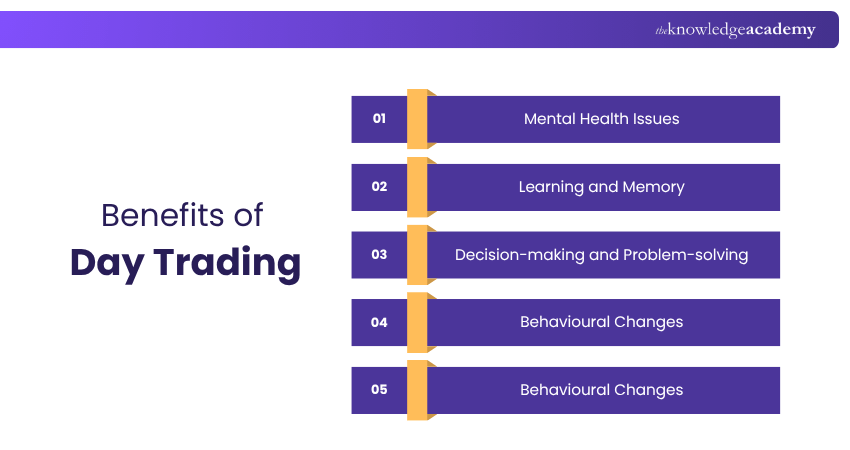
1) Potential for Quick Profits
As a Day Trader, every decision you make is like a roll of the dice. If your trades go well, you can rake in fast profits. Just remember, it’s also aboutRisk Management and keeping your emotions in check.
2) Easy Access
Gone are the days of shouting orders on a crowded trading floor. Modern brokerage platforms let you day trade from the comfort of your home office. Set up your trading station, fire up your laptop, and get going!
3) Not Boring
Unlike usual boring buy-and-hold strategies, Day Trading is like a rollercoaster ride through the stock market. You’ll research, analyse, and pounce on opportunities as fast as possible. It's clearly more impressive to double your money in a single day as opposed to accomplishing the same in 2 years.
4) No Overnight Risk
While regular investors toss and turn, Day Traders sleep soundly. That's because they close out all their positions before the market closes. Day Traders dodge that risk, while regular investors fear losing money if something happens overnight when they aren’t available to perform the trade.
5) Work for Yourself
Imagine being your own boss, setting your own hours, and answering only to your trading instincts. Some pros make a living from Day Trading, turning their passion into a full-time gig. Just remember, it takes discipline, strategy, and nerves of steel.
Drawbacks of Day Trading
While the probability of fast short-term returns is high in Day Trading, as discussed in analyses of the Pros and Cons of Day Trading, the risks are extremely high as well. Here are some of the downsides to this form of investment:
1) High Probability of Losses
Day Trading is like betting on stocks. If your decisions go south, your account balance can nosedive quicker than regular investors. Without proper strategy and Risk Management, even a few bad trades can wipe out a large portion of your capital.
2) Fees and Taxes
Although trading costs have decreased over time, fees are still associated with specific trades, particularly at high volumes. Additionally, Day Traders face higher taxes compared to regular investors. If you sell an investment that you’ve owned for less than a year, you’ll be subject to a higher tax rate for short-term capital gains, as opposed to the long-term capital gains rate.
3) High Stress
Markets move fast, and seeing your balance swing up and down can be stressful (especially if your trades aren’t working out). Worst case scenario, Day Trading can become an addiction, straining your health and relationships.
4) Time-consuming and Challenging
Day Trading isn’t a part-time gig; it’s a full-time commitment. Not only do Day Traders spend hours tracking and making trades, but they also need to research the market and strategies. It’s an enormous challenge to make money while competing with other investors, including seasoned professionals who work for major financial institutions.
5) Deep Pockets Required
In the US, FINRA requires traders to maintain at least $25,000 in their brokerage account to day trade frequently. While this rule does not apply in the UK, traders still need significant capital to manage risks effectively.
Trade globally, profit locally. Start your Trading journey with our Forex Trading Course - Register now!
Example of Day Trading
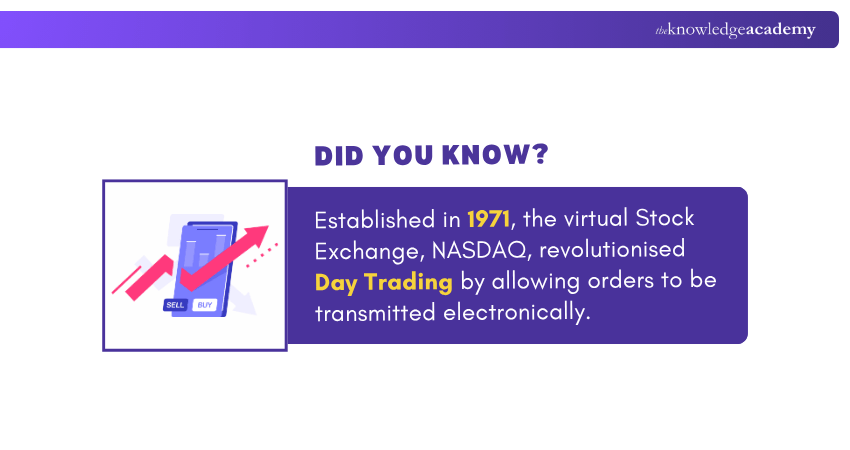
The only difference between a day trade and other forms of stock trade is that both purchase and sale of a stock occur within the same day. It can even occur within seconds of each other.
Let’s consider an example: A Day Trader has completed a technical analysis of a company This analysis indicates that this stock (Listed in the Nasdaq 100) shows a pattern of price rise by at least 0.6% on majority of the days when the Nasdaq is up by more than 0.4%. The Trader has reason to believe that this is his chance to make some quick profit.
a) The Trader buys 1,000 shares of the company when the market opens
b) Then the Trader waits until the company reaches a particular price point, probably up 0.6%.
c) The Trader then immediately sells the entire holding in the company.
This is a day trade. Please remember that the merits of this specific company as an investment have little to do with the Day Trader's actions. It’s simply a case of a trend being exploited, as highlighted in many Day Trading Books that explain how Traders capitalise on short-term market movements.
In case the company had bucked the trend and lost say 0.8%, the Trader would have sold anyway and taken the loss.
Is Day Trading Gambling?
Once you understand What is Day Trading, you may see that it shares some similarities with gambling but it’s not the same thing. Day Trading allows for skill, strategy, analysis, and Risk Management, whereas gambling usually relies more on chance.
However, without discipline and strategy, it can easily slide into gambling-like behaviour. So, Day Trading can resemble gambling if done recklessly but properly executed it’s more about skill and control than pure luck.
Why is Day Trading so Hard?
Day Trading is challenging for several reasons:
1) Emotional and Psychological Control: You must manage fear, greed and stress while making split-second decisions.
2) High Technical Demands: You need deep knowledge of charts, indicators and market mechanics.
3) Intense Competition and High Failure Rates: Most Traders lose money. The markets are zero-sum in many respects, and costs, slippage and latency eat into the margins.
4) Capital and Risk Constraints: Small price movements and margin calls make it difficult to scale profits without risking large losses.
Conclusion
Day Trading is not just about quick profits; it’s about strategy and understanding the rhythm of the markets. For beginners, mastering the basics of What is Day Trading is the first step toward navigating this fast-paced world with confidence. With the right knowledge, Risk Management and mindset, Day Trading can open doors to exciting financial opportunities.
Chart your path to wealth with our comprehensive Investment and Trading Training – Register now!
Frequently Asked Questions
How Much does a Day Trader Make?

Day Traders typically don’t earn a fixed salary. Their income depends on how much capital they trade, their strategy, and profitability.
How Many Hours a Day is Day Trading?
Most independent Day Traders work two to five hours per day. Many spend additional time practising through simulated or demo trades before transitioning to live trading.
What are the Other Resources and Offers provided by The Knowledge Academy?
The Knowledge Academy takes global learning to new heights, offering over 3,000+ online courses across 490+ locations in 190+ countries. This expansive reach ensures accessibility and convenience for learners worldwide.
Alongside our diverse Online Course Catalogue, encompassing 19 major categories, we go the extra mile by providing a plethora of free educational Online Resources like Blogs, eBooks, Interview Questions and Videos. Tailoring learning experiences further, professionals can unlock greater value through a wide range of special discounts, seasonal deals, and Exclusive Offers.
What is The Knowledge Pass, and How Does it Work?
The Knowledge Academy’s Knowledge Pass, a prepaid voucher, adds another layer of flexibility, allowing course bookings over a 12-month period. Join us on a journey where education knows no bounds.
What are the Related Courses and Blogs Provided by The Knowledge Academy?
The Knowledge Academy offers various Investment and Trading Training, including the Real Estate Financial Modelling Training, Day Trading Course and the Binary Options Trading Training. These courses cater to different skill levels, providing comprehensive insights into Bull Market.
Our Business Skills Blogs cover a range of topics related to Day Trading, offering valuable resources, best practices, and industry insights. Whether you are a beginner or looking to advance your Trading skills, The Knowledge Academy's diverse courses and informative blogs have got you covered.

The Knowledge Academy


Global Training Provider
The Knowledge Academy is a world-leading provider of professional training courses, offering globally recognised qualifications across a wide range of subjects. With expert trainers, up-to-date course material, and flexible learning options, we aim to empower professionals and organisations to achieve their goals through continuous learning.


 If you wish to make any changes to your course, please


