


 Top Rated Course

We may not have the course you’re looking for. If you enquire or give us a call on +49 8000101090 and speak to our training experts, we may still be able to help with your training requirements.
What is PMP Process Chart? - A Complete Guide
The Knowledge Academy 20 April 2026This blog expands on the PMP Process Charts, including the process of creating and memorising the Process Charts, Project Management knowledge areas and more.

Training Outcomes Within Your Budget!
We ensure quality, budget-alignment, and timely delivery by our expert instructors.
Table of Contents
PMP Process ChartIf you have searched online for PMP Process chart or Knowledge Areas, you surely have completed reading a few pages of the Project Management Body of Knowledge (PMBOK) Guide. Well, if you want to gain an in-depth understanding of PMP Process Charts, you’re at the right place. This blog will help you understand everything related to Project Management processes, Process Charts, and Project Management Knowledge Areas.
If you are up for the PMP exam preparation, understanding the PMP Process Chart is crucial to passing the exam. Reading this blog will help you understand PMP Process Charts and Knowledge areas required to excel in the PMP Exam. Preparing a PMP Process Chart is also essential for delivering successful projects and bringing value to the organisation. Thereby, making it even more important for PMP aspirants to learn about PMP Process Charts.
Table of Contents
1) What is PMP Process Chart?
2) What are the Project Management Processes?
3) How to create and memorise the PMP Process Chart?
4) This is how your Process Chart Should look like
5) What are the five PMBOK Phases or Process Groups of Project Management?
6) The 10 Project Management Knowledge Areas
7) The difference between PMBOK Knowledge Areas and Process Groups
8) Conclusion
What is PMP Process Chart?
PMP Process Chart is an essential tool for anyone who aims to complete their task without any obstacles. This Chart provides a visual representation of the Project Management Processes.
The Process Chart illustrates how various activities in the project lifecycle are interconnected to each other. The activity flow helps understand the relationship between the components and how essential it is to finish the project. The Project Management Institute (PMI) has been a pioneer in helping organisations worldwide enhance their Project Management expertise. Additionally, PMI developed the Process Chart in order to help Project Management Professionals deliver successful projects efficiently.

What are the Project Management Processes?
In the PMBOK Guide, Processes are described as a set of actions performed to develop a product or service n the form of a project. Project Management processes ensure the appropriate flow of the project activities throughout its completion.
The Pros and Cons of PMP include understanding the structure of the PMBOK Guide, which is divided into ten parts, with each part covering a specific Knowledge Area. This guide outlines 49 processes, each associated with a particular Knowledge Area, and categorizes them within a corresponding Process Group.
Start your preparation from here – sign up for the Introduction to Project Management course!
How to create and memorise the PMP Process Chart?
Each part of the PMBOK Guide expands on each Knowledge Area in the Process Chart. Hence, it would help if you memorised the chart for the exam. Let's discuss how we can remember this:
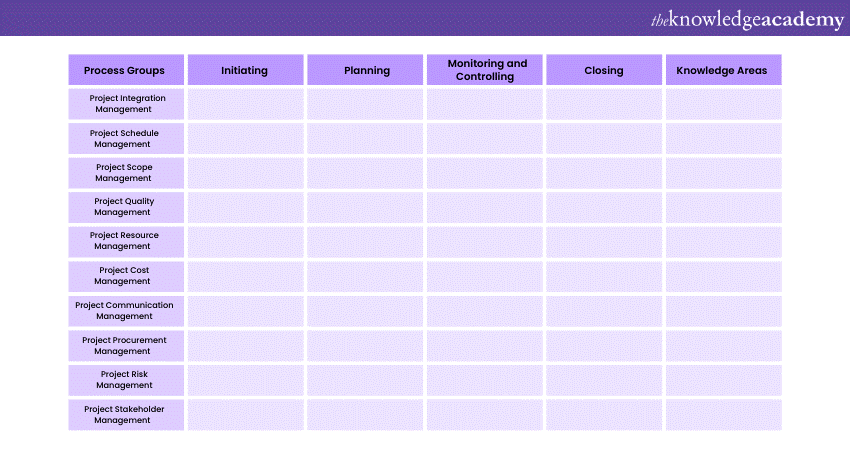
Stage 1: Start by drawing a 6X11 chart.
Draw a table with 11 rows and 6 columns to develop the Process Chart.
Stage 2: Then move on to writing your Process Groups and Knowledge Areas
On the top-most row, write down all 5phases of project management – Initiating, Planning, Executing, Monitoring and Controlling, and Closing
Use this short sentence to remember the Process Groups easily – “In Paris Emily May Cry Constantly”.
In the first column, list the ten Knowledge Areas.
The ten Knowledge Areas are –
a) Project Integration Management
b) Project Scope Management
c) Project Schedule Management
d) Project Cost Management
e) Project Quality Management
f) Project Resources Management
g) Project Communications Management
h) Project Risk Management
i) Project Procurement Management
j) Project Stakeholders Management
Use this short sentence to remember the 10 Knowledge Areas easily – I Saw Two Crows Quietly Relishing Coffee and Reading Poetic Songs.
Now your PMP Process matrix should look something like this:
Stage 3: Now fill these corners.
Fill these four processes in the Process Chart:
1) Developing the Project charter
2) Identifying Stakeholders
3) Closing the Project
4) Closing Procurement
This is how it will look after this stage:
|
Process Groups |
Initiating |
Planning |
Monitoring and Controlling |
Closing |
Knowledge Areas |
|
Project Integration Management |
Developing Project charter |
|
|
|
Closing the Project |
|
Project Scope Management |
|
|
|
|
|
|
Project Schedule Management |
|
|
|
|
|
|
Project Cost Management |
|
|
|
|
|
|
Project Quality Management |
|
|
|
|
|
|
Project Resource Management |
|
|
|
|
|
|
Project Communication Management |
|
|
|
|
|
|
Project Risk Management |
|
|
|
|
|
|
Project Procurement Management |
|
|
|
|
Closing Procurement |
|
Project Stakeholder Management |
|
Identifying Stakeholders |
|
|
Stage 4: There are 10 processes that begin with the word “Planning,” and they all fall in the Planning Process Group.
1) Planning Scope Management
2) Planning Schedule Management
3) Planning Cost Management
4) Planning Quality Management
5) Planning Resource Management
6) Planning Communication Management
7) Planning Risk Management
8) Planning Risk Responses
9) Planning Procurement
10) Planning Stakeholder Management
|
Process Groups |
Initiating |
Planning |
Monitoring and Controlling |
Closing |
Knowledge Areas |
|
Project Integration Management |
Developing Project charter |
Developing Project Management Plan |
|
|
Closing the Project |
|
Project Scope Management |
|
Plan Scope Management |
|
|
|
|
Project Schedule Management |
|
Planning Schedule Management |
|
|
|
|
Project Cost Management |
|
Planning Cost Management |
|
|
|
|
Project Quality Management |
|
Planning Quality Management |
|
|
|
|
Project Resource Management |
|
Planning Resource Management |
|
|
|
|
Project Communication Management |
|
Planning Communications Management |
|
|
|
|
Project Risk Management |
|
Planning Risk Management |
|
|
|
|
Project Procurement Management |
|
Planning Procurement Management |
|
|
Closing Procurement |
|
Project Stakeholder Management |
|
Identifying Stakeholders |
Planning Stakeholder management |
|
Stage 5: Next stage is to fill in the "Estimate" processes into the Planning Process Group in the same way you did in stage 4. It is filled in at the intersection of the Planning Process Group and the Schedule Management Knowledge Area.
|
Process Groups |
Initiating |
Planning |
Monitoring and Controlling |
Closing |
Knowledge Areas |
|
Project Integration Management |
Developing Project charter |
Developing Project Management Plan |
|
|
Closing the Project |
|
Project Scope Management |
|
Plan Scope Management |
|
|
|
|
Project Schedule Management |
|
Planning Schedule Management |
|
|
|
|
Project Cost Management |
|
Planning Cost Management |
|
Frequently Asked Questions

The Knowledge Academy


Global Training Provider
The Knowledge Academy is a world-leading provider of professional training courses, offering globally recognised qualifications across a wide range of subjects. With expert trainers, up-to-date course material, and flexible learning options, we aim to empower professionals and organisations to achieve their goals through continuous learning.

Upcoming Project Management Resources Batches & Dates
Date
 PMP® Certification Training Course
PMP® Certification Training Course
Mon 15th Jun 2026
PMP® Certification Training Course
Sat 20th Jun 2026, Sun 21st Jun 2026
PMP® Certification Training Course
Mon 22nd Jun 2026
PMP® Certification Training Course
Mon 29th Jun 2026
PMP® Certification Training Course
Sat 4th Jul 2026, Sun 5th Jul 2026
PMP® Certification Training Course
Mon 6th Jul 2026
PMP® Certification Training Course
Mon 13th Jul 2026
PMP® Certification Training Course
Sat 18th Jul 2026, Sun 19th Jul 2026
PMP® Certification Training Course
Mon 20th Jul 2026
PMP® Certification Training Course
Mon 27th Jul 2026
PMP® Certification Training Course
Sat 1st Aug 2026, Sun 2nd Aug 2026
PMP® Certification Training Course
Mon 3rd Aug 2026
PMP® Certification Training Course
Mon 10th Aug 2026
PMP® Certification Training Course
Mon 17th Aug 2026
PMP® Certification Training Course
Sat 22nd Aug 2026, Sun 23rd Aug 2026
PMP® Certification Training Course
Mon 24th Aug 2026
PMP® Certification Training Course
Tue 1st Sep 2026
PMP® Certification Training Course
Sat 5th Sep 2026, Sun 6th Sep 2026
PMP® Certification Training Course
Mon 7th Sep 2026
PMP® Certification Training Course
Mon 14th Sep 2026
PMP® Certification Training Course
Sat 19th Sep 2026, Sun 20th Sep 2026
PMP® Certification Training Course
Mon 21st Sep 2026
PMP® Certification Training Course
Mon 28th Sep 2026
PMP® Certification Training Course
Sat 3rd Oct 2026, Sun 4th Oct 2026
PMP® Certification Training Course
Mon 5th Oct 2026
PMP® Certification Training Course
Mon 12th Oct 2026
PMP® Certification Training Course
Sat 17th Oct 2026, Sun 18th Oct 2026
PMP® Certification Training Course
Mon 19th Oct 2026
PMP® Certification Training Course
Mon 26th Oct 2026
PMP® Certification Training Course
Mon 2nd Nov 2026
PMP® Certification Training Course
Sat 7th Nov 2026, Sun 8th Nov 2026
PMP® Certification Training Course
Mon 9th Nov 2026
PMP® Certification Training Course
Mon 16th Nov 2026
PMP® Certification Training Course
Sat 21st Nov 2026, Sun 22nd Nov 2026
PMP® Certification Training Course
Mon 23rd Nov 2026
PMP® Certification Training Course
Mon 30th Nov 2026
PMP® Certification Training Course
Mon 7th Dec 2026
PMP® Certification Training Course
Sat 12th Dec 2026, Sun 13th Dec 2026
PMP® Certification Training Course
Mon 14th Dec 2026
PMP® Certification Training Course
Mon 21st Dec 2026

 If you wish to make any changes to your course, please


