


 Top Rated Course

We may not have the course you’re looking for. If you enquire or give us a call on +420 210012971 and speak to our training experts, we may still be able to help with your training requirements.
The 7 Processes of PRINCE2
Grace Mitchell 10 June 2026PRINCE2 Processes include seven steps: initiating, directing, controlling, managing product delivery, handling boundaries, and closing the project. These structured processes help ensure clarity, control, and consistency, making project delivery more efficient, goal-focused, and aligned with organisational objectives.

Training Outcomes Within Your Budget!
We ensure quality, budget-alignment, and timely delivery by our expert instructors.
Table of Contents

Ever tried juggling tasks, deadlines, and team expectations all at once? It can feel overwhelming. That’s where PRINCE2 Processes come in providing a clear, step-by-step path to follow. Rather than guessing what comes next, you always have a structured roadmap, ensuring nothing is missed and everything is aligned.
From the initial idea to the final handover, each stage in the PRINCE2 Processes is carefully designed to keep your project organised and on track. It’s not just about completing tasks; it’s about achieving meaningful results with control and purpose. In this blog, we’ll walk you through the seven phases of the PRINCE2 Process, helping you understand how each step contributes to project success.
Table of Contents
1) What are the 7 PRINCE2 Processes?
a) PRINCE2 Processes Phase 1: Starting up a Project
b) PRINCE2 Processes Phase 2: Directing a Project
c) PRINCE2 Processes Phase 3: Initiating a Project
d) PRINCE2 Processes Phase 4: Controlling a Stage
e) PRINCE2 Processes Phase 5: Managing Product Delivery
f) PRINCE2 Processes Phase 6: Managing a Stage Boundaries
g) PRINCE2 Processes Phase 7: Closing a Project
2) What are the Four Pillars of PRINCE2?
3) Why is the PRINCE2 Process Important in Project Management?
4) Conclusion
What are the 7 PRINCE2 Processes?
The 7 PRINCE2 Processes offer a clear framework for managing projects from beginning to end. Each step defines key actions, responsibilities, and decisions to ensure successful delivery.
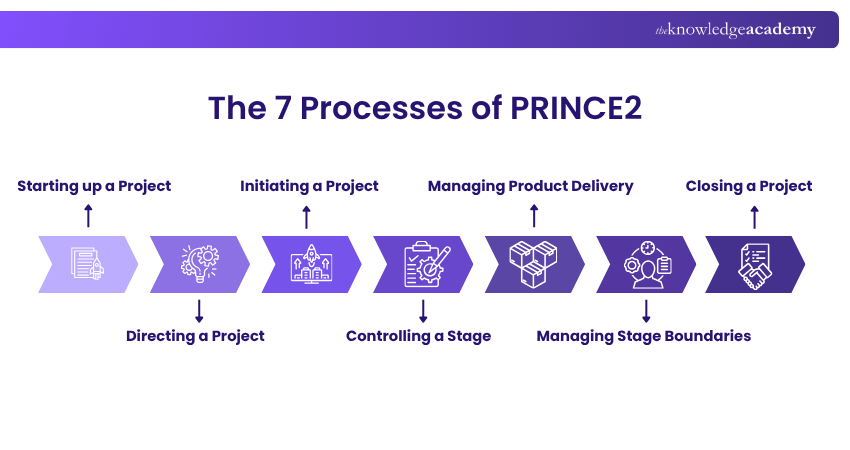
These are the Seven Different Processes of PRINCE2:
A PRINCE2-qualified Project Manager can manage Projects in a better way by utilising the power of the PRINCE2 Process. These processes are divided into seven phases to make it easier to manage Projects. In this section, you will learn the Seven Processes of PRINCE2 and how to implement them. These seven PRINCE2 Processes are listed below:
1) Starting up a Project
2) Directing a Project
3) Initiating a Project
4) Controlling a Stage
5) Managing Product Delivery
6) Managing Stage Boundaries
7) Closing a Project
PRINCE2 Processes Phase 1: Starting up a Project
The "Starting Up a Project" phase lays the foundation for a successful PRINCE2 project. It ensures that the basic requirements for initiating a project are in place before committing significant time or resources. This phase is about answering one key question: Does this project have a viable and worthwhile business case?
During this phase, the project’s executive and Project Manager are appointed, the project brief is prepared, and lessons from previous projects are reviewed. Key elements like the outline business case, possible risks, and project approach are explored. The goal is to confirm that the project is aligned with business objectives and has a solid framework to move forward with confidence in the initiation phase.
PRINCE2 Processes Phase 2: Directing a Project
The Directing a Project phase involves the project board and focuses on making key decisions throughout the project’s lifecycle. While the Project Manager handles day-to-day tasks, the board provides strategic oversight, ensuring the project remains aligned with business goals.
This process ensures there is clear direction at key points authorising the project to start, approving each stage, responding to any major issues, and confirming project closure. It helps maintain control without micromanaging, enabling timely interventions when necessary. The board’s involvement ensures accountability and supports informed decision-making throughout the project.
Learn how to combine PRINCE2 methodology with Agile techniques effectively. Join our PRINCE2 Agile® Practitioner (Version 2) Course today!
PRINCE2 Processes Phase 3: Initiating a Project
The Initiating a Project phase is where detailed planning begins. It builds on the foundation set during the startup phase and ensures that the project has a clear direction, well-defined scope, and a solid business case before work begins.
Key documents like the Project Initiation Documentation (PID) are prepared, covering plans, risks, quality, and communication. This gives the project board the clarity needed to approve the project and ensures everyone understands the project's direction and controls.
Enhance your project skills with PRINCE2 Case Studies!
PRINCE2 Processes Phase 4: Controlling a Stage
The Controlling a Stage phase focuses on the Project Manager’s role in managing each stage of the project. It ensures work is carried out as planned, progress is monitored, and any risks or issues are dealt with swiftly to keep the project on track.
Key tasks include authorising and reviewing work packages, tracking progress through reports, and managing problems as they arise. The Project Manager also provides regular updates to the project board, enabling quick decision-making. This process is repeated in every stage, helping maintain control and alignment with overall project goals.
Attain global recognition as a qualified Agile Project Manager with PRINCE2 Agile® Foundation (Version2) Training – Register today!
PRINCE2 Processes Phase 5: Managing Product Delivery
The Managing Product Delivery phase focuses on the team manager's role in ensuring that project deliverables are created and delivered as specified. It is the bridge between the Project Manager and the team, ensuring that work packages are understood, executed, and completed efficiently.
In this phase, the team manager accepts work packages, executes the tasks, and delivers the completed products back to the Project Manager. This process ensures that the products meet quality standards and are delivered on time, supporting smooth progression through the project's stages.
PRINCE2 Processes Phase 6: Managing a Stage Boundaries
The Managing Stage Boundaries phase helps the Project Manager evaluate the current stage's performance and plan for the next one. It provides the project board with comprehensive information to decide whether the project should continue, change direction, or stop.
During this phase, the team reviews achievements, updates the project plan and business case, and develops a detailed plan for the next stage. If the project deviates from expectations, an exception plan is created. This process maintains project control and ensures alignment with overall objectives.
PRINCE2 Processes Phase 7: Closing a Project
The Closing a Project phase ensures that the project wraps up in an organised and controlled way. It confirms that all work is completed, products are delivered, and the project meets its objectives. This phase also captures lessons learned to help future projects.
Key activities include confirming that all project work is finished, handing over the final products to the customer, evaluating the project's performance, and documenting any lessons learned. This structured closure helps ensure that nothing is left incomplete and that valuable insights are recorded for future reference.
Learn how to integrate Agile frameworks with PRINCE2 effectively with PRINCE2 Agile® Foundation and Practitioner (Version 2) Course – Join today!
What are the Five Pillars of PRINCE2?
PRINCE2 7 is built around five integrated elements: Principles, People, Practices, Processes, and Project Context. These elements work together to provide a structured, flexible, and people-focused approach to Project Management. The Principles guide how every PRINCE2 project should be managed, while the People element focuses on those involved in or affected by the project.

Together, these five integrated elements help organisations manage projects with better structure, control, collaboration, and adaptability. They ensure that PRINCE2 can be applied effectively across different industries, project types, and working environments while keeping business objectives and people at the centre. PRINCE2 7 introduced the People element and refers to Themes as Practices.
Why is the PRINCE2 Process Important in Project Management?
The PRINCE2 process offers a clear, step-by-step structure that guides a project from initiation to completion. It ensures that each phase, starting up, directing, controlling, and closing the project, is handled with defined responsibilities, documentation, and decision-making checkpoints. This structure reduces uncertainty, prevents scope creep, and improves communication among stakeholders.
By following the PRINCE2 process, Project Managers can maintain control over timelines, budgets, risks, and resources. It promotes accountability, ensures continuous business justification, and supports informed decision-making at every stage. This makes the process vital for delivering successful projects that align with organisational goals and stakeholder expectations.
Conclusion
PRINCE2 Processes provide a clear, structured path for managing projects with confidence and control. From start to finish, each stage ensures better planning, accountability, and results. By following these processes, teams stay aligned, risks are managed, and success becomes far more achievable.
Understand PRINCE2® processes to manage and deliver projects efficiently with PRINCE2® Foundation & Practitioner Training – Join now!
Frequently Asked Questions
What is the PRINCE2 Quality Process?

In PRINCE2, the quality process ensures that all project deliverables meet set standards and stakeholder expectations.
1) Define Quality Criteria: Set clear, measurable standards
2) Quality Planning: Plan how quality will be achieved
3) Quality Control: Monitor and evaluate outputs
4) Quality Assurance: Provide confidence to stakeholders
What is Process Flow PRINCE2?
The PRINCE2 process flow outlines seven key steps to guide a project from start to end:
1) Starting Up: Check project viability
2) Directing: Provide strategic direction
3) Initiating: Plan and set controls
4) Controlling a Stage: Monitor progress
5) Product Delivery: Ensure quality outputs
6) Stage Boundary: Review and plan next steps
7) Closing: Confirm completion and evaluate
What are the Other Resources and Offers Provided by The Knowledge Academy?
The Knowledge Academy takes global learning to new heights, offering over 3,000+ online courses across 490+ locations in 190+ countries. This expansive reach ensures accessibility and convenience for learners worldwide.
Alongside our diverse Online Course Catalogue, encompassing 17 major categories, we go the extra mile by providing a plethora of free educational Online Resources like Blogs, eBooks, Interview Questions and Videos. Tailoring learning experiences further, professionals can unlock greater value through a wide range of special discounts, seasonal deals, and Exclusive Offers.
What is The Knowledge Pass, and How Does it Work?
The Knowledge Academy’s Knowledge Pass, a prepaid voucher, adds another layer of flexibility, allowing course bookings over a 12-month period. Join us on a journey where education knows no bounds.
What are the Related Courses and Blogs Provided by The Knowledge Academy?
The Knowledge Academy offers various PRINCE2® Training, including the PRINCE2® Foundation & Practitioner Training Course, PRINCE2 Agile® Foundation and Practitioner (Version 2) Course, and PRINCE2 Agile® Foundation (Version 2) Training. These courses cater to different skill levels, providing comprehensive insights into PRINCE2 Principles.
Our Project Management Blogs cover a range of topics related to PRINCE2®, offering valuable resources, best practices, and industry insights. Whether you are a beginner or looking to advance your Project Management skills, The Knowledge Academy's diverse courses and informative blogs have got you covered.

Grace Mitchell


Senior Project Management Consultant and Author
Grace Mitchell is a highly experienced project management professional with over 15 years of expertise in leading large-scale projects across industries, including construction, IT, and finance. With qualifications in PRINCE2®, PMP®, AgilePM®, and MSP®, Grace specialises in delivering complex programmes with precision and clarity. Her writing is grounded in real-world application and focuses on helping learners build confidence in project delivery and stakeholder management.
View Detail
Upcoming Project Management Resources Batches & Dates
Date
 PRINCE2® Foundation & Practitioner Training Course
PRINCE2® Foundation & Practitioner Training Course
Mon 29th Jun 2026
PRINCE2® Foundation & Practitioner Training Course
Mon 6th Jul 2026
PRINCE2® Foundation & Practitioner Training Course
Sat 11th Jul 2026, Sun 12th Jul 2026
PRINCE2® Foundation & Practitioner Training Course
Mon 13th Jul 2026
PRINCE2® Foundation & Practitioner Training Course
Mon 20th Jul 2026
PRINCE2® Foundation & Practitioner Training Course
Mon 27th Jul 2026
PRINCE2® Foundation & Practitioner Training Course
Mon 3rd Aug 2026
PRINCE2® Foundation & Practitioner Training Course
Mon 10th Aug 2026
PRINCE2® Foundation & Practitioner Training Course
Mon 17th Aug 2026
PRINCE2® Foundation & Practitioner Training Course
Sat 22nd Aug 2026, Sun 23rd Aug 2026
PRINCE2® Foundation & Practitioner Training Course
Mon 24th Aug 2026
PRINCE2® Foundation & Practitioner Training Course
Tue 1st Sep 2026
PRINCE2® Foundation & Practitioner Training Course
Mon 7th Sep 2026
PRINCE2® Foundation & Practitioner Training Course
Sat 12th Sep 2026, Sun 13th Sep 2026
PRINCE2® Foundation & Practitioner Training Course
Mon 14th Sep 2026
PRINCE2® Foundation & Practitioner Training Course
Mon 21st Sep 2026
PRINCE2® Foundation & Practitioner Training Course
Mon 28th Sep 2026
PRINCE2® Foundation & Practitioner Training Course
Mon 5th Oct 2026
PRINCE2® Foundation & Practitioner Training Course
Mon 12th Oct 2026
PRINCE2® Foundation & Practitioner Training Course
Sat 17th Oct 2026, Sun 18th Oct 2026
PRINCE2® Foundation & Practitioner Training Course
Mon 19th Oct 2026
PRINCE2® Foundation & Practitioner Training Course
Mon 26th Oct 2026
PRINCE2® Foundation & Practitioner Training Course
Mon 2nd Nov 2026
PRINCE2® Foundation & Practitioner Training Course
Mon 9th Nov 2026
PRINCE2® Foundation & Practitioner Training Course
Sat 14th Nov 2026, Sun 15th Nov 2026
PRINCE2® Foundation & Practitioner Training Course
Mon 16th Nov 2026
PRINCE2® Foundation & Practitioner Training Course
Mon 23rd Nov 2026
PRINCE2® Foundation & Practitioner Training Course
Mon 30th Nov 2026
PRINCE2® Foundation & Practitioner Training Course
Sat 5th Dec 2026, Sun 6th Dec 2026
PRINCE2® Foundation & Practitioner Training Course
Mon 7th Dec 2026
PRINCE2® Foundation & Practitioner Training Course
Mon 14th Dec 2026
PRINCE2® Foundation & Practitioner Training Course
Mon 21st Dec 2026

 If you wish to make any changes to your course, please


