


 Top Rated Course

We may not have the course you’re looking for. If you enquire or give us a call on +420 210012971 and speak to our training experts, we may still be able to help with your training requirements.
Data Aggregation Process Methods and Key Benefits
Lily Turner 12 May 2026Data Aggregation is the process of collecting and summarising data from multiple sources to provide a unified view for analysis, reporting, or decision-making. These are usually presented in forms like charts, tables, etc., aiming at simplicity and accurate detailing. Understand your targeted audience better with your aggregated research.

Training Outcomes Within Your Budget!
We ensure quality, budget-alignment, and timely delivery by our expert instructors.
Table of Contents
Imagine you have a pile of researched data on your table, and you have to convert it into some sort of statistical data. You might feel lost, not knowing where to start or even how to do it. What if this blog says that it has a secret to make your work quicker and accurate in the calculations? It sounds fantastic, right?
Yes, the secret that the blog is referring to is Data Aggregation and let’s get into What is Data Aggregation to begin your work!
Table of Contents
1) What is Data Aggregation?
2) The Importance of Data Aggregation
3) Types of Data Aggregation
4) Key Stages of the Data Aggregation Process
5) Benefits of Data Aggregation
6) Practical Applications of Data Aggregation
7) Top Data Aggregation Tools
8) Real-world Examples of Data Aggregation
9) Conclusion
What is Data Aggregation?
Data Aggregation refers to the combined process of collecting, analysing and compiling data. It collects raw data from multiple sources, analyses it and then compiles or presents them in a unified and summarised format for statistical view. This process can be done both manually and systematically using certain tools.

The Importance of Data Aggregation
Think about if a company needs data on how many people are showing up regularly for your different Type of Social Event, you need a statistical analysis for that. Luckily, the work will be easy-peasy with the help of Data Aggregation procedures. These are the incidences where the importance of Data Aggregation stands out.
It helps to gain insights upon the responses of your audience or customers with simplified and easily understandable formats. These results will aid you in making informed decisions and being aware of what is going well and what isn’t with your services or products. Eventually, you can identify the current trends and tune your efficiency.
Types of Data Aggregation
Data Aggregation can be done for varied intentions, focusing on different elements or factors. Depending upon the output of the aggregation, it has been classified into the following types:
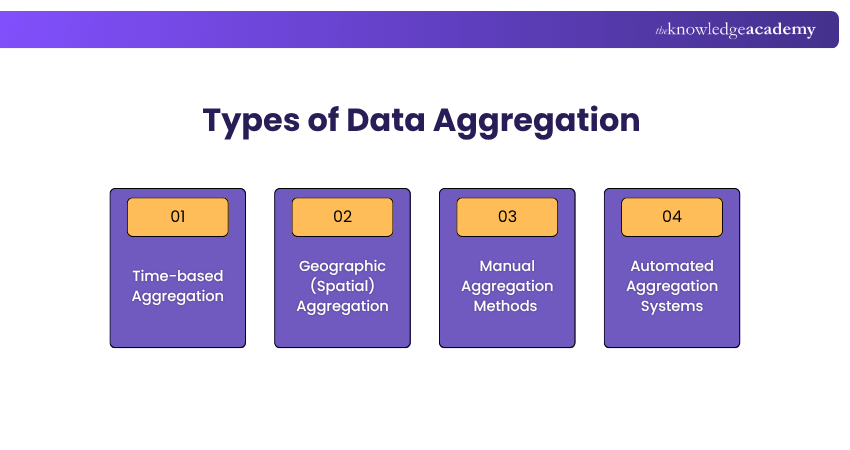
1) Time-based Aggregation
Time-based Aggregation analyses data over a specific period of time. It could be done on an hourly, daily, weekly, monthly, or yearly basis. The collected data is converted into a statistical format for deep insights. It helps to know when you are ranking higher and when it is seasonal.
Tip: As an example, you can consider the data on how many people searched for your business over the last 15 days.
2) Geographic (Spatial) Aggregation
Geographic or Spatial aggregation involves collecting and analyzing data from different physical or virtual locations to assess performance across regions. This helps identify strong and weak markets, enabling location-specific strategies and better resource allocation.
Tip: For example, think of collecting how many stores are advertising your brand from a certain locality or place.
3) Manual Aggregation Methods
The process of collecting and summarising the data manually, without the aid of any software tool is Manual Aggregation Method. It involves manual preparation of statistics, employing spreadsheets and databases.
Tip: As an instance, you can consider the preparation of average marks of your students for all the subjects of their curriculum.
4) Automated Aggregation Systems
Automated Aggregation Systems involves the collection and organisation of data into single form with the help of software. It doesn’t require any manual aid. All works are done by the software itself.
Tip: Think you’re using Zoho Analytics, which is a Data Aggregation tool, coding in which format the result should appear to get your work done.
Key Stages of the Data Aggregation Process
Data Aggregation involves three key stages. Those include the following:

1) Data Collection and Loading
The primary step in Data Aggregation is the process of collection of required data. In this step, you will be collecting all the necessary raw data which is stored in multiple sources. Once it is done, you need to store those particular data in a single repository.
2) Processing Raw Data
Once the data is collected and stored in a single repository, the next step is analysing it to remove the duplicate, invalid or irrelevant data to secure only the required and necessary data.
3) Summarising Information
With accurate and applicable data, the final step of summarisation is proceeded. This step processes the data into a readable format like charts, tables, reports, or any form of representations for your analysis.
Benefits of Data Aggregation
Data Aggregation has numerus benefits in all sectors. Be it the educational field, a company, a government sector, or a Non-Governmental Organisation (NGO), its presence is inevitable. Let's learn what its benefits are.
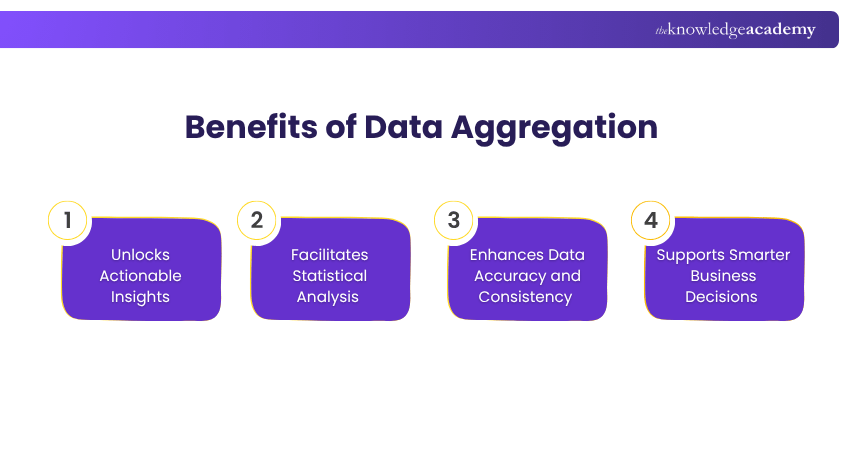
1) Unlocks Actionable Insights
One of the major benefits of Data Aggregation includes its capability to provide insights that help you in deciding what needs to be done or changed. It simplifies complex details into easily understandable formats.
2) Facilitates Statistical Analysis
The main motto of exploring Data Aggregation is to perform statistical analyses. These analyses build the foundation of knowing how you have been performing. It helps to know what the areas you excel in are with discovered trends.
3) Enhances Data Accuracy and Consistency
Data Aggregation does some cleaning jobs to neglect unwanted data. This ensures that accurate data is held for analysis.
Enhance your Data Visualisation methods with our Data Science Analytics Course - Register immediately!
4) Supports Smarter Business Decisions
With the support of Data Aggregation, you can foresee the big picture you can attain if you are making effective strategies. It provides you with the trends, patterns, and the time period when you were best performing to enhance yourself.
Practical Applications of Data Aggregation
There are multiple real-life applications of Data Aggregation. Here are some of those examples:
1) Analytics in Healthcare
In healthcare, statistical analysis is used in day-to-day life. To document the patients’ details, to list out the common issues that people are reaching out to the doctors, the number of people walking into the hospital, and to count the blood banks, etc. With the aggregated data, doctors will learn what the trends are and how much it has been witnessed among the people.
Tip: For instance, the statistical picture of how many births with normal as well as cesarean witnessed on a particular day would fit in.
2) Customer Grouping and Segmentation
For companies, their customers are their backbone. In such cases, you need to understand their needs and preferences. For that, you can read all their minds through their data and aggregate them in a comfortable format. It will give insights into which category people show their interest and you can plan on attracting every one of them.
Tip: Consider that women of age between 20 and 25 are buying lot of travel bags, you can boost your marketing strategy and introduce some new bags which are travel friendly and comfortable to attract those people.
3) Monitoring Sales Performance
Data Aggregation also plays a vital part in monitoring your sales. You can check your statistical data to track and identify your sales performance. It helps you to find the areas that will actually scale up your sales.
Tip: Data on how many people bought your recent product will help you determine the sales.
Are you planning to implement a Big Data Approach to your business? Register for our Big Data Analysis Course to widen your strategy!
Top Data Aggregation Tools
It’s time for you to know some of the top Data Aggregation tools that you can consider using:
1) Stata
Stata as a Data Aggregation tool designed to do research in fields like Data Science, Sociology, Economics, Epidemiology, Finance and so on. You can create customisable tables and reports with Stata.
2) Salesforce
Salesforce offers a wide range of applications to handle sales, marketing, customer support, and analytics. It will help you in monitoring your performance, improvements, and provides insights into your businesses progress. It is basically Customer Relationship Management (CRM) software, especially cloud-based software.
3) Google Looker
Looker, being an extended family of Google, is a free tool that provides analysis of your cloud-stored data into visualisation statistics. The best part about Looker is that it is easily accessible to everyone from your company.
4) Sisense
Sisense is software that is used to analyse and organise data from various sources in the form of reports and dashboards.
5) Zoho Analytics
Zoho Analytics helps you create and analyse reports from multiple data sources. It is a form of a Business Intelligence (BI) and analytics tool. These analyses are easily accessible for anyone to create and share reports with.
6) MongoDB
MongoDB is a kind of document database that is used to combine data from varied sources into a single platform. It is free of cost, and it is capable of supporting and managing multiple operating systems.
7) Alteryx
Alteryx focuses on quick preparation of visualised analytical data for data input. It combines data analytics, data science, and business process automation to make data analysis more accessible.
8) Microsoft Excel
Microsoft Excel is one of the tools that dates back very long in its usage. It has been a saviour for many people to organise and analyse the data. It is a spreadsheet application which allows you to do certain functions to get an analytical outcome.
Become familiar with the tools and features of MS Excel for data analysis by joining our Data Analysis Training Using MS Excel today!
9) DbVisualizer
Database Visualizer or DbVisualizer is used to visualise your data into statistical formats. It is a versatile tool for developers and people who need analytical research to manage and analyse their data.
10) GoSpotCheck
GoSpotCheck has been mainly useful for real-time analysis of data and helps you to have instant insights. It is also available as a mobile application so that you can use it anywhere and anytime you want.
11) IBM Cloud Pak for Data
IBM Cloud Pak for Data has tools for managing, analysing, integrating and governing the data with the foundation of AI. It is one of the services offered by IBM Software Hub.
12) Repsly Mobile CRM
Repsly Mobile CRM helps in having customer details, real-time insights into your performance and where you’re standing among other competitors. It collects and organises data to enhance brand visibility and sales.
13) Cloudera Distribution for Hadoop (CDH)
Cloudera Distribution for Hadoop (CDH) is an open-source tool used to do analysis for enterprise level. It stores, manages, and gives insights for large databases.
Real-world Examples of Data Aggregation
Want to know a few real-world examples of Data Aggregation? Read along!
1) Financial Services
1) Aids to understand economic trends, potential risks, and fraud
2) Helps to check the performance of investment portfolios
2) Social Media Platforms
1) Able to know about user engagement and interactions
2) Helps in identifying recent trends and tuning your content
3) E-Commerce Websites
1) Could track sales trends and customer responses
2) Helps to enhance your marketing strategy
4) Travel and Hospitality Industry
1) Helps to track the prices and customer feedback
2) Easy to understand the seasonal trends and attractive offers
Conclusion
In this blog, we hope that you have explored what Data Aggregation is, its steps, types, and some of the top applications for your future needs. Now, you are good to grab your sources where you have stored the data and select one of the Data Aggregation tools which works for you to get the insights for it.
Acquaint yourself with the probability and statistics of data through our Probability and Statistics for Data Science Training - Sign up now!
Frequently Asked Questions
What is the Difference Between Data Collection and Aggregation?

Data collection is the process of collecting data from various sources. Whereas Data Aggregation is the process that involves certain procedures to unify the collected data into a single source.
Does Aggregation Mean Collection?
Yes, aggregation might mean collection since the process of aggregation involves the collection of data. Collection refers to gathering raw data. It is the initial step where raw data is gathered from various sources like sensors, surveys, databases, or user interactions.
What are the Other Resources and Offers Provided by The Knowledge Academy?
The Knowledge Academy takes global learning to new heights, offering over 3,000 online courses across 490+ locations in 190+ countries. This expansive reach ensures accessibility and convenience for learners worldwide.
Alongside our diverse Online Course Catalogue, encompassing 19 major categories, we go the extra mile by providing a plethora of free educational Online Resources like News updates, Blogs, videos, webinars, and interview questions. Tailoring learning experiences further, professionals can maximise value with customisable Course Bundles of TKA.
What is The Knowledge Pass, and How Does it Work?
The Knowledge Academy’s Knowledge Pass, a prepaid voucher, adds another layer of flexibility, allowing course bookings over a 12-month period. Join us on a journey where education knows no bounds.
What are the Related Courses and Blogs Provided by The Knowledge Academy?
The Knowledge Academy offers various Big Data and Analytics Training, including SAS (Statistical Analysis System) Training, Data Analysis Training Using MS Excel, and Data Science Analytics Training. These courses cater to different skill levels, providing comprehensive insights into Data Analysis.
Our Data, Analytics & AI Blogs cover a range of topics related to Data Aggregation, offering valuable resources, best practices, and industry insights. Whether you are a beginner or looking to advance your Data and Analytical skills, The Knowledge Academy's diverse courses and informative blogs have got you covered.

Lily Turner


Senior AI/ML Engineer and Data Science Author
Lily Turner is a data science professional with over 10 years of experience in artificial intelligence, machine learning, and big data analytics. Her work bridges academic research and industry innovation, with a focus on solving real-world problems using data-driven approaches. Lily’s content empowers aspiring data scientists to build practical, scalable models using the latest tools and techniques.
View Detail
Upcoming Data, Analytics & AI Resources Batches & Dates
Date
 SAS (Statistical Analysis System) Training
SAS (Statistical Analysis System) Training
Thu 24th Sep 2026
SAS (Statistical Analysis System) Training
Thu 17th Dec 2026

 If you wish to make any changes to your course, please


