


 Top Rated Course

We may not have the course you’re looking for. If you enquire or give us a call on +420 210012971 and speak to our training experts, we may still be able to help with your training requirements.
What is a 3D Printed House? Process, Costs, and Examples
Richard Harris 24 February 2026A 3D Printed House is built using large-scale 3D printers that layer concrete or composite materials step by step based on a digital design. This innovative construction method reduces waste, speeds up building time, lowers costs, and promotes sustainable, affordable housing solutions worldwide. Read to learn more!

Training Outcomes Within Your Budget!
We ensure quality, budget-alignment, and timely delivery by our expert instructors.
Table of Contents
Imagine replacing the traditional process of constructing a residential home with workers, mortar, and bricks with a robotic arm precisely layering material, much like frosting on a cake. This is theinnovationconcept of 3D printed houses. Instead of the noisy and time-consuming construction sites we’re used to, homes are now being created through advanced printing technology. But What is A 3D Printed House? It is far more than just a structure; it represents a complete redefinition of how we design and build homes.
Well, it should be obvious to anyone that What is a 3D Printed House is exactly what it sounds like, a house that has been 3D printed. It is now a form of innovative architectural genius that can build homes using the internet connected 3D printers that are sustainable, flexible and affordable at record breaking speed. Let’s explore!
Table of Contents
1) What is a 3D Printed House?
2) How Are 3D-Printed Houses Built?
3) Benefits of 3D Printed Houses
4) 3D Printed Houses Examples
5) Challenge of 3D Printed Houses
6) Will 3D-printed Houses Become Common in the Future?
7) Conclusion
What is a 3D Printed House?
A 3D Printed House is a house constructed by additive manufacturing technology where a large-scale 3D printer places layers of materials such as concrete or composites to form a structure out of a digital model. This method saves time, money and materials, as well as offers the builder the flexibility he needs in order to optimise the use of resources during the construction phase.
This construction strategy is said to be cost-effective, sustainable and efficient in meeting the demands of the housing deficit in the world. Combining efficiency and durability and allowing for a reduction of waste when constructing homes, 3D-printed houses have the potential to offer sustainable living to underprivileged people and rebuilding houses after natural disasters where necessary.

How Are 3D-Printed Houses Built?
Building a 3D Printed House is a fascinating process that combines technology, precision, and innovation. The following are the key steps involved in bringing a 3D Printed House to life:
1) Design and Planning:
It begins with the conceptual digital model of the house that is to be designed with the help of the designing software only. They provide dimensions, features of the architecture, and detailed guidelines regarding the layering on the printer.
2) Site Preparation:
The construction site is developed to make a flat surface on which the foundation and subsequent print can be made. Services like plumbing and electrical work are sometimes designed simultaneously.
3) Printer Setup:
A large 3D printer is transported to the site and installed. These printers could exist on robotic arms or gantry systems to enact the layering of material with adequate precision to the intended shape.
4) Printing Process:
a) The printer dispenses material (which may be cementitious material) in a step-by-step manner, depending on the needs of the program.
b) Whole walls, columns, beams, and some of the design elements are constructed this way, leaving less room for conventional masonry and frame construction.
5) Finishing Touches:
After the outer structure is in place, conventional construction techniques are employed to fit the opaque doors and windows, the roofing, the plumbing and the electrical works among others.
6) Sustainability Considerations:
Most of the 3D Printed Houses use green materials and methods in construction; they can be regarded as an innovative modern building practice.
Benefits of 3D Printed Houses
3D Printed Houses bring innovation, efficiency, and sustainability to modern construction, offering advantages that traditional methods struggle to match. Here are some benefits:
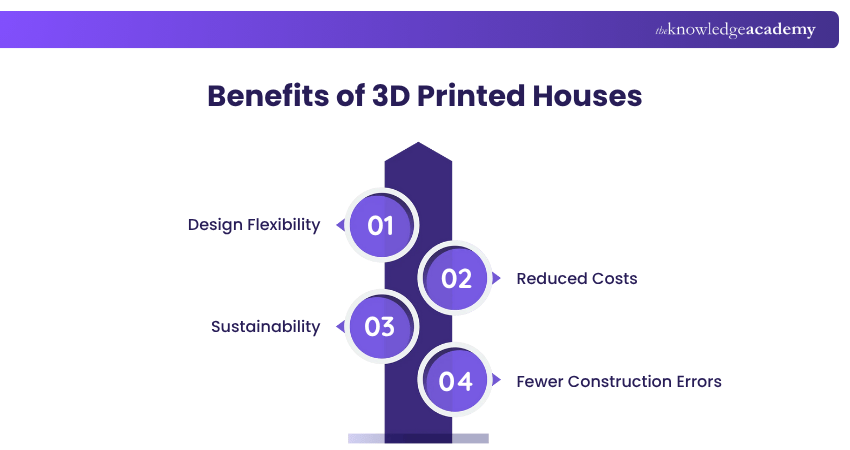
Design Flexibility
3D Printing allows architects to create complex, curved, or customised designs with ease. This flexibility supports creative architectural expression while maintaining precision and structural integrity that would be difficult to achieve using conventional methods.
Reduced Costs
Automated printing reduces labour needs, material waste, and overall construction time. With accurate material deposition and minimal manual intervention, 3D printed houses can be built more affordably while maintaining high-quality standards.
Sustainability
3D Printed construction uses only the required amount of materials, minimising waste and promoting eco-friendly building practices. Many 3D printing mixes can also incorporate recycled or locally sourced materials, supporting greener and more sustainable housing solutions.
Fewer Construction Errors
Since the printing process follows a digital model, human error is significantly reduced. Each layer is precisely placed by the printer, ensuring consistent quality, accuracy, and structural strength throughout the building process.
Learn architectural precision technique with our Architectural Design And Animation In Blender Training – Join now!
3D Printed Houses Examples
Discussed below are a few examples of 3D Printed Houses.
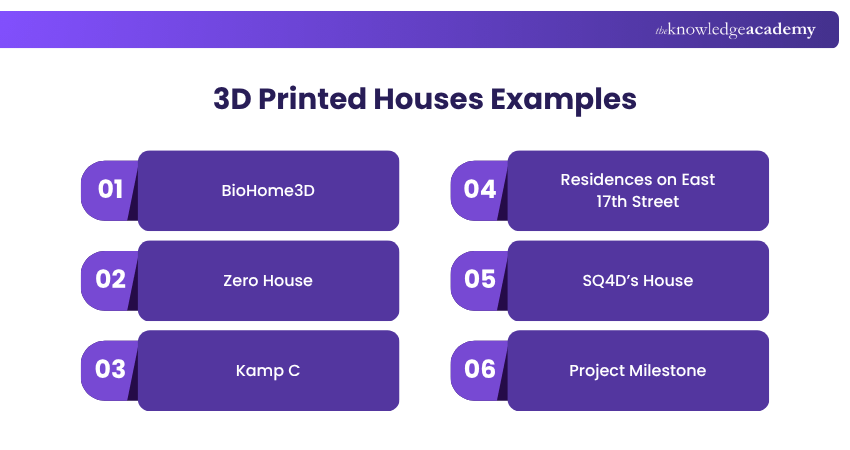
1) BioHome3D
The University of Maine Advanced Structures and Composites Center uses 3D Printing Technology to construct housing structures using bio-resins and wood fibres. This initiative aims to address labour shortages and increase access to affordable housing. The demonstration project, named BioHome3D, kicks off with a 600-square-foot prototype featuring fully 3D Printed flooring and roofing.
The entire one-bedroom, one-bathroom structure is made from 100% recyclable materials, focusing on biodegradability, including the use of wood flour. As a prototype, BioHome3D is equipped with monitoring sensors that measure thermal, environmental, and structural factors, providing valuable resilience-based data to enhance future design considerations.
2) Zero House
The Zero House is a groundbreaking example of a 3D Printed House designed with a focus on sustainability. This innovative dwelling aims to achieve zero net energy consumption, producing as much energy as it uses. The house incorporates renewable energy sources, such as solar panels, and energy-efficient systems to minimise its environmental impact.
What makes the Zero House unique is its commitment to using eco-friendly materials and advanced technologies to create a home that is both energy-responsible and environmentally friendly. This project is an inspiring model for future sustainable housing, demonstrating how 3D Printing can contribute to a greener and more efficient approach to residential construction.
3) Kamp C
Kamp C is a remarkable initiative focusing on sustainable and innovative construction. Located in Belgium, it's a centre for sustainability and circular economy in construction. Kamp C has gained attention for its commitment to eco-friendly building practices. The centre explores cutting-edge technologies like 3D Printing to create sustainable housing solutions.
Focusing on reducing environmental impact, Kamp C aims to inspire and educate the construction industry on adopting greener practices. The projects at Kamp C often serve as practical examples of how sustainable materials and techniques can be integrated into construction. It also emphasises promoting a more environmentally friendly and energy-efficient approach to building homes and structures.
4) Residences on East 17th Street
The Residences on East 17th Street stand as a pioneering example of 3D Printed Housing, illustrating the transformative potential of this technology in urban living. Situated in a bustling urban environment, these residences showcase the seamless integration of modern design and construction techniques. The project not only underscores the adaptability of 3D Printing to diverse settings but also highlights advancements in sustainable urban development.
Focusing on functionality and aesthetics, the Residences on East 17th Street contribute to the evolution of urban architecture. This innovative approach not only addresses housing needs but also sets a precedent for future urban projects, demonstrating the capability of 3D Printing to create aesthetically pleasing, sustainable, and efficiently constructed residential space.
Unlock your creativity with Animation and Design Training. Sign up now to master the art of visual storytelling and bring your ideas to life!
5) SQ4D’s House
SQ4D’s House is one of the earliest large-scale examples of 3D printed residential construction, featuring three bedrooms, two bathrooms, and an open floor plan built entirely using automated technology.
The house demonstrates how additive manufacturing can deliver both design flexibility and robust structural strength. Its walls are made of high-strength mortar, nearly a third stronger than standard concrete block structures.
Designed to provide long-term durability in moderate climates, the project showcases how 3D printing can outperform traditional wood-frame methods in efficiency and resilience.
Offering an affordable alternative to conventional housing, SQ4D’s home highlights the potential of automated construction to reduce costs, cut labour needs, and help address the ongoing challenge of affordable housing globally.
6) Project Milestone
Project Milestone is an innovative series of five 3D printed homes located in Eindhoven, Netherlands, with the first completed in 2021. Each home demonstrates architectural freedom through curved and layered designs that traditional construction cannot easily replicate. Unlike on-site printed buildings, these homes were printed off-site, transported, and assembled with minimal supervision.
Only a few technicians monitored the process, reducing labour requirements while maintaining accuracy and safety. The boulder-shaped design complements the surrounding natural landscape, blending aesthetics with engineering precision.
Additional safety measures, such as mechanical interlocks and reinforced wall connectors, ensure stability and durability. Project Milestone illustrates how 3D printing merges creative design, sustainability, and structural integrity within modern European housing developments.
Elevate your design skills with Blender 3D Modelling for Unity Training – Unlock the power of creativity and seamlessly integrate your creations into the Unity platform!
Challenge of 3D Printed Houses
While 3D Printed Houses offer speed, efficiency, and innovation, several challenges still limit their widespread adoption in modern construction.
1) Technological and Material Limitations
3D Printed Housing still faces technological and material challenges that restrict scalability, durability, and the quality of construction outcomes.
1) Printer Size Constraints: Current printers cannot easily produce multi-storey or large-scale structures, limiting architectural potential.
2) Material Limitations: Few building materials meet the strength and flexibility standards required for reliable 3D printing.
3) Performance Variation: Printed concrete quality often depends on print orientation, complicating consistency in mechanical performance.
2) Regulatory and Legal Barriers
Building regulations and approval processes have not yet adapted to 3D printing, slowing project implementation and innovation adoption.
1) Outdated Building Codes: Existing codes for traditional construction delay approval for 3D printed homes in many regions.
2) Lack of Safety Standards: Authorities still need specific safety and environmental benchmarks for printed structures.
3) Lengthy Approval Periods: Project authorisation can take years due to the absence of defined legal frameworks.
3) Visualising the Market Potential
Understanding the market for 3D printed housing requires data-driven insights to assess growth, cost efficiency, and sustainability benefits.
1) Market Growth Projections: Reports from Verified Market Research highlight steady expansion in 3D housing across global markets.
2) Cost Efficiency: ICON’s data shows significant reductions in material waste and total construction costs.
3) Data Visualisation: Charts and infographics comparing market trends and cost breakdowns enhance understanding of the industry’s potential.
Will 3D-printed Houses Become Common in the Future?
The housing industry is transforming, with 3D Printed Homes driving innovation, sustainability, and affordability. The global market is expected to grow from $36.82 million in 2022 to $1055.1 million by 2030. Supported by sustainable initiatives and projects like Dubai’s goal of 25% 3D printed buildings by 2030, this technology is redefining modern housing worldwide.
Conclusion
3D Printed House represents a paradigm shift in construction, fusing technology and architecture to redefine how we build homes. From enhanced design possibilities to sustainability, this innovative approach opens doors to a more efficient and customised future of housing, marking a transformative chapter in the evolution of construction practices. Hope you now have a better understanding of the subject.
Unlock your creative potential with Blender Creator Training- Join now for a journey into the world of animation and design.
Frequently Asked Questions
Are 3D-Printed Homes More Affordable Than Modular or Prefab Houses?

Yes, 3D printed homes are generally more affordable due to reduced labour, material efficiency, and faster construction times. They can cost up to 30–50% less than modular or prefab houses while maintaining durability and design flexibility.
What Is the Lifespan of the Materials Used in 3D-Printed Homes?
3D printed homes typically use high-strength concrete or mortar with a lifespan of 75 to 100 years. These materials are durable, weather-resistant, and designed to withstand environmental conditions similar to traditional concrete structures.
What are the Other Resources and Offers Provided by The Knowledge Academy?
The Knowledge Academy takes global learning to new heights, offering over 3,000+ online courses across 490+ locations in 190+ countries. This expansive reach ensures accessibility and convenience for learners worldwide.
Alongside our diverse Online Course Catalogue, encompassing 17 major categories, we go the extra mile by providing a plethora of free educational Online Resources like Blogs, eBooks, Interview Questions and Videos. Tailoring learning experiences further, professionals can unlock greater value through a wide range of special discounts, seasonal deals, and Exclusive Offers.
What is The Knowledge Pass, and How Does it Work?
The Knowledge Academy’s Knowledge Pass, a prepaid voucher, adds another layer of flexibility, allowing course bookings over a 12-month period. Join us on a journey where education knows no bounds.
What are the Related Courses and Blogs Provided by The Knowledge Academy?
The Knowledge Academy offers various Animation and Design Training, including the Animation Course, CorelDRAW Training and the Drawing Course. These courses cater to different skill levels, providing comprehensive insights into SketchUp Tools for 3D Design.
Our Office Applications Blogs cover a range of topics related to Designing and Creativity, offering valuable resources, best practices, and industry insights. Whether you are a beginner or looking to advance your Designing skills, The Knowledge Academy's diverse courses and informative blogs have got you covered.

Richard Harris


Senior Full Stack Developer and Technology Educator
Richard Harris is a highly experienced full-stack developer with deep expertise in both frontend and backend technologies. Over his 12-year career, he has built scalable web applications for startups, enterprises and government organisations. Richard’s writing combines technical depth with clear explanations, ideal for developers looking to grow in modern frameworks and tools.

Upcoming Office Applications Resources Batches & Dates
Date
 3D Printing Course
3D Printing Course
Fri 24th Apr 2026
3D Printing Course
Fri 31st Jul 2026
3D Printing Course
Fri 30th Oct 2026

 If you wish to make any changes to your course, please


