


We may not have the course you’re looking for. If you enquire or give us a call on +1 7204454674 and speak to our training experts, we may still be able to help with your training requirements.
ISO 27001 Roles and Responsibilities Explained
ByThe Knowledge AcademyLast updated on: 18 November 2026
ISO 27001 involves more than security policies and technical controls. Explore the key roles involved in implementing and maintaining information security, their key duties and why clearly defined roles are important.
At a Glance
1. ISO 27001 requires organisations to assign and communicate information security responsibilities.2. Risk Owners oversee assigned risks, while Control Owners help ensure security measures operate effectively.3. Information Security Managers and ISMS Managers coordinate security activities and management system processes.4. Internal Auditors assess ISMS conformity and effectiveness while maintaining objectivity and impartiality.
A security system is only as effective as the people responsible for maintaining it. Even the strongest security controls can become ineffective when responsibilities are unclear, risks are not properly managed or essential procedures are overlooked.
That's why clearly defined ISO 27001 roles and responsibilities matter. From assessing information security risks to conducting internal audits, different professionals play an important role in protecting sensitive information and supporting an effective Information Security Management System (ISMS).
But how are these responsibilities divided, and who is accountable for what? Let's explore the key roles of ISO 27001 and their contributions to information security.
ISO 27001 Roles and Responsibilities
ISO 27001 is an international standard that provides requirements for establishing, implementing, maintaining and continually improving an Information Security Management System (ISMS).
It helps organisations manage information security risks and protect sensitive information through structured policies, processes and controls. To implement and maintain an effective ISMS, organisations must clearly define and assign information security responsibilities. The following are key roles that commonly support ISO 27001 implementation and ongoing ISMS management:
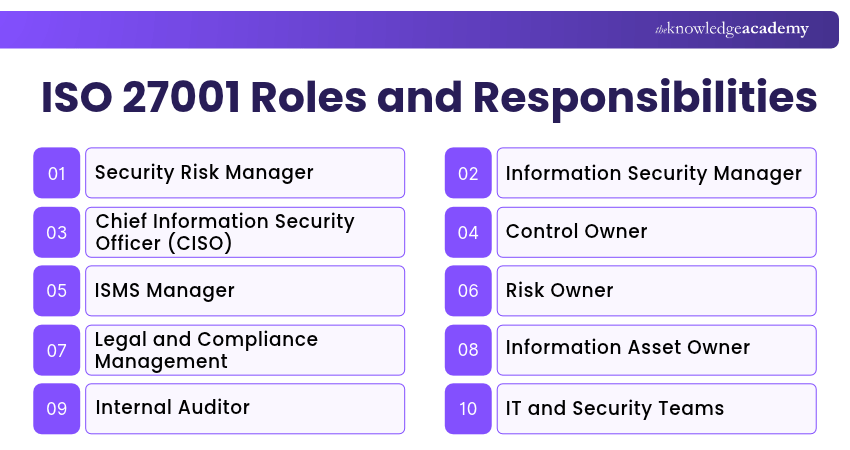
1) Security Risk Manager
Security Risk Managers play an important role in identifying, assessing and addressing risks affecting an organisation's information assets. These assets may include information systems, networks, databases and digital services. Their responsibilities involve evaluating potential threats, assessing vulnerabilities and determining how risks could affect information security.
They also support the development of risk treatment plans, recommend appropriate controls and monitor whether those measures effectively reduce identified risks. Their work helps organisations make informed decisions about managing security threats and protecting critical information.

2) Information Security Manager
An Information Security Manager oversees the organisation's information security activities and helps ensure that appropriate measures are in place to protect information assets. Their responsibilities commonly include developing security policies, coordinating risk assessments, monitoring security controls and supporting compliance with relevant information security requirements.
They also collaborate with departments to address security weaknesses, coordinate awareness activities and monitor the effectiveness of security practices. This role focuses on the ongoing management of information security activities and the coordination of operational security responsibilities across the organisation.
Trainer’s Insight:
Maintain a clear record of who is accountable for each information security control, who operates it and who responds when it fails. This reduces confusion during incidents and helps security teams coordinate corrective actions.
3) Chief Information Security Officer (CISO)
The Chief Information Security Officer (CISO) provides strategic leadership for an organisation's information security programme. Their role involves developing the overall security strategy, establishing security priorities and ensuring that information security initiatives support business objectives.
They also advise senior leadership on major cyber security risks, regulatory obligations and security-related investments. Depending on the organisation's structure, they may oversee security teams, lead improvement initiatives and provide strategic direction during significant security incidents.
4) Control Owner
Control Owners are responsible for implementing, maintaining and monitoring specific information security controls within an organisation. Their responsibilities include ensuring that assigned controls operate as intended and align with established security policies and procedures.
They also review control performance, identify implementation gaps and coordinate improvements where necessary. Although they may delegate technical implementation to relevant teams, they remain accountable for the controls within their assigned authority.
Pro Tip: Use a RACI matrix to clarify who is responsible, accountable, consulted and informed for each security activity. This helps prevent ownership gaps, particularly when multiple departments share responsibility for the same information assets.
5) ISMS Manager
An ISMS Manager is responsible for coordinating the implementation, maintenance and continual improvement of the ISMS. This role focuses on ensuring that ISMS processes, policies, documentation and monitoring activities remain consistent with ISO 27001 requirements and the organisation's information security objectives.
ISMS Managers typically coordinate internal audit programmes, monitor corrective actions, maintain relevant ISMS documentation and support management reviews. Their responsibilities centre on maintaining the ISMS as a structured and continually improving system rather than managing every technical security activity.
6) Risk Owner
An Information Security Risk Owner is accountable for managing specific information security risks assigned to them. This role involves understanding the potential impact of identified risks, reviewing assessment results and ensuring that appropriate risk treatment decisions are made.
Risk Owners are also responsible for accepting residual risks within their assigned authority and the organisation's established risk criteria. They work with relevant teams to monitor changes in risk exposure and confirm whether agreed treatment measures remain appropriate.
7) Legal and Compliance Management
Legal and Compliance Officers help organisations identify and address legal, regulatory and contractual requirements relating to information security. Their responsibilities include reviewing relevant obligations, advising on compliance matters and supporting the development of policies that reflect applicable requirements.
They may also coordinate legal reviews, assist in addressing compliance concerns and liaise with regulatory authorities where necessary. Their involvement helps ensure that information security decisions take account of applicable legal, regulatory and contractual obligations.
8) Information Asset Owner
An Information Asset Owner is responsible for overseeing the appropriate management and protection of assigned information assets. These assets may include databases, business records, applications or other information resources. Asset Owners help determine the importance of these assets and ensure that relevant requirements for their classification, handling, access and protection are established.
They also coordinate with IT and security teams to ensure that appropriate safeguards are applied throughout the asset lifecycle. For example, an Asset Owner may help define who should have access to sensitive business information and review whether those permissions remain appropriate.
9) Internal Auditor
An Internal Auditor evaluates whether the organisation's ISMS conforms to ISO 27001 requirements and the organisation's own information security requirements. Their responsibilities include planning and conducting audits, reviewing documented information, assessing relevant processes and gathering evidence to determine whether the management system is effectively implemented and maintained.
Internal Auditors also identify nonconformities, document audit findings and report results to relevant management. They may review whether corrective actions have addressed previously identified issues.
Conduct effective internal audits and support ISO 27001 compliance with ISO 27001 Internal Auditor Training – Sign up soon!
10) IT and Security Teams
IT and security teams are responsible for maintaining technical security measures that help protect organisational information, networks and systems. Their responsibilities may include managing access controls, maintaining secure configurations, monitoring networks, applying security updates and supporting backup and recovery processes.
These teams also investigate technical vulnerabilities, respond to security events and support the implementation of risk treatment measures. By maintaining technical safeguards and supporting operational security activities, they help translate information security policies into practical protection measures.
11) Department Managers
Department Managers are responsible for ensuring that information security policies and procedures are followed within their respective teams. Their role involves translating organisation-wide security requirements into departmental activities, identifying operational risks and ensuring that employees understand their information security responsibilities.
They also coordinate with security personnel when introducing new processes, managing information assets or addressing incidents affecting their departments. Their involvement helps integrate information security into everyday business operations.
Why are ISO 27001 Roles and Responsibilities Important?
Clearly defined roles and responsibilities help organisations maintain an effective ISMS, strengthen accountability and ensure consistent information security practices. Here are the key reasons why assigning these responsibilities is important:
a) Establishes Clear Accountability: Ensures individuals understand their security responsibilities and prevents important tasks from being overlooked.
b) Strengthens Risk Management: Assigns responsibility for identifying, assessing and managing information security risks.
c) Supports ISO 27001 Compliance: Helps organisations meet requirements for assigning and communicating information security responsibilities.
d) Improves Team Coordination: Enables departments to work together effectively and avoid overlapping responsibilities.
e) Enhances Incident Response: Clarifies who should report, investigate and respond to security incidents.
f) Promotes Security Awareness: Encourages employees to follow security policies and recognise potential threats.
g) Supports Continual Improvement: Assigns responsibility for monitoring security performance, addressing audit findings and implementing corrective actions.
Establish a robust information security framework that supports business objectives with ISO 27001 Lead Implementer Training – Join now!

The Knowledge Academy develops accessible learning content across Project Management, IT, Cybersecurity, Data Science, Business Analysis, HR, Accounting and Finance, Leadership and Health and Safety. Its resources combine subject research with clear explanations to help professionals build practical knowledge across a wide range of disciplines.
View Detail

 If you wish to make any changes to your course, please


