
SALE LIVE
SAVE UPTO 60% BLACK FRIDAY

Communication Skills Courses Black Friday Offers

Communication Skills Courses courses are part of our Black Friday sale. Lock in up to 60% off now, choose online, classroom or onsite training, and schedule your course any time through 2027. Group bookings save up to 60%.

Offer ends 27 November 2026

Communication Skills Courses

Online Instructor-led (1 days)

Online Self-paced (8 hours)

Assertiveness Skills Training Course Outline

Module 1: Introduction to Assertiveness Skills

  • Benefits of Being Assertive
  • Assertiveness and Conflicts
  • Conflict Resolution Model
  • Mode
  • What Does It Mean to Be Assertive?
  • Rules of Assertion
  • When to Be Assertive
  • Being Assertive in the Workplace

Module 2: Getting Your Point Across

  • Presenting Clear Messages
  • Ending Conversations
  • Gaining Confidence
  • Tools

Module 3: Dealing with Difficulty

  • Handling Difficult People and Situations
  • Art of Saying No
  • Managing Conflict and Moving Forward

Module 4: Emotional Intelligence

  • Managing Emotions
  • Dealing with Someone Else’s Emotions

Module 5: Handling Difficult Situations

  • Dealing with Difficult People and Situations
  • CLASS Technique
  • How to Keep Calm in Challenging Situations?
  • Breathing Exercises

Show moredown

Who Should Attend This Assertiveness Skills Training?

This Assertiveness Skills Training is designed for professionals who want to communicate more confidently, handle difficult situations, and manage workplace interactions effectively. It can particularly benefit:

  • Managers and Leaders
  • Customer Service Representatives
  • Sales Professionals
  • Project Managers
  • Educators and Trainers
  • Entrepreneurs and Business Owners
  • Healthcare Professionals

Prerequisites for the Assertiveness Skills Training

There are no formal prerequisites to attend this Assertiveness Skills Course. However, basic communication skills and a willingness to participate in practical communication activities will be beneficial for delegates.

Assertiveness Skills Training Course Overview

Assertiveness Skills Training develops the communication skills needed to express ideas, opinions, and boundaries clearly and confidently. It covers assertive behaviour, workplace communication, conflict resolution, and techniques for getting your point across effectively.

Delegates will build confidence in handling difficult people, managing emotions, and staying calm in challenging situations. They will also learn how to say no appropriately and communicate clear messages.

This 1-Day training by The Knowledge Academy helps delegates apply assertive communication in workplace interactions. They will be able to manage conflict constructively, respond calmly, and communicate with greater confidence.

Assertiveness Skills Training Course Objectives

  • To understand the principles of assertive communication and its importance
  • To distinguish between assertive, aggressive, and passive communication styles
  • To develop techniques for expressing opinions and needs assertively
  • To enhance conflict resolution skills through assertiveness
  • To build confidence in handling challenging conversations
  • To apply assertive communication in professional and personal contexts

Learning Outcomes of this Assertiveness Skills Training

Upon completing this Assertiveness Skills Training, delegates will be able to communicate assertively, handle difficult people and challenging situations, manage conflict, and set clear boundaries. They will also be able to manage emotions, apply the CLASS technique, stay calm under pressure, and build more positive workplace interactions.

Benefits of Assertiveness Skills Training

Assertiveness is an essential workplace skill that enables professionals to communicate confidently, manage challenging situations, and build positive working relationships. Developing assertiveness can improve collaboration, support effective decision-making, and help individuals express their ideas while respecting the views of others.

Key benefits of completing this Assertiveness Training Course include:

  • Communicate with Greater Confidence: Express your thoughts, ideas, and opinions clearly and professionally.
  • Build Stronger Workplace Relationships: Encourage respectful communication and improve collaboration with colleagues and stakeholders.
  • Handle Difficult Conversations Effectively: Approach challenging discussions with confidence while maintaining professionalism.
  • Manage Workplace Conflict Constructively: Apply practical techniques to resolve disagreements and support positive outcomes.
  • Strengthen Emotional Intelligence: Develop greater awareness of your own emotions and respond more effectively to the emotions of others.
  • Support Long-term Career Growth: Assertiveness is a valuable professional skill that enhances leadership potential and workplace effectiveness.

Show moredown

What’s Included in this Assertiveness Skills Training?

  • World-Class Training Sessions from Experienced Instructors
  • Assertiveness Skills Certificate
  • Digital Delegate Pack

Show moredown

Online Instructor-led (1 days)

Online Self-paced (8 hours)

Public Speaking Course Outline

Module 1: Introduction to Public Speaking

  • Overview
  • Facing the Fear of Public Speaking
    • Prepare Thoroughly
    • Visualise Success
    • Focus on the Message
    • Use Relaxation Techniques
    • Start Small
  • Who, What, and How of Speaking Successfully?

Module 2: Getting Your Point Across

  • Presenting Clear Messages
  • Gaining Confidence in What You Say
  • Controlling Your Pace and Timing
  • Tools, You Know You Can Use

Module 3: Controlling the Unexpected

  • Handling Difficult People and Situations
  • Practising the Art of Audience Engagement
  • Moving Awkward Situations Forward

Module 4: Techniques of a Good Public Speaker

  • Controlling your Body Language
  • Engaging the Audience with your Tone and Timing
  • Adapting to your Audience

Show moredown

Who Should Attend this Public Speaking Course?

This Public Speaking Course is designed for professionals who want to build confidence and communicate more effectively when speaking to an audience. It can particularly benefit:

  • Entrepreneurs and Business Owners
  • Educators and Trainers
  • Sales and Marketing Teams
  • Team Leaders and Managers
  • Conference Speakers
  • Technical Professionals
  • Business Professionals

Prerequisites for the Public Speaking Course

There are no formal prerequisites to attend this Public Speaking Course. However, basic communication skills and self-confidence would be beneficial for the delegates.

Public Speaking Course Overview

The Public Speaking Course introduces delegates to practical techniques for speaking clearly and confidently in front of an audience. It covers preparation, managing speaking anxiety, relaxation techniques, body language, tone, and adapting delivery to different audiences.

Delegates will develop skills in presenting clear messages, controlling pace and timing, handling difficult situations, and engaging audiences effectively. The training also builds confidence in responding to unexpected situations and using body language and tone to strengthen delivery.

This 1-Day course by The Knowledge Academy enables delegates to apply Public Speaking techniques in professional and personal settings. They will be able to communicate with greater confidence, engage audiences effectively, and adapt their delivery to different speaking situations.

Public Speaking Course Objectives

  • To understand the fundamental principles of Public Speaking
  • To develop techniques for delivering clear and confident messages
  • To learn strategies for managing public speaking anxiety
  • To control pace and timing for more effective delivery
  • To develop body language, tone, and audience engagement techniques
  • To handle unexpected situations and adapt communication to different audiences

Learning Outcomes of this Public Speaking Course

Upon completing this Public Speaking Course, delegates will understand how to manage speaking anxiety, communicate clear messages, control pace and timing, and use body language and tone effectively. They will also be able to engage different audiences, adapt their delivery, and respond confidently to challenging speaking situations.

Benefits of this Public Speaking Course

At The Knowledge Academy, a trusted training provider, we offer Public Speaking Training in Belarus to help delegates develop effective communication and confident delivery skills. Our course combines essential speaking principles with practical techniques that delegates can apply across various professional and personal speaking situations.

Benefits of Public Speaking Training

Key benefits of this training include:

  • Confidence in Public Speaking: Build confidence to overcome fear, stay calm, and speak comfortably in front of others.
  • Getting Your Point Across Effectively: Communicate ideas in a simple and clear way, ensuring your message is understood and remembered with tested public speaking strategies.
  • Controlling the Unexpected with Confidence: Handle difficult situations and challenges with confidence while maintaining a steady and professional delivery.
  • Impactful Public Speaking Techniques: Improve your delivery using effective methods that help you present clearly and leave a strong impression.
  • Expert-led Practical Speaking Sessions: Develop real presentation skills through The Knowledge Academy’s guided practice and feedback-driven Public Speaking Coaching approach.
  • Industry-focused Communication Training: Benefit from The Knowledge Academy’s structured course design, helping you apply public speaking skills confidently in real workplace and professional settings.
  • Flexible Training Delivery Options: Choose from Classroom, Online Instructor-Led, Online Self-Paced, or Onsite training formats to suit your learning needs and schedule.

Career Opportunities After Public Speaking Course

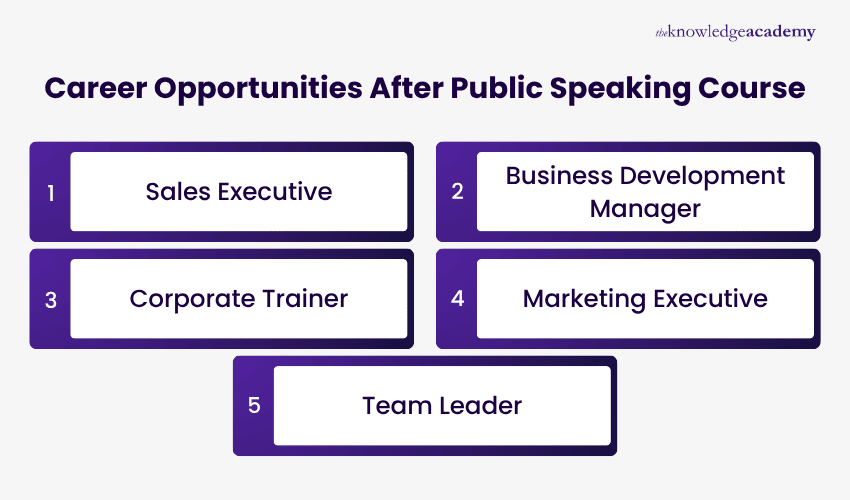
Strong Public Speaking skills are valued across a wide range of industries and professional roles. Completing this Public Speaking Course can help delegates strengthen their communication abilities and prepare for opportunities such as:

Job Opportunities After Public Speaking Training

  • Sales Executive: Deliver persuasive presentations and communicate effectively with clients to support business growth.
  • Business Development Manager: Present proposals confidently and establish good working relationships with stakeholders.
  • Corporate Trainer: Effectively deliver training sessions to a variety of audiences in an engaging way.
  • Marketing Executive: Communicate campaigns, concepts and strategies clearly and confidently with customers and colleagues.
  • Team Leader: Lead meetings, motivate teams and communicate with confidence and clarity about the goals of the organisation.

Show moredown

What’s Included in this Public Speaking Course?

  • World-Class Training Sessions from Experienced Instructors.
  • Public Speaking Certificate.
  • Digital Delegate Pack.

Show moredown

Online Instructor-led (1 days)

Online Self-paced (8 hours)

Negotiation Skills Training Course Outline

This Negotiation Skills Training Course covers the following areas:

Module 1: What is Negotiation?

  • Introduction to Negotiation
  • Types of Negotiation
  • Negotiation and Influencing Skills
  • Factors that Impact Negotiation
  • Stages of Negotiation

Module 2: Planning

  • Planning Overview
    • Preparation
    • Planning Tips
  • Discussion
  • Defining Objectives
  • Achieving Success
  • Coming to an Agreement
  • Executing Action

Module 3: Utilising Communication and Communicating Effectively

  • Significance of Listening
  • Being Assertive
  • Tools and Techniques for Negotiation
  • Building Good Relationships
  • Collaborating with Others
  • Solving Conflict
  • What to Ask Before Picking a Style
  • Conflict Management Personality Types
  • Handling Difficult Situations and Manipulation Professionally
  • Collaborating with Others

Show moredown

Who Should Attend This Negotiation Skills Training?

This Negotiation Skills Training is suitable for professionals who want to strengthen their ability to communicate, influence, manage disagreements, and negotiate effectively in workplace settings. The following individuals can benefit from this course:

  • Business Professionals
  • Sales and Marketing Professionals
  • Managers and Team Leaders
  • Procurement Professionals
  • Entrepreneurs and Business Owners
  • Human Resource Professionals
  • Client-Facing Professionals

Prerequisites for the Negotiation Skills Training

There are no formal prerequisites to attend this training. However, an interest in strengthening communication, influencing, and problem-solving skills will help delegates engage effectively with the course content.

Negotiation Skills Training Course Overview

Negotiation Skills Training covers negotiation fundamentals, planning, communication, influencing, assertiveness, collaboration, and conflict management. It also explores objective-setting, relationship-building, difficult situations, and reaching agreements.

Delegates develop skills in preparing for negotiations, listening effectively, communicating assertively, and managing disagreements. They also strengthen their ability to influence discussions, collaborate with others, and adapt their approach when needed.

This 1-Day course by The Knowledge Academy helps delegates apply structured negotiation approaches in workplace discussions. They will be better equipped to manage challenging conversations, work towards balanced agreements, and communicate with greater confidence.

Negotiation Training Course Objectives

  • To understand the fundamental principles and stages of negotiation
  • To plan negotiations by defining objectives and preparing effectively 
  • To develop listening, assertiveness, and influencing skills
  • To apply techniques for managing conflict and difficult situations
  • To build collaborative relationships during negotiation
  • To work towards clear and mutually acceptable agreements

Learning Outcomes of this Negotiation Training Course

Upon completing this Negotiation Training, delegates will understand how to prepare, communicate, influence, and manage conflict during negotiations. They will also be better equipped to approach workplace discussions confidently and work towards constructive agreements.

Skills Gained from this Negotiation Skills Training

This training helps delegates develop practical communication, planning, influencing, and conflict-management capabilities. Key skills gained from the course include:

Skills Gained from Negotiation Skills Training

  • Negotiation Planning: Define objectives, prepare effectively, and structure discussions clearly.
  • Influencing Skills: Communicate positions persuasively while considering different perspectives.
  • Assertive Communication: Apply active listening and assertiveness to support clearer discussions.
  • Conflict Management: Handle disagreements and difficult situations professionally.
  • Relationship-building: Build rapport and collaborate effectively throughout negotiations.
  • Agreement-building: Work towards clear, balanced, and actionable outcomes.

Practical Uses of Negotiation Skills

Negotiation skills can be applied across a wide range of workplace situations where communication, collaboration, and agreement-building are important. Key areas include:

  • Sales Discussions: Communicate value, respond to different viewpoints, and work towards mutually acceptable agreements.
  • Supplier and Procurement Negotiations: Discuss terms, priorities, expectations, and outcomes with suppliers and business partners.
  • Workplace Conflict: Manage disagreements professionally and support constructive resolution between different parties.
  • Team and Stakeholder Discussions: Balance different priorities, influence decisions, and maintain productive working relationships.
  • Management Conversations: Handle challenging discussions, clarify expectations, and work towards practical agreements with colleagues and teams.

Show moredown

What’s Included in this Negotiation Skills Training?

  • World-Class Training Sessions from Experienced Instructors
  • Negotiation Skills Certificate
  • Digital Delegate Pack

Show moredown

Online Instructor-led (1 days)

Online Self-paced (8 hours)

Effective Communication Skills Training Course Outline

Module 1: Fundamentals of Communication

  • What Is Communication?
  • The Importance of Communication
  • Identifying Key Stakeholders
  • Understanding Stakeholder Needs

Module 2: Advantages of Effective Communication

  • Benefits of Effective Communication
  • Consequences of Ineffective Communication
  • Communication Methods and Their Impact

Module 3: The Communication Process

  • Understanding Different Communication Types
    • Formal and Informal Communication
    • Horizontal and Vertical Communication
  • Choosing the Right Communications Channel
  • Communication Flow and Its Effectiveness

Module 4: Skilled Communicator and Individual Evaluation

  • What is a Skilled Communication?
  • Qualities of a Good Communicator
  • Introduction to Individual Evaluation
  • Reflective Questions for Self-Assessment

Module 5: Overcoming Communication Barriers

  • Identifying and Overcoming Barriers
  • The 7 Cs of Effective Communication
  • Strategies for Clear and Concise Communication

Module 6: Art of Questioning

  • Different Types of Questions
    • Closed Vs Open Questions
    • Probing and Funnel Questions
  • Techniques for Effective Questioning
  • Recall and Process Questions
  • Utilising Responses to Enhance Communication

Module 7: Enhancing Listening Skills

  • Principles of Effective Listening
  • Active Listening Techniques
  • Focusing Techniques While Speaking

Module 8: Navigating Various Communication Scenarios

  • Choosing Appropriate Communication Methods
    • Face-to-Face Communication: Advantages and Challenges
    • Written Communication: Letters and Emails
    • Digital Communication: Phone Calls, Video Calls, and Social Media
  • Understanding and Utilising Non-Verbal Cues
  • Adapting Communication Style to Different Situations

Show moredown

Who Should Attend this Effective Communication Skills Training Course?

This Effective Communication Skills Training is designed for professionals who want to communicate more clearly, listen effectively, and adapt their communication style to different situations. It can particularly benefit:

  • Business Professionals
  • Team Leaders and Managers
  • Customer Service Representatives
  • Sales and Marketing Teams
  • Project Managers
  • Educators and Trainers
  • Human Resource Professionals

Prerequisites for the Effective Communication Skills Training Course

There are no formal prerequisites for this Effective Communication Skills Training Course. However, basic skills like active listening and public speaking would be beneficial for the delegates.

Effective Communication Skills Training Course Overview

The Effective Communication Skills Training introduces delegates to the core principles of clear and effective communication. It covers communication methods, stakeholder needs, communication channels, communication flow, questioning techniques, active listening, non-verbal cues, and different communication scenarios.

Delegates will develop skills in choosing suitable communication methods, overcoming communication barriers, applying the 7 Cs of Effective Communication, asking effective questions, and listening actively. The training also builds practical knowledge of written, digital, face-to-face, and non-verbal communication.

This 1-Day course by The Knowledge Academy enables delegates to communicate more clearly and appropriately across professional situations. They will be able to adapt their communication style, select suitable channels, interpret non-verbal cues, and improve overall communication effectiveness.

Effective Communication Skills Training Course Objectives

  • To understand the fundamentals of effective communication and its impact on professional success
  • To develop strategies for clear, concise, and impactful verbal and non-verbal communication
  • To enhance listening skills for improved understanding and empathy in professional interactions
  • To practice techniques for assertive communication that respects others' views while expressing one's own
  • To learn how to manage and diffuse conflict through effective communication strategies

Learning Outcomes of this Effective Communication Skills Training Course

Upon completing this Effective Communication Skills Training, delegates will be able to communicate more clearly across different professional situations. They will also be able to apply effective questioning and listening techniques, overcome communication barriers, choose suitable communication channels, and adapt their communication style to different audiences and scenarios.

Show moredown

What’s Included in this Effective Communication Skills Training Course?

  • World-Class Training Sessions from Experienced Instructors
  • Effective Communication Skills Certificate
  • Digital Delegate Pack

Show moredown

Online Instructor-led (1 days)

Online Self-paced (8 hours)

Business Communication Course Outline

Module 1: Communication Fundamentals

  • What is Business Communication?
  • Process of Communication
  • Communication
  • Elements of Communication
  • Intercultural Communication

Module 2: Communication and Organisations

  • Organisational Culture and Communication
  • Information and Communications Technology (ICT) in Organisations
  • Organisational Structure and Communication

Module 3: Written Communication in Organisations

  • Business Writing: Planning and Organising
  • Effective Business Writing
  • Effective Design and Visual Aids
  • Effective Business Documents

Module 4: Interpersonal Communication in Organisations

  • Effective Interpersonal Communication: Defining Interpersonal Skills
  • Interpersonal Skills in Action: Communicating Face to Face
  • Meetings and Presentations
  • Building Effective Teams

Module 5: Communication and Change

  • Understanding Organisational Change
  • Making Communication Work

Show moredown

Who Should Attend this Business Communication Course? 

This Business Communication Course is designed for professionals who want to strengthen their written, interpersonal, presentation, and workplace communication skills. It can particularly benefit:

  • Business Executives
  • Managers and Team Leaders
  • Supervisors
  • Sales Representatives
  • Customer Service Professionals
  • HR Professionals
  • Marketing Professionals
  • Public Relations Officers

Prerequisites for the Business Communication Course

There are no formal prerequisites to attend this Business Communication Course. However, an interest in improving professional communication skills can be beneficial.

Business Communication Course Overview

Business Communication Training explores the principles of conveying ideas clearly, professionally, and persuasively in workplace environments. Delegates learn communication techniques that support collaboration, decision-making, and professional interaction effectively.

This training supports upskilling interpersonal communication, message delivery, and professional relationship management. Delegates strengthen their ability to lead discussions, collaborate effectively, and communicate with confidence across organisations.

This 1-Day course offered by The Knowledge Academy enables delegates to apply business communication techniques confidently. Delegates gain practical insight into crafting impactful messages, managing communication challenges, and improving professional presence.

Business Communication Course Objectives

  • To enhance understanding of the principles underpinning effective Business Communication
  • To develop skills in verbal, non-verbal, and written communication
  • To improve public speaking and presentation skills
  • To teach the management of interpersonal communication in a professional setting
  • To offer insights into managing communication in a crisis

Learning Outcomes of this Business Communication Course

Upon completing this Business Communication Course, delegates will be able to communicate more effectively across written, face-to-face, and organisational settings. They will also be able to plan and produce clear business documents, contribute effectively to meetings and presentations, build stronger interpersonal communication, and support communication during organisational change.

Skills Gained from this Business Communication Course

Business Communication Course in Belarus by The Knowledge Academy, a global training provider, enables learners to build essential communication skills for workplace success. It helps professionals communicate clearly, collaborate effectively, and handle different communication scenarios with confidence. This training focuses on developing practical skills across written, verbal, and interpersonal communication in organisational settings.

Skills Gained from Business Communication Course

Key skills gained from this training include:

  • Workplace Communication: Understand key effective business communication concepts, processes, and elements to communicate clearly in business environments.
  • Business Writing and Documentation: Plan, organise, and create clear business documents using effective writing and visual presentation techniques.
  • Interpersonal Communication and Teamwork: Communicate confidently in face-to-face interactions, meetings, and presentations while building strong team relationships.
  • Organisational Change Communication: Communicate effectively during organisational change and ensure messages are delivered clearly in evolving situations.
  • Public Speaking: It enhances your ability to deliver confident and structured presentations to varied audiences.
  • Active Listening: Builds an ability to focus on understanding and accurately responding to information shared by others.

Show moredown

What’s Included in this Business Communication Course?

  • World-Class Training Sessions from Experienced Instructors
  • Business Communication Certificate
  • Digital Delegate Pack

Show moredown

Online Instructor-led (1 days)

Online Self-paced (8 hours)

TOEFL Training Course Outline

Module 1: Introduction to TOEFL

  • Overview of the TOEFL
  • Understanding the Test Format and Sections
  • Importance of TOEFL for Academic and Professional Goals

Module 2: Reading Comprehension

  • Strategies for Effective Reading
  • Practicing Reading Comprehension Questions
  • Time Management Tips for the Reading Section

Module 3: Listening Comprehension

  • Developing Listening Skills
  • Identifying Key Information in Audio Passages
  • Dealing with Accents and Fast Speech

Module 4: Speaking

  • Speaking Section Structure
  • Pronunciation and Intonation Practice
  • Delivering Clear and Coherent Responses

Module 5: Writing

  • Structure of the Writing Section
  • Organising your Ideas in Essays
  • Grammar and Vocabulary for Effective Writing

Module 6: Vocabulary and Grammar

  • Building a Strong Vocabulary
  • Common Grammar Rules and Errors
  • Exercises to Improve Language Skills

Module 7: Test-Taking Strategies

  • Time Management During the Exam
  • Tips for Answering Multiple-Choice Questions
  • Strategies for Essay Writing

Show moredown

Who Should Attend this TOEFL Training Course?

This TOEFL Training Course is designed for individuals who wish to improve their English skills for academic, professional, or personal purposes. The following professionals can particularly benefit from attending this course:

  • Non-native English Speakers
  • Healthcare Professionals
  • Legal Professionals
  • Business Executives and Managers
  • Professionals Seeking International Opportunities
  • Marketing and Communications Professionals
  • Diplomats and International Relations Professionals

Prerequisites for the TOEFL Training Course

There are no formal prerequisites for attending this TOEFL Training Course. However, a basic understanding of English can be beneficial.

TOEFL Training Course Overview

The TOEFL Training Course introduces delegates to the key areas of English language development covered throughout the course. It focuses on reading comprehension, listening, speaking, writing, vocabulary, grammar, pronunciation, and clear communication.

Delegates will develop skills in understanding written and spoken English, organising ideas, building vocabulary, improving grammar, and delivering clear and coherent responses. The training also strengthens pronunciation, intonation, listening accuracy, and overall language confidence.

This 1-Day course by The Knowledge Academy enables delegates to strengthen their English communication skills across academic, professional, and international settings. They will be able to communicate more clearly, understand information more effectively, and use English with greater confidence.

TOEFL Training Course Objectives

  • To understand the format and content of the TOEFL exam
  • To develop strategies for each section of the TOEFL exam
  • To improve reading comprehension skills for the TOEFL
  • To enhance listening comprehension skills for the TOEFL
  • To practice speaking fluently and accurately for the TOEFL
  • To refine writing skills for the TOEFL essay section

Learning Outcomes of this TOEFL Training Course

Upon completing this TOEFL Course, delegates will be able to strengthen their reading, listening, speaking, and writing skills in English. They will also be able to improve vocabulary, grammar, pronunciation, comprehension, and the ability to organise and communicate ideas clearly.

Show moredown

What’s Included in this TOEFL Training Course?

  • World-Class Training Sessions from Experienced Instructors 
  • Digital Delegate Pack 
  • Interactive Learning with 24/7 Support 

Show moredown

Online Instructor-led (1 days)

Online Self-paced (8 hours)

Spoken Arabic Training Course Outline

Module 1: Introduction to Arabic Language

  • Introduction to Arabic
  • Arabic Alphabet
  • How to Learn Arabic?
  • Where to Learn Arabic?
  • Arabic Words in English
  • Transliteration
  • Features of Arabic Language

Module 2: Greet in Arabic

  • How to Say ‘Hello’?
  • Time-Specific Greetings
  • Rose Water and Arabic Coffee
  • Observing Arab Customs and Traditions
  • Making Introductions
  • Talking About Countries and Nationalities

Module 3: Arabic Grammar

  • Introducing Nouns, Adjectives, and Articles
  • Creating Simple and Verb-Free Sentences
  • Working with Verbs

Module 4: Making Small Talk

  • Asking Key Questions
  • Talking About Yourself and Your Family
  • Making Small Talk on the Job
  • Talking About the Weather
  • Talking Numbers
  • Referring to Days and Months

Module 5: Talking on the Phone

  • Dialling Up the Basics
  • Making Plans Over the Phone
  • Leaving a Message

Module 6: Ways to Pick Up Arabic Quickly

  • Watch Arabic Television
  • Use the Dictionary
  • Read Arabic Newspapers
  • Surf the Internet
  • Use a Language Tape or CD
  • Listen to Arabic Music
  • Make Arabic-Speaking Friends
  • Watch Arabic Movies
  • Eat at a Middle Eastern Restaurant
  • Sing Arabic Songs
  • Arabic Expressions

Show moredown

Who Should Attend this Spoken Arabic Training?

The Spoken Arabic Course is designed for individuals of diverse backgrounds who want to learn and improve their Spoken Arabic communication skills. This training can be beneficial for the following professionals:

  • Non-Arabic Speakers
  • Business Executives
  • Customer Service Representatives
  • Tourism and Hospitality Workers
  • Diplomats and International Relations Professionals
  • Journalists and Reporters
  • Interpreters and Translators
  • Linguistic Researchers

Prerequisites for the Spoken Arabic Training

There are no formal prerequisites for attending this Spoken Arabic Training Course. However, an interest in learning the Arabic language and improving communication skills will be beneficial for delegates.

Spoken Arabic Training Course Overview

Arabic Language Training explores essential conversational skills for effective communication in everyday situations. Delegates learn practical language use that supports respectful interaction in Arabic-speaking environments.

This training helps delegates strengthen cross-cultural communication and build meaningful professional relationships. By developing vocabulary, pronunciation, and conversational skills, delegates enhance confidence in real-world interactions.

This 1-Day Spoken Arabic Course offered by The Knowledge Academy enables delegates to apply Arabic language skills confidently. Delegates gain practical insight through interactive learning and practice in dialogue to improve fluency and communication.

Spoken Arabic Training Course Objectives

  • To learn basic Arabic vocabulary and grammar for conversation
  • To practice Arabic pronunciation and intonation
  • To develop confidence in initiating and maintaining conversations in Arabic
  • To understand cultural norms and etiquette in Arabic-speaking contexts
  • To enhance language skills for social and professional interactions
  • To apply learned Arabic phrases and expressions in real-life situations

Learning Outcomes of this Spoken Arabic Training Course

Upon completing this Spoken Arabic Course, delegates will possess the language skills and confidence to engage in Spoken Arabic conversations, enabling them to communicate effectively and build relationships in Arabic-speaking environments.

Show moredown

What’s Included in this Spoken Arabic Training Course?

  • World-Class Training Sessions from Experienced Instructors
  • Spoken Arabic Certificate
  • Digital Delegate Pack

Show moredown

Online Instructor-led (1 days)

Online Self-paced (8 hours)

English Speaking Course Outline

Module 1: Basic Language Structure

  • Phonology
  • Morphology
  • Semantics
  • Syntax
  • Major Approaches to Syntax
  • Computational Analysis of Syntax of ancient Indus Symbols
  • Speech Sounds
  • Mode English Language

Module 2: Communication

  • What is Communication?
  • Human Needs and Communication Skills
  • Changing Your Communication Behaviour
  • Communicative Grammar
  • Nonverbal Communication
  • Intercultural Communication

Module 3: English Grammar

  • Verb Tenses
  • Parts of Speech
  • Modal Verbs
  • Parts of the Sentence
  • Gerunds
  • Participles
  • Infinitives
  • Prepositional Phrases
  • Parallel Structures
  • Word Order and Word Choice
  • Word Forms
  • Idioms

Module 4: Pronunciation and Listening Comprehension

  • Syllables
  • Vowels and Word Stress
  • Sentence Focus and Consonants

Module 5: Dialogues

  • What is Dialogue Writing?
  • Points to Remember in Dialogue Writing
  • Tips to Write Dialogue
  • Format of Dialogue Writing
  • Basic Rules

Module 6: Basic Writing Skills

  • Punctuation
  • Grammar
  • Spelling
  • Apostrophes and Abbreviations
  • Improving Writing Skills
  • Filling in Forms
  • Writing Letters
  • Applying for a Job

Module 7: Presentation Skills

  • Personal Appearance
  • Discussions
  • Question and Answer Techniques

Show moredown

Who Should Attend This English Speaking Course?

This English Speaking Course is suitable for individuals looking to strengthen their English communication skills for professional and everyday situations. The following professionals can particularly benefit from this course:

  • Business Executives
  • Customer Service Representatives
  • Tourism Professionals
  • Hospitality Professionals
  • Public Speakers
  • Team Leaders and Managers
  • Project Managers
  • Administrative Professionals

Prerequisites for the English Speaking Course

There are no formal prerequisites to attend this English Speaking Training. However, an interest in strengthening English language and communication skills would be beneficial for delegates.

English Speaking Course Overview

English Speaking Training develops understanding of English language structure and effective communication for everyday and professional situations. It covers grammar, speech sounds, pronunciation, listening comprehension, communication, dialogue writing, writing skills, and presentations.

This training develops skills in sentence construction, word choice, pronunciation, active communication, writing, discussions, and question-and-answer techniques. Delegates also explore nonverbal and intercultural communication to support clearer interactions across different situations.

This 1-Day course offered by The Knowledge Academy develops practical English language and communication knowledge. Delegates will understand how to communicate more clearly through appropriate grammar, pronunciation, dialogue, writing, discussions, and presentation techniques.

English Speaking Course Objectives

  • To understand fundamental English language structures and communication principles
  • To develop effective speaking, listening, and pronunciation skills
  • To improve grammar, sentence construction, word choice, and language usage
  • To understand dialogue writing and effective interpersonal communication
  • To develop writing skills for everyday and professional applications
  • To strengthen discussion, presentation, and question-and-answer techniques

Learning Outcomes of this English Speaking Course

Upon completing this course, delegates will understand key principles of English grammar, pronunciation, listening, communication, writing, dialogue, and presentation. They will also develop practical knowledge for communicating more clearly and confidently across everyday and professional situations.

Show moredown

What’s Included in this English Speaking Course?

  • World-Class Training Sessions from Experienced Instructors
  • English Speaking Certificate
  • Digital Delegate Pack

Show moredown

Online Instructor-led (1 days)

Online Self-paced (8 hours)

English Grammar Course Outline

Module 1: Two Methods of Learning Grammar

  • Sentence
  • Part of Sentences
  • Sentence Fragment
  • Four Basic Sentence Structures

Module 2: Nouns and Pronouns

  • Different Kinds of Nouns
  • Three Properties of Nouns
  • Fifteen Rules in Forming the Singular and Plural Noun
  • Rules in Forming Possession
  • Five Kinds of Pronoun
  • Personal Pronoun Forms 
  • Possessive Pronouns 
  • Classification of Gender

Module 3: Verbs

  • Verbs Forms
  • Forms of Verbs
  • Three Parts of Verbs
  • Verb Tenses 
  • Six Tenses of the Verb TO BE
  • Six Tenses in Progressive Forms of Verbs
  • Two Group of Verbs
  • Verbs: Voice

Module 4: Agreement of Subject and Verb

  • Agreement of Verb with Compound Subject
  • Agreement with Collective Nouns
  • Agreement of Verbs with Indefinite Pronouns
  • Special Cases of Agreement

Module 5: Complements and Prepositions

  • Complements of Action Verbs
  • Complements of Linking Verbs
  • Two Groups of Prepositions

Module 6: Cases of Nouns and Pronouns

  • Three Cases in English
  • Cases of Nouns
  • Cases of Pronouns
  • Possessive Case of Nouns and Pronouns

Module 7: Adjectives and Adverbs

  • Three Uses of Adjectives
  • Kinds of Adjectives
  • Pronouns as Adjectives
  • Kinds of Adverbs
  • Degree of Comparison

Module 8: Preposition and Conjunctions

  • Prepositional Phrases
  • Types of Prepositional Phrases
  • Correct Use of Prepositions
  • Types of Conjunctions
  • Interjections

Module 9: Clauses

  • Two Kinds of Clauses
    • Types of Dependent Clauses
    • Adverbial Clauses
    • Subordinate Conjunctions
    • Kinds of Adverbial Clauses
    • Subordinate Conjunction Commonly Used in Adverbial Clauses of the Various Types
  • Adjective Clauses
    • Restrictive and Non-restrictive Clauses
    • Noun Clauses
    • Noun Clauses Function
  • Classifying Sentences Based on Clauses
    • Using Comma and Semicolon

Module 10: Verbal’s

  • Three Verb Forms of Verbal
  • Gerunds

Module 11: Punctuation

  • Types of Punctuation
  • Capitalisations

Show moredown

Who Should Attend This English Grammar Course?

This English Grammar Course is designed for individuals who want to strengthen their understanding of grammar and use English more accurately in professional and academic settings. It can particularly benefit:

  • Business Professionals
  • Content Writers
  • Language Instructors
  • Communication Specialists
  • Editors
  • Proofreaders
  • English Teachers

Prerequisites for the English Grammar Course

There are no formal prerequisites to attend this course. However, a basic understanding of English will help delegates gain the most from the training.

English Grammar Course Overview

English Grammar Training covers sentence structures, nouns, pronouns, verbs, subject-verb agreement, complements, prepositions, adjectives, adverbs, conjunctions, clauses, verbals, and punctuation. It also explores possession, tense, voice, comparison, capitalisation, and sentence classification.

Delegates develop skills in recognising grammatical structures, applying agreement rules, using different parts of speech correctly, and constructing clearer sentences. They also strengthen their ability to use clauses, punctuation, and verb forms accurately.

This 1-Day course by The Knowledge Academy helps delegates apply English grammar more confidently across written and spoken communication. They will be better equipped to recognise grammatical errors, improve sentence accuracy, and communicate ideas with greater clarity.

English Grammar Course Objectives

  • To understand the fundamental rules and structures of English Grammar
  • To recognise different nouns, pronouns, verbs, adjectives, and adverbs
  • To apply subject-verb agreement correctly in different sentence structures
  • To understand the use of complements, prepositions, conjunctions, and clauses
  • To apply verb tenses, voice, and grammatical forms accurately
  • To use punctuation and capitalisation to improve sentence clarity

Learning Outcomes of this English Grammar Course

Upon completing this course, delegates will understand how to apply key grammar rules across different sentence structures. They will be better equipped to identify grammatical errors, use parts of speech accurately, and improve clarity in written and spoken English.

Benefits After Completing this English Grammar Course

Strong grammar skills improve the accuracy and clarity of written and spoken communication. This English Grammar Training Course helps delegates communicate with greater confidence in professional and everyday situations.

  • Improved Writing Accuracy: Apply grammar rules, sentence structure, and punctuation correctly, so the written messages look clear and professional, even when you’re rushing a bit or maybe overthinking it.
  • Stronger Proofreading and Editing Skills: Recognise and fix grammatical issues, punctuation, spelling, and sentence construction problems with more confidence and less second-guessing.
  • Greater Confidence in English Usage: Sound more effective in professional, academic, and everyday conversations by using accurate spoken and written English, really steadily.
  • Better Sentence Construction: Build clearer sentences by applying correct word order, verb forms, clauses, and agreement rules. 
  • Improved Use of Grammar Structures: Use nouns, pronouns, adjectives, adverbs, prepositions, and conjunctions more accurately across different types of writing.

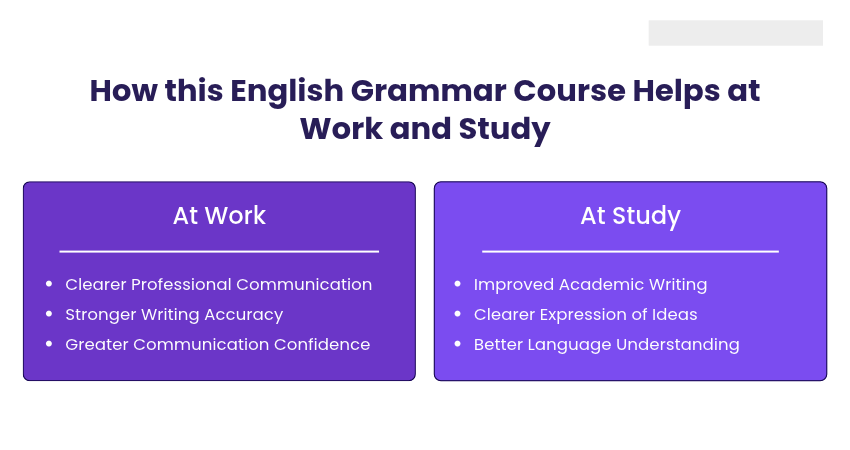
How this English Grammar Course Helps at Work and Study

This English Grammar Course helps professionals and students improve their grammatical accuracy, sentence structure, and written communication. Here is how this course supports success at work and during study:

How this English Grammar Course Helps at Work and Study

At Work

  • Clearer Professional Communication: Use accurate grammar when writing emails, reports, presentations, and workplace documents.
  • Stronger Writing Accuracy: Reduce grammatical errors and improve sentence structure in day-to-day business communication.
  • Greater Communication Confidence: Express ideas more clearly during meetings, discussions, and professional interactions.

At Study

  • Improved Academic Writing: Apply grammar rules more accurately in essays, assignments, reports, and other written work.
  • Clearer Expression of Ideas: Organise sentences and clauses effectively to communicate arguments and explanations with greater clarity.
  • Better Language Understanding: Strengthen knowledge of sentence structure, punctuation, verb forms, and parts of speech to support continued English language development.

Show moredown

What’s Included in this English Grammar Course?

  • World-Class Training Sessions from Experienced Instructors
  • English Grammar Certificate
  • Digital Delegate Pack

Show moredown

Online Instructor-led (1 days)

Online Self-paced (8 hours)

Spoken German Training Course Outline

Module 1: Basics of Spoken German

  • Introduction
  • Greetings and Farewells
  • Introducing Oneself and Others
  • Numbers and Counting
  • Days of the Week
  • Basic Questions and Answers

Module 2: Everyday Conversations

  • Shopping and Transactions
  • Asking for Directions
  • Making Appointments
  • Expressing Likes and Dislikes

Module 3: Travel and Transportation

  • Key Phrases for Travel
  • Using Public Transport
  • Booking Accommodations
  • Cultural Tips for Travellers

Module 4: Dining and Cuisine

  • German Food Vocabulary
  • Ordering Meals and Drinks
  • Table Manners and Etiquette
  • Paying the Bill

Module 5: Social Interactions and Etiquette

  • Formal and Informal Speech
  • Making Small Talk
  • Discussing Hobbies and Interests

Module 6: Work and Professional Environment

  • Office and Business Vocabulary
  • Participating in Meetings
  • Email and Telephone Etiquette
  • Discussing Projects and Plans

Show moredown

Who Should Attend this Spoken German Language Training Course?

This Spoken German Training Course is ideally suited for individuals eager to deepen their linguistic abilities and cultural understanding of the German-speaking world. It is particularly beneficial for:

  • Business Professionals
  • Customer Service Representatives
  • Tourists
  • Language Instructors
  • Healthcare Professionals
  • Media Experts
  • Banking and Finance Experts

Prerequisites for the Spoken German Training Course

There are no formal prerequisites for attending this Spoken German Language Training Course. However, an interest in developing basic German communication skills can be beneficial.

Spoken German Training Course Overview

The Spoken German Training introduces delegates to practical German used in everyday, travel, social, and professional situations. It covers greetings, introductions, basic questions, shopping, directions, appointments, travel phrases, dining, formal and informal speech, and workplace vocabulary.

Delegates will develop skills in holding simple conversations, asking for information, making arrangements, ordering food, and communicating in social settings. The training also builds practical knowledge of meetings, telephone and email etiquette, and discussing projects and plans.

This 1-Day course by The Knowledge Academy enables delegates to use spoken German more confidently in real-world situations. They will be able to communicate more effectively during travel, social interactions, and professional conversations.

Spoken German Training Course Objectives

  • To learn basic German vocabulary and grammar for conversation
  • To practice German pronunciation and intonation
  • To develop confidence in initiating and maintaining conversations in German
  • To understand cultural norms and etiquette in German-speaking contexts
  • To enhance language skills for social and professional interactions
  • To apply learned German phrases and expressions in real-life situations

Learning Outcomes of this Spoken German Training Course

Upon completing this Spoken German Training, delegates will possess the language skills and confidence to engage in spoken German conversations, enabling them to communicate effectively and build relationships in German-speaking environments. Delegates can learn other languages and improve their communication skills in general with The Knowledge Academy’s wide range of Communication Skills Courses.

Show moredown

What’s Included in this Spoken German Training Course?

  • World-Class Training Sessions from Experienced Instructors
  • Spoken German Certificate
  • Digital Delegate Pack

Show moredown

Online Instructor-led (1 days)

Online Self-paced (8 hours)

Spoken French Training Course Outline

Module 1: Introduction to Spoken French

  • Pronunciation and Phonetics
  • Basic Greetings and Expressions
  • Introducing Yourself and Others
  • Common Conversational Phrases

Module 2: Everyday Vocabulary

  • Numbers, Dates, and Time
  • Essential Vocabulary for Daily Activities
  • Shopping and Ordering in French
  • Directions and Location Phrases

Module 3: Social Interactions

  • Making Plans and Invitations
  • Discussing Hobbies and Interests
  • Describing Daily Routines
  • Expressing Opinions and Preferences

Module 4: Travel and Tourism in French

  • Booking Accommodations
  • Ordering Food at Restaurants
  • Transportation and Travel Phrases

Module 5: French Culture and Customs

  • Understanding Cultural Nuances
  • Celebrations and Festivals in France
  • Traditional French Cuisine
  • Politeness and Etiquette

Module 6: Work and Business Expressions

  • Workplace Vocabulary
  • Business Meetings and Correspondence
  • Job Interviews in French
  • Professional Networking Phrases

Module 7: Advanced Conversational Topics

  • Discussing Current Affairs
  • Expressing Emotions and Feelings
  • Narrating Personal Experiences
  • Handling Complex Conversations

Show moredown

Who Should Attend this Spoken French Training Course?

This Spoken French Training Course is designed for professionals who want to improve their French communication skills for everyday, travel, social, and workplace situations. It can particularly benefit:

  • International Business Executives
  • Travel Industry Professionals
  • Customer Service Representatives
  • Tourism Managers
  • Hospitality Managers
  • Journalists and Media Professionals
  • Language Instructors

Prerequisites for the Spoken French Training Course

There are no formal prerequisites to attend this Spoken French Training Course. However, an interest in learning the French language and improving communication skills will be beneficial for delegates.

Spoken French Training Course Overview

The French Language Course introduces delegates to conversational French for everyday, social, travel, and professional situations. It covers pronunciation, vocabulary, common expressions, greetings, directions, travel phrases, workplace communication, and cultural etiquette.

Delegates will develop skills in making plans, discussing interests, handling travel and dining situations, expressing opinions, and communicating in workplace settings. The training also strengthens cultural awareness and supports clearer interaction in French-speaking environments.

This 1-Day Spoken French Course by The Knowledge Academy enables delegates to apply practical French communication skills in real-world situations. They will be able to communicate more confidently across everyday, travel, social, and professional contexts.

Spoken French Training Course Objectives

  • To learn basic French vocabulary and grammar for conversation
  • To practice French pronunciation and intonation
  • To develop confidence in initiating and maintaining conversations in French
  • To understand cultural norms and etiquette in French-speaking contexts
  • To enhance language skills for social and professional interactions
  • To apply learned French phrases and expressions in real-life situations

Learning Outcomes of this Spoken French Training Course

Upon completing this Spoken French Training, delegates will be able to communicate confidently in everyday French conversations. They will also enhance their ability to build relationships and interact effectively in French-speaking environments.

Benefits of this Spoken French Training Course

Our Spoken French Training Course provides structured learning in the fundamentals of spoken French and its practical applications. It introduces delegates to essential language concepts and their use in different communication contexts. The following are some of the key benefits of completing this course:

  • Improved Pronunciation: Develop clearer French pronunciation and phonetic awareness
  • Stronger Vocabulary: Build useful vocabulary for daily, travel, and workplace situations
  • Better Conversational Skills: Communicate more confidently in social and professional settings
  • Travel Communication: Handle accommodation, dining, transport, and direction-related conversations
  • Professional Communication: Use French in meetings, interviews, correspondence, and networking
  • Greater Cultural Awareness: Understand French customs, etiquette, celebrations, and social expectations

Show moredown

What’s Included in this Spoken French Training Course?

  • World-Class Training Sessions from Experienced Instructors
  • Spoken French Training Certificate
  • Digital Delegate Pack

Show moredown

Online Instructor-led (1 days)

Online Self-paced (8 hours)

Spanish Language Course Outline

Module 1: Introduction to Spanish

  • Spanish Alphabets and Pronunciation
  • Greetings and Introductions
  • Common Phrases for Politeness
  • Numbers and Counting
  • Days of the Week and Months

Module 2: Basic Vocabulary

  • Colors and Shapes
  • Family and Relationships
  • Professions and Occupations
  • Food and Drinks
  • Hobbies and Interests

Module 3: Grammar Fundamentals

  • Nouns and Gender
  • Articles (Definite and Indefinite)
  • Singular and Plural Forms
  • Adjectives and Adjective Agreement
  • Basic Sentence Structure

Module 4: Everyday Communication

  • Asking for Directions
  • Ordering Food in a Restaurant
  • Shopping and Bargaining
  • Talking about the Weather
  • Describing Daily Routines

Module 5: Verb Conjugation

  • Regular Verbs (AR, ER, IR)
  • Irregular Verbs (Ser, Estar, Tener, Hacer)
  • Present Tense and Basic Verb Forms
  • Expressing Likes and Dislikes
  • Forming Questions and Negatives

Module 6: Advanced Grammar

  • Past Tense (Preterit and Imperfect)
  • Future and Conditional Tenses
  • Reflexive Verbs
  • Subjunctive Mood (Introduction)
  • Comparatives and Superlatives

Module 7: Cultural Insights

  • Spanish-Speaking Countries and Capitals
  • Traditional Festivals and Celebrations
  • Spanish Cuisine and Dishes
  • Famous Spanish Artists and Writers
  • Social Etiquette and Customs

Module 8: Practical Conversations

  • Travel and Booking Accommodation
  • Health and Medical Emergencies
  • Discussing Hobbies and Interests
  • Making Future Plans
  • Talking About the Past

Module 9: Advanced Communication

  • Giving and Receiving Directions
  • Expressing Opinions and Preferences
  • Debates and Discussions
  • Storytelling and Narratives
  • Formal and Informal Language

Show moredown

Who Should Attend this Spanish Language Course?

This Spanish Language Training Course is designed for a diverse range of professionals and individuals who desires to develop the Spanish  speaking skills for career, education, and personal growth. This course will benefit the following professionals:

  • Business Executives
  • Managers
  • Travel Industry Professionals
  • Language Instructors
  • International Relations Specialists
  • Sales Executives
  • Marketing Professionals

Prerequisites for the Spanish Language Course

There are no formal prerequisites to attend this Spanish Language Training Course. However, a basic understanding of English for instruction comprehension would be beneficial.

Spanish Language Course Overview

Spanish Language Training introduces delegates to foundational Spanish communication skills while highlighting the language’s global relevance. The training focuses on essential vocabulary, everyday expressions, and practical conversation skills for professional and personal use.

This training supports upskilling by strengthening cross-cultural communication, confidence in international interactions, and language proficiency. Delegates enhance their ability to engage effectively with Spanish-speaking clients, colleagues, and communities across diverse sectors.

This 1-Day Spanish Language Course offered by The Knowledge Academy helps delegates apply Spanish language skills confidently in real-world scenarios. Delegates gain practical experience using common phrases and expressions to communicate clearly in Spanish-speaking environments.

Spanish Language Course Objectives

  • To learn basic Spanish vocabulary and grammar for conversation
  • To practice Spanish pronunciation and intonation
  • To develop confidence in initiating and maintaining conversations in Spanish
  • To understand cultural norms and etiquette in Spanish-speaking contexts
  • To enhance language skills for social and professional interactions
  • To apply learned Spanish phrases and expressions in real-life situations

Learning Outcomes of this Spanish Language Course

Upon completing this Spanish Language Course in Belarus, delegates will possess the language skills and confidence to engage in spoken Spanish conversations, enabling them to communicate effectively and build relationships in Spanish-speaking environments.

Show moredown

What’s Included in this Spanish Language Course?

  • World-Class Training Sessions from Experienced Instructors
  • Spanish Language Certificate
  • Digital Delegate Pack

Show moredown

Online Instructor-led (1 days)

Online Self-paced (8 hours)

Spoken Dutch Training Course Outline

Module 1: Introduction to Dutch

  • Learn Basic Dutch
  • Why Learn Dutch?
  • Speak and Write Dutch

Module 2: Understand Useful Dutch

  • Benefits of Learning Dutch
  • Learn Dutch for Travel
  • Build your Business Dutch Skills
  • Immerse yourself in Dutch Culture

Module 3: Basics of Dutch Grammar

  • Dutch Verbs and Dutch Verb Conjugations
  • Dutch Nouns and Dutch Gender
  • Basic Dutch Phrases and Dutch Greetings

Module 4: Ways to Learn Dutch

  • Easiest Way to Learn Dutch
  • Dutch Self-Study
  • Dutch Practice

Module 5: Politeness and Formal Communication

  • Polite Requests and Offers
  • Formal Greetings and Introductions
  • Business and Professional Communication
  • Telephone Etiquette in Dutch
  • Writing Formal Emails in Dutch

Module 6: Cultural Nuances and Idiomatic Expressions

  • Understanding Dutch Idioms and Proverbs
  • Cultural Customs and Traditions
  • Regional Dialects and Variations
  • Celebrations and Festivals in Netherlands
  • Media and Entertainment in Dutch
  • Building Cultural Sensitivity in Communication

Show moredown

Who Should Attend this Spoken Dutch Training Course?

This Spoken Dutch Training Course is designed for professionals and individuals seeking to develop effective Dutch communication skills for everyday interactions, travel, and workplace settings. It is particularly suitable for the following individuals and professionals:

  • Language Interpreters
  • Customer Service Representatives
  • Tour Guides
  • Hospitality Professionals
  • International Relations Coordinators
  • Multilingual Call Centre Agents
  • Cross-Cultural Communication Specialists

Prerequisites for the Spoken Dutch Training Course

There are no formal prerequisites for attending this Spoken Dutch Training Course. However, an interest in learning Dutch and developing basic communication skills can be beneficial.

Spoken Dutch Training Course Overview

The Spoken Dutch Training introduces delegates to the fundamentals of Dutch communication for everyday, travel, and professional situations. It covers basic Dutch, greetings, common phrases, grammar, verbs, nouns, travel communication, Business Dutch, and formal communication.

Delegates will develop skills in making polite requests, using formal greetings, communicating by telephone, and writing professional emails in Dutch. The training also builds awareness of Dutch idioms, cultural customs, regional variations, and appropriate communication across different settings.

This 1-Day course by The Knowledge Academy enables delegates to use Dutch more confidently in social and professional situations. They will be able to communicate using practical phrases, apply basic grammar, and adapt their communication with greater cultural awareness.

Spoken Dutch Training Course Objectives

  • To build confidence in speaking Dutch through practical exercises
  • To improve pronunciation and accent for clear communication
  • To expand vocabulary for diverse conversational settings
  • To enhance listening comprehension in Dutch
  • To develop fluency for social and professional interactions
  • To understand the cultural aspects of the Dutch language
  • To practise real-life scenarios for better language application

Learning Outcomes of this Spoken Dutch Training Course

Upon completing this course, delegates will receive a certification in Spoken Dutch, signifying their ability to communicate effectively in Dutch. This certification will enhance their communication skills and broaden their cultural and professional horizons.

Show moredown

What’s Included in this Spoken Dutch Training Course?

  • World-class training sessions from Experienced Instructors
  • Spoken Dutch Certificate
  • Digital Delegate Pack
     

Show moredown

Online Instructor-led (1 days)

Online Self-paced (8 hours)

British Sign Language Training Course Outline

Module 1: Introduction to Sign Language

  • Importance and Role of Sign Language in Deaf Communities Worldwide
  • Recognising Major Global Sign Languages

Module 2: Basics of Sign Language Communication

  • Role of Hand Shapes, Facial Expressions, and Body Language
  • Importance of Context and Non-Manual Features
  • General Syntax and Structure Overview

Module 3: Manual Alphabet and Numbers

  • Learning the Basic Manual Alphabet Common to Many Sign Languages
  • Counting in Sign Language
  • Exercise

Module 4: Everyday Vocabulary and Phrases

  • Introducing Oneself and Others
  • Expressing Feelings and Emotions
  • Basic Conversational Phrases for Daily Situations

Module 5: Questions and Responses in Sign Language

  • Forming Different Types of Questions
  • Appropriate Facial Expressions for Queries
  • Constructing and Elaborating Answers

Module 6: Grammar and Syntax Basics

  • General Sentence Structure in Sign Languages
  • Role of Time, Manner, and Place in Statements
  • Introduction to Verb Modification

Module 7: Storytelling and Narrative in Sign Language

  • Crafting Clear Narratives Using Role Shift and Perspective
  • Incorporating Classifiers and Appropriate Expressions
  • Guided Storytelling Practice

Module 8: Cultural Awareness and Etiquette

  • Introduction to Global Deaf Cultures
  • Deaf Community Values and Norms in Various Regions
  • Respectful Communication Practices

Module 9: Application and Role-Playing

  • Role-Play Scenarios for Real-World Situations

Module 10: Using Technology and Resources to Enhance Learning

  • Overview of Sign Language Learning Apps and Online Resources
  • Emphasis on Continuous Practice
  • Recommendations for Engaging with Local Deaf Communities

Show moredown

Who Should Attend this British Sign Language Training Course?

This British Sign Language Training Course is designed for professionals who want to develop practical sign language communication skills and improve interactions with Deaf and hard-of-hearing individuals. It can particularly benefit:

  • Customer Service Representatives
  • Teachers and Educators
  • Healthcare Professionals
  • Social Workers
  • Human Resources Professionals
  • Retail and Hospitality Staff
  • Interpreters and Translators

Prerequisites for the British Sign Language Training Course

There are no formal prerequisites for attending this British Sign Language Training Course. However, an interest in learning sign language and communicating more effectively with Deaf and hard-of-hearing individuals can be beneficial.

British Sign Language Training Course Overview

British Sign Language (BSL) Training introduces essential signs, phrases, and communication techniques. It highlights its importance in promoting inclusivity and bridging communication gaps. The training supports effective interaction with deaf individuals in various settings.

This training develops practical signing skills for real-world communication. It benefits professionals in healthcare, education, and customer-facing roles. It enhances accessibility, inclusivity, and confident communication skills.

This 1-Day course offered by The Knowledge Academy provides foundational BSL skills. Delegates learn basic signs and conversational techniques through interactive practice. It enables confident communication with deaf individuals in real-life situations.

British Sign Language Training Course Objectives

  • To understand the basics of British Sign Language
  • To develop basic signing skills for everyday conversations
  • To recognise and use common signs and phrases
  • To communicate effectively with deaf individuals
  • To foster a more inclusive environment in their workplace
  • To gain confidence in using BSL in practical settings

Learning Outcomes of this British Sign Language Course

Upon completing the British Sign Language Course, delegates will receive a certificate of completion. This certification signifies their newly acquired skills in British Sign Language, enhancing their professional profile and demonstrating their commitment to inclusivity and effective communication.

Show moredown

What’s Included in this British Sign Language Training Course?

This training course includes the following:

  • World-class Training Sessions from Experienced Instructors   
  • British Sign Language Training Certificate  
  • Digital Delegate Pack 

Show moredown

Online Instructor-led (1 days)

Online Self-paced (8 hours)

Visual Communication Course Outline

Module 1: Introduction to Visual Communication

  • What is Visual Communication?
  • Importance of Visual Communication
  • How to Use Visual Communication?
  • Challenges of Visual Communication
  • Visual Communication Tools

Module 2: Types of Visual Communication

  • Process Diagram
  • Physical or Virtual Whiteboards
  • Organisational Charts
  • Infographic
  • Interactive Diagrams and Charts
  • Empathy Maps
  • Screen Recording
  • Data Visualisation
  • Kanban Boards
  • Visual Maps
  • Animation
  • GIFs

Module 3: How to Use Good Visual Communication?

  • Onboard New Employees
  • Capture Inspiration
  • Skip Writing Pages of Notes
  • Give Clear Feedback
  • Reporting Progress
  • Better Emails

Module 4: How to Improve Visual Design Skills for Non-Designers?

  • Seek Inspiration Everywhere
  • Follow the "Less is More" Approach
  • How does Texture Works?
  • Utilise Typography
  • Pay Attention to Colour
  • Use Whitespace Wisely
  • Go for Balance and Harmony
  • How to Use Size, Scale, and Proportion?

Module 5: Ways to Build Brand with Visual Communication

  • Find Signature Voice
  • Express Vision
  • Persuade Audience
  • Ability to Stand Out
  • Use Mood Boards
  • Use Emotions You Want to Elicit
  • Consistency
  • Put It to the Test
  • Iterate

Show moredown

Who Should Attend this Visual Communication Course?

This Visual Communication Course is designed for professionals who want to present information more clearly using visual formats, design principles, and branding elements. It can particularly benefit:

  • Graphics Designers
  • Marketing Professionals
  • Content Creators
  • Web Designers
  • Communication Specialists
  • Social Media Managers
  • Educators and Trainers

Prerequisites for the Visual Communication Course

There are no formal prerequisites for the Visual Communication Training Course. However, a basic understanding of graphic design and content creation can be beneficial.

Visual Communication Course Overview

The Visual Communication Course introduces delegates to the principles and tools used to communicate ideas clearly through visual formats. It covers process diagrams, infographics, charts, whiteboards, visual maps, data visualisation, screen recordings, animation, GIFs, and other visual communication methods.

Delegates will develop skills in improving visual design through typography, colour, whitespace, balance, scale, and proportion. The training also builds practical knowledge of using visuals for onboarding, feedback, progress reporting, emails, branding, mood boards, and consistent visual communication.

This 1-Day course by The Knowledge Academy enables delegates to apply visual communication techniques across professional situations. They will be able to present information more clearly, strengthen visual consistency, and create more engaging communication for workplace and brand-related needs.

Visual Communication Course Objectives

  • To develop proficiency in graphic design software such as Adobe Creative Suite
  • To master the art of creating impactful visual content for diverse media
  • To understand the principles of typography, colour theory, and layout design
  • To explore multimedia production techniques, including video and animation
  • To learn to tailor visuals for various platforms, from print to digital

Learning Outcomes of this Visual Communication Course

Upon completing this Visual Communication Training, delegates will be able to apply effective Visual Communication techniques for branding and creative design. They will also strengthen creative thinking skills and develop unique visual concepts.

Skills Gained from this Visual Communication Course

Visual Communication Training in Belarus by The Knowledge Academy, a trusted global training provider, enables learners to present information clearly using visuals instead of lengthy text.

It helps professionals communicate ideas more effectively, improve understanding, and enhance engagement across different platforms. This training focuses on developing practical skills to create, use, and improve visual communication in professional settings.

Skills Gained from Visual Communication Course

Key skills gained from this Visual Communication Training include:

  • Visual Storytelling: Learn how to communicate ideas, messages, and information clearly through visual elements that engage audiences effectively.
  • Information Design and Data Visualisation: Develop the ability to present complex information using infographics, charts, diagrams, and visual maps for improved understanding.
  • Brand Communication: Gain skills in creating consistent visual content that strengthens brand identity, expresses organisational values, and enhances audience recognition.
  • Visual Design Principles: Understand typography, colour theory, whitespace, balance, proportion, and layout techniques to create impactful visual communications.
  • Audience Engagement and Communication: Learn to use visual communication tools strategically to improve collaboration, provide feedback, onboard employees, and support effective workplace communication.
  • Creative Thinking: Supports the generation of innovative visual ideas to communicate messages effectively.

Benefits of Choosing a Career in Visual Communication

A career in Visual Communication offers opportunities across a wide range of industries as organisations increasingly rely on visual content to engage audiences, simplify information and strengthen communication.

Some key benefits of choosing a career in Visual Communication include:

  • Diverse Career Opportunities: Work across industries such as marketing, advertising, media, education, technology, and corporate communications.
  • Growing Demand for Visual Content: Organisations continue to invest in visual communication to improve audience engagement across digital and traditional platforms.
  • Creative and Business Impact: Combine creativity with strategic communication to influence organisations present information, products, and services.
  • Opportunities Across Multiple Roles: Apply visual communication knowledge in areas including content creation, branding, training, internal communications, and social media.
  • Supports Career Progression: Visual communication expertise complements marketing, design, and communication roles, helping professionals take on greater responsibilities.
  • Transferable Professional Capability: The ability to communicate ideas visually is valuable across a wide variety of business functions and professional environments.

Show moredown

What’s Included in this Visual Communication Course?

  • World-Class Training Sessions from Experienced Instructors
  • Visual Communication Certificate
  • Digital Delegate Pack

Show moredown

Online Instructor-led (1 days)

Online Self-paced (8 hours)

Nonverbal Communication Training Course Outline

Module 1: Introduction to Nonverbal Communication

  • What is Nonverbal Communication?
  • Types of Nonverbal Communication
  • Principles of Nonverbal Communication
  • Functions of Nonverbal Communication
  • How Nonverbal Communication Affect Others?
  • How to Improve Your Nonverbal Communication Skills?
  • Importance of Nonverbal Communication

Module 2: Nonverbal Communication in the Workplace

  • What is Nonverbal Communication in the Workplace?
  • Why Nonverbal Communication Matters in the Workplace
  • Types of Effective Nonverbal Communication at Work
  • Nonverbal Communication Tips for Managers and Teams

Module 3: Body Language for Business

  • Power of Body Language
  • Importance of Body Language in Business Communication
  • How Body Language Can Impact Your Business Success?
  • Body Language Tips for Business Meetings

Module 4: Power of Facial Expression

  • What are Facial Expressions?
  • Facial Expressions and Emotions
  • Facial Expression Analysis Techniques
  • Facial Expression Analysis Technology
  • How to Read Facial Expressions?

Module 5: Adjusting Communication Attitude

  • What is Communication Attitude?
  • Effective Communication Strategies
  • How Does Attitude Affect Communication?
  • Attitude in Business Communication

Module 6: Expressions of Emotion and Communication Affection

  • Defining Emotion
  • Nonverbal Expressions of Emotions in Relationships
  • Emotional Skill in Close Relationships
  • How Do Humans Convey Affection Nonverbally?
  • Use of Nonverbal Affection Behaviours

Module 7: Nonverbal Correlates of Power and Interpersonal Dominance

  • Defining Power, Dominance, and Status
  • Relative Power and Dominant Communication in Relationships
  • Nonverbal Correlates of Power
  • Sex Differences in Power Cues
  • Reducing Power Differentials
  • Interpersonal Dominance Through Social Skill
  • Interpersonal Dominance Through Intimidation or Threat

Show moredown

Who Should Attend this Nonverbal Communication Training?

This Nonverbal Communication Training is designed for professionals who want to better understand body language, facial expressions, emotional cues, and other nonverbal signals in workplace interactions. It can particularly benefit:

  • Public Speakers and Presenters
  • Sales and Marketing Executives
  • Human Resource Professionals
  • Customer Service Representatives
  • Team Leaders and Supervisors
  • Counsellors
  • Interviewers and Recruiters

Prerequisites for the Nonverbal Communication Training

There are no formal prerequisites for attending this Nonverbal Communication Training. However, an interest in improving workplace communication and understanding nonverbal cues can be beneficial.

Nonverbal Communication Training Course Overview

The Nonverbal Communication Training introduces delegates to the principles and functions of communication without words. It covers body language, facial expressions, workplace cues, communication attitude, emotional expression, and the nonverbal signals linked to power, dominance, and status.

Delegates will develop skills in interpreting body language, reading facial expressions, recognising emotional cues, and adjusting their communication approach in different situations. The training also builds practical knowledge of nonverbal behaviour in meetings, workplace interactions, relationships, and team environments.

This 1-Day course by The Knowledge Academy enables delegates to use and interpret nonverbal communication more effectively. They will be able to recognise important cues, respond more appropriately to others, and strengthen communication across professional and interpersonal situations.

Nonverbal Communication Training Course Objectives

  • To understand the concepts of facial expression and communication strategies
  • To get acquainted with interpersonal dominance through social skill
  • To acquire knowledge about emotional skills in close relationships
  • To describe the role and usage of nonverbal affection behaviours
  • To establish an understanding of the communication attitude in business
  • To know about power, dominance, and the status of interpersonal dominance

Learning Outcomes of this Nonverbal Communication Training

Upon completing this Nonverbal Communication Training, delegates will be able to recognise and apply different forms of nonverbal communication in workplace and interpersonal situations. They will also be able to interpret body language and facial expressions, recognise emotional and power-related cues, and adjust their communication approach more effectively.

Show moredown

What’s Included in this Nonverbal Communication Training Course?

  • World-Class Training Sessions from Experienced Instructors
  • Nonverbal Communication Certificate
  • Digital Delegate Pack

Show moredown

Online Instructor-led (1 days)

Online Self-paced (8 hours)

Executive Communication Training​ Course Outline

Module 1: Introduction to Communication

  • What is Communication?
  • Nature of Communication
  • Need for and Importance of Communication
  • Types of Communication
  • Communication Loop

Module 2: Leadership and Executive Communication

  • What and Who is a Business Executive?
  • What is Leadership?
  • Skill Set Needed for an Executive
  • Duties of a Business Executive
  • Difference Between Boss, Leader, and Manager
  • Leadership Styles
  • Leadership Communication Style
  • Formal and Informal Communication
  • Communication Channels, Flows, and Networks
  • Principles and Objectives of Leader’s Communication

Module 3: Negotiation and Communicating Effectively

  • Significance of Listening 
  • Being Assertive 
  • Tools and Techniques for Negotiation
  • Effective Communication for Effective Negotiation
  • Solving Conflict
  • Engaging with Stakeholders
  • Negotiating with Stakeholders
  • Handling Difficult Situations and Manipulation Professionally 
  • Self-Assessment of Personal Negotiation Style

Module 4: Business Communication and Writing

  • Essence of Effective Communication
  • Types and Structure Business Letters
  • Responding to Business Letters
  • Essential Business Communication Documents and Modes
    • E-Mail
    • Memorandum
    • Orders
    • Circulars
    • Notice
    • Agenda
    • Meeting Minute
    • Tender Notification 

Module 5: Barriers to Effective Communication

  • What is a Communication Barrier?
  • Types of Barriers
  • Common Barriers to Effective Communication
  • Ways to Overcome Communication Barriers
  • Keeping Word Choice and Tone Right for Communication
  • How to Communicate Concisely?
  • Ingredients of Effective Executive Communication
    • Essential Ingredients for Effective Executive Communication

Show moredown

Who Should Attend this Executive Communication Training Course?

This Executive Communication Training Course is designed for senior professionals who want to strengthen leadership communication, negotiation, stakeholder engagement, and business writing skills. It can particularly benefit:

  • Executives and Business Leaders
  • Senior Managers
  • Department Heads
  • Communications Directors
  • Senior HR Professionals
  • Public Relations Professionals
  • Managers and Supervisors

Prerequisites for the Executive Communication Training Course

There are no formal prerequisites for attending this Executive Communication Training Course. However, some experience in professional communication, leadership, or stakeholder interaction can be beneficial.

Executive Communication Training Course Overview

The Executive Communication Training introduces delegates to the principles of effective communication at leadership and executive levels. It covers communication styles, leadership communication, formal and informal channels, negotiation, stakeholder engagement, business writing, and communication barriers.

Delegates will develop skills in active listening, assertiveness, negotiation, conflict resolution, stakeholder communication, and concise business writing. The training also builds practical knowledge of business letters, emails, memorandums, agendas, meeting minutes, tone, and word choice.

This 1-Day course by The Knowledge Academy enables delegates to communicate more effectively in leadership and professional settings. They will be able to engage stakeholders, handle difficult situations, overcome communication barriers, and deliver clear and concise executive communication.

Executive Communication Training Course Objectives

  • To develop exceptional interpersonal communication skills
  • To master the art of persuasive and impactful public speaking
  • To enhance their written communication abilities for executive-level documents
  • To cultivate active listening techniques for effective leadership
  • To build and maintain influential relationships with key stakeholders
  • To build confidence in delivering clear, strategic messages during high-stakes situations

Learning Outcomes of this Executive Communication Training

Upon completing this Executive Communication Training Course, delegates will acquire essential communication skills to address challenges and present ideas with clarity and confidence, making a lasting impact.

Show moredown

What’s Included in this Executive Communication Training Course?

  • World-Class Training Sessions from Experienced Instructors
  • Executive Communication Certificate
  • Digital Delegate Pack

Show moredown

Online Instructor-led (1 days)

Online Self-paced (8 hours)

Cross Cultural Communications Training Course Outline

Module 1: Cross-Cultural Communications

  • Defining Cross-Cultural Communication and Its Benefits
  • Barriers to Cross-cultural Communication
  • Cultural Values and Communication Styles
  • Strategies for Improving Cross-Cultural Communication

Module 2: Cultural Styles

  • Impact of Your Cultural Style
  • Diagnosing Cultural Styles of Others
  • Managing and Benefiting from Cultural Diversity
  • Inclusive Collaboration Methods

Module 3: Effective Communication in Global Virtual Teams

  • Cross-Border Communication Effectiveness
  • Language Use in International Contexts
  • Virtual Engagement Strategies
  • Inclusivity in Virtual Meetings

Module 4: Cultural Diversity

  • Understanding Organisational Cultural Diversity
  • Cultural Influence on Perspectives
  • Sensitivity to Cultural Variations
  • Leveraging Cultural Diversity for Creativity and Decision-Making
  • Harnessing Multicultural Team Skills

Show moredown

Who Should Attend this Cross Cultural Communications Training?

This Cross Cultural Communications Training is designed for professionals who want to communicate more effectively across different cultural environments and work confidently with diverse teams. It can particularly benefit:

  • International Sales and Marketing Teams
  • Entrepreneurs and Startups
  • Customer Service Representatives
  • Human Resource Personnel
  • Educators and Trainers
  • Diplomats and International Relations Professionals
  • Travel and Hospitality Professionals

Prerequisites for the Cross Cultural Communications Training

There are no formal prerequisites to attend this Cross Cultural Communications Training. However, a basic knowledge of communication skills and cultural awareness would be beneficial for the delegates.

Cross Cultural Communications Training Overview

The Cross Cultural Communications Training introduces delegates to the principles of communicating effectively across different cultural backgrounds. It covers cultural values, communication styles, cross-cultural barriers, cultural diversity, inclusive collaboration, and communication within global virtual teams.

Delegates will develop skills in recognising cultural differences, adapting communication approaches, improving cross-border communication, and supporting inclusive virtual engagement. The training also builds practical knowledge of cultural sensitivity, multicultural teamwork, and using diverse perspectives to support creativity and decision-making.

This 1-Day course by The Knowledge Academy enables delegates to communicate more effectively in multicultural and international environments. They will be able to reduce misunderstandings, strengthen collaboration, and work more confidently with culturally diverse teams.

Cross Cultural Communications Training Course Objectives

  • To understand the significance of Cross Cultural Communication in diverse environments
  • To recognise cultural differences in communication styles, values, and norms
  • To develop strategies for adapting communication to different cultural contexts
  • To enhance cultural intelligence and sensitivity in communication.
  • To improve intercultural collaboration and relationships

Learning Outcomes of this Cross Cultural Communications Training

Upon completing this Cross-cultural Communication Training, delegates will possess the knowledge and skills to confidently navigate cross-cultural communication, foster effective interactions, and build successful relationships across diverse cultural backgrounds.

Show moredown

What’s included in this Cross Cultural Communications Training?

  • World-Class Training Sessions from Experienced Instructors
  • Cross Cultural Communications Certificate
  • Digital Delegate Pack

Show moredown

Online Instructor-led (1 days)

Online Self-paced (8 hours)

Conflict Resolution and Negotiation for Change Training Course Outline

Module 1: Introduction to Conflict Resolution and Negotiation

  • Understanding Conflict and Its Impact
  • Role of Conflict in Change Initiatives
  • Introduction to Negotiation
  • Ethical Considerations in Conflict Resolution and Negotiation

Module 2: Types and Sources of Conflict

  • Identifying Different Types of Conflict
  • Common Sources of Conflict in the Workplace
  • Conflict's Impact on Individuals and Teams
  • Early Warning Signs of Escalating Conflict

Module 3: Conflict Resolution Styles and Approaches

  • Conflict Resolution Styles
  • Choosing the Right Conflict Resolution Style
  • Adapting Conflict Styles for Different Situations
  • Assessing Personal Conflict Resolution Style

Module 4: Communication Skills in Conflict Resolution

  • Effective Communication Techniques
  • Active Listening and Empathetic Communication
  • Non-Verbal Communication Cues
  • Managing Emotional Responses in Conflict
  • Diffusing Tension through Language

Module 5: Conflict Resolution Strategies

  • Conflict Resolution Process
  • Mediation and Facilitation Techniques
  • De-escalation Strategies
  • Conflict Resolution Tools and Models
  • Group Conflict Resolution Dynamics

Module 6: Negotiation Fundamentals

  • Introduction to Negotiation as a Problem-Solving Tool
  • Principled Negotiation
  • Preparing for Negotiation
  • Setting Negotiation Goals and Objectives
  • Negotiation Styles and Tactics

Module 7: Building Negotiation Skills

  • Effective Preparation and Planning
  • Active Listening in Negotiation
  • Generating Creative Solutions
  • Overcoming Common Negotiation Pitfalls
  • Handling Difficult Negotiation Situations

Module 8: Negotiation Strategies and Techniques

  • Distributive Vs Integrative Bargaining
  • Positional Vs Interest-Based Negotiation
  • Strategies for Achieving Win-Win Outcomes
  • Multi-Party and Complex Negotiations
  • Cross-Cultural Negotiation Considerations

Module 9: Negotiation for Change and Conflict Resolution in Organisations

  • Negotiation as a Change Management Tool
  • Navigating Organisational Conflict
  • Applying Conflict Resolution and Negotiation to Change Initiatives
  • Implementing Conflict Resolution Strategies in Organisations

Show moredown

Who Should Attend this Conflict Resolution and Negotiation for Change Training Course?

The Conflict Resolution and Negotiation for Change Course is designed for individuals who want to develop skills in effectively managing conflicts, facilitating negotiations, and driving positive change within various contexts. This training course can be beneficial for a variety of professionals, including:

  • Human Resources Professionals
  • Mediators and Facilitators
  • Diplomats and International Relations Specialists:
  • Legal Professionals
  • Social Services Professionals
  • Healthcare Professionals
  • Emergency Responders

Prerequisites for the Conflict Resolution and Negotiation for Change Training

There are no formal prerequisites for this Conflict Resolution and Negotiation for Change Training Course. However, prior knowledge of workplace communication, conflict management, or organisational change can help delegates better understand the concepts covered in the course.

Conflict Resolution and Negotiation for Change Training Course Overview

The Conflict Resolution and Negotiation for Change Training introduces delegates to the principles of managing workplace conflict and using negotiation effectively during organisational change. It covers conflict types and sources, resolution styles, communication techniques, mediation, de-escalation, negotiation planning, and bargaining approaches.

Delegates will develop skills in active listening, empathetic communication, managing emotional responses, choosing suitable conflict resolution styles, and handling difficult negotiation situations. The training also builds practical knowledge of principled negotiation, win-win outcomes, multi-party negotiations, and cross-cultural considerations.

This 1-Day course by The Knowledge Academy enables delegates to apply conflict resolution and negotiation techniques across workplace and change-related situations. They will be able to manage disagreements constructively, reduce tension, negotiate more effectively, and support change initiatives with greater confidence.

Conflict Resolution and Negotiation for Change Training Course Objectives

  • To understand the fundamentals of conflict theory and its impact on individuals and organisations
  • To develop effective communication skills to de-escalate conflicts and foster collaboration
  • To master negotiation techniques to achieve win-win outcomes in complex situations
  • To identify personal and organisational biases that can hinder conflict resolution and change efforts
  • To apply mediation strategies to facilitate peaceful resolutions in diverse contexts

Learning Outcomes of this Conflict Resolution and Negotiation for Change Training

Upon completing this Conflict Resolution and Negotiation for Change Training, delegates will be able to manage workplace conflict, apply suitable resolution approaches, and communicate more effectively during challenging situations. They will also be able to plan negotiations, avoid common pitfalls, handle difficult discussions, and support constructive outcomes during organisational change.

Show moredown

What’s Included in this Conflict Resolution and Negotiation for Change Training Course?

  • World-Class Training Sessions from Experienced Instructors 
  • Conflict Resolution and Negotiation for Change Certificate 
  • Digital Delegate Pack
     

Show moredown

Online Instructor-led (1 days)

Online Self-paced (8 hours)

Call Centre Training Course Outline

Module 1: Plan and Manage Call-Centre Resources

  • Step-by-Step Guide to Plan and Manage Call Centre Resources
    • Define Objectives
    • Analyse Historical Data
    • Forecast Call Volumes
    • Determine Staffing Requirements
    • Schedule Agents Effectively
    • Provide Ongoing Training
    • Implement Performance Metrics
    • Monitor and Manage Real-time Adherence
    • Foster a Positive Work Environment
    • Continuously Improve Processes

Module 2: Establish and Meeting Performance Objectives

  • Selecting Criteria for Success
  • Meeting Criteria for Success

Module 3: Understand Call Waiting Standards and Customer Expectations

  • Overview
    • Call Waiting Standards
    • Customer Expectations

Module 4: Using "Downtime" and Outgoing Call Management

  • Employee Downtime
  • Outgoing Call Management

Module 5: Quality Service and Integrity

  • Introduction to Quality Service
  • Introduction to Integrity

Module 6: Tackling Bottlenecks and Celebrating Commitment

  • Bottlenecks Overview
  • Celebrating Commitment
  • Employee Commitment
  • Customer Commitment

Module 7: Providing Feedback and Encourage and Reward Commitment

  • Introduction to Providing Feedback
  • Encouraging and Rewarding Commitment

Module 8: Evaluating Call Handling in Terms of Sales and Customer Care Training

  • Call Handling and Sales
  • Call Handling and Customer Care

Module 9: Provide Effective Support and Develop the Management Skills of Team Leaders, Lead Agents and Supervisors

  • Strategies
    • Training and Development Programs
    • Mentorship and Coaching
    • Performance Feedback and Evaluation
    • Clear Roles and Responsibilities
    • Continuous Communication and Collaboration
    • Lead by Example

Module 10: Decision Making, Performance Management

  • Elements of Decision Making
  • Effective Performance Management
  • What is Customer Experience?
  • Why is Customer Experience Important?
  • Customer Experience vs Customer Service
  • Assessing Customer Experience

Module 11: Do’s and Don’ts

  • Introduction
  • Review
  • Action Plan and Q&A

Show moredown

Who Should Attend this Call Centre Training Course?

Our Call Centre Training is designed for professionals involved in managing, supervising, and improving customer service operations. It is particularly suitable for those seeking to strengthen their operational management, team leadership, and service delivery skills, including the following professionals:

  • Call Centre Managers
  • Customer Service Leaders
  • Operations Managers
  • Team Leaders and Supervisors
  • Quality Assurance Managers
  • Service Delivery Specialists
  • Human Resource Professionals

Prerequisites for the Call Centre Training

There are no formal prerequisites to attend this Call Centre Training Course. However, a basic understanding of Call Centre Operations, communication and management skills would be beneficial for the delegates.

Call Centre Training Course Overview

Call Centre Training focuses on improving the efficiency and effectiveness of customer service operations. It covers key areas such as leadership, technology integration, and customer interaction strategies to enhance service quality.

This training supports professionals in customer service management, team leadership, and call centre operations. It builds the skills needed to improve team performance, maintain service standards, and increase customer satisfaction.

This 1-Day course offered by The Knowledge Academy enables delegates to apply call centre management techniques with confidence. Delegates gain practical insight into best practices, improving productivity, and delivering exceptional customer experiences.

Call Centre Training Course Objectives

  • To Understand Call Centre operations and key performance indicators (KPIs)
  • To Implement effective customer service strategies
  • To Optimise workforce scheduling and management
  • To Leverage technology for Call Centre efficiency
  • To Develop leadership skills for team management

Learning Outcomes of this Call Centre Training

Upon completing this Call Centre Training Course, delegates will be able to plan and manage call-centre resources, monitor performance, support team leaders, and improve call-handling standards. They will also be able to strengthen customer service, provide effective feedback, manage performance, and support a more consistent customer experience.


Show moredown

What’s Included in this Call Centre Training Course?

  • World-Class Training Sessions from Experienced Instructors
  • Call Centre Management Certificate
  • Digital Delegate Pack

Show moredown

Online Instructor-led (1 days)

Online Self-paced (8 hours)

B2B Communications Training Course Outline

Module 1: Business-to-Business Marketing Overview

  • Introduction to Business-to-Business Marketing
  • Characteristics of Business Markets
  • Types of Organisational Customers
  • Types of Business Goods and Services
  • Characteristics of B2B Marketing
  • B2B Marketing Management Approaches
  • Understanding Value and Supply Chains
  • Importance of B2B Relationships

Module 2: B2B Marketing Communication Strategy

  • Defining Marketing Communications
  • Role of Marketing Communications
  • Model of B2B Communications
  • Strategy and Planning MCs
  • B2B Branding
  • Planning B2B Marketing Communication Activities
  • Strategic Drift and Balance
  • Inter organisational Communication
  • Channel-Based Marketing Communications
  • Propensity to Share Information
  • Relationship-Based Marketing Communications
  • Agency/Client Relationships

Module 3: Tools of B2B Marketing Communications

  • Advertising and B2B Communications
  • Sales Promotion and B2B Communications
  • Control and the Use of Channel Incentives
  • Public Relations and B2B Communications
  • Direct Marketing and B2B Communications
  • Personal Selling and B2B Communications
  • Business-to-Business Media
  • Internet and B2B Marketing Communications
  • Coordinating Promotional Activities

Module 4: Personal Selling and Key Account Management

  • Role and Tasks of Personal Selling
  • Characteristics of Personal Selling
  • When Personal Selling Should be Major Part of Promotional Mix?
  • Personal Selling and Managing Relationships
  • Multiple Channel Selling
  • Sales Force
    • Management and Organisation
    • Ownership, Size, and Shape
    • Structure and Automation
  • Key Account Management

Show moredown

Who Should Attend this B2B Communications Training Course?

Our B2B Communications Training Course is designed for professionals involved in business communication, client relationships, and cross-organisational collaboration. It is particularly suitable for those seeking to strengthen their communication skills and manage professional interactions effectively, including the following roles:

  • Sales and Business Development Professionals
  • Marketing Managers
  • Corporate Communication Specialists
  • Client Relationship Managers
  • Public Relations (PR) Professionals
  • Account Managers
  • Supply Chain and Procurement Professionals

Prerequisites for the B2B Communications Training

There are no formal prerequisites for this B2B Communications Training Course. However, prior knowledge of business operations and communication principles can help delegates better understand the concepts covered in the course.

B2B Communications Training Course Overview

The B2B Communications Training introduces delegates to the principles of Business-to-Business communication and marketing. It covers business markets, organisational customers, B2B relationships, communication strategy, branding, marketing channels, and promotional activities.

Delegates will develop skills in planning B2B communication activities, managing client relationships, using suitable communication channels, and coordinating promotional efforts. The training also builds practical knowledge of personal selling, multiple-channel selling, sales force organisation, and key account management.

This 1-Day course by The Knowledge Academy enables delegates to apply B2B communication techniques more effectively across professional environments. They will be able to strengthen business relationships, improve communication planning, and support more coordinated marketing and sales activities.

B2B Communications Training Course Objectives

  • To understand the unique dynamics and challenges of B2B communication
  • To develop effective communication strategies tailored to B2B relationships
  • To master negotiation techniques for successful B2B deals
  • To harness digital tools and platforms for efficient B2B communication
  • To create persuasive and impactful B2B presentations and proposals

Learning Outcomes of this B2B Communications Training

Upon completing this B2B Communications Training Course, delegates will be able to plan B2B marketing communication activities, select suitable communication channels, and coordinate promotional efforts more effectively. They will also be able to strengthen business relationships, apply personal selling approaches, use channel incentives appropriately, and support key account management activities.

Show moredown

What’s Included in this B2B Communications Training Course?

  • World-Class Training Sessions from Experienced Instructors
  • B2B Communications Certificate
  • Digital Delegate Pack

Show moredown

Online Instructor-led (1 days)

Online Self-paced (8 hours)

Interpersonal Skills Training​ Course Outline

Module 1: Introduction to Interpersonal Skills

  • Importance of Interpersonal Skills
  • Identifying Key Elements of Effective Communication
  • Recognising Different Communication Styles
  • Building Rapport in Professional and Personal Relationships

Module 2: Verbal Communication Skills

  • Speaking Clearly and Confidently
  • Active Listening Techniques
  • Giving and Receiving Feedback Effectively
  • Using Positive Language for Better Impact

Module 3: Non-Verbal Communication Skills

  • Understanding Body Language Cues
  • Role of Eye Contact in Communication
  • Managing Facial Expressions Appropriately
  • Using Gestures and Posture to Convey Messages

Module 4: Emotional Intelligence

  • Recognising and Managing Your Emotions
  • Understanding the Emotions of Others
  • Developing Empathy and Compassion
  • Building Emotional Resilience in Challenging Situations

Module 5: Conflict Resolution

  • Identifying the Causes of Conflict
  • Using Effective Negotiation Techniques
  • Managing Disagreements Constructively
  • Achieving Win-Win Solutions

Module 6: Assertiveness and Confidence

  • Understanding Assertiveness versus Aggressiveness
  • Expressing Your Needs and Desires Clearly
  • Setting Boundaries Without Conflict
  • Developing Self-Confidence in Communication

Module 7: Teamwork and Collaboration

  • Recognising the Importance of Teamwork in Professional Settings
  • Effective Team Communication Strategies
  • Encouraging Inclusivity and Participation in Group Work
  • Building Trust and Mutual Respect in Teams

Show moredown

Who Should Attend this Interpersonal Skills Training Course?

This Interpersonal Skills Training Course is designed for professionals who want to strengthen communication, relationship-building, teamwork, and conflict resolution skills. It can particularly benefit:

  • Business Professionals
  • Team Leaders and Managers
  • Customer Service Representatives
  • Sales and Marketing Professionals
  • Project Managers
  • Educators and Trainers
  • Human Resource Personnel

Prerequisites for the Interpersonal Skills Training

There are no formal prerequisites for attending this Interpersonal Skills Training Course. However, an interest in improving communication, teamwork, and relationship-building skills can be beneficial.

Interpersonal Skills Training Course Overview

The Interpersonal Skills Training introduces delegates to the core principles of effective communication and relationship building. It covers communication styles, rapport building, active listening, feedback, body language, emotional intelligence, conflict resolution, assertiveness, and teamwork.

Delegates will develop skills in communicating clearly, managing emotions, understanding others, resolving disagreements, and setting boundaries confidently. The training also builds practical knowledge of negotiation, positive language, team communication, inclusivity, trust, and mutual respect.

This 1-Day course by The Knowledge Academy enables delegates to apply interpersonal skills more effectively in professional settings. They will be able to communicate with greater confidence, strengthen workplace relationships, manage conflict constructively, and contribute more effectively within teams.

Interpersonal Skills Training Course Objectives

  • To enhance verbal and non-verbal communication skills
  • To develop active listening techniques
  • To improve conflict resolution and negotiation skills
  • To foster empathy and emotional intelligence
  • To build strong, positive relationships with colleagues and clients
  • To strengthen teamwork through trust, inclusivity, and participation

Learning Outcomes of this Interpersonal Skills Training

Upon completing this Interpersonal Skills Training Course, delegates will be able to communicate more effectively, build stronger professional relationships, and work more confidently with others. They will also be able to apply active listening, emotional intelligence, assertiveness, conflict resolution, and teamwork skills across different workplace situations.

Skills gained from this Interpersonal Skills Training

Our Interpersonal Skills Training helps delegates develop practical abilities for communicating clearly, managing interactions, and working effectively with others. Key skills gained include:

  • Communication Awareness: Adapt communication styles and use verbal and non-verbal cues effectively.
  • Active Listening: Listen attentively, understand others, and respond with appropriate feedback.
  • Emotional Intelligence: Recognise emotions, demonstrate empathy, and manage challenging situations.
  • Conflict Resolution: Handle disagreements constructively using negotiation and win-win approaches.
  • Assertiveness and Collaboration: Set boundaries confidently while building trust and participation in teams.

Benefits of taking this Interpersonal Skills Training

This Interpersonal Skills Course helps delegates apply interpersonal abilities more effectively across everyday professional situations. Key benefits include:

  • More Productive Interactions: Reduce misunderstandings and support clearer workplace exchanges.
  • Stronger Working Relationships: Build greater trust and mutual respect with colleagues and teams.
  • Smoother Team Dynamics: Encourage participation and more inclusive group interactions.
  • Constructive Workplace Conversations: Approach feedback and disagreements more positively.
  • Greater Professional Confidence: Handle different interpersonal situations with greater composure.

Show moredown

What’s Included in this Interpersonal Skills Training Course?

  • World-Class Training Sessions from Experienced Instructors
  • Communication and Interpersonal Skills Certificate
  • Digital Delegate Pack

Show moredown

Not sure which course to choose?

Speak to a training expert for advice if you are unsure of what course is right for you. Give us a call on +44 1344 203 999 or Enquire.

Core Concepts Covered in These Communication Skills Courses

Our Communication Skills Courses provide delegates with a structured understanding of essential communication principles and their practical applications in professional settings. The following are some of the key concepts covered across our training courses:

Core Concepts Covered in these Communication Skills Courses

  • Verbal & Non-verbal Communication: Speak clearly and use positive body language to share your message effectively. 
  • Active Listening: Listen carefully to others. Strong listening skills can improve teamwork by about 40%. 
  • Conflict Resolution: Handle disagreements calmly to keep a friendly and respectful work environment. 
  • Presentation & Public Speaking: Speak with confidence. Good presentation skills help keep audiences engaged and interested. 
  • Cross-cultural Communication: Communicate respectfully with people from different cultures to build understanding and trust. 
  • Written Communication: Write clear and simple emails, reports, or messages to avoid confusion. 
  • Persuasion & Negotiation: Use clear reasoning and empathy to influence others and achieve fair outcomes.
     

Career Opportunities with Communication Skills Courses 

Our Communication Skills Courses help delegates develop transferable skills that support professional growth across various industries. These capabilities can strengthen their confidence, enhance workplace performance, and help them pursue relevant career opportunities, including the following:

Career Opportunities with Communication Skills Courses

  • Customer Service Specialist: Communicate effectively with customers, address enquiries, resolve concerns, and build positive customer relationships. 
  • Sales Executive: Apply persuasive communication techniques to understand customer needs, present solutions, and support sales discussions. 
  • Project Coordinator/Manager: Facilitate communication between teams and stakeholders to support project coordination and delivery. 
  • Team Leader or Supervisor: Use active listening, constructive feedback, and interpersonal skills to guide teams and encourage collaboration. 
  • Public Relations Officer: Communicate key messages clearly, maintain professional relationships, and support organisational reputation management. 
  • Trainer or Coach: Present information effectively, explain concepts clearly, and support professional learning and development. 
  • Business Consultant: Communicate recommendations, engage stakeholders, and present insights to support informed business decisions.
Show more blue-arrow

Package deals for Communication Skills Courses

Our training experts have compiled a range of course packages on a variety of categories in Communication Skills Courses, to boost your career. The packages consist of the best possible qualifications with Communication Skills Courses, and allows you to purchase multiple courses at a discounted rate.

Swipe for more. Don’t miss out!

Communication Skills Courses FAQs

Our Communication Skills Courses provide structured training in essential communication principles and techniques for professional and everyday interactions. They help delegates develop the ability to express ideas clearly, build stronger relationships, resolve misunderstandings, and communicate confidently across diverse situations.

Effective communication is essential in professional environments where misunderstandings, unclear instructions, and communication barriers can affect productivity and collaboration. Our Communication Skills Training addresses these challenges by providing structured guidance on communicating clearly, understanding different perspectives, and managing workplace interactions effectively.

The prerequisites for our Communication Skills Courses vary depending on the specific course and its requirements. Delegates are advised to visit the relevant course page and review the Prerequisites section for exact details before registering.

Verbal communication uses spoken or written words to convey information. Non-verbal communication involves cues such as facial expressions, gestures, posture, eye contact, and body language that can reinforce or influence a message.

Our dedicated 24/7 customer support team is available to assist delegates throughout their training. You can contact us by phone or email for help with course access, technical difficulties, learning materials, and other training-related queries to ensure a smooth learning experience. 

Our dedicated 24/7 customer support team is available to assist delegates throughout their training. You can contact us by phone or email for help with course access, technical difficulties, learning materials, and other training-related queries to ensure a smooth learning experience.

Yes, Our Communication Skills Training can help professionals communicate with greater confidence in workplace situations. It develops skills in expressing ideas clearly, listening actively, responding appropriately, and adapting communication to different audiences.

Yes, The Knowledge Academy offers Self-Paced Learning for Communication Skills Courses, along with Online Instructor-Led, Classroom, and Onsite options. Delegates can choose a learning format that best suits their schedule and preferred way of learning.

The duration of our Communication Skills Courses varies depending on the specific training selected. Delegates can visit the relevant course page and refer to the Course Duration section for detailed information on the training length.

The Knowledge Academy offers a wide range of Communication Skills Courses covering different areas of professional communication. Start by assessing the skills you want to improve and choose a course that best matches your role, experience, and learning goals. If you are unsure which course is most suitable, you can contact our support team for guidance.

Yes, delegates receive a certificate after successfully completing the relevant Communication Skills Course. The certificate confirms completion of the training and the communication skills covered. 

Individuals can measure improvement by comparing how effectively they communicate before and after the training. Clearer conversations, stronger listening, greater confidence, fewer misunderstandings, and better feedback from colleagues or managers can all indicate progress.

Communication skills are valuable across industries such as business, healthcare, education, finance, technology, hospitality, retail, sales, marketing, and customer service. They are particularly useful in roles involving teamwork, clients, leadership, or frequent professional interaction.

Skills such as active listening, emotional intelligence, teamwork, negotiation, conflict resolution, assertiveness, and leadership complement strong communication. Together, they help professionals manage interactions and workplace relationships more effectively.

Yes, Our Communication Courses include written communication topics such as business writing, emails, memorandums, and professional documents. These areas help delegates communicate more clearly, accurately, and professionally in the workplace.

Communication Skills Training can strengthen abilities that are valuable across many professional roles, including presenting ideas, collaborating with others, managing discussions, and building workplace relationships. These skills can support progression into roles with greater communication, leadership, or client-facing responsibilities.

We regularly review our Communication Skills Courses to ensure the training reflects evolving industry trends, workplace communication practices, and professional expectations. This approach helps delegates develop relevant skills that support effective communication across modern professional environments.

The conflict management techniques covered vary depending on the Communication Skills Course selected. Courses that focus on areas such as negotiation, assertiveness, interpersonal communication, or conflict resolution include relevant methods for managing disagreements and difficult interactions effectively.

These courses can strengthen skills in expressing ideas clearly, listening to different perspectives, collaborating with others, and giving constructive feedback. Better communication can help teams share ideas more effectively and support creative problem-solving within the organisation.

As one of the top training providers, The Knowledge Academy offers a broad range of Communication Skills Courses with expert-led training and flexible learning options. Delegates can choose training that matches their communication goals, professional responsibilities, and preferred learning style.

The Knowledge Academy is one of the Leading global training provider for Communication Skills Courses.

The training fees for Communication Skills Courses in Belarus starts from €1495

Show more down

Why we're the go to training provider for you

icon

Best price in the industry

You won't find better value in the marketplace. If you do find a lower price, we will beat it.

icon

Trusted & Approved

Recognised by leading certification bodies, we deliver training you can trust.

icon

Many delivery methods

Flexible delivery methods are available depending on your learning style.

icon

High quality resources

Resources are included for a comprehensive learning experience.

barclays Logo
deloitte Logo
Thames Water Logo

"Really good course and well organised. Trainer was great with a sense of humour - his experience allowed a free flowing course, structured to help you gain as much information & relevant experience whilst helping prepare you for the exam"

Joshua Davies, Thames Water

santander logo
bmw Logo
Google Logo
cross

Exclusive Deals For Future Leaders!

friday-sale UP TO 60% OFF!

* WHO WILL BE FUNDING THE COURSE?

close

close

Thank you for your enquiry!

One of our training experts will be in touch shortly to go over your training requirements.

close

close

Press esc to close

close close

Back to course information

Thank you for your enquiry!

One of our training experts will be in touch shortly to go overy your training requirements.

close close

Thank you for your enquiry!

One of our training experts will be in touch shortly to go over your training requirements.