


 Top Rated Course

We may not have the course you’re looking for. If you enquire or give us a call on +44 1344 203 999 and speak to our training experts, we may still be able to help with your training requirements.
14 Key Product Manager Skills Professionals Should Know
The Knowledge Academy 25 December 2025Product Manager Skills blend strategy and execution using Market Research, Roadmapping, and Performance Analysis to drive consistent brand growth. These skills help you manage complex projects with confidence and deliver meaningful value to users. They also support long-term career growth and industry readiness for professionals.

Training Outcomes Within Your Budget!
We ensure quality, budget-alignment, and timely delivery by our expert instructors.
Table of Contents

To excel in product roles, building up one's abilities is a must. When the appropriate Product Manager Skills are known, it results in better decision-making, collaboration, and eventually, the product being successful as a whole. This blog will discuss the main skills that all product professionals should put their time and effort into.
Table of Contents
1) Top 14 Product Manager Skills
a) Market Research
b) Strategic Thinking
c) Prioritisation Skills
d) Technical Skills
e) Roadmapping
f) Data Analysis
g) Decision-making
h) Performance Metrics Analysis
i) Emotional intelligence
j) Leadership Skills
k) Effective Communication
2) How Does AI Impact Product Manager Skills?
3) What are the Common Mistakes Product Managers Make When Developing Their Skills?
4) Conclusion
Top 14 Product Manager Skills
This blog highlights the essential skills necessary for a successful Product Manager in the fields of market research, customer comprehension, Agile methodologies, and analytics-based decision-making. These skills allow for tackling obstacles, fostering creativity, and ultimately leading to the production of goods that are beneficial both to the customers and the company.

1) Market Research
Market research is an important skill for product managers, helping them to get to know their customers and the competition better. The right kind of market research aids product-market fit, profitability, and decision-making based on facts.
It merges figures, user behaviour insights, and gut feelings to develop product vision and strategy. If the teams regularly apply the well-planned research methods, they will be able to see where the market is heading and thus give significant value to the users.
2) Strategic Thinking
The practice of strategic thinking in Product Management is to have a comprehensive view of things and to make choices that are in line with the organisation's vision for the future. This ability is a great asset for Product Managers to perceive changes in the market, to analyse possibilities, and to select the path which brings the highest value.
The situation is vice versa: it constantly checks the vision against reality, thus allowing the teams to recreate their plans whenever the customers’ needs are changing or the industry trends are evolving. By having a clear strategy that directs all the decisions, Product Managers will be able to produce products that are different and have a lasting impact.
3) Prioritisation Skills
Prioritisation helps product managers identify the most valuable features and focus their teams on what matters most. It also keeps the waste of time and resources at bay by making sure that the right features are being dealt with at the right time.
The most common way of effective prioritisation is to make use of frameworks like RICE, MoSCoW and Kano that help to make decisions. These tools help the managers to weigh the effort against the impact and to make their priorities in accordance with the company’s strategic goals.
4) Technical Skills
Technical skills enable Product Managers to grasp the inner workings of software, data and systems, thus allowing them to make knowledgeable and sound decisions. Besides, they are the ones who voice the technical part of the discussion, articulate the engineers' point of view, and, at the same time, establish reasonable expectations.
Through technology, they are able to conduct data analysis and utilise Agile tools to steer priorities and likewise enhance the results of the product. This technical competence facilitates better cooperation and guarantees that the products are made in a precise and skilled manner.
5) Roadmapping
Roadmapping can be characterised as a communication mechanism that helps turn the product vision into steps, and at the same time keeps the whole team informed about the plan. It is a kind of map that shows the direction to be taken, plus the strategy, priorities, and timing to be followed in order to advance the product.
This instrument puts the entire company: engineering, design, marketing and leadership, in one boat and sets shared goals and milestones for them to row towards. It also allows for adjustments to be made continuously, taking into account feedback from the market and changes in the business environment and needs.
Develop real skills, boost confidence, and learn with an industry focus. Join our Industry Training now!
6) Data Analysis
Data analysis does not merely allow Product Managers to view user behaviour, market tendencies, and performance measures as clear and actionable insights, but also provides decision-making with a solid base. By indicating what is good, what needs improving, and where the possible chances are, it allows the latter to be more informed.
Product Managers who possess knowledge of KPIs, analytics tools, and A/B testing can, by means of evidence rather than pure speculation, lead the product to flourish. Mastery of tools such as Google Analytics, SQL, and Excel enhances the quality of data-informed decisions.
7) Decision-making
Product Managers are always making strategic decisions, like deciding which features to prioritise and determining the direction of the product. Good decision-making is supported by the collection of ideas through market research, customer feedback, and consultations with cross-functional teams.
Moreover, they take into account the effect the decision will have in the long run and consider the trade-offs in such a way that they can get the best of both worlds, i.e. short-term profit and sustainable product value. This guarantees that the product is always in line with its customers and the company's objectives.
8) Performance Metrics Analysis
Performance Metrics Analysis empowers Product Managers to not only define but also to follow and understand the key indicators that mirror the health and success of the products. This whole process transforms the raw statistics into the insights that help make decisions, align with the company's goals, and enhance the value to the users.
The proper analysis is through the choice of relevant KPIs, the setting up of the tracking systems, and the observation of trends over time. Accurate metrics help Product Managers to detect opportunities, solve bottlenecks, and confidently direct their products.
9) Emotional Intelligence
Emotional intelligence assists Product Managers in understanding their team's character, settling disputes, and maintaining composure in stressful situations. It allows them to hear out, feel for, and lead the groups to common goals through the light of understanding.
Moreover, it fortifies the bond between customers and the company by changing feedback to valuable improvements. Those Product Managers equipped with high EI have an upper hand in making choices and bringing forth more appealing products for the users.
10) Leadership Skills
Leadership abilities give Product Managers the authority to advocate for product vision, energise different departments, and build a culture that supports creativity. Effective leaders promote clarity of objectives and take responsibility, thus navigating the teams through doubt with intention.
Moreover, these abilities encompass the coaching of others, the creation of convincing stories, and the making of decisions that attract the support of stakeholders and conform to strategic goals.
Strengthen your operational expertise through comprehensive Logistics Management Training now!
11) Effective Communication
Product Managers defined by communication skills efficiently connect teams, stakeholders, and the public to a common vision. By employing clear language, they make sure that everybody is aware of the plan, is going the same way and is paying attention.
Moreover, they change their vocabulary and manner of speaking according to the audience, which ranges from engineers to top management, thus giving rise to very lucid and practical messages. Communication that is powerful cultivates trust, invites teamwork, and creates conducive conditions for successful product results.
12) Negotiation and Conflict Resolution
Product Managers who skillfully negotiate and resolve conflicts are able to control the situation with different priorities and bring the parties involved to a consensus. Empathetic and clear communication while making trade-offs helps to keep the teams on the path of the unified objective instead of wasting time and energy on internal disputes.
These skills also enable Product Managers to turn tense discussions into constructive outcomes, helping the product progress with clarity and alignment. They provide a way to resolve disputes by building trust, maintaining team unity, and keeping the product advancing.
13) Flexibility
Flexibility gives Product Managers the power to rapidly respond and adjust their products in line with the market demands. They are open to new inputs and change the course of action but are still focused on the ultimate goals.
Flexible Product Managers do not hesitate to turn their strategy upside down when the data, customer feedback, or even the business direction changes. Along with that, they are always at the centre of the action, ensure the team stays on the same page, and continue to provide value, no matter what the situation is.
14) Product Development Lifecycle
The product development lifecycle is a very important aspect that a Product Manager has to handle correctly because it is very hard for them to lead a product through all the various stages, from initial idea to launching and afterwards making it better. Moreover, it makes it possible for features, user needs, and business goals to be in sync throughout all stages.
This way, the managers can make the most of their assets and bring about a successful product that lasts. When every step is done with lucidity, it not only empowers the decision-making but also keeps the product alive and at the forefront of the changing market.
Enhance safety and efficiency in machinery operations with our comprehensive Machinery Systems Risk Assessment Training!
How Does AI Impact Product Manager Skills?
a) Product Managers are able to rely on AI when it comes to speedy analysis of large data sets, along with the detection of patterns that lead to better decisions.
b) AI has made it possible for routine tasks such as collecting feedback and setting feature priorities to be performed faster than ever with the help of AI-powered automation tools.
c) Predictive analytics grants PMs the ability to accurately foresee user actions, product outcomes, and shifts in the market.
d) By measuring opinions, usage patterns, and pain points throughout different channels, AI is helping to build a better understanding of customers.
e) PMs are now able to devote their time mainly to the big picture because of AI-based recommendations, which is a big shift from the focus on tasks.
f) The collaboration significantly improves the use of AI, which supplies all teams with the same level of visibility that is necessary for making unified decisions by the cross-functional groups.
What are Common Mistakes Product Managers Make When Developing Their Skills?
Product Managers frequently experience many avoidable pitfalls as they grow in their roles. Here are a couple of common mistakes with a brief description of each.
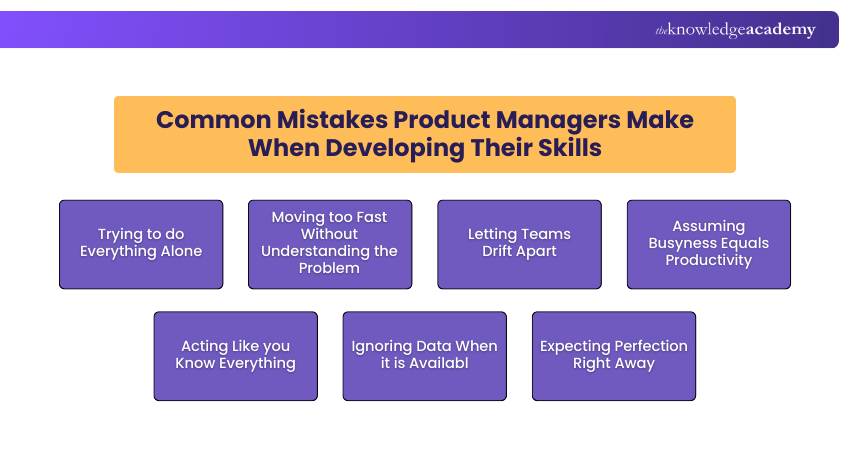
a) Trying to do Everything Alone: Assimilating a lot into a personal frail system hinders collaborative work and leads to minimal success.
b) Moving too Fast Without Understanding the Problem: Developing features without initially validating the problem is usually a waste of time.
c) Letting Teams Drift Apart: Absence of marketing, engineering, and leadership alignment can derail product focus.
d) Assuming Busyness Equals Productivity: A packed schedule can conceal the absence of meaningful progress.
e) Acting Like you Know Everything: The absence of questioning and admissions of ignorance undermines trust and growth.
f) Ignoring Data When it is Available: While analytic approaches predicate that decision-making is free from isolated, discretionary anecdotal instincts, immunity thereto would lead to erroneous conclusions.
g) Expecting Perfection Right Away: Product management is an iterative process that rules out starting all operations without any prior preparation, thus leading to the elimination of unrealistic pressure.
Conclusion
Every Product Manager takes it as an ongoing journey to develop strong skills. As markets change and customers evolve, being adaptable is the key. The overcoming of difficulties and the formation of good habits all contribute to one’s confidence being built. By taking the right path to Product Manager Skills, professionals are capable of yielding impactful results and facilitating the success of the product in the long run.
Unlock your global business potential by joining our Import Export Course!
Frequently Asked Questions
What are the Top 3 Responsibilities of a Product Manager?

A Product Manager’s top three responsibilities are defining product strategy, prioritising features based on user and business needs, and guiding cross-functional teams to deliver successful outcomes.
What are the Three Pillars of Product Management?
A Product Manager’s three core pillars are strategy, execution, and customer understanding, which guide successful product development and decision-making.
What are the Other Resources and Offers Provided by The Knowledge Academy?
The Knowledge Academy takes global learning to new heights, offering over 3,000+ online courses across 490+ locations in 190+ countries. This expansive reach ensures accessibility and convenience for learners worldwide.
Alongside our diverse Online Course Catalogue, encompassing 19 major categories, we go the extra mile by providing a plethora of free educational Online Resources like Blogs, eBooks, Interview Questions and Videos. Tailoring learning experiences further, professionals can unlock greater value through a wide range of special discounts, seasonal deals, and Exclusive Offers.
What is The Knowledge Pass, and How Does it Work?
The Knowledge Academy’s Knowledge Pass, a prepaid voucher, adds another layer of flexibility, allowing course bookings over a 12-month period. Join us on a journey where education knows no bounds.
What are the Related Courses and Blogs Provided by The Knowledge Academy?
The Knowledge Academy offers various Industry Training including the Facilitation Skills Training Course and Basic Barista Course, and the Facilities Management Training Course. These courses cater to different skill levels, providing comprehensive insights into Motivation.
Our Business Skills Blogs cover a range of topics related to Project Management, offering valuable resources, best practices, and industry insights. Whether you are a beginner or looking to advance your Communication skills, The Knowledge Academy's diverse courses and informative blogs have got you covered.

The Knowledge Academy


Global Training Provider
The Knowledge Academy is a world-leading provider of professional training courses, offering globally recognised qualifications across a wide range of subjects. With expert trainers, up-to-date course material, and flexible learning options, we aim to empower professionals and organisations to achieve their goals through continuous learning.

Upcoming Business Skills Resources Batches & Dates
Date
 Product Management Training
Product Management Training
Fri 17th Apr 2026
Product Management Training
Fri 17th Jul 2026
Product Management Training
Fri 9th Oct 2026

 If you wish to make any changes to your course, please


