




We may not have the course you’re looking for. If you enquire or give us a call on +1 7204454674 and speak to our training experts, we may still be able to help with your training requirements.
How to Bypass ChatGPT Filter: Exploring Potential Risks
ByVishnu SankarLast updated on: 18 September 2026
Understand what ChatGPT Filters are, why they support safer AI interactions, and the risks associated with attempting to bypass them. Explore ethical, legal, privacy, security, and misinformation concerns while learning why responsible AI use matters.
As the use of AI language models like ChatGPT becomes more widespread, the need to filter and control the content generated by these systems becomes crucial. While filters are designed to prevent the dissemination of harmful or inappropriate material, some individuals may attempt to bypass these safeguards. In this blog, we will expand on how to bypass ChatGPT filters, their potential risks, and the measures needed to ensure responsible use.
Understanding ChatGPT Filters
ChatGPT Filters are mechanisms integrated into the AI system that assess and restrict the output to stop the generation of inappropriate or harmful content. These filters use a combination of Natural Language Processing (NLP) algorithms and human moderation to maintain the quality and safety of the AI-generated responses.
Although ChatGPT filters support safer AI use, some users may still try to bypass them. This can create ethical, legal, privacy, and security risks, and it can also violate platform rules. Understanding the reasons behind this behaviour is essential to address the underlying issues effectively.
Risks Associated with Bypassing ChatGPT Filters
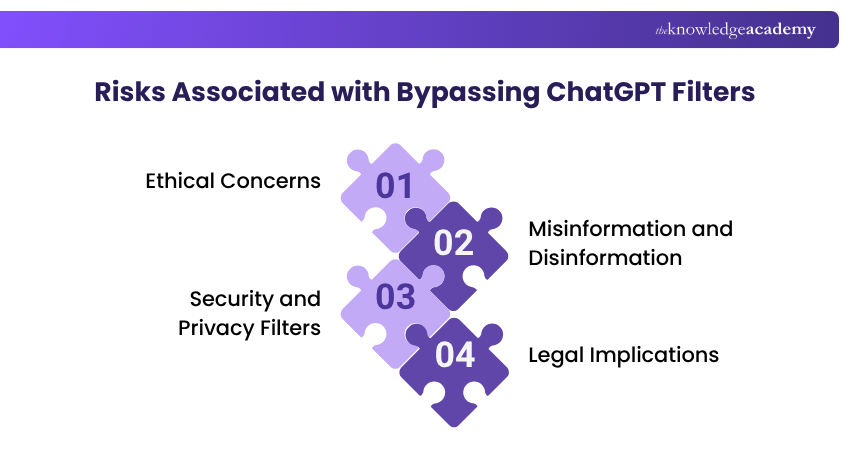
Bypassing ChatGPT Filters can have far-reaching consequences that extend beyond the immediate act of circumventing restrictions. These risks encompass ethical, social, and legal dimensions, affecting not only individual users but also entire online communities.
Ethical Concerns
Ethical considerations come to the forefront when users attempt to Bypass ChatGPT Filters. The AI language model, like ChatGPT, is designed to promote responsible and ethical communication. When filters are bypassed, users may generate content that includes hate speech, discriminatory language, or offensive material. Such content can cause harm, perpetuate biases, and marginalise vulnerable communities.
The ethical dilemma lies in balancing freedom of expression with preventing harm to others. Unfiltered content that propagates harmful ideologies or fosters animosity among users contradicts the principles of a respectful and inclusive online environment.
Misinformation and Disinformation
One of the most significant risks of bypassing ChatGPT Filters is the potential spread of misinformation and disinformation. Misinformation refers to false or inaccurate information shared unintentionally, while disinformation is the deliberate dissemination of false information to deceive or manipulate others.
When filters are circumvented, users may generate content that appears credible but contains inaccuracies or deliberately misleading information. This can mislead the public, spread baseless conspiracy theories, and contribute to the erosion of trust in reliable sources of information.
Security and Privacy Filters
Bypassing ChatGPT Filters can expose users to security and privacy risks. Unfiltered content may contain links to malicious websites, phishing attempts, or scams that target unsuspecting individuals. Users could unknowingly divulge sensitive personal information or fall victim to online fraud, leading to financial losses or identity theft.
Moreover, some individuals may use ChatGPT to seek sensitive information about others, which can be misused for malicious purposes. Bypassing filters allows such attempts to go unchecked, further compromising users' security and privacy.
Legal Implications
From a legal standpoint, bypassing ChatGPT Filters can lead to significant consequences for both users and developers. Generating and disseminating harmful or illegal content, even unintentionally, may result in legal action against the individual responsible. This could range from defamation and harassment charges to violations of Intellectual Property Rights (IPR).
For developers and platforms hosting AI language models, not effectively preventing the bypassing of filters could result in legal liabilities. They may face legal challenges for not taking adequate measures to prevent the dissemination of harmful content or for not adhering to established guidelines and regulations.
Learn about chatbot customisation and deployment with our ChatGPT Course – Register now!
Techniques for Navigating ChatGPT Response Limitations
Now that you understand the risks of trying to bypass ChatGPT filters, it is important to focus on safer and more responsible ways to use AI tools. Efforts to Bypass ChatGPT Filters involve a variety of techniques aimed at evading the system's restrictions. Understanding these methods is crucial in developing effective countermeasures to maintain the integrity and safety of AI-generated responses.
Altering Text and Syntax
One common method used to navigate ChatGPT response is by altering the text and syntax of the input. Users may modify certain words, phrases, or sentence structures to avoid triggering the filter while still conveying the intended message. Such modifications can be subtle, making it challenging for the filter to detect potentially harmful or inappropriate content.
By employing slight changes in punctuation, capitalisation, or sentence order, users may attempt to manipulate ChatGPT's understanding of the query. This tactic aims to exploit the model's limitations in interpreting nuanced variations of language, thereby bypassing the filter's restrictions.
Using Synonyms and Antonyms
Another approach to bypass filters involves replacing potentially problematic words with synonyms or antonyms. By substituting words with similar or opposite meanings, users aim to maintain the intended message while avoiding the detection of specific keywords that might trigger the filter.
This method capitalises on the wide vocabulary knowledge of AI language models like ChatGPT. However, as AI systems become more advanced, they can recognise such word substitutions and still identify inappropriate or harmful content.
Incorporating Images and Media
To circumvent textual scrutiny, users may attempt to include images or media along with their textual input. By using images, memes, or multimedia content, users hope to influence the AI's response without relying solely on textual communication.
The integration of images allows users to introduce concepts, ideas, or emotions that might not be directly stated in the text. By manipulating the context or connotations of accompanying media, users can steer the AI-generated output in the desired direction while avoiding the filter's detection.
Exploiting Context and Ambiguity
Users might employ ambiguous phrasing or context to bypass ChatGPT filters successfully. Ambiguous statements can be interpreted in multiple ways, and users may rely on this ambiguity to receive an AI-generated response that aligns with their intent.
Contextual exploitation involves providing incomplete information or framing the query in a way that influences ChatGPT's interpretation. By strategically guiding the AI's understanding of the prompt, users seek to receive responses that might not be possible with straightforward or explicit queries.
Pro Tip:
AI safeguards are designed to guide safer interactions. If a response is restricted, improving the prompt with clearer context, purpose, and wording can often produce a more useful response without attempting to bypass safeguards.
Explore creative and technical use cases for ChatGPT with our ChatGPT Prompt Engineering Certification Course – Join now!

Vishnu Sankar is a Senior Content Writer with 5+ years of experience across content development, software development, web development and system administration. His technical background and professional training support his expertise in IT and Tech, while his extensive research and writing experience covers Project Management and Health and Safety.
View Detail

 If you wish to make any changes to your course, please


