




We may not have the course you’re looking for. If you enquire or give us a call on +1 7204454674 and speak to our training experts, we may still be able to help with your training requirements.
Docker Swarm vs Kubernetes Explained: Key Differences
ByLily TurnerLast updated on: 15 July 2026
Docker Swarm vs Kubernetes is a comparison between simplicity and ease of use versus advanced features, scalability, and robust container orchestration. Two powerful container orchestration tools, each having unique strengths, so choosing the right one depends on your project’s size, complexity, and infrastructure needs.

You’ve got containers, but now what? Managing them is a whole new challenge. Enter the titans of orchestration:Docker Swarm vs Kubernetes. One is the enterprise-grade powerhouse running at the heart of the cloud-native revolution. The other? A lean, mean, deployment machine perfect for fast-moving teams.
Kubernetes bring powerful scalability and control. Docker Swarm shines with its simplicity and speed. In this blog, we unpack the features, real-world strengths, and trade-offs of both tools. Whether you’re scaling an app to thousands or just starting your container journey, this helps you make the right call, without a migraine.
Table of Contents
1) What is Docker Swarm?
2) What is Kubernetes?
3) Difference Between Kubernetes and Docker Swarm
4) What is the Primary Purpose of Kubernetes and Docker Swarm?
5) What are the Real-world Use Cases of Docker Swarm vs Kubernetes?
6) Conclusion
What is Docker Swarm?
Docker Swarm is Docker’s native tool for orchestrating and managing clusters of Docker containers. It turns a group of Docker engines into a single, virtual Docker host. This allows you to deploy, scale, and manage containers across multiple servers easily. It is a practical choice for teams looking for a lightweight and easy-to-use orchestration solution.
Key Features:
1) Creating a swarm cluster by joining multiple Docker hosts
2) Deploying services using simple YAML configurations
3) Distributing containers across nodes for load balancing
4) Managing container scaling and failover
5) Using Docker CLI commands you're already familiar with

What is Kubernetes?
Kubernetes is a powerful open-source platform that automates the deployment, scaling, and management of containerised applications. Originally developed by Google, it is now maintained by the Cloud Native Computing Foundation (CNCF). Kubernetes has become the industry standard for container orchestration, widely adopted by enterprises for its robustness, flexibility, and scalability.
Key Features:
1) Deploy and manage containers across a cluster of machines
2) Scale applications automatically based on demand
3) Ensure high availability through self-healing
4) Roll out updates or rollbacks with minimal downtime
5) Define complex networking, storage, and configuration rules
Check out our Kubernetes Training and learn to build, deploy and maintain the project.
Difference Between Kubernetes and Docker Swarm
Kubernetes and Docker Swarm are both powerful container orchestration tools, but they differ in setup, complexity, scalability, and ecosystem support. Here are the key differences across various aspects:
Setup and Installation
Kubernetes offers powerful orchestration but has a more complex setup, while Docker Swarm is simple to install and ideal for quick deployment. Here is a comparison on how both differ in terms of setup complexity, required tools, and ease of getting started.

Scalability
Kubernetes supports advanced, automated scaling for large environments; Docker Swarm scales well manually but lacks built-in autoscaling. Here is a comparison on how both differ in terms of scalability:

Extensibility
Kubernetes is highly extensible with custom resources and plugins, whereas Docker Swarm offers limited flexibility and integrations. Here is an elaborated difference:
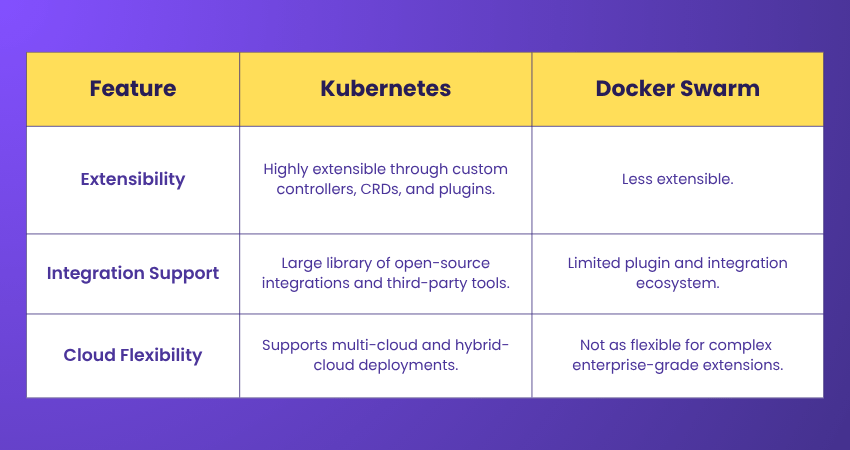
In contrast, Docker Swarm is simpler to set up and use, but lacks the depth and ecosystem support Kubernetes provides.
Dev meets Ops. You meet success. Start learning DevOps Engineering Foundation Course now!
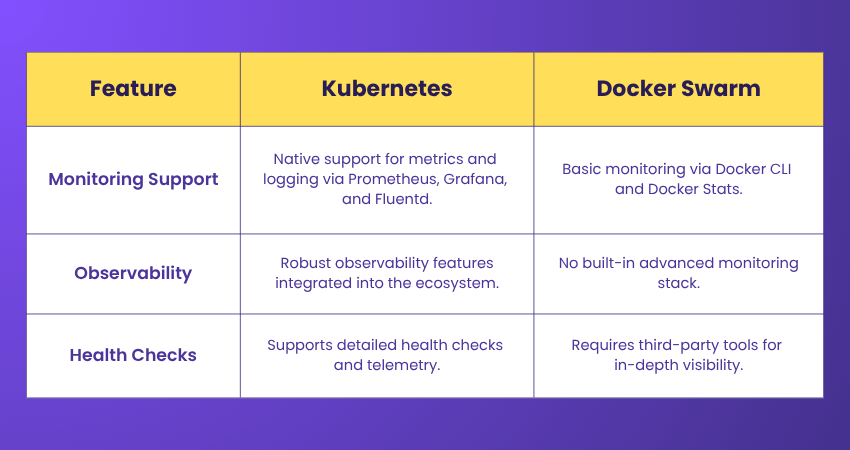
Monitoring
Kubernetes supports native monitoring tools and telemetry integration; Docker Swarm needs third-party tools for advanced visibility. Here is a comparison on how both differ in terms of monitoring:
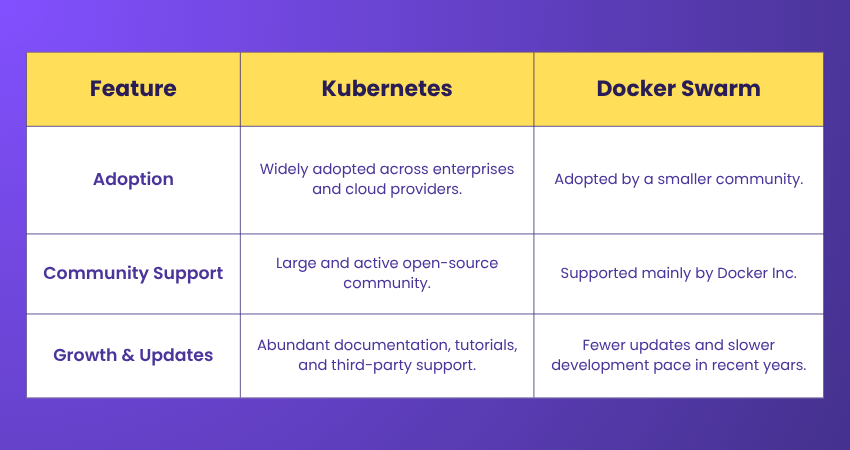
Community and Adoption
Kubernetes boasts broad industry adoption and a vast open-source community; Docker Swarm has a smaller, less active user base. Here is a comparison on how both differ in terms of Community and Adoption:
Security Features
Kubernetes provides granular access control and policy enforcement, while Docker Swarm offers basic encryption and secret management. Here is a table to compare their security features:

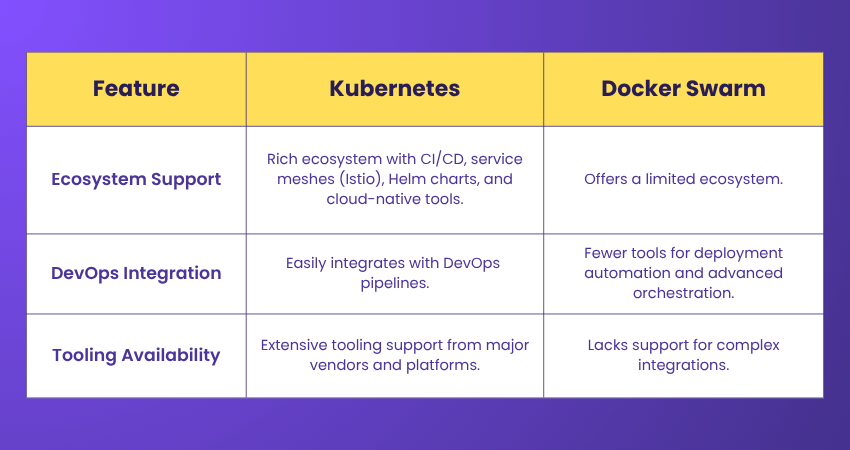
Ecosystem and Tooling
Kubernetes has a rich ecosystem of tools and DevOps integrations; Docker Swarm has limited support for complex workflows. Here is a comparison on how both differ in terms of ecosystem and tooling:
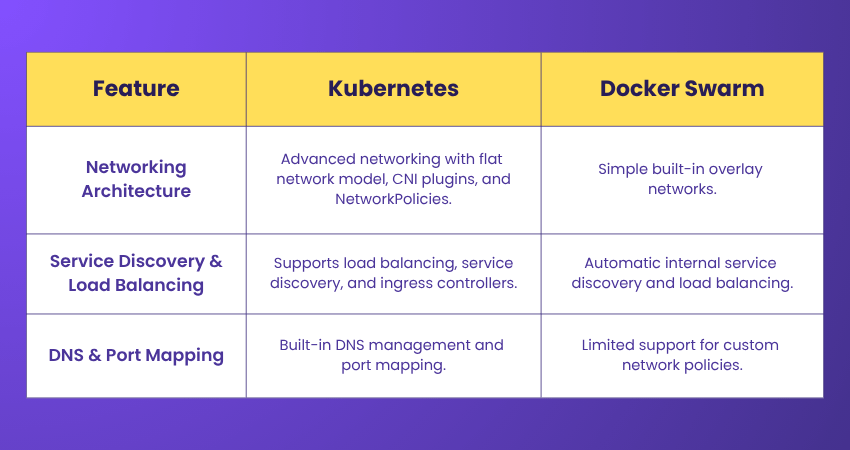
Networking Capabilities
Kubernetes offers advanced networking with policies and plugins; Docker Swarm uses simpler, built-in overlay networks. Here is a comparison based on their networking capabilities:
GUI Support
Kubernetes supports a native dashboard and third-party GUIs; Docker Swarm lacks an official GUI but works with tools like Portainer. Here is the differentiation based on their support system:

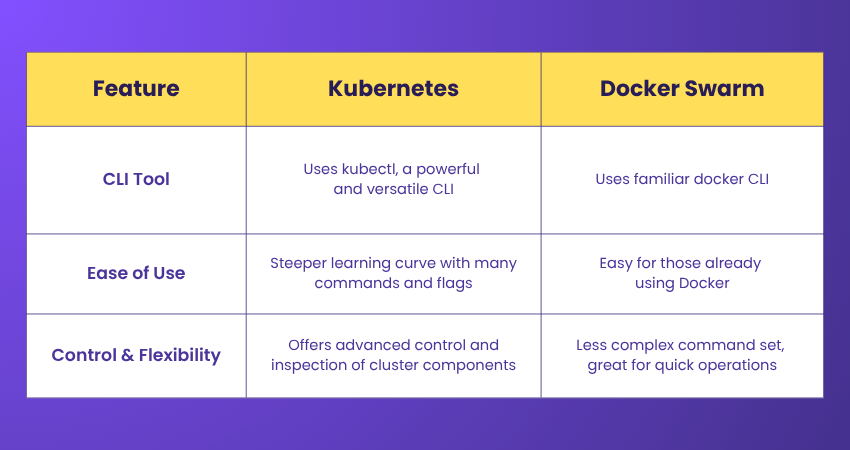
Command-line Tools
Kubernetes uses the versatile kubectl CLI with deep control; Docker Swarm leverages the simpler, familiar docker CLI. Here is a comparison on how both differ:
What is the Primary Purpose of Kubernetes and Docker Swarm?
Kubernetes and Docker Swarm are both container orchestration tools, but they serve the same core purpose; to manage and scale containers efficiently. They help automate tasks such as deployment, load balancing, and service discovery, making it easier to run applications in a distributed environment.
Kubernetes offers advanced features for complex workloads, while Docker Swarm is simpler and easier to set up for smaller projects. Both aim to improve reliability and speed by coordinating how containers work together across multiple systems.
Secure your Devops pipeline- Register at our Certified DevOps Security Professional (CDSOP) Course now!
What are the Real-world Use Cases of Docker Swarm vs Kubernetes?
Docker Swarm:
1) Rapid deployment of small-to-medium microservices
2) Lightweight orchestration for startups and dev teams
3) Simple CI/CD pipelines with minimal infrastructure
4) Temporary or test environments needing quick setup
Kubernetes:
1) Managing large-scale production environments
2) Multi-cloud or hybrid-cloud application deployments
3) Complex microservices architecture with autoscaling
4) Enterprises needing high availability, failover, and observability
Conclusion
So, after studying Docker Swarm Vs Kubernetes, which one wins? Well, it depends on your game plan. If you're building a massive, complex system and need serious muscle, Kubernetes is your go-to. But if you want something quick, simple, and efficient, Docker Swarm keeps things smooth and stress-free. The real win? Choosing the tool that fits your team, your goals, and your growth. Containers are the future so just pick the right captain to steer the ship!
It's time to simplify software delivery – Enhance skills with our DevOps Certification now!

Lily Turner is a data science professional with over 10 years of experience in artificial intelligence, machine learning, and big data analytics. Her work bridges academic research and industry innovation, with a focus on solving real-world problems using data-driven approaches. Lily’s content empowers aspiring data scientists to build practical, scalable models using the latest tools and techniques.
View Detail

 If you wish to make any changes to your course, please


