


We may not have the course you’re looking for. If you enquire or give us a call on +1 7204454674 and speak to our training experts, we may still be able to help with your training requirements.
Top Digital Twin Benefits for Businesses
ByThe Knowledge AcademyLast updated on: 17 November 2026
Digital twin benefits help businesses improve product quality, operational efficiency and decision-making through data-driven virtual models. From faster product development to stronger supply chain resilience, digital twins offer opportunities to reduce risks, optimise resources and support business innovation.
At a Glance
1. Digital twins use real-world data for monitoring, analysis and simulation.2. They improve product quality, support predictive maintenance and accelerate development.3. They support sustainability, supply chain resilience and operational efficiency.4. Their effectiveness depends on accurate data, reliable models and system integration.
What if businesses could test a product, identify equipment problems, or explore supply chain disruptions before making costly real-world decisions? Digital twins make this possible by connecting virtual representations with data from real-world systems.
It is a virtual representation of a physical object, system or process that uses real-world data to support monitoring, analysis and simulation. It integrates information from sources such as sensors, Internet of Things (IoT) devices and historical records to keep the model updated at an appropriate frequency.
By using digital twins, organisations can monitor performance, simulate different scenarios, and spot opportunities for improvement. These capabilities are changing how industries approach product development, operations, and long-term planning.
Top Benefits of Digital Twins
Digital twins can provide a wide range of benefits across industries, including manufacturing, supply chain management, healthcare, and infrastructure. Let's learn about the top ones below:
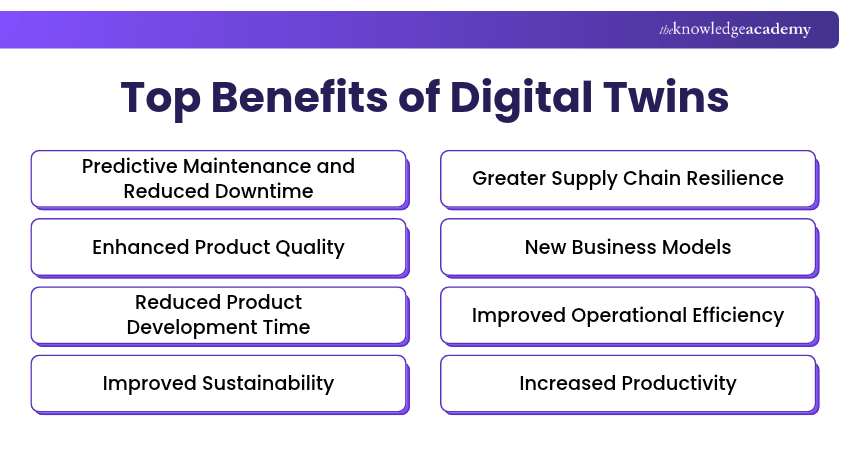
1) Predictive Maintenance and Reduced Downtime
Digital twins can help organisations predict equipment problems and reduce unplanned downtime by monitoring asset performance and analysing operational data. By identifying unusual patterns in equipment conditions, businesses can spot potential faults before they lead to failures.
For example, a manufacturing company may use a digital twin to monitor machinery performance and assess when maintenance is required. This supports timely repairs, reduces unnecessary maintenance and helps maintain operational continuity.

2) Enhanced Product Quality
Digital twins can help improve product quality by enabling faster and more informed testing, validation, and verification. By simulating different scenarios and conditions, digital twins can help spot and resolve potential issues and defects before they affect the physical product.
Digital twins can also help optimise product design and performance while reducing waste and errors. However, simulation results must be validated against real-world data, and physical testing may still be necessary to confirm product quality and safety.
3) Reduced Product Development Time
Digital twins can help reduce product development time by accelerating and streamlining design, prototyping, and manufacturing processes. By utilising digital models and simulations, businesses can reduce the number of physical prototypes and trials required, enabling faster iterations and feedback.
Digital twins can also help reduce costs and risks associated with product development by allowing teams to evaluate design alternatives before committing resources to physical production.
Pro Tip
Before running a design simulation, define the performance limits the product must meet, such as temperature tolerance, load capacity, or energy consumption. This makes the results easier to evaluate against specific design requirements.
4) Improved Sustainability
Digital twins can help promote sustainability by enabling more efficient use of resources and energy. By monitoring and analysing the environmental impact of products and processes, digital twins can help identify opportunities to reduce emissions, waste, and resource consumption.
For example, a building operator can use a digital twin to compare heating, ventilation and cooling settings to identify opportunities for reducing energy consumption while maintaining indoor comfort.
5) Greater Supply Chain Resilience
Supply chain digital twins can enhance agility and resilience by improving visibility into the flow of materials, goods, and information. Using integrated data from sensors, Radio Frequency Identification (RFID), GPS, and business systems, they can help organisations track the location, status and condition of assets and inventory.
They can also help organisations assess potential disruptions and evaluate alternative routes, suppliers, or inventory arrangements. These capabilities support better contingency planning and help businesses respond more effectively to supply chain risks.
Trainer's insight
A supply chain digital twin is only as useful as the information available to it. Businesses should identify data gaps between suppliers, logistics partners and internal systems before relying on simulations to guide disruption planning.
6) New Business Models
Digital twins can help create new business opportunities and revenue streams by enabling different ways of delivering value. By using data and insights from digital twins, businesses can offer services such as predictive maintenance, performance optimisation and remote assistance.
For example, equipment manufacturers can offer condition-monitoring services alongside their physical products. Instead of relying solely on product sales, businesses can explore ongoing service contracts that support maintenance, reliability, and customer relationships.
7) Improved Operational Efficiency
Digital twins can help improve operational efficiency by enabling smarter and faster decision-making. By using data and analytics from digital twins, businesses can develop a deeper understanding of their operations and performance and identify opportunities for improvement.
Digital twins can also help organisations evaluate process adjustments, equipment settings and maintenance schedules before applying changes to physical operations. When integrated with suitable control and automation systems, they may also support automated operational responses.
Learn how to turn connected data into intelligent decisions with the Internet of Things IoT Systems and Applications Training now!
8) Increased Productivity
Digital twins can help boost productivity by enabling more effective team collaboration and information sharing. By using shared digital representations and supporting platforms, teams can access consistent information about assets, processes and ongoing activities, including when working across different locations.
For example, engineering and maintenance teams can review the same digital model to understand equipment conditions, coordinate repairs, and prepare technical instructions. This can reduce communication gaps and support more efficient collaboration across departments.
Bonus Tip
When evaluating productivity improvements, compare task completion times and rework rates before and after introducing a digital twin. This helps distinguish measurable improvements from perceived gains in collaboration.

The Knowledge Academy develops accessible learning content across Project Management, IT, Cybersecurity, Data Science, Business Analysis, HR, Accounting and Finance, Leadership and Health and Safety. Its resources combine subject research with clear explanations to help professionals build practical knowledge across a wide range of disciplines.
View Detail

 If you wish to make any changes to your course, please


