


We may not have the course you’re looking for. If you enquire or give us a call on 01344203999 and speak to our training experts, we may still be able to help with your training requirements.
Benefits of P3O®: A Complete Guide
ByDavid EvansLast updated on: 17 September 2026
Discover the key Benefits of P3O, its core components, and how it supports strategic alignment, decision-making, resource utilisation, governance, and consistent delivery.

Picture this: your organisation has the right projects, talented teams and ambitious goals. Yet priorities compete, resources overlap, and decision-makers struggle to see whether all that activity is moving the business in the right direction.
That’s the challenge P3O is designed to address. The Benefits of P3O become clearer when portfolios, programmes and projects need to work as one connected system rather than separate pieces of change.
So, what happens when strategy, governance and delivery finally start speaking the same language?
From clearer portfolio visibility to smarter decisions and stronger governance, the Benefits of P3O can help organisations turn complex change into coordinated and strategically focused action. Let’s learn more about it in the blog!
What is P3O®?
Portfolio, Programme and Project Offices (P3O) is management guidance that helps organisations support and coordinate their portfolios, programmes and projects. It provides structures, tools and guidance to improve decision-making, governance, resource management and strategic alignment.
P3O allows organisations to develop a model suited to their specific needs. A P3O model can provide functions such as information and analysis, governance support, standards, assurance and specialist expertise across portfolio, programme and project environments.

What are the Components of a P3O® Model?
A P3O model can contain different component offices according to organisational requirements. Let's look at the important components below:
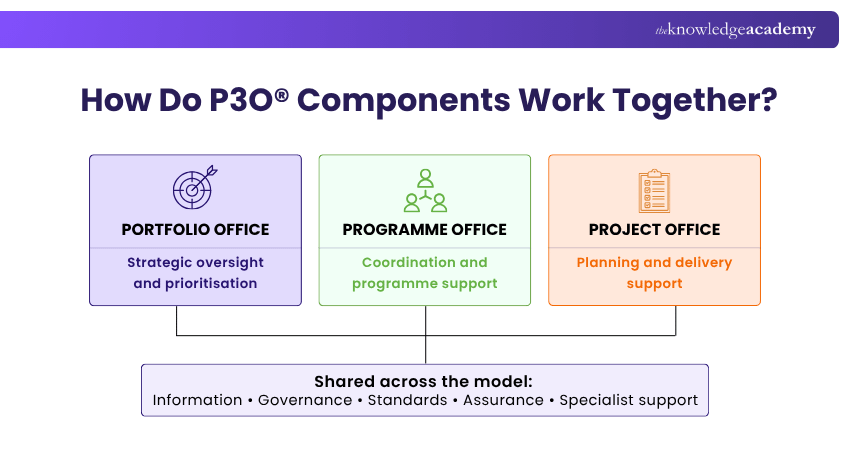
1) Portfolio Office
The Portfolio Office supports strategic decision-making by providing oversight of the organisation’s portfolio of programmes and projects. It takes a broader view of investments and change initiatives rather than focusing on individual projects.
Its role is to help decision-makers evaluate strategic alignment, priorities, risks, resources and expected value across the portfolio. This helps ensure that programmes and projects support organisational strategy and deliver value to the business.
2) Programme Office
The Programme Office supports programmes within the organisation, assisting Programme Managers and helping coordinate programme activities. Monitoring programme performance and progress facilitates communication between projects within the programme.
This coordination is particularly important where multiple related projects contribute to shared outcomes. A Programme Office can help consolidate information, maintain standards, coordinate dependencies and provide management support across those projects.
3) Project Office
The Project Office mainly focuses on individual projects, providing support and guidance to Project Managers. It can support Project Management processes, monitor project progress and performance, and help manage information relating to risks and issues.
Depending on the P3O design, the Project Office may provide planning, reporting, administrative and specialist support. It can also help coordinate project activities, provide expert guidance and maintain consistent standards across the project environment.
Pro Tip
Don’t assume every organisation needs every P3O component in the same form. Choose the components and services according to the organisation’s scale, complexity and management needs.
What are the Benefits of P3O®?
The Benefits of P3O arise from bringing appropriate information, governance, support and decision-making capabilities into a coordinated model. Let’s look at some of the core benefits below:
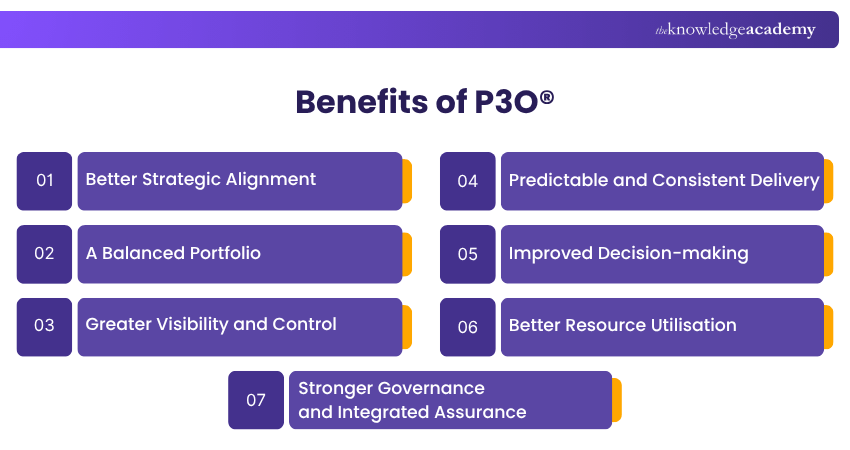
1) Better Strategic Alignment
P3O helps connect portfolios, programmes and projects with the organisation’s wider strategy. It allows decision-makers to assess whether change initiatives support key priorities and expected business value.
This helps organisations focus attention and investment on initiatives that contribute most effectively to strategic objectives, rather than evaluating each project in isolation.
Pro Tip
When reviewing an initiative, ask more than “Does it have a valid business case?” Consider how strongly it supports current strategic priorities and what value it contributes alongside other initiatives.
2) A Balanced Portfolio
P3O supports a balanced portfolio by helping organisations evaluate programmes and projects collectively. It provides a broader view of strategic contribution, available resources, risks and competing priorities.
This enables more considered investment and resource decisions while reducing the risk of overcommitting to one area at the expense of other important priorities.
3) Greater Visibility and Control
P3O improves visibility by providing a clearer, consolidated view of programme and project performance. Stakeholders can monitor progress, milestones, risks and other important information across multiple initiatives.
Consistent reporting also helps decision-makers identify issues and dependencies earlier. The aim is to provide useful information that supports timely action, rather than simply producing more reports.
4) Predictable and Consistent Delivery
P3O supports more predictable and consistent delivery by establishing common standards, procedures and governance across programmes and projects. This reduces unnecessary variation in how management activities are performed.
Greater consistency also makes it easier to compare performance, share knowledge and provide effective oversight. However, P3O does not guarantee successful delivery; it creates stronger conditions for managing work in a controlled and consistent way.
5) Improved Decision-making
P3O provides relevant information and analysis to help stakeholders make informed decisions about priorities, risks, performance and opportunities. It creates a more consistent evidence base for evaluating programmes and projects.
This can help leaders decide whether to continue an initiative, redirect resources, address emerging risks or adjust portfolio priorities based on changing circumstances.
6) Better Resource Utilisation
P3O provides greater visibility of resource demand across portfolios, programmes and projects. This helps organisations allocate people, funding and specialist capabilities according to strategic priorities.
Rather than allowing individual projects to compete for resources independently, decision-makers can consider requirements collectively. This can reduce unnecessary duplication and direct limited resources towards higher-value work.
Trainer’s Insight
Effective resource utilisation is not about keeping every person at maximum capacity. It is about directing limited people, funding and specialist capabilities towards work that provides the greatest strategic value.
7) Stronger Governance and Integrated Assurance
P3O strengthens governance by establishing clearer responsibilities, decision-making structures, reporting arrangements and oversight across portfolios, programmes and projects.
Integrated assurance supports this by providing greater confidence that appropriate controls, reviews and standards are being followed. Together, they create more coordinated oversight of performance, risk and compliance.
Learn to connect strategy, support and delivery with our P3O® Foundation & Practitioner Training – Sign up now!

David Evans creates accessible resources that help professionals understand different approaches to planning and delivering projects. His content addresses changing requirements, collaborative working and the practical demands of contemporary project environments.
View Detail

 If you wish to make any changes to your course, please


