


We may not have the course you’re looking for. If you enquire or give us a call on 01344203999 and speak to our training experts, we may still be able to help with your training requirements.
Top Benefits of MSP for Organisations
ByThe Knowledge AcademyLast updated on: 10 November 2026
Managing Successful Programmes (MSP®) helps organisations manage complex programmes, strengthen governance and align change with strategic objectives. Explore the key benefits of MSP, along with best practices for achieving programme outcomes.

Quick Overview
1. MSP helps organisations connect programme activities with long-term business objectives.2. Clearly defined roles and governance structures support accountability and informed decision-making.3. Effective stakeholder engagement and change management help organisations prepare for new ways of working.4. Coordinated resource planning and risk management support smoother programme delivery.5. Regular performance reviews and benefits tracking help organisations assess progress and achieve intended outcomes.
In today's complex business landscape, organisations face multiple challenges when delivering successful programmes. Managing Successful Programmes (MSP®), now known as PRINCE2 Programme Management (Version 5), provides a structured framework of principles, themes and processes for managing programmes and supporting organisational objectives.
By clarifying programme objectives, MSP helps reduce ambiguity and foster a shared understanding of what needs to be achieved. In this blog, we will explore the key benefits of MSP and the best practices that can help organisations achieve them. Let's get started!
Top Benefits of MSP
Managing Successful Programmes (MSP) is a structured framework that helps organisations manage programmes of change and work towards strategic outcomes. The framework supports complex programmes by establishing clear objectives, strengthening governance, managing change and supporting benefits realisation. Here are the key benefits of applying MSP:
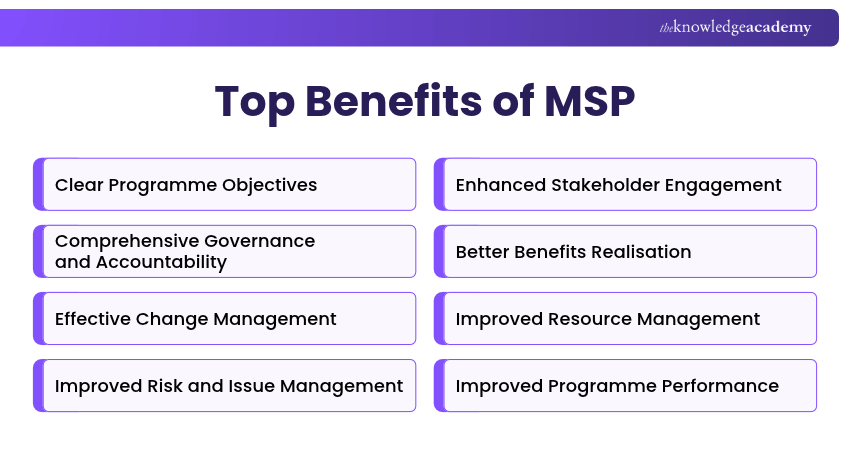
1) Clear Programme Objectives
MSP emphasises the importance of defining a clear programme vision and objectives. It helps stakeholders understand the desired outcomes, align their efforts and work towards common goals. This clarity reduces ambiguity, supports informed decision-making and helps keep programme activities aligned with organisational priorities.

2) Comprehensive Governance and Accountability
MSP provides a structured governance framework with clearly defined roles, responsibilities and decision-making authority. This helps organisations maintain transparency, monitor progress and establish accountability throughout the programme. Effective governance also supports timely decisions and better programme control.
3) Effective Change Management
MSP supports organisations in managing change by preparing and engaging stakeholders affected by the programme. It encourages clear communication, assessment of change impacts and support for people affected by new processes, systems or ways of working. This helps address concerns, improve readiness for change and encourage the adoption of new working practices to support sustainable organisational improvements.
4) Improved Risk and Issue Management
MSP provides a structured approach to identifying, assessing and managing programme risks and issues. It helps organisations anticipate potential challenges, develop suitable responses and address emerging problems promptly. This can reduce disruptions, minimise avoidable delays and improve programme resilience.
5) Enhanced Stakeholder Engagement
MSP encourages organisations to identify key stakeholders, understand their expectations and maintain regular communication throughout the programme. By involving stakeholders in relevant discussions and decisions, organisations can address concerns, strengthen relationships and gain greater support for programme objectives.
6) Better Benefits Realisation
MSP helps organisations identify expected programme benefits, establish measurable targets and monitor progress towards achieving them. By assigning clear ownership and reviewing outcomes, organisations can assess whether programme changes deliver the intended value and contribute to long-term strategic objectives. Benefits may continue to be realised after the programme closes, so ongoing measurement and ownership are important.
Trainer's Insight
Consider an organisation introducing a new Customer Relationship Management (CRM) system. Completing the implementation is a programme deliverable, but the real benefits may include faster customer responses or improved service quality. MSP encourages organisations to measure these improvements rather than treating delivery alone as success.
7) Improved Resource Management
MSP supports coordinated resource planning across projects within a programme. By identifying resource requirements, managing dependencies and reviewing competing priorities, organisations can allocate people, time and other resources more effectively. This helps reduce resource conflicts and supports smoother programme delivery.
8) Improved Programme Performance
MSP encourages organisations to review programme performance, evaluate outcomes and apply lessons learnt throughout the programme lifecycle. By identifying areas for improvement and adjusting plans and management approaches, organisations can strengthen programme delivery and apply lessons to future initiatives.
Plan, coordinate, and control programmes by joining the MSP® Foundation Training now!
Best Practices for Maximising the Benefits of MSP
While MSP provides a structured approach to programme management, achieving its benefits depends on how effectively organisations apply the framework. Here are some best practices that can help organisations get greater value from MSP:
a) Tailor MSP to Programme Requirements: Adapt MSP to the programme's size, complexity, and organisational needs. This helps maintain appropriate governance and control without introducing unnecessary processes.
b) Define Measurable Benefits and Ownership: Identify the expected benefits, establish suitable measures and assign clear ownership. This helps organisations track progress and maintain accountability for realising programme outcomes.
c) Monitor Outcomes and Adjust Programme Plans: Regularly review programme performance, changing priorities and progress towards expected benefits. Use these findings to update plans, address emerging concerns and maintain alignment with organisational objectives.
d) Embed Changes into Business Operations: Prepare employees and operational teams to adopt new processes, systems or working practices. Providing suitable support and maintaining ownership of benefits can help organisations sustain improvements after the relevant changes have been introduced and the programme has closed.
Keep This in Mind
A programme is not successful simply because all its projects are completed on time. What truly matters is whether the programme delivers the intended outcomes and realises the expected organisational benefits. MSP helps keep this bigger picture in focus, supporting the connection between programme delivery and long-term business value.
Enhance your programme leadership capabilities with MSP® Practitioner Training – Sign up now!

The Knowledge Academy develops accessible learning content across Project Management, IT, Cybersecurity, Data Science, Business Analysis, HR, Accounting and Finance, Leadership and Health and Safety. Its resources combine subject research with clear explanations to help professionals build practical knowledge across a wide range of disciplines.
View Detail

 If you wish to make any changes to your course, please


