


 Top Rated Course

We may not have the course you’re looking for. If you enquire or give us a call on +43 720 115337 and speak to our training experts, we may still be able to help with your training requirements.
What is Flexible Budget? An Ultimate Guide
The Knowledge Academy 12 February 2026Curious about What is Flexible Budget? This is a powerful budgeting model that allows businesses to make changes or adjustments in their business activities. The changes take place in production volume and sales, etc. In this blog, you will dive into the fundamentals, its structure, benefits and applications across various industries.

Training Outcomes Within Your Budget!
We ensure quality, budget-alignment, and timely delivery by our expert instructors.
Table of Contents

Picture this: you set a budget for the month, but halfway through, demand spikes or costs unexpectedly rise. Do you stick to the original plan or adapt to the situation? That’s exactly where a Flexible Budget steps in. So, What is Flexible Budget, and why does it matter? Unlike a fixed budget that stays the same, a Flexible Budget moves with your actual revenue and expenses.
A rigid plan can hold you back, but a Flexible Budget ensures you’re always a step ahead. In this guide, we’ll break down What is Flexible Budget, how it works, and why it’s a game-changer. Ready to rethink your budgeting strategy? Let’s dive in!
Table of Contents
1) What is a Flexible Budget?
2) Types of Flexible Budgets
3) Creating a Flexible Budget
4) Benefits of Implementing a Flexible Budget
5) Drawbacks of Employing a Flexible Budget
6) Effective Strategies for Successful Flexible Budgeting
7) Flexible vs Static Budgets
8) Flexible Budgeting Example
9) Conclusion
What is a Flexible Budget?
A Flexible Budget is an essential type of Budget that targets businesses in a changing environment. It works in alignment with business cost variations. The Budget contains a variable rate per unit to identify potential increments or decrements in finance needs. Usually, the changes are based on the company's revenue.
It has two parts: Fixed cost and variable cost. The fixed cost section has a fixed cost portion, and the variable cost section has a variable cost portion. The Budget is created depending on the behaviour of fixed and variable costs.
A flexible budget is more advanced than a Static Budget, where the finance team spends a considerable amount of time creating a budget. Often, businesses find themselves in trouble because of the Traditional Budgeting system. But no worries; a Flexible Budget overcomes the hardships of a Static Budget and provides a full-proof system. The system is also beneficial in unpredictable and volatile markets as well.

The Levels of Flexible Budget
Three levels of Flexible Budget are briefly mentioned below:
1) Foundational Flexible Budgeting
It’s the basic Flexible Budgeting level that changes expenditure relating to revenues. Expenses at a particular revenue level can be calculated by multiplying actual revenue with the finance percentage. It provides an accurate, flexible budget compared to a static budget. The only drawback is that all the details are not provided.
2) Intermediate Flexible Budgeting
Account expenses that exceed the company's revenue fall under the Intermediate Flexible Budgeting. Since revenue is a vital component when it comes to decision-making, this level includes measures of benefits and salaries of employees within the company.
3) Advanced Flexible Budgeting
In Advanced Flexible Budgeting, fixed and variable costs are included as per changes in business activity levels. The goal of this level is to come up with a clear picture of all levels of activity.
Creating a Flexible Budget
Now, you have understood why a Flexible Budget is essential for business growth. Let’s move on to the next step. Here’s how you can craft a successful Flexible Budget plan step by step:
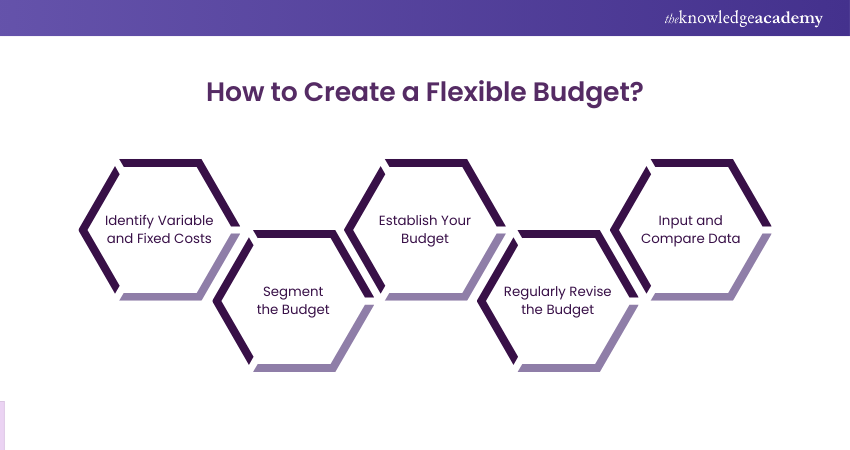
1) Identify Variable and Fixed Costs
The very first thing you need to perform while drafting a Flexible Budget is to identify the company's fixed and variable costs. Fixed costs include insurance, budgets surrounding marketing, and rent. Variable costs include sales through merchandise.
2) Segment the Budget
The next step is to separate both in the budget sheet depending on spending on each of them. This way, you get a cost per unit for your Budget. You need to calculate revenue and cost percentages for a particular accounting period. As per the estimate, you can adjust the cost percentage of revenue for each category.
3) Establish Your Budget
It’s time to create a budget using your variable and fixed costs. Organise both as per the activity level in budgeting software. You can use functions and formulas to come up with expected costs for the activities.
4) Regularly Revise the Budget
Regularly revising your Flexible Budget plan helps find the gap between actual and expected results. This way, you get to forecast budgets for the future.
5) Input and Compare Data
No, it’s not ended yet. Input your Flexible Budget into accounting software. It is used to compare data from actual expenses to anticipated numbers.
Turn your business idea into reality with our Entrepreneurship Course – join us now!
Benefits of Implementing a Flexible Budget
Flexible Budget has more benefits than the Static Budget. Three main advantages are as follows:
a) Parameter of Performance: A plan says a thousand words about your business than anything else. Accurate planning enables you to go in the right direction that satisfies your budget variables.
b) Cost Control: You can control your costs by predicting them soon. With a Flexible Budget, the finance team can view ahead and prepare for different scenarios. Cost control can also lower your over-budget variance.
c) Efficient Processes: A flexible Budget comes with a faster budgeting process than a static budget. Now, you can re-forecast or project calculations for scenarios.
d) Motivate Employees: Since a Flexible Budget allows adjustments with costs and revenue, employees can spend wisely to achieve desired goals.
Drawbacks of Employing a Flexible Budget
A flexible Budget has its limitations, too. It may only work for some companies. So, it’s worth knowing the drawbacks of implementing a Flexible Budget.
a) Time-consuming Calculations: The process is time-consuming as it is a complex budget. So, it demands some resources and time to create and develop a Flexible Budget. The Financial Planning and Analysis (FP&A) team can find difficulty using it.
b) Too Much Flexibility: Businesses work with other plans as well. So, the finance team’s ability to create plans gets hindered. Budget experts should handle the complexity of a Flexible Budget carefully.
c) Outdated Quickly: The predictions of a Flexible Budget have a shorter life span despite its flexibility factor. The time and effort a company invests might get invalidated in extreme situations like a pandemic.
d) Less Accountability: Flexible Budget is less accountable due to the absence of discipline. Budget owners must set definite expectations.
e) No Revenue Comparison: A Flexible Budget deals with extreme variance levels, so revenue comparison becomes impossible. This is the biggest drawback of a Flexible Budget.
f) Not Ideal Budget: A Flexible Budget is not an ideal budget as the level of precision decreases with the time and resources it demands. You can’t expect accurate financial results as variations in levels often give far projected outcomes in future.
Unlike the Static Budget, Flexible Budget requires attention to detailing. The Finance team needs to stretch harder to properly support the idea. At one point, you may find it a little challenging due to the high flexibility it offers. Accounting team may find it intimidating however with proper strategy, a Flexible Budget can be easily created.
Become an effective leader with our Supervisor Training – sign up today!
Effective Strategies for Successful Flexible Budgeting
Flexible Strategy is an essential tool for all businesses, so successfully creating it is necessary. Given below are some effective strategies for crafting a successful Flexible Budget plan:
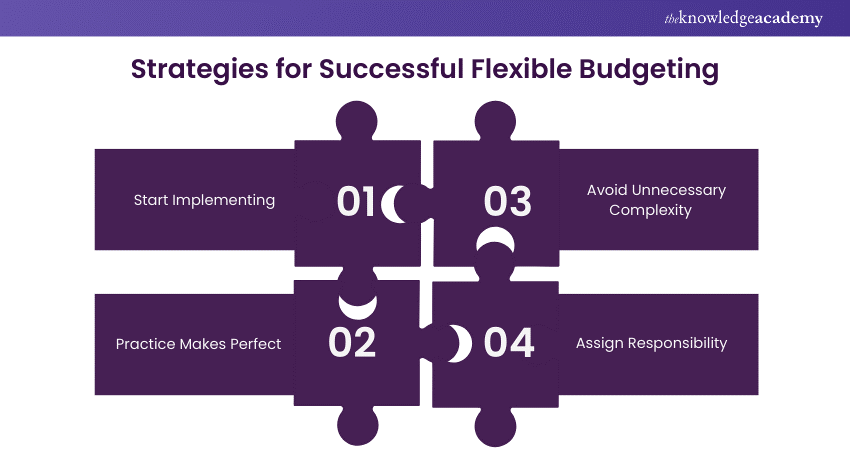
1) Start Implementing
Flexible Budget could look intimidating as it has too many complexities. Top management gurus recommend starting a Flexible Budget without any delay. At first, you will be bad; however, with time, you get to understand how to arrange numbers correctly. With each iteration, you learn things and improve with the process.
Make smarter and more impactful decisions – register for our Strategic Planning and Thinking Course!
2) Practice Makes Perfect
Perfectionists often find themselves delaying things till the very end. This way, you will not be able to create a Flexible Budget. You must begin and let go of the obsession of being perfect. That’s how you craft a sophisticated finance budget for business operations.
3) Avoid Unnecessary Complexity
Sometimes, we create complexities on our own. Don’t be a devil in the details and overcomplicated things. Carefully access things and create a plan that aligns with your business goals. Your plan should reflect an overview of the business objective.
4) Assign Responsibility
For accountability, responsibility is a must. As the business owner, take the initiative to hold a Flexible Budget. Plan and forecast effectively.
Flexible vs Static Budgets
A static budget remains unchanged despite variations in business activity, making it useful for setting financial expectations but less adaptable to real-world fluctuations. In contrast, a Flexible Budget adjusts based on actual revenue and expenses, offering a more accurate financial representation.

Flexible Budgeting Example
A Flexible Budget adjusts based on actual business activity, making it more practical for performance evaluation. Consider a manufacturing company that produces mobile phone cases.
Scenario:
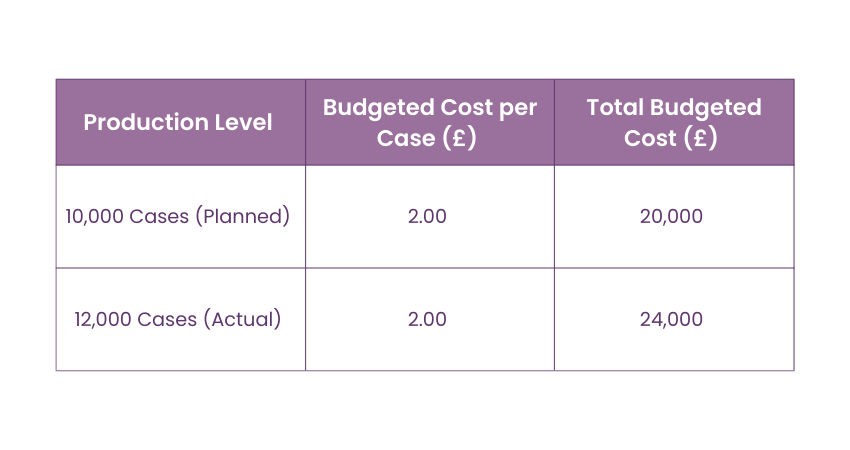
a) The company initially plans to produce 10,000 cases with a budgeted cost of £2 per case, totalling £20,000.
b) However, due to increased demand, the company ends up producing 12,000 cases.
Explanation:
a) If the company had used a static budget, the budgeted cost would remain £20,000, making it appear as though the company overspent.
b) However, with a Flexible Budget, the budgeted cost adjusts to £24,000, aligning with the increased production level and providing a more accurate performance evaluation.
Conclusion
In essence, a Flexible Budget serves as your financial safety net, adjusting as your business evolves. Now that you know What is Flexible Budget, you’re equipped to make smarter, more adaptable decisions. It’s not about guessing the future; it’s about staying in control, no matter what comes your way. Time to put it to work!
Master productive skills with our Personal Development Courses- register now!
Frequently Asked Questions
What is the Difference Between a Fixed Budget and a Flexible Budget?

A fixed budget remains unchanged regardless of business activity, making it useful for planning but less adaptable. In contrast, a Flexible Budget adjusts based on actual revenue or expenses, providing a more accurate financial picture. Flexible Budgets enhance performance evaluation and cost control.
What is Flexible Budget Formula?
The Flexible Budget formula comprises three components: activity level, variable costs and fixed costs.
Flexible Budget = Fixed costs + (Variable costs per unit x Activity level)
What are the Other Resources and Offers Provided by The Knowledge Academy?
The Knowledge Academy takes global learning to new heights, offering over 3,000+ online courses across 490+ locations in 190+ countries. This expansive reach ensures accessibility and convenience for learners worldwide.
Alongside our diverse Online Course Catalogue, encompassing 19 major categories, we go the extra mile by providing a plethora of free educational Online Resources like Blogs, eBooks, Interview Questions and Videos. Tailoring learning experiences further, professionals can unlock greater value through a wide range of special discounts, seasonal deals, and Exclusive Offers.
What is The Knowledge Pass, and How Does it Work?
The Knowledge Academy’s Knowledge Pass, a prepaid voucher, adds another layer of flexibility, allowing course bookings over a 12-month period. Join us on a journey where education knows no bounds.
What are the Related Courses and Blogs Provided by The Knowledge Academy?
The Knowledge Academy offers various Personal Development Courses, including the Introduction to Managing Budgets and Strategic Planning and Thinking Course. These courses cater to different skill levels and provide comprehensive insights into What is Budget.
Our Business Skills Blogs cover a range of topics related to Personal Development, offering valuable resources, best practices, and industry insights. Whether you are a beginner or looking to advance your Business Skills, The Knowledge Academy's diverse courses and informative blogs have got you covered.

The Knowledge Academy


Global Training Provider
The Knowledge Academy is a world-leading provider of professional training courses, offering globally recognised qualifications across a wide range of subjects. With expert trainers, up-to-date course material, and flexible learning options, we aim to empower professionals and organisations to achieve their goals through continuous learning.

Upcoming Business Skills Resources Batches & Dates
Date
 Marketing Budget Course
Marketing Budget Course
Thu 27th Aug 2026
Marketing Budget Course
Thu 19th Nov 2026

 If you wish to make any changes to your course, please


