


 Top Rated Course

We may not have the course you’re looking for. If you enquire or give us a call on +44 1344 203 999 and speak to our training experts, we may still be able to help with your training requirements.
What is Laissez Faire Leadership? Explained
Benjamin Walker 20 February 2026Laissez-faire Leadership is a style where leaders give their team independence to make choices and work freely. This blog explores What is Laissez-faire Leadership, its characteristics, advantages, disadvantages, and provides examples of leaders who use this style effectively. Read on to learn more about it in detail.

Training Outcomes Within Your Budget!
We ensure quality, budget-alignment, and timely delivery by our expert instructors.
Table of Contents

Imagine a workplace where employees have the freedom to make their own choices and manage their tasks without constant supervision. This is the essence of Laissez-faire Leadership. But What is Laissez-faire Leadership? It’s a leadership style where leaders trust their team to work independently, fostering creativity and responsibility.
In this blog, we discuss the concept of Laissez-faire Leadership, its history, characteristics, advantages, and drawbacks. Let’s explore how it can shape workplaces and drive success.
Table of Contents
1) What is Laissez-faire Leadership?
2) Characteristics of Laissez-faire Leadership
3) Examples of Laissez-faire Leadership
4) Advantages of Laissez-faire Leadership
5) Drawbacks of Laissez-faire Leadership
6) Conclusion
What is Laissez-faire Leadership?
Laissez-faire Leadership is a style where leaders give their team members a lot of freedom to make decisions and manage their own work. The leader trusts their team to complete tasks without much supervision. This type of leadership works well when team members are skilled and motivated. It allows creativity and independence to thrive, as long as the team stays on track.
However, this leadership style might not work in all situations. If the team lacks direction or motivation, Laissez-faire Leadership can lead to confusion or a lack of progress. It's important for leaders to step in when needed to provide guidance and support.
History of Laissez-faire Leadership
1) Laissez-faire Leadership ideas started in the 18th century during the Enlightenment in Europe
2) It was inspired by "Laissez-faire" economics, where the government doesn't interfere with businesses
3) The term became popular in leadership practices in the 20th century, especially in the U.S
4) Leaders like William Ouchi studied how this style could work in organisations

Characteristics of Laissez-faire Leadership
Here are the key features of it:

1) Delegates Decisions to Employees
In Laissez-faire Leadership, the leader trusts employees to make their own decisions. This allows workers to take ownership of their tasks and work independently.
1) Employees have the freedom to make choices within their roles
2) Leaders encourage creativity and innovation
3) Team members are empowered to solve problems on their own
4) This style works well when employees are skilled and motivated
2) Takes Responsibility for Outcomes
Even though the leader gives freedom to employees, they still take responsibility for the overall results. The leader ensures that the team stays on track and delivers successful outcomes.
1) The leader is accountable for the team's performance
2) They oversee the team’s progress but without micromanaging
3) If there are issues, the leader steps in to help guide the team
4) The leader ensures that goals are met even with limited supervision
3) Adopts a Hands-off Management Style
The leader uses a hands-off approach, trusting employees to manage their work. They don’t micromanage but provide the freedom to get the job done.
1) Employees have control over how they complete tasks
2) Leaders avoid interfering in daily tasks unless necessary
3) This style works well with experienced and self-motivated teams
4) It encourages independence and responsibility among employees
4) Provides Training and Support to Employees
Laissez-faire leaders ensure employees are well-trained and supported in their roles. While the leader gives freedom, they make sure the team has the resources they need.
1) The leader offers guidance when needed but not constant supervision
2) Employees get the training they need to do their jobs well
3) Support is available when employees face challenges
4) Leaders encourage growth and development within the team
Learn conflict resolution with our Successful People Management and Team Leadership Course – Join today!
Examples of Laissez-faire Leadership
We can find the Laissez-faire Leadership style being implemented in various contexts, including business, politics, and technology. Some of the leaders who preferred Laissez-faire Leadership are given below:
1) Warren Buffett
Warren Buffett, the renowned investor and CEO of Berkshire Hathaway, is the perfect example of this style. He implemented Laissez-faire Leadership in the modern business landscape, empowering managers within his firm to make decisions autonomously. It fostered a culture of independence and accountability.
2) John F. Kennedy
John F. Kennedy, the 35th President of the United States, used Laissez-faire Leadership during his time in office. He trusted his advisors and team members to make their own decisions and gave them the freedom to act. This approach helped them feel responsible for their work and encouraged different ideas.
3) Steve Jobs
Steve Jobs, the co-founder of Apple Inc., is a renowned person in the world of technology. He demonstrated Laissez-faire Leadership by inspiring creativity and innovation among his team members. Steve Jobs also provided his employees with the freedom to implement new ideas in their work.
Advantages of Laissez-faire Leadership
There are many advantages to the Laissez-faire Leadership style. A few of them are briefly discussed below:
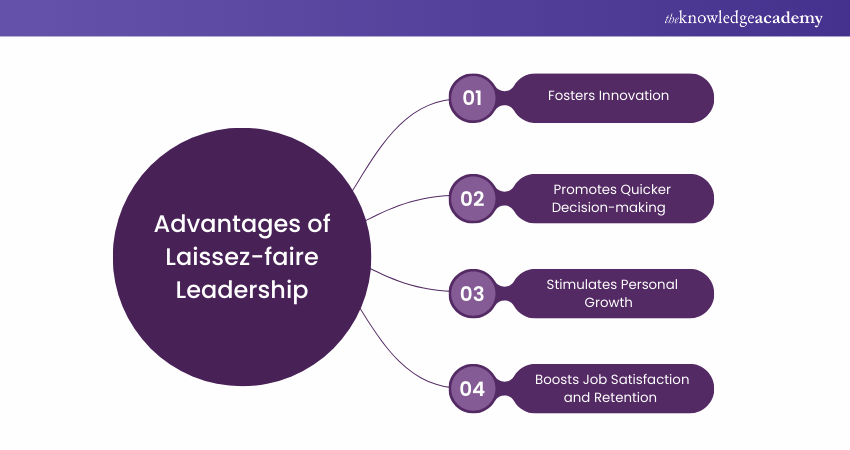
1) Fosters Innovation
Laissez Faire's Leadership style inspires creativity through different perspectives and ideas that a team can bring. It focuses on individual empowerment and general trust in the capabilities of the team, which creates room for innovation. Therefore, this style helps team members to be creative without the fear of failure or the consequences of failure.
2) Promotes Quicker Decision-making
The Laissez-faire Leadership style helps with faster decision-making. The group members don’t need to pass ideas to the group leader in the decision-making process. This makes the process fast and smoother. They can take the remaining time to focus on other important tasks, and the group can progress and work faster.
3) Stimulates Personal Growth
Another key advantage of Laissez-faire Leadership is its ability to foster personal growth and motivation among the team. Through this leadership style, employees get the freedom to explore their own ideas and learn from their mistakes.
4) Boosts Job Satisfaction and Retention
Laissez-faire Leadership helps create a positive work environment by giving employees the freedom to make their own choices. This sense of independence leads to higher job satisfaction and encourages employees to stay longer with the company. Leaders using this style often reward and recognise their team members, which boosts motivation.
Drawbacks of Laissez-faire Leadership
Laissez-faire Leadership relies more on the group’s skills. Therefore, it is not very reliable if the team members lack the experience to perform tasks and make decisions. The following are some of the major drawbacks of the Laissez-faire Leadership style:
1) Limited Engagement with the Team
1) Leaders may not interact enough with their team
2) Lack of guidance can lead to confusion
3) Team members might feel unsupported
4) Communication gaps can form due to minimal involvement
2) Low Productivity Concerns
1) Employees may lack motivation without clear direction
2) Team members may not take initiative
3) Leaders might struggle to keep the team focused
4) Progress can slow down when there's no active leadership
3) Ambiguity in Role Definitions
1) Team members may not completely understand their roles
2) Tasks and responsibilities can overlap or be unclear
3) Lack of structure may cause confusion in decision-making
4) Employees may not know who to turn to for support
4) Reduced Accountability
1) The leader may struggle to hold employees accountable
2) Employees might not feel responsible for their actions
3) Performance issues can be overlooked
4) Without clear expectations, responsibility can be unclear
Learn strategies for team management with our Leadership Skills Training – Join today!
Conclusion
We hope you have understood What is Laissez-faire Leadership and how it works. This leadership style gives employees the freedom to make their own choices. While it has many advantages, like fostering innovation and job satisfaction, it also has its challenges. By understanding its benefits and drawbacks, leaders can decide when and how to use this style for their team’s success.
Learn about different leadership styles with our Creative Leader Training – Join today!
Frequently Asked Questions
How Does Laissez-faire Leadership Help Performance?

When employees have the freedom to make decisions within their areas of expertise, they feel motivated and engaged. This leads to innovation and increased productivity within the team. As this Leadership style encourages creativity and initiative, employees are encouraged to find their own solutions to challenges.
What are the limitations of Laissez-faire Decision-making?
Laissez-faire decision-making can lead to confusion, lack of direction, and slow progress. Without clear guidance, employees may struggle to make decisions or take responsibility. It can also cause issues with accountability, as roles and expectations might not be clear.
What are the Other Resources and Offers Provided by The Knowledge Academy?
The Knowledge Academy takes global learning to new heights, offering over 3,000+ online courses across 490+ locations in 190+ countries. This expansive reach ensures accessibility and convenience for learners worldwide.
Alongside our diverse Online Course Catalogue, encompassing 19 major categories, we go the extra mile by providing a plethora of free educational Online Resources like Blogs, eBooks, Interview Questions and Videos. Tailoring learning experiences further, professionals can unlock greater value through a wide range of special discounts, seasonal deals, and Exclusive Offers.
What is The Knowledge Pass, and How Does it Work?
The Knowledge Academy’s Knowledge Pass, a prepaid voucher, adds another layer of flexibility, allowing course bookings over a 12-month period. Join us on a journey where education knows no bounds.
What are Related Courses and Blogs Provided by The Knowledge Academy?
The Knowledge Academy offers various Leadership courses, including Leadership Skills, Introduction to Supervising a Team, and Successful People Management and Team Leadership Courses. These courses cater to different skill levels, providing comprehensive insights into Types of Leadership Styles.
Our Business Skills blogs covers a range of topics related to Leadership, offering valuable resources, best practices, and industry insights. Whether you are a beginner or looking to advance your Leadership skills, The Knowledge Academy's diverse courses and informative blogs have you covered.

Benjamin Walker


Leadership Development Coach and Management Consultant
Benjamin Walker is a leadership coach and business consultant with over 18 years of experience in guiding organisations through strategic growth and transformation. He specialises in developing leadership capabilities at all levels, from emerging managers to executive teams. Benjamin’s work focuses on practical leadership, team dynamics, and performance management.
View Detail
Upcoming Business Skills Resources Batches & Dates
Date
 Introduction to Supervising a Team
Introduction to Supervising a Team
Fri 12th Jun 2026
Introduction to Supervising a Team
Fri 21st Aug 2026
Introduction to Supervising a Team
Fri 30th Oct 2026

 If you wish to make any changes to your course, please


