


 Top Rated Course

We may not have the course you’re looking for. If you enquire or give us a call on +27 800 780004 and speak to our training experts, we may still be able to help with your training requirements.
Symmetric Encryption: How It Works and Why to Use It
John Davies 22 April 2026Symmetric Encryption uses a single private key method that uses a single key to encrypt and decrypt data and the messages transacted within various systems. For this to work, the sender and receiver must securely share the same key, making it a single-key system. This contrasts with Asymmetric Encryption, which uses separate keys.

Training Outcomes Within Your Budget!
We ensure quality, budget-alignment, and timely delivery by our expert instructors.
Table of Contents
In a world where data travels faster than ever, keeping it safe is no small feat. This is where Symmetric Encryption comes in as one of the most trusted guardians of digital information. By using a single secret key to lock and unlock data, it offers speed and security in equal measures. From protecting Wi-Fi connections to safeguarding cloud storage, this method quietly powers countless secure exchanges every day.
This blog explores the elegant mechanics behind Symmetric Encryption and explores why it remains a trusted choice for securing everything from personal messages to enterprise data. So read on and master the essentials behind this Cyber Security powerhouse!
Table of Contents
1) What is Symmetric Encryption?
2) How Does Symmetric Encryption Work?
3) What are the Different Types of Symmetric Encryption Algorithms?
4) Use Cases of Symmetric Encryption
5) Benefits of Symmetric Encryption
6) Challenges of Symmetric Encryption
7) Real-world Example of Symmetric Encryption
8) Conclusion
What is Symmetric Encryption?
Symmetric Encryption, also called Symmetric Key or Secret-key Cryptography, is one of the two main types of Encryptions, alongside Asymmetric Encryption. It uses a single shared key to both encrypt and decrypt information, making it simple and efficient for protecting data. However, its main drawback lies in key security.
Since both sender and receiver share the same key, any interception or compromise can expose the data. Effective key management and secure key exchange are therefore essential for maintaining confidentiality. To address this limitation, many modern systems and messaging platforms use hybrid encryption, which combines Asymmetric Encryption for secure key exchange with Symmetric Encryption for rapid data transfer.
How Does Symmetric Encryption Work?
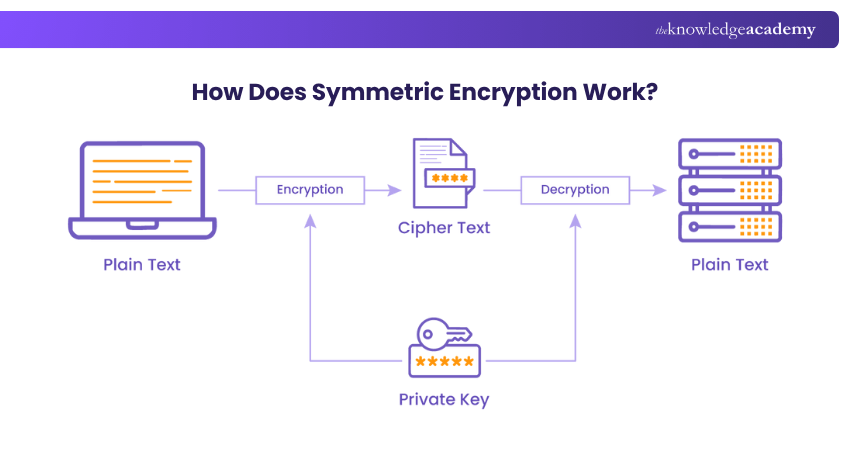
Symmetric Encryption involves many stages, from generating a key to decoding the message. Here’s how data is securely shared using this method:
1) Key Generation
The process begins with the creation of a private key. This key is often produced using algorithms such as HMAC-based Key Derivation Function (HKDF) or secure random number generators. The same key must be safely distributed to the recipient for later use.
Example: A 128-bit DES key: 5E8A19C7... (16-byte hexadecimal string).
2) Encryption
Next, the plaintext message is encrypted via the secret key. Encryption algorithms process the data in either blocks or streams and convert it into unreadable ciphertext.
Example: Blowfish or ChaCha20 uses the secret key to scramble plaintext into a secure, encoded message.
3) Transfer of Cypher text
The encrypted message (ciphertext) is then transmitted across the network. Even if intercepted, it remains indecipherable without the correct key and encryption algorithm.
Example: A banking system transmitting customer PINs securely over an encrypted connection.
4) Decryption
Finally, the receiver uses the same secret key to reverse the Encryption process. This helps restore the original readable text.
Example: The recipient uses the shared AES key to decrypt an email attachment into its original form.
Sharpen your instincts against digital deception with our up-to-date Social Engineering Training - Sign up now!
What are the Different Types of Symmetric Encryption Algorithms?
Several widely recognised symmetric key Encryption algorithms are used to secure digital communication. These include:
1) Advanced Encryption Standard (AES)
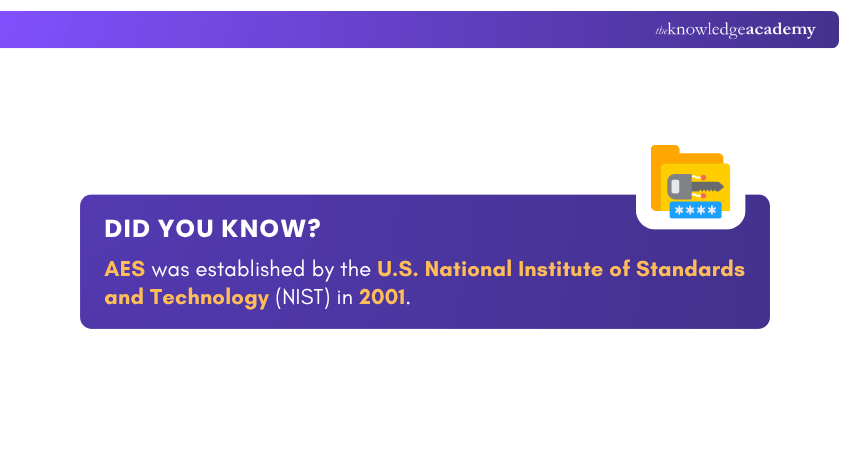
Globally, AES is the most widely adopted Symmetric Encryption algorithm. It supports the key lengths of 128, 192 and 256 bits, providing varying levels of protection. AES-256 is known for its exceptional strength and is preferred for top-security environments. AES is efficient in both hardware and software, making it suitable for applications such as VPNs, wireless communications and data storage.
2) Data Encryption Standard (DES) & Triple DES (3DES)
Introduced by IBM in the 1970s, DES was once the benchmark for Data Encryption. However, its 56-bit key length made it susceptible to brute-force attacks. To strengthen it, Triple DES (3DES) was developed which applies DES three times to each data block to enhance security.
3) Twofish
Twofish is a fast and secure block cypher that operates on 128-bit blocks and supports keys of 128, 192 or 256 bits. It’s open-source and resistant to Cryptanalysis, making it ideal for environments that demand strong protection and high performance. Twofish is frequently used in file and disk Encryption software.
4) Blowfish
Blowfish is a lightweight block cypher designed for speed and simplicity. It allows variable key lengths from 32 to 448 bits, thus offering flexibility for different security needs. Although it remains popular for software Encryption, it has been largely superseded by newer algorithms like Twofish and AES that provide stronger protection.
Master the mindset of a cyber defender with our Certified Cyber Security Professional (CCS-PRO) Course - Sign up now!
Use Cases of Symmetric Encryption
Symmetric Encryption plays a vital role in modern Cyber Security. Its speed and efficiency make it the obvious choice for protecting data across a wide range of applications. Common use cases include:
1) Cloud Security
1) Symmetric Encryption protects sensitive data both in transit and at rest within Cloud environments.
2) It ensures that even in the event of a breach, encrypted data remains inaccessible without the correct key.
3) Enterprises increasingly use hybrid Encryption frameworks combining symmetric and asymmetric methods for end-to-end protection across on-premises and cloud systems.
2) Database Encryption
1) Symmetric Encryption protects sensitive information such as financial records and personal identifiers stored in databases.
2) It can encrypt entire databases or specific fields like account numbers and passwords.
3) It makes sure that even if attackers gain access, the stolen data remains unreadable and secure.
3) Data Integrity
1) Symmetric Encryption ensures not only data confidentiality but also verifies the accuracy and authenticity of data.
2) It uses Message Authentication Codes (MACs) and hash functions to confirm that the data remains unchanged during transmission.
3) It's commonly applied in online banking and financial systems to ensure that the transaction data is not tampered with.
4) File, Folder and Disk Encryption
1) Symmetric Encryption protects files stored on local systems, shared drives, and removable media.
2) It uses Full Disk Encryption (FDE) tools like BitLocker and VeraCrypt based on Symmetric Encryption.
3) It ensures data confidentiality even if the devices are lost, stolen or accessed without authorisation.
5) Hardware-based Encryption
1) Symmetric Encryption is built into devices such as smartphones, laptops and SSDs for boosted data protection.
2) It performs Encryption directly at the hardware level, improving speed and efficiency.
3) It offers stronger defence against physical tampering compared to software-based Encryption methods.
6) Compliance Management
1) Symmetric Encryption meets legal and industry requirements under frameworks like FIPS 140-3 and GDPR.
2) It uses approved Symmetric Encryption standards such as AES for secure data handling.
3) It improves customer trust and safeguards data privacy and system integrity through regulatory compliance.
7) Data Security (Particularly for Large Amounts of Data)
1) Symmetric Encryption converts readable data into encrypted form (ciphertext) to prevent unauthorised access.
2) It reduces the financial impact and risks associated with data breach.
3) It’s highly efficient for encrypting large volumes such as databases, backups and archives.
8) Secure Communication and Web Browsing
1) Protocols such as TLS and SSL use Symmetric Encryption to maintain data privacy during transmission.
2) After an initial asymmetric handshake, a symmetric session key is created for faster Encryption and decryption.
3) It ensures confidentiality and integrity for online activities like emails, instant messaging and web browsing.
Awareness Is your first line of defence. Sign up for our Cyber Security Awareness Course and navigate the web safely.
Benefits of Symmetric Encryption
Here are the key advantages of Symmetric Encryption:
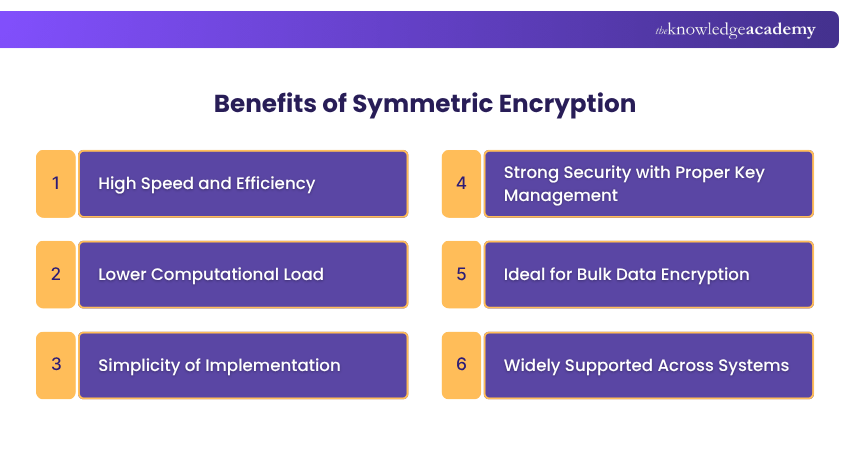
1) High Speed and Efficiency
1) Symmetric Encryption processes data rapidly, ideal for encrypting or handling large volumes in real time.
2) It maintains performance even as data size or system load increases.
3) It ensures consistent and accurate results without slowing down critical operations.
2) Lower Computational Load
1) Symmetric Encryption uses minimal processing power, making it efficient on most hardware.
2) It enables faster encryption and decryption compared to asymmetric methods.
3) It is ideal for mobile and embedded systems with limited resources.
3) Simplicity of Implementation
1) Symmetric Encryption operates with a single shared secret key for both encryption and decryption.
2) It’s easier to develop and maintain due to its straightforward design.
3) It reduces complexity in system configuration and management.
4) Strong Security with Proper Key Management
1) Symmetric Encryption provides robust protection when keys are randomly generated.
2) Security depends on safe key storage and exchange methods.
3) Regular key rotation catalyses long-term data protection.
5) Ideal for Bulk Data Encryption
1) Symmetric Encryption processes large files, databases, and backups efficiently.
2) It maintains speed and performance even with high data volume.
3) It ensures consistent results across multiple encryption cycles.
6) Widely Supported Across Systems
1) Symmetric Encryption is compatible with popular algorithms like AES, Blowfish, and Twofish.
2) It’s supported by major operating systems and security frameworks.
3) It easily integrates with existing encryption tools and software.
Challenges of Symmetric Encryption
While Symmetric Encryption is efficient and fast, it presents several challenges related to Key Management, storage and scalability:
1) Key Sharing Security
1) The biggest challenge is securely distributing the secret key between parties.
2) If an attacker intercepts or compromises the key, all encrypted data becomes exposed.
3) A common solution is to use Asymmetric Encryption (e.g., RSA) during the initial key exchange, as seen in hybrid Encryption systems.
2) Key Storage
1) Storing the secret key securely is crucial to prevent unauthorised access.
2) Compromised storage can lead to a total data breach.
3) Organisations often use Hardware Security Modules (HSMs) for physical protection or cloud-based Key Management Services (KMS) such as AWS KMS or Azure Key Vault for secure, scalable storage.
3) Scalability
1) As the number of users or systems increases, managing multiple secret keys becomes complex and resource-intensive.
2) To overcome this, organisations implement hierarchical key structures or automated key rotation policies to maintain security and operational efficiency.
Real-world Example of Symmetric Encryption
A common real-world example of Symmetric Encryption is Wi-Fi network security using WPA2 (Wi-Fi Protected Access 2).
1) In this system, both the router and the connected device share a pre-shared key (PSK).
2) When you enter your Wi-Fi password, it generates a symmetric key that encrypts all data transmitted between your device and the router.
3) This ensures that even if someone intercepts the wireless signal, the information (browsing activity, login credentials, or downloads) remains unreadable without the shared key.
4) This combination of speed, efficiency and strong Encryption makes Symmetric Encryption ideal for real-time communications like Wi-Fi, VPNs, and secure messaging apps.
Conclusion
Symmetric Encryption continues to be a cornerstone of modern Cyber Security. Its single-key mechanism makes it perfect for securing massive data volumes. When combined with proper Key Management and hybrid systems, it delivers powerful protection across digital networks. It ensures that sensitive information stays safe in an increasingly connected and vulnerable world.
Learn the essentials that protect organisations from digital chaos in our comprehensive Cyber Security Training - Sign up now!
Frequently Asked Questions
Can Symmetric Encryption be Cracked?

Yes, Symmetric Encryption can be cracked, but it’s challenging when strong algorithms like AES-256 are used correctly. Cracking typically requires enormous computational power or poor Key Management. As long as the keys are long, random and securely stored, Symmetric Encryption remains highly secure against modern attacks.
What's the Difference Between Asymmetric and Symmetric Encryption?
Symmetric Encryption uses one shared key for both Encryption and decryption, thus making it faster and simpler. Asymmetric Encryption, on the other hand, uses two separate keys: a public key for Encryption and a private key for decryption. This offers stronger but slower security.
What are the Other Resources and Offers Provided by The Knowledge Academy?
The Knowledge Academy takes global learning to new heights, offering over 3,000+ online courses across 490+ locations in 190+ countries. This expansive reach ensures accessibility and convenience for learners worldwide.
Alongside our diverse Online Course Catalogue, encompassing 17 major categories, we go the extra mile by providing a plethora of free educational Online Resources like Blogs, eBooks, Interview Questions and Videos. Tailoring learning experiences further, professionals can unlock greater value through a wide range of special discounts, seasonal deals, and Exclusive Offers.
What is The Knowledge Pass, and How Does it Work?
The Knowledge Academy’s Knowledge Pass, a prepaid voucher, adds another layer of flexibility, allowing course bookings over a 12-month period. Join us on a journey where education knows no bounds.
What are the Related Courses and Blogs Provided by The Knowledge Academy?
The Knowledge Academy offers various Cyber Security Courses, including Introduction to System and Network Security Course, Certified Artificial Intelligence (AI) for Cyber Security Professionals Training and the Cyber Security Risk Management Course. These courses cater to different skill levels, providing comprehensive insights into Replay Attack.
Our IT Security & Data Protection Blogs cover a range of topics related to Symmetric Encryption, offering valuable resources, best practices, and industry insights. Whether you are a beginner or looking to advance your IT Security skills, The Knowledge Academy's diverse courses and informative blogs have got you covered.

John Davies


Cyber Security Governance & Assurance Specialist
John Davies is a cybersecurity expert specialising in governance, risk management, and compliance. With over 15 years in the field, he has led enterprise-wide security programmes across finance, healthcare and public sector organisations. His content provides practical guidance on building secure environments, managing risk and aligning with regulatory frameworks.

Upcoming IT Security & Data Protection Resources Batches & Dates
Date
 Introduction to System and Network Security
Introduction to System and Network Security
Fri 28th Aug 2026
Introduction to System and Network Security
Fri 13th Nov 2026

 If you wish to make any changes to your course, please


