


 Top Rated Course

We may not have the course you’re looking for. If you enquire or give us a call on +27 800 780004 and speak to our training experts, we may still be able to help with your training requirements.
Methods of Demand Forecasting for Business Growth
The Knowledge Academy 30 December 2025Demand Forecasting combines expert and data-driven approaches using Delphi Technique, Trend Analysis, and Barometric Analysis for accurate planning. The Methods of Demand Forecasting are categorised into qualitative and quantitative types and find applications in Inventory Management, production planning and market entry decisions.

Training Outcomes Within Your Budget!
We ensure quality, budget-alignment, and timely delivery by our expert instructors.
Table of Contents

Want to ace the prediction game and equip your business with long-term competitive edge? It's time to go deep into the Methods of Demand Forecasting. This process will help you accurately predict future demand, keep your businesses agile, optimise inventory, reduce waste and keep your customers happy.
From the basic Statistical Analysis method and the Delphi technique to Barometric Analysis and the Sales Force Composite method, this blog assembles the proven Methods of Demand Forecasting. So read on, forecast like a pro and prepare for the most drastic market shift with ease!
Table of Contents
1) What is Demand Forecasting?
2) Types of Demand Forecasting
3) Methods of Demand Forecasting
4) Benefits of Demand Forecasting
5) The Impact of Forecasting on Supply Chain and Fulfilment
6) Conclusion
What is Demand Forecasting?
Demand Forecasting is a vital business activity that helps organisations anticipate future demand for their products or services. It involves examining past sales data, current market trends, and influencing factors to estimate future demand patterns. Accurate forecasts enable businesses to plan effectively, reduce operational inefficiencies, and consistently meet customer expectations.
Demand Forecasting is important for organisations of all sizes and industries. It directly supports decision-making across production planning, inventory control, sales strategies, marketing efforts and resource distribution. Thanks to the various Methods of Demand Forecasting, reliable forecasts help prevent overproduction and underproduction.

Types of Demand Forecasting
Demand Forecasting can be conducted in several ways. These six ways have been proven to achieve an accurate, well-rounded picture of future sales:
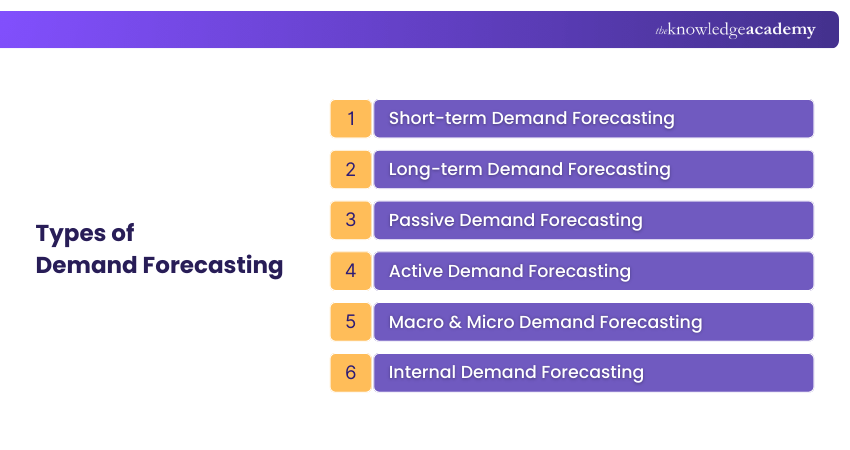
1) Short-term Demand Forecasting
a) Focus on Short Timeframes: Short-term Demand Forecasting examines demand over brief periods to support day-to-day operational decisions, such as planning inventory for seasonal events.
b) Operational Use Cases: This forecasting method is especially good for managing just-in-time supply chains and product ranges that change frequently.
c) Role in Overall Forecasting Strategy: Short-term Demand Forecasting is rarely used alone and is most effective when combined with long-term forecasts.
2) Long-term Demand Forecasting
a) Extended Forecasting Horizon: Long-term Demand Forecasting covers periods longer than one year. This enables businesses to identify recurring annual trends and future production capacity requirements.
b) Strategic Planning Support: This approach is a strategic blueprint, helping organisations shape long-term growth objectives and develop fulfilment and marketing plans.
c) Investment and Expansion Planning: Long-term forecasts support informed decisions around capital investments, capacity expansion, and infrastructure development.
3) Passive Demand Forecasting
a) Overview of Passive Demand Forecasting: It uses past sales data to estimate future demand without applying statistical techniques or economic trend analysis.
b) Data Requirements: This method is most effective for businesses with extensive historical sales data, as accurate forecasts rely heavily on reliable past performance records.
c) Suitability for Business Growth: Passive Demand Forecasting assumes future demand will largely follow previous sales trends, making it suitable for organisations seeking stable operations rather than rapid or unpredictable growth.
4) Active Demand Forecasting
a) Target Business Types: Active Demand Forecasting is widely used by start-ups and fast-growing organisations that lack sufficient historical data or operate in rapidly changing markets.
b) Growth-Oriented Planning: This approach uses aggressive growth strategies, including marketing campaigns, product development initiatives and business expansion plans.
c) Market and Industry Considerations: Active Demand Forecasting gauges the broader competitive environment by analysing economic conditions, industry trends and market growth projections.
5) Macro & Micro Demand Forecasting
a) Macro-level Demand Forecasting: This kind of Demand Forecasting analyses external forces like economic conditions, competitive pressures, and consumer trends to identify growth opportunities.
b) Business Stability and Risk Awareness: Even organisations focused on stability benefit from macro-level insights, as understanding wider market forces helps businesses stay informed about external risks.
c) Micro-level Demand Forecasting: Micro-level Demand Forecasting focuses on specific industries, markets or customer segments. This helps businesses predict demand for particular products or services within clearly defined target audiences.
6) Internal Demand Forecasting
a) Purpose of Internal Demand Forecasting: Internal Demand Forecasting focuses on gauging an organisation’s capacity to meet future demand.
b) Capacity and Resource Evaluation: This approach examines internal constraints such as workforce, infrastructure and operational capabilities to determine whether the business can support demand increases.
c) Workforce and Operational Planning: Internal Demand Forecasting supports areas like human resources by estimating future hiring needs and resource requirements.
Step into real-world industry expertise and bridge the gap between theory and practice. Sign up for our Industry Training now!
Methods of Demand Forecasting
Let’s explore the various Methods of Demand Forecasting that have proven high success rates across industries. While one method may suffice in a lot of cases, sometimes you may need a combination of these methods to achieve the desired results:
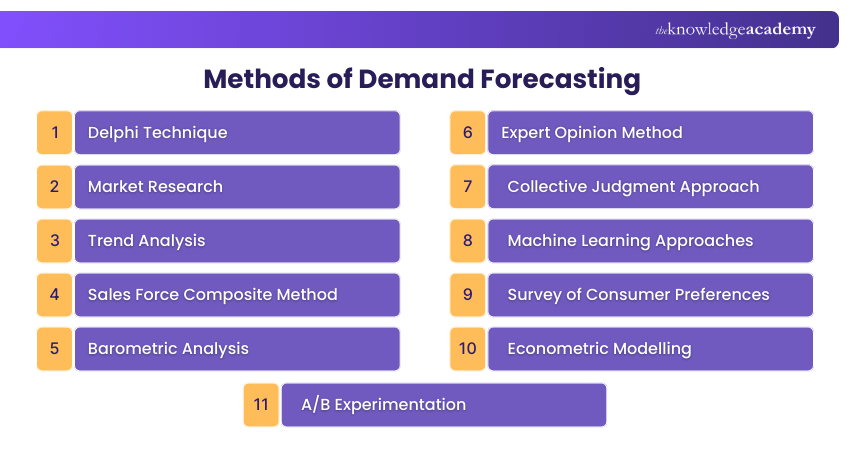
1) Delphi Technique
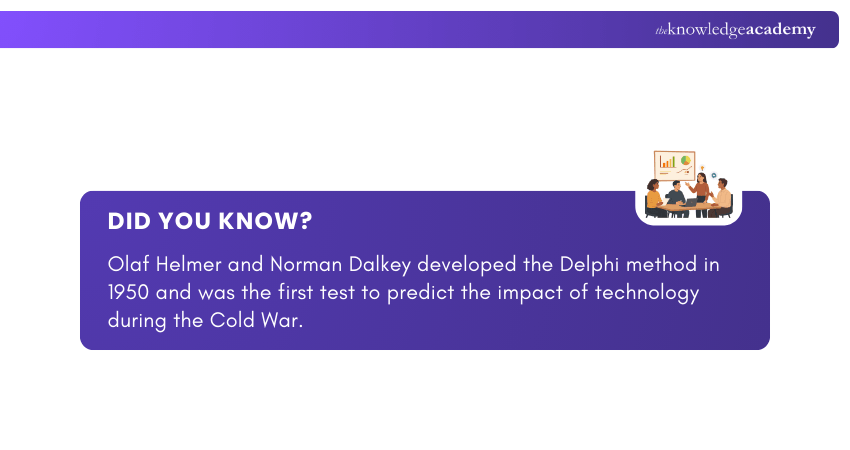
The Delphi method is an approach based on group consensus. Here are the key points to remember about this method:
a) You must collect predictions and opinions from a panel of experts.
b) Use an iterative process to reach a consensus forecast.
c) Identify a panel of experts and collect their initial projections.
d) Compile and aggregate the initial estimates.
e) Provide expert feedback on the overall results.
f) Collect updated forecasts from the experts.
g) Create a consensus demand forecast.
h) This method is useful for complex problems where a single expert's forecast may not be reliable.
i) It helps reduce personal biases and improves the accuracy of the final predictions.
2) Market Research
Sending out surveys and compiling the data takes time and effort, but the benefits are worth it. This is one of the most potent Methods of Demand Forecasting because it provides insights into your typical customer that internal sales data alone cannot offer. Market research can be conducted continuously or during focused research periods. It helps gather demographic data, aiding in the targeting of future marketing efforts. This approach is especially valuable for young companies still learning about their customers.
3) Trend Analysis
This is the most straightforward Demand Forecasting methodology which requires adjusting future projections to account for historical anomalies. Consider these scenarios:
a) There was a sudden spike in demand last year, but it occurred after the product was featured on a popular television show, making it unlikely to be repeated.
b) The ecommerce site was hacked, leading to a significant drop in sales. Remember to note unusual factors in your historical data when using the trend projection method.
4) Sales Force Composite Method
The sales force composite approach involves sales teams estimating demand within their assigned territories. These forecasts are then combined at the branch or regional level, and the consolidated insights are used to create an overall company-wide demand forecast. Here are some points to remember:
a) The sales force composite method follows a bottom-up approach, where sales teams contribute demand estimates based on their close understanding of customer behaviour.
b) This method benefits from real-time market insights, as salespeople can often provide accurate forecasts informed by customer feedback.
c) Regional factors such as pricing, marketing activities, customer income levels and competitive conditions must be considered.
d) Demand data can be collected using Inventory Management systems with built-in reporting tools.
Be the brain behind every successful delivery. Sign up for our Logistics Management Training and experience efficiency in motion!
5) Barometric Analysis
This forecasting method relies on three types of indicators to assess and predict demand trends:
a) Leading indicators are used to anticipate future outcomes, such as rising customer complaints about delivery delays or backorders, which can signal a potential drop in future sales.
b) Lagging indicators evaluate the effects of past events. For example, a surge in sales the previous month may signal an emerging trend that warrants close monitoring for inventory planning.
c) Coincidental indicators reflect current market conditions. An example is real-time inventory turnover, which shows ongoing sales activity and current demand levels.
6) Expert Opinion Method
While collective input is useful, expert insight can add a deeper perspective. With this forecasting method, organisations engage external specialists to estimate future demand. The process typically starts with collaborative discussions in which key assumptions are developed to guide leadership expectations in the short, medium and long term.
Gain expertise in cost-effective maintenance with our comprehensive Facilities Management Course - Register now!
7) Collective Judgment Approach
In this method, a firm's salesperson forecasts the expected future sales for their region. These individual forecasts are then combined to determine the overall projected future sales. These estimates are reviewed considering factors like:
a) Future changes in the selling price
b) Product designs
c) Changes in competition
d) Advertisement campaigns
e) Purchasing power of the consumers
f) Employment opportunities
g) Population
The underlying principle of this method is that due to the closeness of salespeople to the consumers, they are likelier to understand the changes in their demands.
8) Machine Learning Approaches
Data Scientists employ Machine Learning models for Demand Forecasting, often achieving higher accuracy than traditional statistical methods. Machine Learning can address two key aspects of Demand Forecasting:
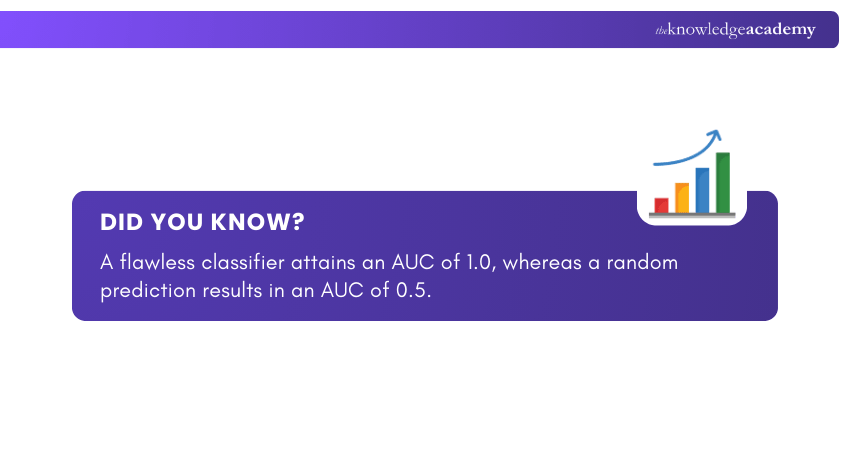
a) Predicting Demand Occurrence: A classification model is trained to predict when demand will occur, with Area Under the Receiver Operating Characteristic Curve (AU ROC) metrics used for evaluation. A nested cross-validation approach is often employed, especially for time-sensitive models.
b) Estimating Demand Size: A regression model is trained to predict the size of demand.
9) Survey of Consumer Preferences
When the demand needs to be forecasted in the short run, such as a year, the most feasible step is to directly ask the customers what they intend to buy in the forthcoming period. This survey can be done in the following ways:
a) Sample Survey Method: A sample of potential buyers is selected scientifically, and only the chosen ones are interviewed.
b) Complete Enumeration Method: Almost every potential buyer is asked about their future purchase plans.
c) End-use Method: The final users (consuming industries) are identified under this method. Desirable product consumption norms are fixed, targeted output levels are estimated, and the norms are applied.
Master the skills to manage the product development lifecycle in our Product Management Course - Sign up now!
10) Econometric Modelling
This statistical approach for predicting future sales is based on past sales data and relevant economic factors.
a) It utilises Regression Analysis and various other statistical tools to establish relationships between the demand and independent variables (e.g., economic indicators, market trends).
b) The model is used to predict future trends based on expected changes in independent variables.
c) This method is considered highly reliable and accurate, particularly for products or services with a long sales history.
d) Requires a large amount of data and a strong understanding of statistical techniques for effective implementation.
11) A/B Experimentation
Customer behaviour can be analysed through controlled market experiments. This involves A/B testing variations across promotions, product features, website designs and email subject lines. Clear customer preferences help businesses understand demand drivers and improve forecasting accuracy.
Learn the essentials of trade compliance practice and export regulations in our Export and Trade Compliance Training - Sign up now!
Benefits of Demand Forecasting
Demand forecasting is the key to long-term stability across industries. Here are the key reasons why Demand Forecasting is important:
1) Improved Inventory Control: Accurate forecasts help businesses maintain balanced inventory levels. It helps them avoid excess stock and shortages.
2) Cost Efficiency: By aligning production with expected demand, organisations reduce waste, limit excess capacity and streamline supply chain operations.
3) Enhanced Customer Satisfaction: Reliable demand forecasts ensure products and services are available when needed.
4) Effective Production Planning: Manufacturers use demand forecasts to plan production schedules more efficiently.
5) Optimised Resource Allocation: Demand Forecasting supports better allocation of labour, equipment and raw materials.
6) Targeted Marketing and Promotions: Forecasting insights help identify the right timing and locations for marketing activities.
7) Accurate Financial Planning: Demand forecasts support budgeting and revenue projections, helping organisations plan investments with greater confidence.
8) Risk Management: By anticipating demand shifts, businesses can mitigate risks and respond proactively to unexpected changes.
9) Strategic Decision Support: Forecasting informs long-term decisions such as product development, market expansion and capacity planning.
10) Supply Chain Optimisation: Clear visibility into future demand allows businesses to optimise supply chains and reduce lead times.
11) Seasonal Demand Planning: For businesses affected by seasonality, Demand Forecasting enables proactive planning of inventory, staffing, and production.
12) Competitive Advantage: Organisations with accurate Demand Forecasting can respond quickly to market changes and customer needs.
The Impact of Forecasting on Supply Chain and Fulfilment
Forecasting has substantial impact on supply chain and fulfilment. Here are some of its benefits:
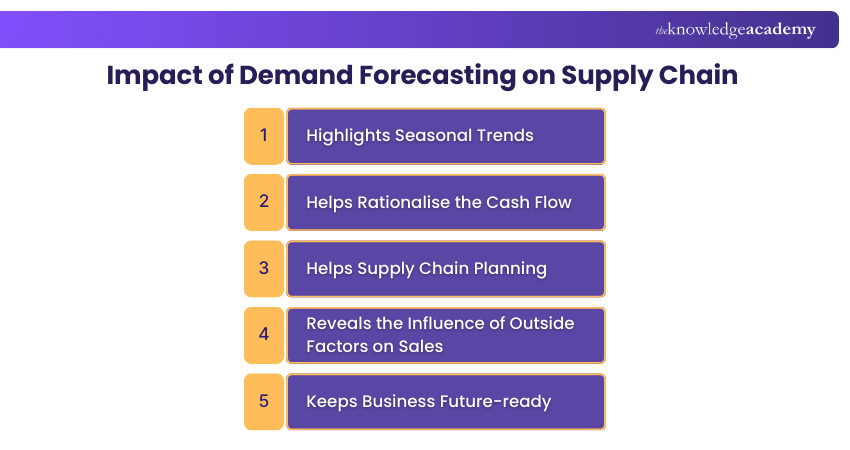
1) Highlights Seasonal Trends: Reviewing historical sales data helps identify seasonal fluctuations, including peak holiday periods and months with lower customer demand, to improve sales forecasting.
2) Helps Rationalise the Cash Flow: Your past balance sheet reveals how sales revenue aligns with the costs of goods sold, helping determine when you'll have the cash to maintain required inventory levels.
3) Helps Supply Chain Planning: Demand Forecasting plays a crucial role in Capacity Requirement Planning by assisting with capacity and Inventory Management, ensuring stock availability during demand spikes while preventing rush charges and backorders.
4) Reveals the Influence of Outside Factors on Sales: Forecasts, including industry trends, economic conditions, and market sector projections, help you adapt and grow your business.
5) Keeps Business Future-ready: Demand Forecasting prepares your business and supply chain to handle unexpected challenges, like natural disasters or new competitors.
Conclusion
Forecasting is the ultimate tool for business success, and the various Methods of Demand Forecasting outlined in this blog provide a powerful toolkit for predicting future trends accurately. Whether you're fine-tuning your approach or starting fresh as a businessperson, these strategies will help you make informed decisions, optimise resources, and stay ahead in an evolving market.
Your gateway to international markets starts here. Sign up for our Import Export Course now!
Frequently Asked Questions
Why is Demand Forecasting Crucial for Supply Chain Management?

Demand Forecasting in supply chains involves estimating future demand for products or services. It’s especially vital in supply chain businesses, as it helps manage inventory, determine the right time to restock, and plan for capacity.
What are Qualitative and Quantitative Methods of Demand Forecasting?
Qualitative Demand Forecasting methods rely on subjective judgment and insights, often using expert opinions, market research and focus groups to predict future demand. Quantitative methods utilise historical data and statistical techniques to forecast demand, such as Time Series Analysis, Regression Analysis and mathematical models.
What are the Other Resources and Offers Provided by The Knowledge Academy?
The Knowledge Academy takes global learning to new heights, offering over 3,000+ online courses across 490+ locations in 190+ countries. This expansive reach ensures accessibility and convenience for learners worldwide.
Alongside our diverse Online Course Catalogue, encompassing 19 major categories, we go the extra mile by providing a plethora of free educational Online Resources like Blogs, eBooks, Interview Questions and Videos. Tailoring learning experiences further, professionals can unlock greater value through a wide range of special discounts, seasonal deals, and Exclusive Offers.
What is The Knowledge Pass, and How Does it Work?
The Knowledge Academy’s Knowledge Pass, a prepaid voucher, adds another layer of flexibility, allowing course bookings over a 12-month period. Join us on a journey where education knows no bounds.
What are the Related Courses and Blogs Provided by The Knowledge Academy?
The Knowledge Academy offers various Industry Training, including the Facilities Management Training, Supply Chain Management Training and the Product Management Training. These courses cater to different skill levels, providing comprehensive insights into Facilities Management Best Practices.
Our Business Skills Blogs cover a range of topics related to Methods of Demand Forecasting, offering valuable resources, best practices, and industry insights. Whether you are a beginner or looking to advance your Demand Forecasting skills, The Knowledge Academy's diverse courses and informative blogs have got you covered.

The Knowledge Academy


Global Training Provider
The Knowledge Academy is a world-leading provider of professional training courses, offering globally recognised qualifications across a wide range of subjects. With expert trainers, up-to-date course material, and flexible learning options, we aim to empower professionals and organisations to achieve their goals through continuous learning.

Upcoming Business Skills Resources Batches & Dates
Date
 Supply Chain Management Training
Supply Chain Management Training
Fri 31st Jul 2026
Supply Chain Management Training
Fri 23rd Oct 2026

 If you wish to make any changes to your course, please


