


 Top Rated Course

We may not have the course you’re looking for. If you enquire or give us a call on + 1-866 272 8822 and speak to our training experts, we may still be able to help with your training requirements.
History of Coffee: From Ancient Origins to Modern Culture
The Knowledge Academy 18 April 2026History of Coffee started in Ethiopia with Kaldi’s discovery, then travelled through Arabia and Europe. From coffeehouses to modern espresso, enrich its history. Its global rise shaped trade, traditions and social life across continents. Dive in to explore how a simple bean became a worldwide cultural icon.

Training Outcomes Within Your Budget!
We ensure quality, budget-alignment, and timely delivery by our expert instructors.
Table of Contents

The History of Coffee is a journey filled with legend, discovery, and cultural transformation. From mystical beginnings in ancient Ethiopia to its rise as a global staple, coffee has shaped societies in unexpected ways. Each chapter of its past reveals how a simple bean grew into a worldwide obsession.
As coffee travelled across continents, it fuelled conversations, inspired revolutions, and became a symbol of connection. In this blog, you’ll uncover how coffee travelled from ancient Ethiopian legends to becoming a global cultural icon, shaping societies and daily rituals across the world.
Table of Contents
1) What is Coffee?
2) Origin of Coffee
3) History of Coffee in Detail
4) How Did Colonial Powers Contribute to the Global Spread of Coffee Cultivation?
5) Coffee in the Modern World
6) Conclusion
What is coffee?
Coffee is made from the beans of the coffee tree, processed through steps like harvesting, roasting, and grinding. Despite its simple preparation, it remains a remarkably complex drink with flavours shaped by bean type, origin, and processing methods. It naturally contains caffeine, which boosts alertness, focus, and energy levels. Beyond this, coffee also provides antioxidants that support the body’s defence against environmental damage.

Origin of coffee
Although there is no certainty as to when the worldwide production of the beverage started, according to popular myths and stories, Black Coffee Vs Green Tea has an interesting history and origin.
1) Ethiopia
As per legend, an Ethiopian goat herder called Kaldi is credited with the first coffee discovery. He noticed that his goats had a lot of energy after they ate the berries from a specific tree in the ancient coffee forests of the Ethiopian plateau.
He informed the local monastery abbot of this, who then made a drink out of the cherries and found that it was the reason why he could be awake during evening prayers. The monks took the drink, and its source started to be known among the people in the east, thereby starting the spread of coffee.
Gain expertise in cost-effective maintenance with our Facilities Management Course – Join today!
History of coffee in detail
While we have seen that coffee originated in Middle-East Asia, the rest of the world embraced it so widely that today, almost every country has a coffee named after it. For example, Americano Coffee, Irish Coffee, Viennese Coffee, Vietnamese Coffee, and many more.
So, let's have a look into History of Coffee in detail. Also, find how the beverage reached every corner of the globe. And what does Coffee mean to people today?
1) Middle-East to Arabia
Coffee history dates back to the 15th century when coffee beans reached Southern Arabia; however, it was not welcomed merrily. At the same time, History of Coffee states that some became fond of the drink because it was a good replacement for alcohol which is prohibited by the religion.
On the other hand, it faced rejection by the Islamic religious groups, who thought it contained the same intoxicating elements as alcohol. After a lot of tussles, due to its exhilarating effects, its production caught pace in the Arabian Peninsula with a rapid emergence of coffeehouses where it was called qahveh khaneh.
2) Arabia to European Countries
Coffee from Arabia captivated the curiosity of European travellers little by little and finally came to Europe, where it became popular very fast by the 17th century. Italy was the first European coffee hub, established by trade with the Ottoman Empire and Venice, which opened the first European coffee house in 1645.
The coffee culture was later brought to England by the Dutch and British East India Companies, and the first coffee house in Oxford was opened in 1651. Shortly, London’s lively coffee houses became places for business, discussions, and social interaction.
3) Rise of Coffee Plantations in Asia
The Dutch owned coffee seeds and, after the unsuccessful efforts growing them in India, finally managed to cultivate them in Indonesia, beginning with Java by the end of the 17th century. The trees did well, resulting in a booming trade, which later reached Sumatra and Sulawesi.
Moreover, they produced the first-ever coffee blend, Mocha Java, by mixing Arabian beans with Javanese coffee. Almost 200 years later, the French missionaries brought arabica trees to Vietnam, and they were planted in the Tonkin area during the 1850s.
3) European countries to the rest of the world
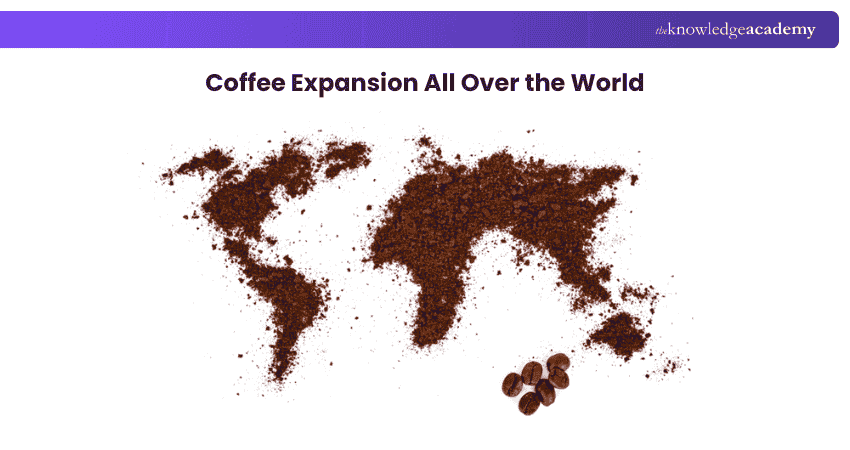
Up until the late 17th century, Yemen and regions of Africa were the main sources of coffee for the world. The Europeans, through colonisation, planted coffee in numerous areas, the cultivation of which soon became predominant in Brazil, certain African countries, Java, and some parts of Asia, but the entire output was mainly consumed by the British market.
The late 19th and early 20th centuries saw industrialisation revolutionise coffee production with new methods like roasting, grinding, and vacuum-sealing. Also, the decaffeination process started with similar advancements and, by the 1950s, instant coffee's acceptance led to a rise in Robusta bean production in Africa.
4) Coffee as we see it today
Coffee history gradually made its way to the New World and eventually found its place. It was brought to Jamestown in 1607 but, in the beginning, lost to tea. At the turn of the 17th century, coffee was discovered in Boston, but it was the American Revolution, when tea drinking was considered unpatriotic, that really brought coffee to the forefront.
Not long after, the sunny and hot climates of Central and South America were found to be perfect for the growth of coffee. The number of coffee plantations increased rapidly, and the first major harvest was reported in 1726.
Latin America not only cleared large areas of forest to meet the demand but also established itself as a leading coffee supplier in the world in the 18th century. Brazil, the largest coffee producer today, is the one that has the most impact on the present-day coffee industry.
Want to make your daily brew even better for your health? Dive into our Benefits of Coffee guide now!
How Did Colonial Powers Contribute to the Global Spread of Coffee Cultivation?
European colonial nations had a vital impact on the transition of coffee from a regional drink to a worldwide agricultural commodity. The colonisers, after the drink had won over the taste buds of the Europeans, searched for the tropical areas where coffee could be planted on a large scale and turned their overseas territories into plantation hubs.
Among the Europeans, the French were first and then followed by Dutch soon afterwards, As their colonial reach expanded, they established major plantations across the Caribbean and parts of South America. The American coffee demand was flooding in, and the colonial powers were quickly carrying coffee cultivation over to the New World, especially to Brazil, Colombia, and Cuba.
These tropical countries were endowed with splendid weather and, thus, when the colonial era was about to end, coffee had become one of the most lucrative cash crops and the industry that we know today had already been shaped in part.
Coffee in the Modern World
The coffee and its history has undergone a major transformation in the past few decades, which has been the Italian-style traditional way, with the consumers' preference shifting to quality espresso gradually instead of big and heavily flavoured drinks.
The coffee industry is already looking to the future, and the so-called e-commerce and home brewing are believed to be the forces driving the upcoming “fourth wave” of coffee. A larger group of people are now buying premium beans over the Internet, making them fresh and enjoying barista-style coffee in their homes with reasonably priced equipment.
No matter the uncertainty that coffee culture is going to have in the future, it is a known fact that the time for coffee lovers to have access to high-quality, freshly brewed coffee with no need to pay cafe prices has never been more thrilling.
Conclusion
The History of Coffee shows how a simple bean transformed cultures, economies and everyday rituals across the world. From ancient legends to global trade and modern café culture, coffee’s journey reflects centuries of change and innovation. Today, its influence continues to grow, shaped by evolving tastes and brewing trends. One thing remains unchanged, every cup we enjoy carries centuries of history, tradition and passion.
Step into real-world expertise with our immersive Industry Training- Join today!
Frequently Asked Questions
Why is Yemen Important in the History of Coffee?

The region of Yemen was the first to grow and sell coffee commercially, which changed the status of coffee from a local discovery to that of a worldwide drink. The port city of Mocha became the earliest and the most powerful among the coffee-exporting cities in the world.
What was the Role of Coffee in the Industrial Revolution?
Coffee was very important since it gave the factory workers the energy that was driven by caffeine, and that was necessary to keep up with the factory schedule. With the change in the industries to strict "clock time," coffee took the place of the older eating habits and helped to keep the workers productive during long shifts.
What are the Other Resources and Offers Provided by The Knowledge Academy?
The Knowledge Academy takes global learning to new heights, offering over 3,000+ online courses across 490+ locations in 190+ countries. This expansive reach ensures accessibility and convenience for learners worldwide.
Alongside our diverse Online Course Catalogue, encompassing 19 major categories, we go the extra mile by providing a plethora of free educational Online Resources like Blogs, eBooks, Interview Questions and Videos. Tailoring learning experiences further, professionals can unlock greater value through a wide range of special discounts, seasonal deals, and Exclusive Offers.
What is The Knowledge Pass, and How Does it Work?
The Knowledge Academy’s Knowledge Pass, a prepaid voucher, adds another layer of flexibility, allowing course bookings over a 12-month period. Join us on a journey where education knows no bounds.
What are the Related Courses and Blogs Provided by The Knowledge Academy?
The Knowledge Academy offers various Industry Courses, including the Floristry Introduction Course, and the Product Management Training. These courses cater to different skill levels, providing comprehensive insights into Latest Coffee Trends.
Our Business Skills Blogs cover a range of topics related to coffee origin and evolution, offering valuable resources, best practices, and industry insights. Whether you are a beginner or looking to advance your Barista skills, The Knowledge Academy's diverse courses and informative blogs have got you covered.

The Knowledge Academy


Global Training Provider
The Knowledge Academy is a world-leading provider of professional training courses, offering globally recognised qualifications across a wide range of subjects. With expert trainers, up-to-date course material, and flexible learning options, we aim to empower professionals and organisations to achieve their goals through continuous learning.

Upcoming Business Skills Resources Batches & Dates
Date
 Basic Barista Course
Basic Barista Course
Fri 14th Aug 2026
Basic Barista Course
Fri 18th Sep 2026
Basic Barista Course
Fri 11th Dec 2026

 If you wish to make any changes to your course, please


