


 Top Rated Course

We may not have the course you’re looking for. If you enquire or give us a call on 44 1344 203 999 and speak to our training experts, we may still be able to help with your training requirements.
What is Print Management? Understanding the basics
James Smith 19 February 2026Print Management oversees and optimises printing resources and processes to boost efficiency, cut costs, and strengthen security across an organisation. It also supports sustainability goals, improves device uptime, enables secure print release, tracks usage by user or department, and integrates with IT systems for full visibility.

Training Outcomes Within Your Budget!
We ensure quality, budget-alignment, and timely delivery by our expert instructors.
Table of Contents

Wondering What is Print Management and why it matters? It helps organisations take control of their printing processes to reduce costs, improve efficiency, and protect sensitive information. With the right tools and strategy, your business can turn printing into a streamlined, secure, and sustainable operation. Read on to explore the basics, benefits, and practical applications of Print Management across various industries.
Table of Contents
1) What is Print Management?
2) What is Print Management Software?
3) How does Print Management Software Work?
4) Key Types of Print Management
5) Print Management Across Various Industries
6) Benefits of Print Management
7) What is the Print Management Strategy?
8) What is the Print Management Policy?
9) Conclusion
What is Print Management?
Print Management is the business practice of monitoring, controlling, and optimising an organisation’s printing infrastructure. It involves managing printers, copiers, and multifunction devices (MFDs/MFPs) and ensuring they connect seamlessly with print-enabled devices such as desktops, laptops, smartphones, and tablets.
Effective Print Management extends beyond producing documents. IT teams must oversee device performance, monitor print output, control costs, enforce information security, and manage end-user printing behaviours. This ensures resources are used efficiently while maintaining operational security and compliance.
Many Print Management solutions also offer additional features that support broader document workflows. These may include integrated tools for scanning, copying, and faxing, providing a centralised approach to document and output management across the organisation.

What is Print Management Software?
Print Management Software is a tool designed to monitor, control, and optimise printing activities within an organisation. It helps businesses manage their print infrastructure, track usage, reduce waste, and enhance document security. By centralising print operations, this software allows IT teams or administrators to gain detailed insights into how, where, and by whom printing resources are being used.
Typically, Print Management Software offers features such as user authentication, print quotas, secure print release, job tracking, and reporting. It can support various devices including printers, copiers, and multifunction devices and often integrates with existing IT systems. Whether deployed on-premises or in the cloud, this software enables organisations to reduce costs, enforce print policies, and operate more sustainably by cutting down on unnecessary or unauthorised printing.
How Does Print Management Software Work?
Print Management software functions by giving businesses the ability to control their printing setup from one single location. This entails assigning expenses and resources, establishing printing standards and guidelines, and tracking and monitoring print jobs. This software can be integrated with current print hardware and software and installed either locally or in the cloud.
a) The software intercepts the print jobs before they are sent to the printer.
b) It can assign jobs to the best printer based on location or printer availability.
c) It can also apply printing regulations such as printing solely in black and white or double-sided printing.
Print Management software helps businesses improve their printing infrastructure by offering comprehensive printer usage and expense statistics.
Key Types of Print Management
Print Management includes various functions that ensure secure, efficient, and cost-effective printing. Below are key types, each with a brief definition:
1) Queue Management: Controls which print queues a user can access. This is especially important in multi-site environments such as branch offices, where queue visibility needs to be restricted or optimised based on user location or role.
2) Driver Management: Ensures the correct printer drivers (e.g. Xerox, Canon, HP, Sharp, Konica Minolta) are properly installed and maintained on end-user devices such as Windows PCs, Macs, or Chromebooks.
3) Cloud Printing & Follow-Me Printing: Supports the ability to print from any device to any printer, regardless of physical location. Follow-me or pull-printing ensures documents are only released at the printer once the user authenticates.
4) Printer Monitoring: Provides real-time visibility into printer status, including toner levels, paper jams, and error alerts. This helps reduce downtime and improves service response.
5) Output Monitoring: Tracks and reports on print activity by user, department, or device. Helps organisations identify usage trends and opportunities to reduce waste or improve efficiency.
6) Output Control: Imposes rules and restrictions such as print quotas, colour printing limits, or page count thresholds. Enables cost savings and promotes responsible printing behaviour.
7) Output Security: Ensures printed documents are only collected by the authorised user. Typically includes secure print release, user authentication, and encrypted print jobs to prevent data breaches.
8) Fleet Management: Allows IT administrators to push configuration updates, firmware changes, or settings to multiple printers simultaneously. Helps automate and standardise printer setup across an organisation.
9) Commercial Print Management: Refers to specialised print solutions used by print shops or in-house production teams. Supports large-format printing, banner production, and advanced finishing options for marketing materials and publications.
10) Mobile Printing Management: Enables users to print directly from smartphones or tablets within a secure and managed environment. It ensures compatibility across devices and maintains print control policies for mobile users.
Print Management across various industries
Print Management is essential to many different businesses in the current digital era. It assists us in effectively managing the printing jobs while preserving resources and guaranteeing security. Scroll down to explore the implementation of this software and its significance in the manufacturing, healthcare, and educational sectors.

1) Print Management in Healthcare
Information management and documentation are very important in the healthcare industry. Print Management systems, thus, guarantee adherence to strict requirements and streamline procedures. It includes simply managing administrative paperwork, medical reports, and patient records.
Print Management software additionally enables the safe printing of private patient data. It guarantees patient privacy protection and adherence to HIPAA laws. Furthermore, it facilitates the monitoring and managing of printing expenses for healthcare facilities by implementing print quotas, usage tracking, and cost-efficient printer fleet optimisation.
2) Print Management in Manufacturing
Print Management is all about increasing output and simplifying processes in the manufacturing industry. Manufacturers use printed materials extensively for anything from safety rules and quality control documentation to production schedules and inventory reports.
Print Management systems assist producers in streamlining their printing processes so that critical papers are available on the production floor on time. These systems also make it possible to manage printing equipment centrally, which lowers maintenance expenses and downtime. Sensitive information about product designs, patents, and confidential information is further protected by putting secure printing processes into place.
3) Print Management in Education
Print Management promotes sustainability and cost control while meeting the various printing demands of academic staff, administrative personnel, and students. These software solutions facilitate the central administration of campus printing resources. Administrators can use it to set print policies, assign quotas, and monitor consumption.
Print Management solutions facilitate the effortless printing of course materials, assignments, and research papers by integrating with student information systems. In addition, this software promotes environmental sustainability through digital alternatives to cut down on paper use, enforces print quotas, and encourages duplex printing.
4) Print Management in Enterprise
Enterprise Print Management solutions are designed to support large, complex IT environments. They provide centralised control over hundreds or thousands of devices across departments, office locations, or even countries. Key features include automated driver deployment, secure pull printing, print quotas, and analytics for cost tracking.
Scalability and integration are critical. Solutions must work seamlessly with identity management tools like Active Directory, support hybrid or cloud environments, and maintain compliance with data protection policies. Print Management also helps streamline device maintenance and enforce consistent policies across distributed workforces.
5) Print Management in Legal
Legal firms require high levels of security, confidentiality, and compliance in document handling. Print Management helps achieve this through user authentication, secure release printing, and detailed audit trails. These features ensure sensitive legal documents are only accessed by authorised individuals.
Additionally, legal environments benefit from integration with case and document management systems. Print policies can be set to reduce waste while ensuring accountability for every print job. With client confidentiality at the core, Print Management in legal practices enhances operational efficiency while meeting strict data protection and regulatory standards.
Benefits of Print Management
Print Management provides numerous benefits to businesses in various industries. It ranges from cost-efficiency to improved security and sustainability practices. Let's delve into the main advantages of implementing this software in businesses:
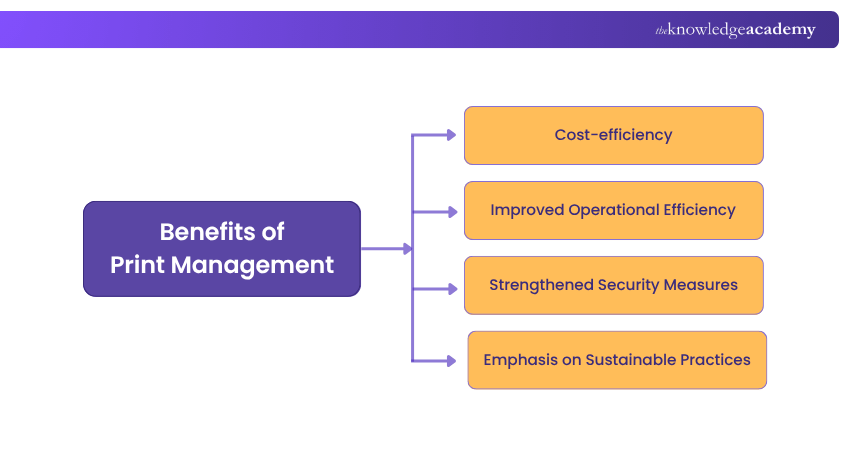
1) Cost-efficiency
Print Management systems are a great help to businesses in maximising their printing resources. It cuts errors or waste and saves money on overhead. Businesses can handle printing materials, maintenance, and energy use costs by enforcing print policies, tracking usage, and setting print quotas.
2) Improved Operational Efficiency
Print Management optimises printing activities to guarantee the timely availability of critical papers while reducing downtime and interruptions. The centralised management of printing devices and resources removes the inefficiencies and bottlenecks in the printing process.
3) Strengthened Security Measures
Print Management solutions enhance data protection by implementing user authentication, encryption, and secure printing protocols. Business firms reduce the risk of data breaches and guarantee regulatory compliance by guarding confidential information and preventing unauthorised access to critical documents.
4) Emphasis on Sustainable Practices
Print Management encourages responsible printing methods and minimises paper usage, contributing to environmental sustainability. Features like print quotas, electronic document dissemination, and duplex printing encourage environmentally responsible activities and support the company's CSR efforts.
What is the Print Management Strategy?
A Print Management strategy is a long-term plan to control, optimise, and secure an organisation’s printing environment. It aligns print infrastructure with business goals, focusing on cost reduction, sustainability, user productivity, and data security through policies, tools, and performance monitoring.
What is the Print Management Policy?
A Print Management policy is a set of rules that govern how printing resources are used within an organisation. It defines user access, print limits, security protocols, and device usage guidelines to ensure efficient, secure, and responsible printing across all departments.
Conclusion
Understanding What is Print Management helps organisations streamline printing, reduce costs, and enhance security. By adopting the right strategies and software, businesses can improve efficiency and support sustainable practices. No matter the industry, Print Management is a key element in modern IT infrastructure. Start building your knowledge today with our Introduction to Management course.
Learn different approaches to management skills with our Introduction To Managing People course. Join today!
Frequently Asked Questions
What Industry is Print Management?

Print Management is a service-oriented industry. It manages and streamlines a business firm's internal workflows, resources, and printing processes. This software applies to a wide range of industries like healthcare, manufacturing, education, finance, and more.
Which City Is Famous for its Printing Industry?
Cities like Delhi, Kolkata, Mumbai, Hyderabad, Chennai, and Sivakasi are home to most large printers. Among these, Sivakasi has become a major commercial printing hub. This city is responsible for a significant share of exports from the Indian printing industry.
What are the other resources and offers provided by The Knowledge Academy?
The Knowledge Academy takes global learning to new heights, offering over 3,000+ online courses across 490+ locations in 190+ countries. This expansive reach ensures accessibility and convenience for learners worldwide.
Alongside our diverse Online Course Catalogue, encompassing 19 major categories, we go the extra mile by providing a plethora of free educational Online Resources like Blogs, eBooks, Interview Questions and Videos. Tailoring learning experiences further, professionals can unlock greater value through a wide range of special discounts, seasonal deals, and Exclusive Offers.
What is Knowledge Pass, and how does it work?
The Knowledge Academy’s Knowledge Pass, a prepaid voucher, adds another layer of flexibility, allowing course bookings over a 12-month period. Join us on a journey where education knows no bounds.
What Are the Related Leadership Courses and Blogs Provided by the Knowledge Academy?
The Knowledge Academy offers various Management Courses, including Introduction to Management Training, Introduction to Managing People Course and Senior Management Training. These courses cater to different skill levels, providing comprehensive insights into the Principles of Management.
Our Business Skills blogs cover a range of topics related to Print Management, offering valuable resources, best practices, and industry insights. Whether you are a beginner or looking to advance your Business skills, The Knowledge Academy's diverse courses and informative blogs have you covered.

James Smith


Digital Marketing Manager and Trainer
James Smith is a digital marketing professional with over a decade of experience in SEO, content strategy, paid media and analytics. He has supported both SMEs and global brands in transforming their digital presence. James’s writing and training are rooted in results-driven tactics and the latest marketing trends.
View Detail
Upcoming Business Skills Resources Batches & Dates
Date
 Management Training for New Managers
Management Training for New Managers
Fri 26th Jun 2026
Management Training for New Managers
Fri 21st Aug 2026
Management Training for New Managers
Fri 30th Oct 2026

 If you wish to make any changes to your course, please


