


 Top Rated Course

We may not have the course you’re looking for. If you enquire or give us a call on 44 1344 203 999 and speak to our training experts, we may still be able to help with your training requirements.
Negotiation Skills: A Comprehensive Guide
Charlotte Wilson 26 March 2026Negotiation Skills help resolve conflicts and reach agreements through Communication, active Listening, emotional intelligence and strategic problem-solving. They are essential in both personal and professional lives. These skills enable you to communicate meaningfully, build trust and find solutions for the benefit of everyone involved.

Training Outcomes Within Your Budget!
We ensure quality, budget-alignment, and timely delivery by our expert instructors.
Table of Contents

Negotiation Skills are vital in various aspects of life, ranging from business deals and career advancements to personal relationships and everyday interactions. These skills can empower individuals to achieve mutually beneficial outcomes, resolve conflicts, and foster positive connections.
By mastering these skills, you can gain valuable abilities that help you in various scenarios, such as salary Negotiations or personal decision-making processes. But the question is: What are Negotiation Skills and how can they be beneficial? This blog will give an extensive overview of the importance and skills of Negotiation. Keep reading to learn more!
Table of Contents
1) What are Negotiation Skills?
2) Importance of Negotiation Skills
3) 10 Essential Negotiation Skills
4) Steps to Improve Your Negotiation Skills
5) What are the Four Golden Rules of Negotiation?
6) What is an Example of Negotiation Skills?
7) Conclusion
What are Negotiation Skills?
Negotiation Skills are the abilities that enable individuals to engage in discussions and resolve conflicts. The main goal of Negotiation is to find a fair middle ground that all parties can agree upon. Such skills include soft skills, including analysis, planning, convincing, collaborating, and effective communication.

Importance of Negotiation Skills
Negotiation Skills are important for achieving favourable outcomes in both personal and professional interactions. Some of the required skills are:
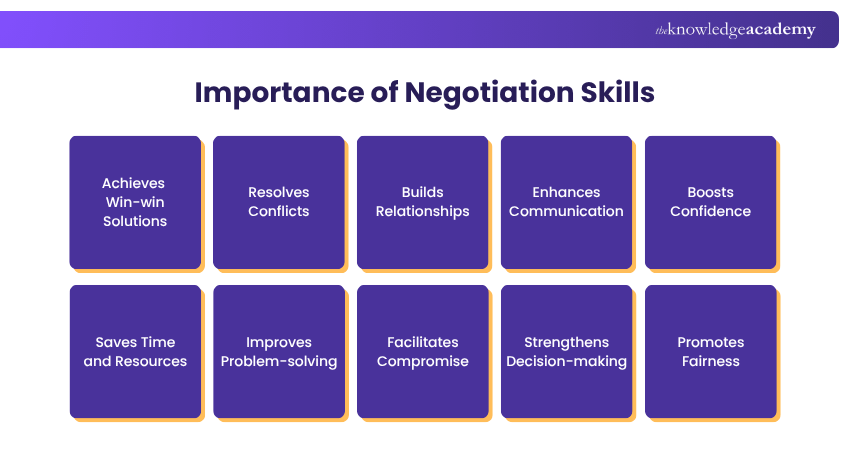
a) Achieves Win-win Solutions: Negotiation helps both sides get what they need. It creates outcomes where everyone benefits.
b) Resolves Conflicts: It helps settle disagreements peacefully. This reduces tension and finds common ground.
c) Builds Relationships: Good negotiation strengthens personal and professional bonds. It fosters trust and cooperation.
d) Enhances Communication: It improves how people talk and understand each other. Clear Communication Skills leads to better outcomes.
e) Boosts Confidence: Negotiating successfully builds self-assurance. This confidence helps in future discussions and decisions.
f) Saves Time and Resources: Effective negotiation prevents long disputes. It avoids unnecessary costs and wasted time.
g) Improves Problem-solving: It encourages finding creative solutions. Negotiation helps address issues effectively.
h) Facilitates Compromise: It helps find a middle ground that satisfies everyone. Compromise makes sure all parties are happy.
i) Strengthens Decision-making: It helps make informed choices. Better decisions lead to better results.
j) Promotes Fairness: It ensures outcomes are fair for all involved. Fair negotiation builds trust and respect.
Learn how culture influences your perspective with our Cross-Cultural Communications Training – join today!
10 Essential Negotiation Skills
It is essential to learn Negotiation Skills for various aspects of life. This section covers 10 essential Negotiation Skills that will help you handle discussions effectively and achieve mutually beneficial outcomes, while understanding the various Factors Affecting Negotiation that can influence the process. Let's explore these key skills.

1) Active Listening
Active Listening is one of the fundamental Negotiation Skills. It engages the speaker and fosters understanding of their point of view. It includes giving your full attention, noticing non-verbal cues, and building empathy with the given message. Through listening actively, Negotiators can find important details, understand interests, and build trust.
2) Effective Communication
Effective Communication is an important Negotiation Skill. It involves expressing ideas clearly, listening attentively, and maintaining a respectful tone throughout the discussion. It helps to prevent misunderstanding, build trust, and encourage a collaborative atmosphere. By mixing listening with empathy, Negotiators find solutions that benefit mutually.
3) Preparation and Research
Preparation and research build the foundation of effective Negotiation. When you fully know and understand the context, the other person’s interests and helps negotiators make smart decisions. Through conducting thorough research and collecting relevant data, Negotiation Strategies are strengthened and bring more suitable results.
4) Problem Solving
Effective Negotiators possess strong problem-solving skills, enabling them to identify creative and mutually beneficial solutions. Problem-solving involves analysing complex issues, thinking critically, and exploring various alternatives. By adopting a collaborative approach and seeking innovative solutions, Negotiators can overcome obstacles and find resolutions that meet the needs of all parties.
5) Emotional Intelligence
Emotional intelligence plays a vital role in negotiations. It refers to the ability to recognise, understand, and manage emotions—both in oneself and others. Negotiators can navigate sensitive situations with greater sensitivity and effectiveness by being aware of emotions and employing empathy. Emotional intelligence facilitates building rapport, diffusing conflicts, and finding common ground.
Gain real-world skills to communicate your thoughts effectively - register for our Communication Skills Course.
6) Flexibility and Adaptability
Flexibility and adaptability are fundamental Negotiation Skills in a fast and dynamic environment. By staying open to newer perspectives, ideas and methods, Negotiators adapt their strategies. This openness fosters creativity, helping Negotiators to discover solutions and reach an agreement to meet the interests of both parties.
7) Strategy
By defining your strategy clearly, you set yourself up for a successful Negotiation. Begin by defining your role where you know your objectives and limits. Afterwards, understand your value and recognise what you bring to the table. Also, consider your counterpart’s perspective, anticipate their goals and challenges. Finally, check with yourself to ensure emotional balance and confidence before the discussion.
8) Persuasion
Persuasion helps you to influence other people’s viewpoints and guide discussions toward mutual agreement. Skilled Negotiators use persuasion to help others see situations from a new perspective. By presenting well-supported arguments that align with shared interests, they make it easier to reach fair and beneficial compromises.
9) Analysing
Analysing helps to objectively assess situations and identify the risks and opportunities involved. A strong analysis enables one to understand the nuances of the discussions before proposing any solution. By assessing interests, facts and possible consequences, Negotiators can think critically and make smarter decisions.
10) Teamwork
Team is essential in successful Negotiations. It enhances understanding, empathy, and collaboration. The mark of an effective Negotiator is seen in how well they work with others and recognise differences in perspectives. By cooperation and open communication, Negotiators gain deeper insights into the needs of people. This builds stronger connections and ideas.
Steps to Improve Your Negotiation Skills
If you're ready to improve your Negotiation capabilities, consider these recommendations:
a) Practice Regularly: Like any skill, negotiation improves with practice. If real-life negotiation opportunities are short, you can practise role-play sessions with a friend or mentor. Create diverse scenarios that require different negotiation approaches to improve your comfort and versatility.
b) Cultivate Confidence: Confidence plays a pivotal role in successful negotiations. When you are self-assured, it often instils trust in the other party and makes them more inclined to agree to your terms. On the other hand, a lack of confidence can convey unpreparedness and uncertainty.
c) Define Clear Objectives: Enter negotiations with a well-defined understanding of your objectives, build an appropriate approach to achieve them, and understand the limits within which you're willing to compromise. This clarity provides you with a roadmap toward your goals and allows you to respond effectively to counteroffers.
d) Initiate the discussion: You can often seize control of the Negotiation by making the initial offer. By setting the baseline, you can establish the starting point for the discussion and direct the bargaining process from a position of your choice.
e) Learn from experience: After each Negotiation, whether it ends successfully or not, you can take time to assess your performance. Reflect on what went well and areas that require improvement. Recognising your weaknesses helps you to target them for further improvement through additional Negotiation training.
Learn to articulate ideas clearly with our Effective Communication Skills Course – join today!
What are the Four Golden Rules of Negotiation?
The Four Golden Rules of Negotiation are explained below. These principles help professionals approach discussions with confidence, clarity, and mutual respect.
1) Never “Sell”
The first golden rule emphasises that you should not approach Negotiation with the objective of selling something. Your goal should be to bring a solution to a problem. People respond to value instead of pressure. It is important to listen actively to other people’s pain points and focus on the value you can provide them.
2) Build Trust
In any successful Negotiation, trust is the core foundation that enables it. It is essential to show integrity, remain honest and bring realistic expectations. By remaining transparent about your terms and assuring the decision-makers are on board, you develop a trusted partnership.
3) Come from a Position of Strength
Successful Negotiations is about being composed, confident, and informed. Entering a Negotiation from a strong position means listening first, speaking second, and avoiding being aggressive. Always negotiate after you have done your research and recognised your value. Also, negotiating when internal metrics, such as time and budget are not in a weak spot is a plus.
4) Know When to Walk Away
When you recognise that the deal is not working anymore, have the courage to step away. Always set your boundaries during Negotiation and witness how it evolves. If the terms fall beneath your value or compromise integrity, walking away is the best option.
What is an Example of Negotiation Skills?
Here, we have provided some real-world examples that demonstrate Negotiation Skills.
1) The U.S Mortgage Foreclosure Settlement (2012)
In 2012, U.S. officials and five major banks reached a $25 billion settlement to resolve foreclosure abuses during the housing crisis. Negotiators showed analytical, communication, and persuasion skills, balancing accountability with public interests while compensating homeowners and restoring trust in the banking system.
2) Merge of Disney and Pixar (2006)
According to The Walt Disney Company, Disney acquired Pixar in an all-stock transaction valued at approximately $7.4 billion. Steve Jobs and Bob Iger led negotiations that emphasised mutual trust, respect for Pixar’s creative culture, and alignment of strategic interests. This transformed a potential power struggle into a collaborative partnership, strengthening Disney’s future in animation.
3) Brexit Negotiations (2016-2020)
The United Kingdom and European Union held years of complex Brexit negotiations to settle trade, immigration, and regulatory terms. Negotiators used preparation, patience, adaptability, and diplomacy to manage conflicts, showing how persistence and strategic communication can bridge divisions and reach practical agreements.
Conclusion
Negotiation Skills empower you to handle challenges confidently and reach outcomes that benefit everyone involved. By developing these abilities, you can think strategically, communicate clearly, and strengthen professional relationships. Remember, every successful negotiation is built on understanding, cooperation, and the willingness to find common ground.
Learn how to negotiate successfully with our Negotiation Skills Course - join today!
Frequently Asked Questions
How do Cultural Differences Impact Negotiation Dynamics, and how can They be Navigated?

Cultural differences impact negotiation dynamics through varying communication styles, attitudes towards conflict, decision-making practices, and value systems. Navigating these requires cultural sensitivity, flexibility, and open-mindedness.
How can Negotiation Skills be Honed for Virtual or Remote Communication Scenarios?
Honing Negotiation Skills for virtual scenarios involves mastering digital communication tools and enhancing clarity and conciseness in written and verbal communication. It also includes understanding the nuances of non-verbal cues through video, practising active listening, and being adaptable to technology glitches.
What are the Other Resources and Offers Provided by The Knowledge Academy?
The Knowledge Academy takes global learning to new heights, offering over 3,000+ online courses across 490+ locations in 190+ countries. This expansive reach ensures accessibility and convenience for learners worldwide.
Alongside our diverse Online Course Catalogue, encompassing 17 major categories, we go the extra mile by providing a plethora of free educational Online Resources like Blogs, eBooks, Interview Questions and Videos. Tailoring learning experiences further, professionals can unlock greater value through a wide range of special discounts, seasonal deals, and Exclusive Offers.
What is Knowledge Pass, and how Does it Work?
The Knowledge Academy’s Knowledge Pass, a prepaid voucher, adds another layer of flexibility, allowing course bookings over a 12-month period. Join us on a journey where education knows no bounds.
What are Related Courses and Blogs Provided by The Knowledge Academy?
The Knowledge Academy offers various Communication Skills Courses including Assertiveness Skills Training, Negotiation Skills Training and Effective Communication Skills Training. These courses cater to different skill levels, providing comprehensive insights into Types of Negotiation.
Our Business Skills Blogs cover a range of topics related to communication skills along with negotiation techniques and examples, offering valuable resources, best practices, and industry insights. Whether you are a beginner or looking to advance your Communication skills, The Knowledge Academy's diverse courses and informative blogs have you covered.

Charlotte Wilson


Soft Skills and Business Training Manager
Charlotte Wilson is an expert in soft skills development, with over 14 years of experience helping individuals and teams improve communication, productivity and emotional intelligence in the workplace. Her training content is focused on enhancing interpersonal effectiveness and fostering positive, collaborative environments across all levels of an organisation.
View Detail
Upcoming Business Skills Resources Batches & Dates
Date
 Public Speaking Course
Public Speaking Course
Fri 17th Jul 2026
Public Speaking Course
Fri 16th Oct 2026

 If you wish to make any changes to your course, please


