


 Top Rated Course

We may not have the course you’re looking for. If you enquire or give us a call on 44 1344 203 999 and speak to our training experts, we may still be able to help with your training requirements.
Clojure vs Java: Choose the Right Language for Your Project
The Knowledge Academy 23 February 2026Navigate the choice between Clojure and Java with our insightful blog. Explore the nuances of each language, from syntax to performance, aiding your decision-making process. Uncover which language aligns with your project goals for optimal efficiency. Make an informed choice with our comprehensive Clojure vs Java comparison.

Training Outcomes Within Your Budget!
We ensure quality, budget-alignment, and timely delivery by our expert instructors.
Table of Contents

As a developer, you need to be picky when selecting Programming Languages for your various projects. From Java to Clojure, Haskell, and .NET, each of these languages offers a different set of capabilities to the user. Selecting the appropriate language for the project requires careful examination and comparison. In this blog, we will compare Clojure vs Java and help you understand both languages, their features, use cases, advantages and disadvantages. Hopefully this Clojure vs Java examination will help you make an informed decision when selecting the appropriate language.
Table of Contents
1) What is Clojure?
a) Advantages of Clojure
b) Disadvantages of Clojure
2) What is Java?
3) Clojure vs Java: The key differences
4) Conclusion
What is Clojure?
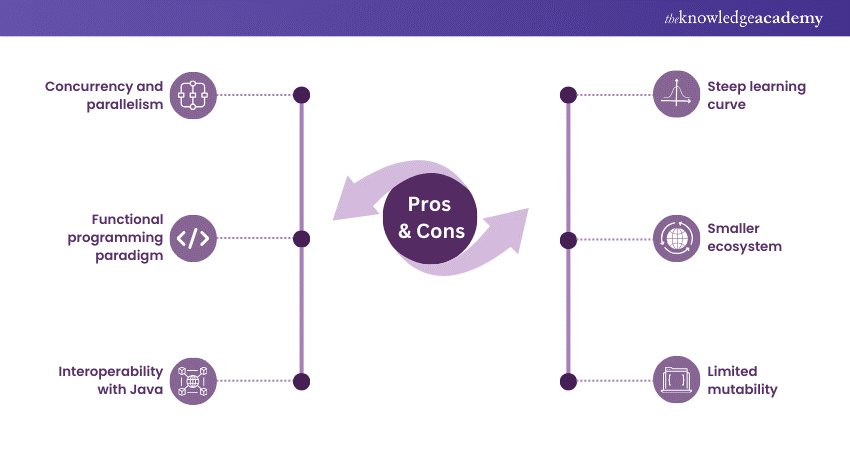
Clojure is a modern, functional Programming Language on the Java Virtual Machine (JVM). Designed for concurrent and interactive programming, Clojure emphasises simplicity and immutability. Developed by Rich Hickey, it incorporates Lisp's powerful features while seamlessly integrating with Java libraries.
One distinguishing aspect of Clojure is its emphasis on immutable data structures, promoting safer concurrent programming by avoiding shared mutable states. It supports functional programming paradigms, including first-class and higher-order functions, facilitating expressive and concise code.
Clojure's syntax is based on S-expressions, offering a consistent and minimalist structure. It features dynamic typing, making it adaptable and suitable for rapid development. The language encourages a REPL-driven development approach, enabling programmers to experiment and evaluate code snippets interactively.
With a focus on simplicity, concurrency, and interoperability with Java, Clojure has found applications in various domains, including web development, data analysis, and distributed systems. The Clojure Loop attracts a community of developers who appreciate its elegance and pragmatic design, making it a valuable tool for tackling complex problems in these areas.
Advantages of Clojure
Clojure, a modern dialect of Lisp, offers several distinct advantages in software development. Its emphasis on simplicity, immutability, and functional programming principles contributes to its appeal. Clojure's simplicity lies in its minimalist syntax and powerful abstractions, enabling concise and expressive code.
Immutability, a core principle, ensures that data structures are immutable by default, reducing bugs related to mutable states and facilitating concurrent programming. Clojure Data Types benefit from this approach, enhancing code reliability and scalability in multi-threaded environments.
Furthermore, Clojure's functional programming paradigm encourages functions as first-class citizens, promoting a declarative and concise coding style. It enables a focus on transformations rather than state manipulation, leading to more transparent and more maintainable codebases.
Additionally, Clojure's interoperability with Java provides access to a vast ecosystem of libraries and tools, enhancing its versatility and making it an attractive choice for developers seeking a robust language for building scalable, concurrent, and high-performance applications.
Disadvantages of Clojure
While Clojure offers unique advantages, it is essential to consider potential disadvantages. One drawback is its relatively steep learning curve, especially for developers unfamiliar with functional programming paradigms. Based on Lisp, the syntax might pose challenges for those accustomed to more mainstream languages. Additionally, the community support for Clojure, while passionate, is smaller than languages like Java or Python, potentially affecting the availability of resources and libraries.
Furthermore, integration with existing Java libraries may not always be seamless, leading to additional complexities. The lack of widespread adoption in certain industry domains could be considered a limitation, influencing its suitability for specific projects. Despite these drawbacks, many developers appreciate Clojure's conciseness, simplicity, and immutability features. Still, carefully considering the project's requirements and team expertise is crucial before opting for this functional Programming Language.

What is Java?
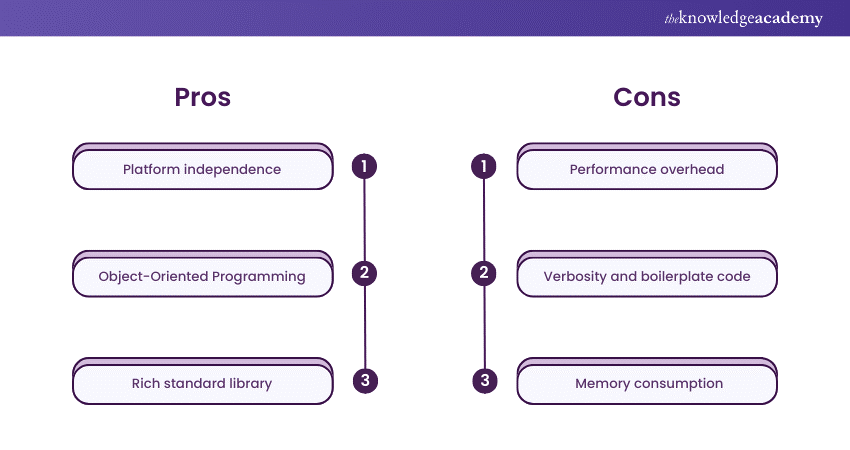
Java is a versatile, Object-Oriented Programming (OOPs) language renowned for its platform independence and ease of use. Developed by Sun Microsystems, it allows developers to write code once and run it on any device supporting Java, thanks to its "Write Once, Run Anywhere" (WORA) philosophy. Java applications run in a Java Virtual Machine (JVM), enhancing portability. It offers a rich set of libraries, making it suitable for various applications, from web development to mobile apps. Java's syntax is familiar to many programmers, aiding quick adaptation. Its strong memory management, security features, and support for multithreading contribute to its widespread adoption. Java remains dominant in enterprise applications, Android development, and web services, making it a pivotal language in the software development landscape. Understanding both OOP and POP in Java helps developers leverage its full potential for building scalable and efficient software solutions.
Discover essential Clojure Interview Questions and Answers to prepare for your next job interview.
Advantages of Java
Java, a versatile and widely adopted Programming Language, offers numerous advantages. Its platform independence stands out, as Java applications can run on any device with a Java Virtual Machine (JVM). This cross-platform compatibility ensures broad accessibility.
Java's object-oriented nature promotes modular and scalable code, enhancing code organisation and maintenance. Its automatic memory management through garbage collection reduces the risk of memory-related errors.
Java emphasises security with built-in features like the Security Manager and bytecode verification, ensuring robust protection against potential vulnerabilities. Its extensive standard library simplifies development by providing pre-built modules for various functionalities.
The strong community support and rich ecosystem of libraries and frameworks, including Spring and Hibernate, contribute to Java's popularity. Furthermore, Java's multithreading capabilities enable concurrent execution, fostering efficient and responsive applications. Overall, the combination of portability, security, modularity, and a robust development ecosystem positions Java as a powerhouse in the programming world.
Disadvantages of Java
While Java boasts various strengths, it's not without limitations. One notable drawback is its performance. Java's "Write Once, Run Anywhere" philosophy, achieved through bytecode interpretation, can lead to slower execution than natively compiled languages. Additionally, its memory consumption tends to be higher than some other languages due to automatic memory management by the garbage collector, which can occasionally cause performance hiccups.
Another disadvantage is its verbosity. Java code can be more verbose than other languages, requiring more lines of code to perform specific tasks. This vocabulary can sometimes lead to a longer development cycle and increased complexity.
Furthermore, Java's User Interface (UI) capabilities, while improving with frameworks like JavaFX, have historically been criticised for lagging behind those of some other languages. This limitation can affect the development of modern, visually rich applications.
Lastly, Java's licensing can pose challenges in certain commercial contexts, as Oracle's licensing and support policies may be restrictive for some users and enterprises.
Master the art of software design: Register for our Object-Oriented Programming (OOPs) Course and unleash your coding potential today!
Clojure vs Java: The key differences
|
Feature |
Clojure |
Java |
|
Paradigm |
Functional Programming Language |
Object-oriented Programming Language |
|
Syntax |
Concise, expressive, and lisp-based |
Verbose, syntax-heavy, and class-based |
|
Concurrency |
Built-in support for immutable data structures and Software Transactional Memory (STM) |
Concurrency managed through threads and explicit synchronisation |
|
Mutability |
Emphasises immutability |
Mutable state is common |
|
Platform |
Runs on the Java Virtual Machine (JVM) |
Native language for the JVM |
|
Community |
Smaller community compared to java |
Large and established community |
|
Performance |
Generally performs well, especially in concurrent tasks |
Strong performance but might be more resource-intensive |
|
Learning curve |
May have a learning curve for those unfamiliar with lisp syntax |
Steeper learning curve for beginners due to extensive syntax and concepts |
|
Tooling |
Growing ecosystem, with good tooling support |
Extensive and mature tooling support |
|
Use cases |
Well-suited for concurrent and parallel programming, data analysis, and functional programming paradigms |
Versatile, used for enterprise applications, mobile development, and a wide range of domains |
|
Interoperability |
Seamless integration with java code |
Native interoperability with other java-based technologies |
|
Memory management |
Garbage collection similar to java |
Java's garbage collection is widely used |
|
Adoption |
Growing in popularity, especially in specific niches |
Ubiquitous and widely adopted in various industries |
|
Examples |
(Defn greet [name] (str "hello, " name "!")) |
Public class helloworld { public static void main(string[] args) { system.Out.Println("hello, world!"); }} |
Clojure and Java, both powerful Programming Language s, possess distinct characteristics and applications, catering to different programming paradigms while sharing roots in the Java Virtual Machine (JVM).
Clojure, a dynamic and functional Lisp dialect, emphasises immutability, simplicity, and concurrency. Its focus on functional programming fosters immutable data structures and pure functions, facilitating simpler code and minimising side effects. Clojure's emphasis on immutable data enables safer and more straightforward code, promoting concurrency and making debugging easier.
In contrast, Java is an Object-Oriented Language known for its robustness, portability, and rich ecosystem. It adopts a more imperative style, supporting object-oriented and procedural programming paradigms. Java's strong typing and extensive libraries make it suitable for building large-scale enterprise applications, and its object-oriented nature promotes reusable and maintainable code.
One significant difference lies in their syntax and approach to programming paradigms. Clojure's Lisp-like syntax and functional programming encourage a more concise and expressive coding style, focusing on data transformation and immutable state. On the other hand, Java's syntax is more verbose and follows a traditional object-oriented approach, emphasising mutable state and imperative programming.
Clojure's emphasis on leveraging the JVM ecosystem also allows seamless interoperability with existing Java codebases. It inherits Java's robustness and performance while introducing functional programming concepts. This interoperability enables developers to harness the benefits of both languages, leveraging Java's extensive libraries and Clojure's succinctness.
In terms of concurrency, Clojure's immutable data structures and Software Transactional Memory (STM) facilitate easier management of concurrent operations, mitigating common concurrency-related issues. Java, while supporting concurrency through threads and libraries like Java.util.concurrent, requires careful handling of mutable state to avoid synchronisation problems.
When considering performance, Java offers faster execution speed due to its static typing and compiler optimisations. Clojure, although slightly slower in execution speed due to its dynamic nature, compensates with its focus on concurrency and more straightforward, more maintainable code.
The choice between Clojure and Java hinges on specific project requirements and programming paradigms. Clojure appeals to those inclined towards functional programming, immutable data, and simplified concurrency handling. With its widespread usage, robustness, and versatility, Java remains a popular choice for enterprise-level applications requiring object-oriented programming and a vast ecosystem of libraries.
While both languages have their strengths and applications, the choice between Clojure and Java ultimately depends on the project's needs, developer preferences, and the desired programming paradigm—whether functional, immutable, and concise (Clojure), or object-oriented, robust, and widely supported (Java).
Unlock the power of Clojure: Register now for comprehensive Clojure Programming Language Training and elevate your coding prowess!
Conclusion
In conclusion, selecting between Clojure vs Java hinges on project specifics. Clojure excels in functional programming and concurrency, while Java's versatility suits a broader spectrum. Assess your project's needs, considering syntax preferences, platform requirements, and community support to make an informed decision aligning with your development goals.
Transform your coding journey: Join our Programming Training today and master the skills that propel you toward coding excellence!
Frequently Asked Questions
Which projects are better suited for Clojure, and which ones for Java?

Clojure is well-suited for projects requiring concurrent and functional programming paradigms, making it an excellent choice for data analysis and real-time systems. On the other hand, Java's versatility makes it ideal for a broad spectrum of projects, from enterprise-level applications to mobile development. The decision between Clojure and Java should be based on the specific needs of the project, considering factors like concurrency requirements, functional programming preferences, and the overall goals of the development.
How does the learning curve of Clojure compare to Java for beginners?
The learning curve of Clojure may be steeper for beginners unfamiliar with Lisp syntax, requiring an adjustment to functional programming concepts. In contrast, Java's learning curve can be challenging due to its extensive syntax and object-oriented paradigm. Both languages, however, provide ample learning resources, and the choice depends on a programmer's preferences and project requirements, with support available for mastering the intricacies of either Clojure or Java.
Can Clojure and Java be used together in a project?
Certainly. Clojure and Java can be seamlessly used together within a project. Since Clojure runs on the Java Virtual Machine (JVM), it can effortlessly interoperate with Java code. This integration allows developers to leverage the strengths of both languages simultaneously, combining Clojure's functional programming capabilities with Java's versatility. Whether building new applications or extending existing Java projects, the interoperability between Clojure and Java enhances flexibility and promotes efficient code reuse.
What are the other resources and offers provided by The Knowledge Academy?
The Knowledge Academy takes global learning to new heights, offering over 3,000+ online courses across 490+ locations in 190+ countries. This expansive reach ensures accessibility and convenience for learners worldwide.
Alongside our diverse Online Course Catalogue, encompassing 17 major categories, we go the extra mile by providing a plethora of free educational Online Resources like Blogs, eBooks, Interview Questions and Videos. Tailoring learning experiences further, professionals can unlock greater value through a wide range of special discounts, seasonal deals, and Exclusive Offers.
What are related PRINCE2 courses and blogs provided by The Knowledge Academy?
The Knowledge Academy offers various Programming Trainings, including Object Oriented Programming (OOPs) Course, Python Programming Course and Haskell Programming Training. These courses cater to different skill levels, providing comprehensive insights into Software Developer Career Path.
Our Programming Training Blogs covers a range of topics related to Programming, offering valuable resources, best practices, and industry insights. Whether you are a beginner or looking to advance your Programming skills, The Knowledge Academy's diverse courses and informative blogs have you covered.
What is Knowledge Pass, and how does it work?
The Knowledge Academy’s Knowledge Pass, a prepaid voucher, adds another layer of flexibility, allowing course bookings over a 12-month period. Join us on a journey where education knows no bounds.

The Knowledge Academy


Global Training Provider
The Knowledge Academy is a world-leading provider of professional training courses, offering globally recognised qualifications across a wide range of subjects. With expert trainers, up-to-date course material, and flexible learning options, we aim to empower professionals and organisations to achieve their goals through continuous learning.

Upcoming Programming & DevOps Resources Batches & Dates
Date
 Clojure Programming Language Training
Clojure Programming Language Training
Fri 19th Jun 2026
Clojure Programming Language Training
Fri 7th Aug 2026
Clojure Programming Language Training
Fri 25th Sep 2026

 If you wish to make any changes to your course, please


