Who Should Attend this Clojure Programming Language Training Course?
This Clojure Programming Language Training is suitable for individuals looking to develop or strengthen their Clojure programming skills. It supports delegates new to Clojure as well as those improving their existing programming knowledge. The following individuals can benefit from this course.
- Programmers
- Java Developers
- Software Developers
- Web Developers
- Application Developers
- Backend Developers
- Technical Architects
Prerequisites for the Clojure Programming Language Training
There are no formal prerequisites to attend this Clojure Programming Language Course. However, a basic understanding of Java programming and software development would be beneficial for delegates.
Clojure Programming Language Training Overview
Clojure Programming Language Training introduces Clojure as a modern Lisp Programming Language and covers syntax, functions, collections, flow control, Java interoperability, and namespaces. It also introduces recursion, exceptions, and techniques for navigating and editing Clojure code.
Delegates develop skills in creating and applying functions, working with immutable collections, controlling program flow, and using Java interoperability. They also strengthen their ability to work with namespaces, recursion, exceptions, and common development tools.
This 1-Day Clojure Course by The Knowledge Academy enables delegates to apply core Clojure concepts in practical development situations. They will be better equipped to write, organise, and manage Clojure code using the language features and tools covered.
Clojure Programming Language Course Objectives
- To understand core Clojure concepts and syntax
- To install Clojure and work with common development editors
- To apply structural editing techniques for navigating and modifying Clojure code
- To create and apply functions, locals, closures, and Java interoperability
- To work with sequential and hashed collections in Clojure
- To apply flow control, recursion, exceptions, and namespace concepts
Learning Outcomes of this Clojure Programming Language Training Course
Upon completing this Clojure Course, delegates will understand how core Clojure features, collections, functions, structural editing, flow control, Java interoperability, and namespaces work together. They will be better equipped to apply this knowledge when developing and maintaining structured Clojure applications.
Clojure Programming Language Career Paths
Clojure knowledge can support progression into software development roles that use functional programming, JVM technologies, backend systems, and distributed applications. Depending on experience and broader technical skills, relevant career paths include:
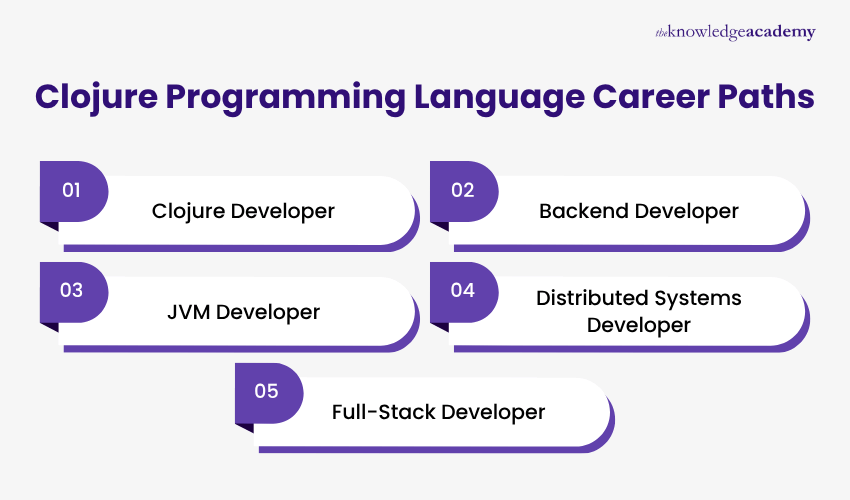
- Clojure Developer: Develops applications using Clojure, functional programming principles, and JVM interoperability.
- Backend Developer: Builds server-side applications and services using Clojure within JVM-based environments.
- JVM Developer: Works across Java and Clojure technologies to develop and integrate application components.
- Distributed Systems Developer: Contributes to large-scale systems that involve distributed processing and concurrent application design.
- Full-Stack Developer: Uses Clojure for backend development and can extend into frontend development with ClojureScript.





 If you miss out, enquire to get
yourself
on the waiting list for the next day!
If you miss out, enquire to get
yourself
on the waiting list for the next day!













 If you wish to make any changes to your course, please


