

SQL Courses

Online Instructor-led (1 days)

Online Self-paced (8 hours)

Introduction to SQL Course Outline

Module 1: SQL-An Overview

  • DBMS and RDBMS
  • Introduction to SQL
  • SQL Environmental Setup

Module 2: Data Constraint, Keys and Datatypes

  • Introduction
  • Constraints
  • Keys
  • Data types

Module 3: Normalisation

  • What is Normalisation?
  • Types of Normalisation

Module 4: Creating Databases and Tables

  • Types of SQL Commands
  • DDL Statements
  • DML Statements
  • TCL Statements

Module 5: Clauses and Aggregate Functions

  • Group by Clause
  • Aggregate Functions
  • Where Clause
  • Having and Order by Clause
  • Distinct Clause

Module 6: Joins

  • Aliases
  • Joins
  • Inner Join
  • Outer Join
  • Right Outer Join

Module 7: Views

  • Introduction to Views
  • Advantages
  • Types of Views
  • Simple View
  • Complex View
  • Operations

Module 8: Triggers

  • Introduction to Triggers
  • Advantages
  • Disadvantages
  • Hands-on

Show moredown

Who Should Attend this Introduction to SQL Course?

This course is designed for individuals who want to learn the fundamentals of Structured Query Language (SQL) for database management and data manipulation. This course will benefit a wide range of professionals, including:

  • Data Analysts
  • Database Administrators
  • Software Developers
  • Business Intelligence Analysts
  • Database Developers
  • IT Professionals
  • Systems Analysts

Prerequisites of the Introduction to SQL Course

There are no formal prerequisites to attend the Introduction to SQL Course. However, a basic knowledge of computers and databases can be beneficial for delegates.

Introduction to SQL Course Overview

SQL (Structured Query Language) is fundamental for managing and manipulating relational databases. This training introduces core concepts including queries, data structures, and database operations essential for efficient data handling.

Developing SQL skills enables professionals to retrieve, analyse, and manage data effectively. It supports better decision-making and enhances productivity across data-driven roles and industries.

This 1-Day course offered by The Knowledge Academy equips delegates with practical SQL skills. Delegates gain hands-on experience in querying, managing data, and applying SQL techniques confidently in real-world scenarios.

Introduction to SQL Course Objectives

  • To comprehend the fundamental principles of SQL
  • To learn various SQL commands for data retrieval and manipulation
  • To understand database design and management
  • To apply SQL queries to solve practical business problems
  • To grasp the significance of data integrity within databases
  • To acquire proficiency in writing complex SQL queries
  • To practice optimising database performance
  • To employ SQL in extracting valuable insights from data

After completing this training, delegates receive a certificate of completion demonstrating their understanding of SQL fundamentals. It highlights their ability to work with databases, create effective queries, and apply SQL techniques for data analysis and management.

Show moredown

What’s included in this Introduction to SQL Training Course?

  • World-Class Training Sessions from Experienced Instructors
  • Introduction to SQL Certificate
  • Digital Delegate Pack

Show moredown

Online Instructor-led (2 days)

Online Self-paced (16 hours)

Advanced SQL Training Course Outline

Module 1: Creating Tables

  • Creating Tables in SQL
  • Inserting Data
  • Inserting Multiple Rows
  • View Table

Module 2: Stored Procedure Basics

  • Pros and Cons of Stored Procedures
  • Creating Stored Procedures
  • Two Ways to Execute
  • System Stored Procedures

Module 3: Variables

  • Declaring Variables
  • SET Versus SELECT
  • Global Variables
  • Tricks with Variables

Module 4: Parameters and Return Values

  • Passing Parameters
  • Default Values and WHERE Clauses
  • Output Parameters
  • Using RETURN

Module 5: Scalar Functions

  • Introduction to Scalar Functions
  • Various Scalar Functions
  • Advantages of Scalar Functions

Module 6: Testing Conditions

  • IF/ELSE Conditions
  • Using CASE Where Possible

Module 7: Looping

  • While Loop
  • Breaking Out of a Loop
  • Basic Transactions
  • Using DELETE and UPDATE
  • Sys.Objects

Module 8: Temporary Tables and Table Variables

  • Using Temporary Tables
  • Creating Table Variables
  • Pros and Cons of Each Approach

Module 9: Table Valued Functions

  • In-line Table-Valued Functions
  • Multi-Statement Table-Valued Functions
  • Limitations of User-Defined Functions

Module 10: Derived Tables and CTEs

  • Using Derived Tables
  • Common Table Expressions (CTEs)
  • Recursive CTEs

Module 11: Subqueries

  • Subquery
  • Using ALL, ANY and IN
  • Correlated Subqueries
  • Using EXISTS

Module 12: Cursors

  • What is Cursor?
  • Life Cycle of Cursor
  • Types of Cursor
  • Syntax of Fetching Rows

Module 13: Error-Handling

  • Using TRY/CATCH
  • System Error Functions
  • Custom Error Messages
  • Obsolete @Error Function
  • SQL Server Debugger

Show moredown

Who Should Attend this Advanced SQL Course?

The Advanced SQL Training is designed for delegates who want to strengthen their knowledge of Structured Query Language (SQL) and learn advanced techniques for database management and data manipulation. This course will benefit a wide range of professionals, including:

  • Database Administrators
  • Data Analysts
  • Business Intelligence Developers
  • Software Developers
  • Data Scientists
  • Data Engineers
  • System Architects
  • Application Developers

Prerequisites of the Advanced SQL Course

There are no formal prerequisites to attend the Advanced SQL Course Online. However, delegates are recommended to have a foundational understanding of SQL.

Advanced SQL Course Overview

Advanced SQL Training focuses on complex querying, optimisation, and database management techniques. It covers advanced functions, joins, and performance tuning strategies for handling large datasets.

Mastering Advanced SQL enables professionals to optimise database performance and manage complex data operations efficiently. It supports deeper insights and improved analytical capabilities.

This 2-Day course offered by The Knowledge Academy equips delegates with advanced SQL expertise. Delegates gain hands-on experience in writing complex queries and optimising database performance.

Advanced SQL Course Objectives

  • To understand and implement complex SQL queries with multiple joins and subqueries
  • To utilise advanced SQL functions, stored procedures, and triggers effectively
  • To optimise database performance through indexing and query optimisation techniques
  • To master techniques for managing large datasets and data integrity in SQL
  • To comprehend and apply transaction management and concurrency control methods
  • To practice advanced SQL techniques through hands-on exercises and case studies

After completing this Advanced SQL Training, delegates will receive a certificate of completion demonstrating their proficiency in Advanced SQL concepts. It reflects their ability to manage complex databases, optimise query performance, and handle intricate data scenarios effectively.

Show moredown

What’s Included in this Advanced SQL Course?

  • World-Class Training Sessions from Experienced Instructors
  • Advanced SQL Certificate
  • Digital Delegate Pack

Show moredown

Online Instructor-led (1 days)

Online Self-paced (8 hours)

Introduction to MySQL Course Outline

Module 1: Database Concepts

  • Databases
  • Databases Management System (DBMS)
  • Characteristics of a Database
  • Users of a Database
  • Types of Database Management Systems
  • Relational Database
  • Hierarchal Database
  • Network Database Model
  • Object-oriented Models

Module 2: Using MySQL Client

  • Introduction
  • Using MySQL Client
  • MySQL Client Programs
  • Types

Module 3: Date, Time and Other Functions

  • Date and Time Functions
  • String Functions
  • Control Flow Functions

Module 4: Managing Data

  • Ways to Manage Data
  • Exporting Data to a Simple CSV File
  • Exporting Data to a Custom File Format
  • Import Data from a Simple CSV File

Module 5: Limit, Aggregate and Union Functions

  • Limit Functions
  • Aggregate Function
  • Union Function

Module 6: Indexes and Views

  • Indexes
  • Views

Show moredown

Who Should Attend this Introduction to MySQL Course?

The Introduction to MySQL Course is designed for delegates who want to learn the basics of MySQL, a popular open-source Relational Database Management System. This course can be beneficial for a wide range of professionals, including:

  • Database Administrators
  • Software Developers
  • Data Analysts
  • Business Intelligence Analysts
  • Web Developers
  • Application Engineers
  • IT Professionals

Prerequisites of the Introduction to MySQL Course

There are no formal prerequisites to attend this Introduction to MySQL Courses. However, some basic knowledge of computers, databases and basics of SQL can be beneficial for delegates before attending this SQL Courses.

Introduction to MySQL Training Course Overview

MySQL is a widely used relational database system that supports modern applications and data management needs. This training covers database creation, querying, and essential management techniques.

Learning MySQL helps professionals handle structured data efficiently and supports scalable application development. It enhances the ability to manage and interpret data effectively.

This 1-Day course offered by The Knowledge Academy enables delegates to develop foundational MySQL skills. Delegates gain practical experience in database management and querying through real-world exercises.

Introduction to MySQL Course Objectives

  • To comprehend the fundamental concepts of relational databases
  • To learn how to create and manage MySQL databases effectively
  • To execute basic to intermediate SQL queries for data retrieval
  • To understand the importance of data normalisation and its application
  • To grasp the concepts of table relationships and their significance
  • To explore data manipulation techniques using MySQL
  • To comprehend security aspects related to MySQL databases

After completing this course, delegates will receive a certification recognising their proficiency in MySQL Fundamentals. These SQL Courses testify to their capability to handle MySQL databases effectively, boosting their credentials in the competitive landscape of data-driven roles.

Show moredown

What’s Included in this Introduction to MySQL Course?

  • World-Class Training Sessions from Experienced Instructors
  • Introduction to MySQL Certificate
  • Digital Delegate Pack

Show moredown

Online Instructor-led (1 days)

Online Self-paced (8 hours)

SQL Server Reporting Services (SSRS) Training Course Outline

Module 1: Introducing SQL Server Reporting Services (SSRS)

  • What is SSRS?
  • SSRS Utilisation
  • Visual Studio Windows
  • Enterprise Reporting
  • Dashboard, Applications, and Reports

Module 2: Reporting Services Framework

  • Installation and Deployment
  • Reporting Lifecycle
  • SRSS Tools and Components
  • SRSS Extensions and Processors
  • How SSRS Works?
  • Creating Database
  • Connecting Database

Module 3: Simple Report Design

  • Creating Reports
  • Components of a Report
  • SQL Server Data Tools and BIDS
  • Report Builder
  • Textbox and Text Properties
  • Toolbars

Module 4: Layout and Formatting

  • Report Layout Types
  • Formatting Report Data
  • Tablix Report Properties 
  • Matrix Reports Properties
  • Map Reports Properties
  • Gauge Reports Properties
  • Page Breaks
  • Dynamic Filtering

Module 5: Advanced Report Design

  • Report Templates
  • SubReports
  • Drill Through and Drill Down Reports
  • SSRS Functions and Operators
  • Padded and Embedded Formatting
  • Non-SQL Data Sources
  • Building Queries

Modules 6: Tables and Charts Reports

  • Creating and Formatting Tables
  • Nested Tables
  • Creating and Formatting Charts
  • Creating Multi-Series Charts
  • Properties and Settings
  • Chart Properties

Modules 7: Data Access Design

  • Data Sources and Sets
  • Types of Filters in SSRS
  • Report Parameters and Filtering
  • Creating Lists

Module 8: Content Management and Server Administration

  • Navigating Report Manager
  • Organising Reports and Datasets
  • Managing Reports and Data Sources
  • Data Source Security
  • Report Service Authentication
  • Managing Data Security from Report Manager
  • Backup

Show moredown

Who Should Attend this SQL Server Reporting Services Training?

The SQL Server Reporting Services (SSRS) Course is designed for individuals who want to become proficient in creating, designing, and managing reports using SQL Server Reporting Services. This SQL Certification Course can be beneficial for a wide range of professionals, including:

  • Report Developers
  • Data Analysts
  • Database Administrators
  • BI Consultants
  • SQL Developers
  • Data Visualisation Specialists
  • IT Professionals

Prerequisites of the SQL Server Reporting Services Training

There are no formal prerequisites to attend the SQL Server Reporting Services Training. However, some basic knowledge of SQL concepts, such as creating tables, inserting data, and selecting data can be beneficial for delegates.

SQL Server Reporting Services (SSRS) Training Overview

SQL Server Reporting Services (SSRS) Training focuses on developing skills in creating and managing data reports. It covers report design, deployment, and data visualisation techniques.

It enhances the ability to present insights and supports informed decision-making. Delegates improve reporting accuracy and data communication skills.

This 1-Day course offered by The Knowledge Academy equips delegates with reporting skills. Delegates learn to design, manage, and deploy reports effectively using SSRS.

SQL Server Reporting Services (SSRS) Training Course Objectives

  • To comprehend SSRS architecture and its components
  • To design and create diverse report types using SSRS functionalities
  • To implement data visualisation techniques for impactful reporting
  • To understand SSRS security and deployment strategies
  • To optimise report performance and enhance user interactivity
  • To integrate SSRS with other Microsoft tools for comprehensive reporting
  • To troubleshoot common SSRS issues effectively

After completing this SQL Course, delegates receive a certification validating their expertise in SSRS. This training demonstrate proficiency in designing, implementing, and managing robust reporting solutions using SQL Server Reporting Services, enhancing career prospects in data analytics and business intelligence.

Show moredown

What’s Included in this SQL Server Reporting Services Training?

  • World-Class Training Sessions from Experienced Instructors
  • SQL Server Reporting Services Certificate
  • Digital Delegate Pack

Show moredown

Online Instructor-led (1 days)

Online Self-paced (8 hours)

PostgreSQL Administration Training Course Outline

Module 1: Introduction

  • What is PostgreSQL?
  • Conventions
  • Bug Reporting

Module 2: Getting Started with PostgreSQL

  • Creating and Assessing a Database
  • Installation from Binaries

Module 3: Advanced Features

  • Views
  • Foreign Keys
  • Transactions
  • Window Functions
  • Inheritance

Module 4: SQL Language

  • What is SQL?
  • Applications of SQL
  • Joins Between Tables

Module 5: SQL Language Functions

  • SQL Syntax
  • Data Types
  • Functions and Operators

Module 6: Database Administration

  • Database Roles
  • Managing Databases
  • Localisation
  • Routine Database Maintenance Tasks
  • Backup and Restore

Module 7: Client Interfaces

  • Large Objects
  • Information Schema

Module 8: Procedural Languages

  • Introduction
  • PL/pgSQL – SQL Procedural Language

Module 9: Internals

  • Overview of PostgreSQL Internals
  • System Catalogs
  • Frontend/Backend Protocol
  • PostgreSQL Coding Conventions
  • Native Language Support

Show moredown

Who Should Attend this PostgreSQL Administration Training Course?

The PostgreSQL Administration Training Course is tailored for individuals seeking to become proficient in managing and optimising PostgreSQL database systems. This SQL Online Course can be beneficial for a wide range of professionals, including:

  • Database Administrators
  • System Administrators
  • Database Developers
  • Software Engineers
  • IT Managers
  • Data Analysts
  • DevOps Engineers

Prerequisites of the PostgreSQL Administration Training Course

There are no formal prerequisites required for PostgreSQL Administration Training Course. However, basic understanding of relational databases and SQL concepts can be beneficial for delegates.


PostgreSQL Administration Training Course Overview

PostgreSQL Administration Training focuses on managing and maintaining PostgreSQL database systems. It covers installation, configuration, and performance optimisation techniques.

It improves system efficiency and supports secure data management. Delegates gain skills to manage databases effectively in real-world environments.

This 1-Day course offered by The Knowledge Academy provides delegates with practical administrative skills. Delegates gain hands-on experience in managing PostgreSQL environments effectively.

PostgreSQL Administration Training Course Objectives

  • To comprehend PostgreSQL architecture and its administrative components
  • To perform installations and configurations effectively
  • To execute backups, restores, and disaster recovery plans proficiently
  • To implement security measures and user access controls
  • To optimise database performance through indexing and query tuning
  • To troubleshoot and resolve common PostgreSQL issues
  • To explore advanced functionalities for scalability and high availability

After completing these SQL Courses Online, delegates receive a certification acknowledging their expertise in PostgreSQL Administration. These SQL Courses validate their skills in efficiently managing PostgreSQL environments, enhancing their credibility and employability in roles demanding database administration proficiency.

Show moredown

What’s Included in this PostgreSQL Administration Training Course?

  • World-Class Training Sessions from Experienced Instructors
  • PostgreSQL Administration Certificate
  • Digital Delegate Pack

Show moredown

Not sure which course to choose?

Speak to a training expert for advice if you are unsure of what course is right for you. Give us a call on + 1-866 272 8822 or Enquire.

Career Opportunities After SQL Courses

Completing The Knowledge Academy’s SQL Courses opens multiple pathways in data and technology-focused careers. Learners gain the expertise to manage databases, analyse trends, and support digital transformation initiatives in roles such as:

  • SQL Developer: Design, create, and optimise databases for efficient data storage and retrieval.
  • Data Analyst: Extract and interpret large datasets to support data-driven business decisions.
  • Business Intelligence Analyst: Combine SQL with analytical tools to develop dashboards and performance insights.
  • Data Engineer: Build and maintain robust data pipelines to support analytics and operational systems.
  • Database Administrator: Ensure database performance, integrity, and security within enterprise systems.
     

Benefits of SQL Courses

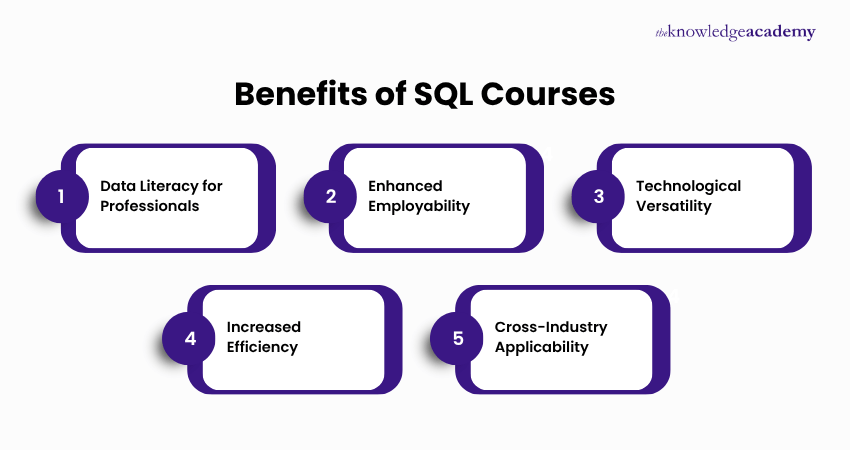
Benefits of SQL Courses

The Knowledge Academy’s SQL Training Courses equip learners with the technical skills to manage, analyse, and retrieve data efficiently. SQL remains one of the most in-demand languages across industries, and learners can gain benefits such as:

  • Data Literacy for Professionals: Professionals learn to write SQL queries, extract insights, and manipulate datasets for accurate analysis and reporting.
  • Enhanced Employability: SQL proficiency is highly valued by employers across IT, finance, and analytics sectors, improving career prospects.
  • Technological Versatility: Learners gain skills applicable to various platforms, including relational databases, business intelligence tools, and cloud-based systems.
  • Increased Efficiency: Automate data retrieval and analysis, empowering faster and more accurate decision-making within organisations.
  • Cross-Industry Applicability: SQL skills are essential in diverse domains such as software development, marketing analytics, and healthcare informatics.
Show more blue-arrow

Package deals for SQL Courses

Our training experts have compiled a range of course packages on a variety of categories in SQL Courses, to boost your career. The packages consist of the best possible qualifications with SQL Courses, and allows you to purchase multiple courses at a discounted rate.

Swipe for more. Don’t miss out!

SQL Courses FAQs

SQL (Structured Query Language) is a standard language used to store, manage, and retrieve data in relational databases. It allows users to perform operations like querying, updating, and organising data efficiently. SQL is important because it powers data-driven applications, supports decision-making, and is widely used across industries for managing large volumes of data.

Yes, SQL skills is a valuable asset in today's data-driven world. It can improve your ability to find work in many different fields, such as employment opportunities in data analytics, software program design and information technology.

The ideal delegates who should attend the training include both entry-level data analysts and entry-level software developers, database administrators and IT professionals. It is also appropriate for anyone interested in learning how to manage data effectively.

Yes, technical knowledge is not required for SQL Training Courses offered by The Knowledge Academy, one of the top training providers. Our Courses begin with basic skills and develop practical experience throughout the course of training.

SQL Certifications are following a pathway from entry level to advanced specialisation. There are courses which involve SQL foundations, management, reporting, and advanced SQL for optimising query performance.

The prerequisites for the SQL Courses are based on the course specifications and the target group of professionals it serves. Check the respective course page of the course that you are planning to take to know about its prerequisites.

In these courses, delegates will have intensive training with our experienced instructors, a digital delegate pack consisting of important notes related to this course, and a certificate after course completion.

Yes, The Knowledge Academy provides flexible self-paced training. Self-paced training is beneficial for individuals who have an independent learning style and wish to study at their own pace and convenience.

There are many job opportunities available to delegates upon completion of SQL Training, such as Database Administrator, Data Analyst, SQL Developer and Business Intelligence Analyst. These jobs are available in numerous industries.

Yes, The Knowledge Academy offers flexible online learning options, allowing you to complete the SQL Online Training Course at your own pace and from any location, making it convenient for working professionals.

You will learn how to query databases, manage data and perform SQL commands. In addition, you will also learn data analysis and management functions.

Topics included are database basics, SQL command queries, joining tables, functions, manipulating data, and performance monitoring. SQL Advanced Courses usually include Stored Procedure creation and reporting tools.

If you are unable to access your Courses, contact the support team via email or phone for assistance. At The Knowledge Academy, one of the trusted training provider in (location), we ensure prompt support to resolve any access or technical issues.

Yes, The Knowledge Academy offers 24/7 support via phone and email before, during, and after the course. As one of the trusted training provider in (location), we ensure continuous support throughout your learning journey.

Please see our SQL Courses available in El Salvador

The Knowledge Academy is one of the Leading global training provider for SQL Courses.

The training fees for SQL Courses in El Salvador starts from $1995

Show more down

Why we're the go to training provider for you

icon

Best price in the industry

You won't find better value in the marketplace. If you do find a lower price, we will beat it.

icon

Trusted & Approved

Recognised by leading certification bodies, we deliver training you can trust.

icon

Many delivery methods

Flexible delivery methods are available depending on your learning style.

icon

High quality resources

Resources are included for a comprehensive learning experience.

barclays Logo
deloitte Logo
Thames Water Logo

"Really good course and well organised. Trainer was great with a sense of humour - his experience allowed a free flowing course, structured to help you gain as much information & relevant experience whilst helping prepare you for the exam"

Joshua Davies, Thames Water

santander logo
bmw Logo
Google Logo
cross

Upgrade Your Skills. Save More Today.

superSale Unlock up to 40% off today!

WHO WILL BE FUNDING THE COURSE?

close

close

Thank you for your enquiry!

One of our training experts will be in touch shortly to go over your training requirements.

close

close

Press esc to close

close close

Back to course information

Thank you for your enquiry!

One of our training experts will be in touch shortly to go overy your training requirements.

close close

Thank you for your enquiry!

One of our training experts will be in touch shortly to go over your training requirements.