Mental Health Courses

Online Instructor-led (1 days)

Online Self-paced (8 hours)

Mental Health and Wellbeing Training​ Course Outline

Module 1: Mental Health Awareness

  • Introduction to Mental Health Awareness
  • Mental Health Problems
  • Wellbeing Toolkit
  • Tips for Management

Module 2: Managing Anxiety

  • Introduction to Anxiety
  • Management and Treatment of Anxiety
  • Coping Skills Anxiety

Module 3: Resilience

  • What is Resilience?
  • Why Develop Resilience?
  • Why is Resilience Important?
  • 5 Pillars of Resilience
  • Resilience Toolkit

Module 4: Stress Awareness and Management

  • Understanding Stress
  • Causes of Stress
  • Symptoms of Distress
  • Managing Stress

Module 5: Handling Difficult Conversations

  • What are Difficult Conversations?
  • Action Checklist
  • Managers Should Avoid
  • Key Guidance
  • Closing Conversations About Mental Health
  • Remember Your Skills

Show moredown

Who Should Attend this Mental Health and Wellbeing Training?

This Mental Health and Wellbeing Training Course is suitable for professionals who want to strengthen mental health awareness, support wellbeing, manage stress, and handle sensitive workplace conversations more effectively. This course is particularly beneficial for:

  • Human Resources Managers
  • Team Leaders
  • Healthcare Professionals
  • Social Workers
  • Educators
  • Counsellors
  • Occupational Therapists
  • Mental Health Advocates

Prerequisites for the Mental Health and Wellbeing Training

There are no formal prerequisites to attend this Mental Health and Wellbeing Training Course. However, a basic understanding of workplace wellbeing and mental health awareness would be beneficial for delegates.

Mental Health and Wellbeing Training Overview

Mental Health and Wellbeing Training helps delegates build a clearer understanding of mental wellbeing and how to respond appropriately to common workplace challenges. It covers mental health awareness, anxiety, resilience, and approaches for handling difficult conversations sensitively.

Delegates develop skills in recognising mental health concerns, managing stress and anxiety, strengthening resilience, and communicating more effectively during difficult conversations. They also build confidence in using practical wellbeing strategies within workplace settings.

This 1-Day course by The Knowledge Academy enables delegates to apply mental health and wellbeing approaches across professional environments. They will be better equipped to respond sensitively to concerns, manage challenging conversations, and support more informed workplace interactions.

Mental Health and Wellbeing Training Course Objectives

  • To understand the principles of mental health awareness and wellbeing
  • To recognise common mental health concerns and their workplace impact
  • To apply practical approaches for managing stress and anxiety
  • To develop resilience and practical coping strategies
  • To understand how to handle difficult conversations about mental health
  • To communicate confidently and appropriately during sensitive workplace discussions

Learning Outcomes of this Mental Health and Wellbeing Training 

Upon completing this Mental Health and Wellbeing Training, delegates will be able to recognise common mental health concerns, apply practical approaches for managing stress and anxiety, and strengthen resilience. They will also be better equipped to handle sensitive conversations and respond more appropriately to mental health-related situations in the workplace.

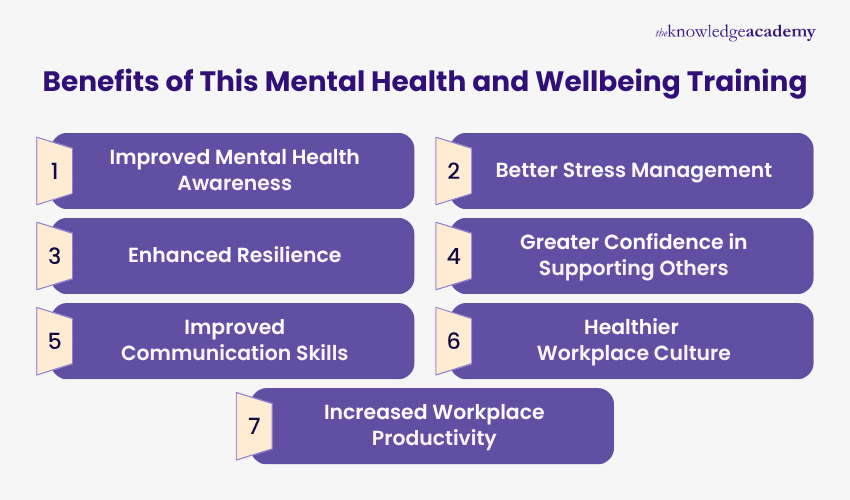
Benefits of this Mental Health and Wellbeing Training

Mental Health and Wellbeing Training by The Knowledge Academy equips delegates with practical techniques to support their own wellbeing and contribute to a healthier workplace. It also helps organisations foster a positive culture where mental health is understood, supported, and prioritised. These are the benefits of attending this training:

Mental Health and Wellbeing Training benefits: awareness, stress management, resilience, confidence, and workplace trust.

  • Improved Mental Health Awareness: Recognise common mental health challenges and understand their impact on individuals and workplaces.
  • Better Stress Management: Apply practical techniques to manage stress effectively and maintain emotional wellbeing.
  • Enhanced Resilience: Build resilience to adapt to workplace challenges and recover more confidently from setbacks.
  • Greater Confidence in Supporting Others: Develop the skills to recognise concerns and provide appropriate support to colleagues.
  • Improved Communication Skills: Handle sensitive conversations about mental health with empathy, confidence, and professionalism.
  • Healthier Workplace Culture: Promote openness, inclusivity, and wellbeing to create a more positive working environment.
  • Increased Workplace Productivity: Support employee wellbeing, helping improve engagement, collaboration, and overall workplace performance.

Show moredown

What’s Included in this Mental Health and Wellbeing Training?

  • World-Class Training Sessions from Experienced Instructors
  • Mental Health and Wellbeing Training Certificate
  • Digital Delegate Pack

Show moredown

Online Instructor-led (1 days)

Online Self-paced (8 hours)

Work Place Stress and Mental Health Identification for Manager​ Course Outline

Module 1: Introduction to Stress

  • What is Stress?
  • Degradation of Human Performance
  • Physiology of Stress
  • Model of Human Performance and Stress
  • Causes and Effects of Stress

Module 2: Responses to Stress

  • Symptoms of Stress
  • Responses to Prolonged Stress
  • Stages of the Stress Response
  • Anxiety and Depression
  • Role Theory
  • Personality and Stress
  • Alcohol Misuse
  • Drug Misuse and Addiction
  • Women at Work

Module 3: Stress in the Workplace

  • Advice to Employers
  • Strategies for Reducing Stress
  • Recognising Stress in the Workplace
  • Human Behaviour and Stress
  • Mentally and Physically Challenged Employees
  • Workplace Indicators of Stress
  • Stress in Groups
  • Stress and the Potential for Human Error

Module 4: Managing Stress at Work

  • Employers' Responsibilities and Duties in Relation to Stress
  • Duties of Senior Management
  • Human Factors and the Need to Manage Stress
  • Developing a Strategy
  • Strategies for Managing Stress
  • Decision-Making and Stress
  • Communicating Change
  • Creating a Healthy Workplace
  • Work-Related Stress Risk Assessment
  • Termination of Employment for Work-Related Stress
  • Stress Management Action Plans

Module 5: Workplace Mental Health

  • What is Mental Health and Mental Illness?
  • Workplace Mental Health Promotion
  • Psychological Risk Factors
  • Issues in the Workplace that Affect Employee Mental Health
  • Stigma and Discrimination
  • Anti-Stigma
  • Work-Life Balance
  • Presenteeism
  • Job Burnout
  • Mobbing
  • Substance Use, Misuse, and Abuse at Work

Show moredown

Who Should Attend this Workplace Stress and Mental Health Identification for Manager Course?

This Workplace Stress and Mental Health Identification for Manager Course is suitable for professionals responsible for supporting employee wellbeing, managing workplace pressures, and responding to stress-related concerns within teams. It can particularly benefit the following professional:

  • Human Resources Managers
  • Team Leaders
  • Operations Managers
  • Project Managers
  • Business Executives
  • Health and Safety Officers
  • Employee Assistance Programme Coordinators
  • Training and Development Managers

Prerequisites of the Workplace Stress and Mental Health Identification for Manager Course

There are no formal prerequisites to attend this Workplace Stress and Mental Health Identification for Manager Course. However, an interest in workplace wellbeing, stress management, and employee support will help delegates engage effectively with the course content.

Workplace Stress and Mental Health Identification for Manager Course Overview

Workplace Stress and Mental Health Identification for Manager Training helps delegates understand how stress and mental health concerns can affect employees and workplace performance. It explores how to recognise warning signs, understand risk factors, and support appropriate management responses.

Delegates develop skills in recognising workplace stress, understanding prolonged stress responses, assessing work-related risks, communicating change, and applying stress management strategies. They also strengthen their ability to identify workplace factors that can affect employee mental health.

This 1-Day course by The Knowledge Academy enables delegates to apply workplace stress and mental health awareness practices within managerial and supervisory roles. They will be better equipped to recognise concerns, support appropriate workplace responses, and contribute to more informed wellbeing practices.

Workplace Stress and Mental Health Identification for Manager Course Objectives

  • To understand the causes, effects, and physiological impact of stress
  • To recognise symptoms and responses associated with prolonged stress
  • To identify workplace indicators and risk factors linked to stress
  • To understand employer and management responsibilities for workplace stress
  • To apply workplace stress management strategies and risk assessment approaches
  • To recognise mental health, burnout, stigma, and substance misuse issues in the workplace

Learning Outcomes of this Workplace Stress and Mental Health Identification for Manager Course

Upon completing this course, delegates will understand how workplace stress, mental health risks, burnout, stigma, and related factors can affect employees and organisations. They will be better equipped to recognise concerns, apply appropriate stress management approaches, and support more informed workplace wellbeing practices.

Show moredown

What’s Included in this Work Place Stress and Mental Health Identification for Manager Course?

  • World-Class Training Sessions from Experienced Instructors
  • Work Place Stress and Mental Health Identification for Manager Certificate
  • Digital Delegate Pack

Show moredown

Online Instructor-led (1 days)

Online Self-paced (8 hours)

Handle Stress and Develop Your Resilience​ Training Course Outline

Module 1: What is Stress

  • Introduction of Stress
  • Types of Stress
  • Acute Stress
  • Episodic Acute Stress
  • Chronic Stress

Module 2: Spotting Stress

  • Warning Signs of Stress
  • Causes of Stress

Module 3: Stress Triggers

  • What Exactly can Trigger Stress?
  • Internal Irritations
  • Change Stressors
  • Decision Stressors
  • Phobic Stressors
  • Pain Stressors

Module 4: Beating Stress

  • How to Beat the Stress?

Module 5: Action Planning

  • What is Action Planning?
  • Examples of Action Planning

Module 6: What is Resilience?

  • Overview
  • What is Stress Resilience?
  • Tips to Increase Stress Resilience

Module 7: Factors and Your Profile

  • Factors of the Resilience Framework
    • Vision
    • Determination
    • Interaction
    • Relationships
    • Problem Solving
    • Organisation
    • Self-Confidence

Module 8: Emotional Regulation

  • What is Emotional Regulation?
  • Tips for Regulating Emotions
  • Changing Thoughts is Easier as Compared to Changing Your Feelings

Module 9: Impulse Control

  • Introduction
  • How to Manage Your Impulses?

Module 10: Causal Analysis

  • What is Causal Analysis?

Module 11: Self -Efficacy

  • What is Self-Efficacy?
  • Three Ways of Self-Efficacy
    • Mastery
    • Social Model
    • Self-Belief

Module 12: Realistic Optimism and Empathy

  • Introduction to Realistic Optimism

Module 13: Empathy

  • What is Empathy?

Module 14: Reaching Out

  • What does reaching out mean?

Module 15: Putting Things into Perspective

  • What Exactly is Putting Things into Perspective Mean?

Show moredown

Who Should Attend this Handle Stress and Develop Your Resilience Training Course?

This Handle Stress and Develop Your Resilience Course is suitable for professionals who want to manage stress more effectively, strengthen resilience, and respond more constructively to challenging situations. It can particularly benefit:

  • Healthcare Professionals
  • Educators
  • Customer Service Representatives
  • Human Resources Managers
  • Emergency Responders
  • Social Workers
  • Corporate Executives
  • Mental Health Practitioners

Prerequisites for the Handle Stress and Develop Your Resilience Training Course

There are no formal prerequisites to attend this Handle Stress and Develop Your Resilience Course. However, an interest in strengthening stress management and resilience will help delegates engage effectively with the course content.

Handle Stress and Develop Your Resilience Training Course Overview

Handle Stress and Develop Your Resilience Training helps delegates understand how stress affects their responses and how resilience can support more effective coping in challenging situations. It covers practical approaches for recognising stress, managing reactions, and strengthening personal resilience.

Delegates develop skills in identifying stress triggers, regulating emotions, managing impulses, analysing causes, strengthening self-efficacy, and applying practical resilience techniques. They also build their ability to use empathy, realistic optimism, and perspective when responding to challenging situations.

This 1-Day course by The Knowledge Academy enables delegates to apply stress management and resilience strategies across personal and professional situations. They will be better equipped to recognise pressure, respond more constructively to challenges, and create practical action plans for continued development.

Handle Stress and Develop Your Resilience Training Course Objectives

  • To understand different types of stress and the principles of resilience
  • To identify personal stress triggers, warning signs, and responses
  • To apply practical approaches for managing stress
  • To strengthen emotional regulation, impulse control, and self-efficacy
  • To develop realistic optimism, empathy, and perspective
  • To create practical action plans for continued resilience development

Learning Outcomes of this Handle Stress and Develop Your Resilience Training

Upon completing this course, delegates will understand how stress triggers, emotional regulation, resilience, self-efficacy, optimism, empathy, and perspective influence responses to challenging situations. They will be better equipped to apply practical strategies for managing pressure, strengthening resilience, and planning continued personal development.

Show moredown

What’s Included in this Handle Stress and Develop Your Resilience Training Course?

  • World-Class Training Sessions from Experienced Instructors
  • Handle Stress and Develop Your Resilience Training Certificate
  • Digital Delegate Pack

Show moredown

Online Instructor-led (1 days)

Online Self-paced (8 hours)

Mindfulness Training Course Outline

Module 1: Introduction to Mindfulness

  • What is Mindfulness?
  • How Does Mindfulness Work?
  • How Does Mindfulness Treat Mental Health Problems?

Module 2: Making Friends with Yourself

  • Meditation Relationship with Ourselves
  • Discovering Capacity to Love
  • Teddy Bear of Breath
  • Cool Boredom
  • Gentleness
  • Rhinoceros and Parrot
  • Present Moment
  • Bridge of Compassion

Module 3: How to Meditate?

  • Attitude
  • Taking Your Seat
  • Posture
  • Mindfulness of Breath
  • Working with Thoughts
  • Irritation and Exertion
  • Group Sitting
  • Sitting by Yourself

Module 4: Foundations of Mindfulness

  • First Thought
  • Appreciation
  • Life Force
  • Touching the Surface of Mind
  • Spontaneous Discipline
  • Recollection

Module 5: Mindfulness in Action

  • Touch and Go
  • Meditation and the Fourth Moment
  • Sword in Your Heart
  • Galaxies of Stars, Grains of Sand
  • Fringe of Our Emotions
  • Heart of Emotion
  • Mindful Society

Show moredown

Who Should Attend this Mindfulness Training?

This Mindfulness Training is suitable for professionals seeking to develop meditation, self-awareness, and present-moment attention. This training will benefit the following professionals:

  • Nurses
  • Mental Health Support Workers
  • Security Officers
  • Business Managers
  • Graphic Designers
  • Transport Coordinators
  • Social Workers

Prerequisites of the Mindfulness Training

There are no formal prerequisites to attend this Mindfulness Course. However, an interest in meditation and a willingness to explore mindfulness practices would be beneficial for delegates.

Mindfulness Training Course Overview

Mindfulness Training introduces delegates to the principles of mindfulness, how it works, and its relationship with mental wellbeing. It also explores self-compassion, present-moment awareness, appreciation, recollection, and emotional awareness.

Delegates will develop meditation skills through posture, mindful breathing, seated practice, and techniques for working with thoughts, irritation, and exertion. They will also learn to recognise emotional responses and maintain attention during meditation.

This 1-Day course by The Knowledge Academy enables delegates to integrate mindfulness practices into everyday routines and interactions. They can use these approaches to navigate experiences with greater attentiveness, gentleness, and compassion.

Mindfulness Training Course Objectives

  • To explain the principles and purpose of mindfulness
  • To practise seated meditation with appropriate posture and mindful breathing
  • To work with thoughts, irritation, and exertion during meditation
  • To recognise emotions and respond with greater awareness
  • To explore appreciation, recollection, compassion, and discipline
  • To apply mindfulness principles in everyday situations

Learning Outcomes of this Mindfulness Training

Upon completion of this Mindfulness Training, delegates will understand core mindfulness principles, meditation practices, self-compassion, emotional awareness, and present-moment attention. They will be able to practise mindfulness more effectively, work with thoughts and emotions, and apply suitable techniques in everyday situations.

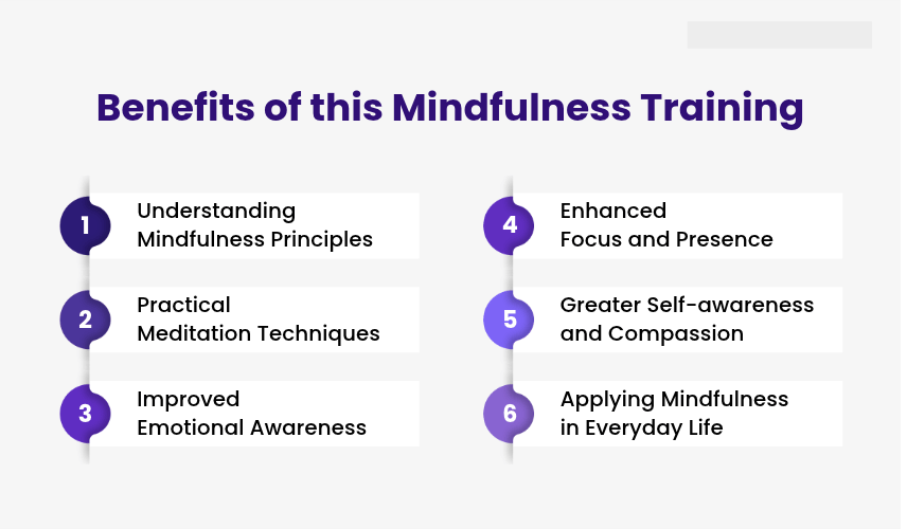
Benefits of this Mindfulness Training

This Mindfulness Training equips delegates with practical techniques to develop mindfulness, improve self-awareness, and cultivate a balanced approach to personal and professional life. It builds the ability to practise mindfulness in everyday situations, helping individuals manage challenges with greater focus and emotional awareness.

Mindfulness Training benefits: principles, meditation techniques, emotional awareness, focus, compassion and daily life.

Key benefits of this training include:

  • Understanding Mindfulness Principles: Gain a clear understanding of mindfulness concepts, their purpose, and how they support mental well-being and personal development.
  • Practical Meditation Techniques: Learn a variety of mindfulness and meditation practices that can be incorporated into daily routines to improve focus and awareness.
  • Improved Emotional Awareness: Develop techniques to recognise emotions, respond thoughtfully to challenges, and respond with greater awareness.
  • Enhanced Focus and Presence: Strengthen the ability to remain present, minimise distractions, and improve concentration in personal and professional settings.
  • Greater Self-awareness and Compassion: Explore practices that encourage self-reflection, empathy, and a more compassionate approach towards yourself and others.
  • Applying Mindfulness in Everyday Life: Learn how to integrate mindfulness techniques into daily activities and workplace interactions to support greater attention and awareness in everyday situations.

Show moredown

What’s Included in this Mindfulness Training Course? 

  • World-Class Training Sessions from Experienced Instructors
  • Mindfulness Certificate 
  • Digital Delegate Pack

Show moredown

Online Instructor-led (1 days)

Online Self-paced (8 hours)

Anxiety​ Course Outline

Module 1: Duck Syndrome

  • Growing Issue
  • Cover-Up
  • Ducks at Stanford
  • Resilient
  • Eight Strategies

Module 2: How Anxiety Fills the Gap

  • Power of Directness
  • Communicating Frequently One-on-One
  • Six Methods to Meet Uncertainty Head-On
    • Make It Okay to Not Have All the Answers
    • Loosen your Grip in Tough Times
    • Ensure Everyone Knows Exactly What’s Expected of Them
    • Keep People Focused on What Can be Controlled
    • Have a Bias to Action
    • Offer Constructive Feedback
  • Putting the Methods Together

Module 3: How to Turn Less into More?

  • Stress as a Tool
  • Hiding in Plain Sight
  • Create Clear Roadmaps
  • Balance Loads
  • Rotate People
  • Closely Monitor Progress
  • Help People Prioritise
  • Avoid Distractions
  • Encourage R&R

Module 4: Clear Paths Forward

  • Create More Steps to Grow
  • Coach Employees About How to Get Ahead
  • Help Employees Assess Their Skills and Motivations
  • Use a Skill Development Flow
  • Make Learning Real-Time
  • Tailor Development to the Individual
  • Carefully Calibrate Growth Opportunities
  • Encourage Peer-to-Peer Support

Module 5: How “it’s Not Perfect” Can Become “It’s Good, I’ll Move On”

  • Endless Report Card
  • How to Spot It?
  • Clarify What Good Enough Is
  • Share the Wisdom of Innovators
  • Treat Failures as Learning Opportunities
  • Regularly Check in on Progress
  • Team Them Up
  • Discuss the Issue Openly

Module 6: From Conflict Avoidance to Healthy Debate

  • Discuss the Issue Openly
  • Conflict-Avoidant Versus Peacemaker
  • Millennials and Conflict
    • Address the Issue, Value, Solution
    • Don’t Delay
    • Stick to Facts
    • Use Your Words
    • Assume Positive Intent
    • Have a Plan
    • Give and Take
    • Get Comfortable with the Uncomfortable
  • Bringing It All Together

Module 7: Transform Exclusion into Connection

  • Build Camaraderie
  • Find a Common Core
  • Foster Connections and Friendships
  • Provide Frequent Validation
  • Include Remotes

Show moredown

Who Should Attend this Anxiety Course?

This Anxiety Course is suitable for individuals looking to strengthen their ability to manage uncertainty, workplace pressure, communication challenges, and difficult professional situations. The following individuals can benefit from this course: 

  • Managers
  • Team Leaders
  • Human Resources Professionals
  • Business Owners
  • Corporate Executives
  • Project Managers
  • Supervisors
  • Learning and Development Professionals

Prerequisites for the Anxiety Course

There are no formal prerequisites to attend this Anxiety Course. However, an interest in strengthening workplace communication, coping, and responses to uncertainty will help delegates engage effectively with the course content.

Anxiety Course Overview

Our Anxiety Training Course introduces delegates to managing workplace anxiety, uncertainty, pressure, and conflict. It covers practical approaches to workload management, communication, perfectionism, and building supportive workplace relationships.

Delegates will develop skills in setting realistic expectations, prioritising tasks, providing constructive feedback, and handling difficult conversations. They will also learn to manage workplace challenges and encourage positive team interactions.

This 1-Day training by The Knowledge Academy equips delegates with strategies to handle demanding workplace situations confidently. They will be able to manage competing priorities, communicate effectively, and contribute to a more supportive and productive work environment.

Anxiety Course Objectives

  • To understand how uncertainty and workplace pressure can affect individuals and teams
  • To apply practical approaches for communicating clearly during uncertain situations
  • To manage workload, priorities, distractions, and recovery more effectively
  • To recognise and address perfectionism that can hinder progress
  • To develop constructive approaches for workplace conflict and healthy debate
  • To strengthen connection, peer support, and inclusion within teams

Learning Outcomes of this Anxiety Course

Upon completing this Anxiety Course, delegates will be able to respond more effectively to workplace uncertainty, manage competing demands, and communicate constructively during challenging situations. They will also strengthen their ability to address perfectionism, approach conflict positively, and support stronger connections within teams.

Show moredown

What’s Included in this Anxiety Course?

  • World-Class Training Sessions from Experienced Instructors
  • Handle Anxiety Trainiing Certificate
  • Digital Delegate Pack

Show moredown

Online Instructor-led (1 days)

Online Self-paced (8 hours)

Counselling Course Outline

Module 1: What is Counselling and Helping?

  • Counselling, Psychotherapy, and Helping
  • What is the Lifeskills Counselling Approach?
  • Types of Counselling

Module 2: Create Communication Skills and Feelings

  • What are Lifeskills?
  • Creating Communication and Action Skills
  • Feelings and Physical Reactions

Module 3: Lifeskills Counselling Model

  • Stages and Phases of the Lifeskills Counselling Model
  • Applying the Model

Module 4: Listening Skills

  • Counselling Relationship
  • Active Listening
  • Possess an Attitude of Respect and Acceptance
  • Understand the Client’s Internal Frame of Reference
  • Receive Voice Messages Accurately
  • Give Small Rewards and Ask Open-Ended Questions

Module 5: Clarify Problems Skills

  • Questioning Skills
  • Challenging Skills
  • Feedback Skills
  • Self-Disclosure Skills

Module 6: Plan Interventions

  • Interventions and Plans
  • Choosing Interventions
  • Planning Interventions
  • Considerations in Planning
  • Skills for Working with Clients

Module 7: Personal Counselling and Continuing Professional Development

  • Personal Counselling and Self-Help
  • Continuing Professional Development (CPD)

Show moredown

Who Should Attend this Counselling Course?

This Counselling Course is designed for individuals who want to strengthen their communication, listening, helping, and interpersonal skills. It is particularly relevant to professionals whose roles involve supporting, guiding, communicating with, or understanding others. This course can benefit:

  • Social Workers
  • Psychologists
  • Mental Health Practitioners
  • Life Coaches
  • Human Resources Professionals
  • Educators
  • Community Service Managers
  • Rehabilitation Counsellors

Prerequisites for the Counselling Course

There are no formal prerequisites to attend this Counselling Course. However, an interest in developing communication, listening, and helping skills can help delegates engage effectively with the training.

Counselling Course Overview

Counselling Skills Training introduces delegates to counselling, helping approaches, and the Lifeskills Counselling Model. It covers communication, active listening, questioning, feedback, self-disclosure, and understanding client perspectives.

Delegates develop practical knowledge of clarifying problems, planning interventions, and building supportive counselling relationships. They also explore personal counselling, self-help, and Continuing Professional Development.

This 1-Day course by The Knowledge Academy helps delegates apply counselling-informed communication and helping skills across supportive interactions. They will be better equipped to listen attentively, respond appropriately to concerns, and build more constructive helping relationships.

Counselling Course Objectives

  • To understand counselling, helping, and the lifeskills counselling approach
  • To develop effective communication and active listening skills
  • To understand and apply the stages of the Lifeskills Counselling Model
  • To develop questioning, challenging, feedback, and self-disclosure skills
  • To understand how to choose and plan appropriate interventions
  • To explore personal counselling, self-help, and Continuing Professional Development 

Learning Outcomes for this Counselling Course

Upon completing this Counselling Course, delegates will be able to apply core counselling and helping principles, use effective communication and active listening skills, and clarify client concerns more effectively. They will also strengthen their ability to plan suitable interventions, support client interactions, and continue developing their counselling knowledge and skills.

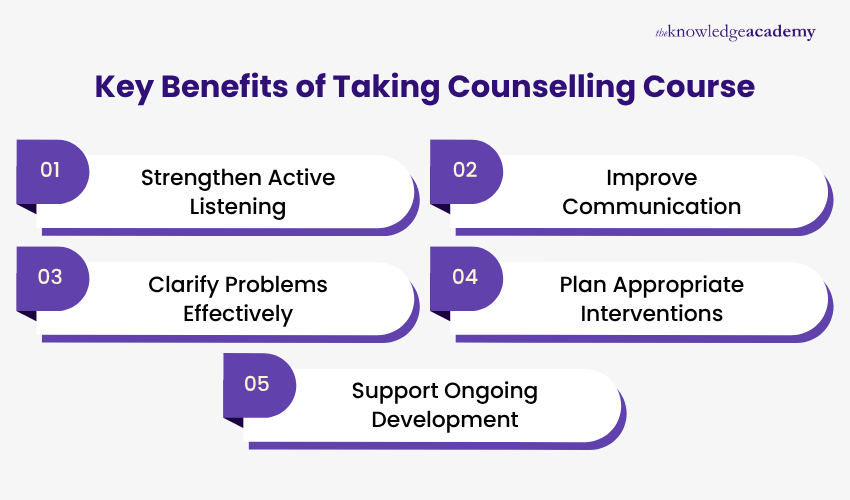
Key Benefits of Taking this Counselling Course

This Counselling Course develops practical communication and helping skills that can be valuable across professional and everyday interactions. Key benefits include:

Key Benefits of Taking this Counselling Course

  • Strengthen Active Listening: Develop skills to listen attentively and better understand another person’s perspective.
  • Improve Communication: Build questioning, feedback, and self-disclosure skills for clearer and more supportive conversations.
  • Clarify Problems Effectively: Use questioning and challenging skills to explore concerns and improve understanding.
  • Plan Suitable Interventions: Understand how to select and plan appropriate helping interventions based on client needs and relevant considerations.
  • Support Ongoing Development: Explore personal counselling, self-help, and Continuing Professional Development to strengthen future learning.

How Does this Counselling Course Fits Your Career Goals

This course develops foundational counselling and helping skills that can support people-focused work or further study. It can also provide a useful base for delegates considering a career in counselling or continued development in counselling-related areas.

  • Support and Wellbeing Roles: Build listening and communication skills that can support roles focused on guidance, wellbeing, and interpersonal support.
  • Care and Education Roles: Develop supportive communication skills that can be useful when working with individuals in care or learning environments.
  • People-focused Roles: Strengthen questioning, feedback, and active listening skills for roles involving regular interaction and relationship building.
  • Further Counselling-related Study: Gain foundational knowledge of counselling models, interventions, and helping skills that can support progression into further training.

Show moredown

What’s Included in this Counselling Course?

  • World-Class Training Sessions from Experienced Instructors
  • Counselling Course Certificate
  • Digital Delegate Pack

Show moredown

Online Instructor-led (1 days)

Online Self-paced (8 hours)

Psychology Course Outline

Introduction 1: Introduction to Psychology

  • What is Psychology?
  • What Does it Involve?
  • Branches of Psychology
  • Behaviourism
  • Humanism
  • Cognitive Theory

Module 2: Conceptual Framework

  • An Integrative Approach in Counselling
  • Therapeutic Relationship: Exploring Clients' Symptoms and Strengths
  • Powered by Struggles and Strengths

Module 3: Integration of Counselling Theories and Positive Psychology

  • Positive Psychology in Counselling
  • Psychoanalytic Therapy
  • Adlerian Therapy
  • Existential Therapy
  • Person-Centred Therapy
  • Gestalt Therapy
  • Behaviour Therapy
  • Cognitive-Behaviour Therapy
  • Reality Therapy
  • Feminist Therapy
  • Family Therapy

Module 4: Psychological Disorders

  • Why It Matters: Psychological Disorders
  • What are Psychological Disorders?
  • Diagnosing and Classifying Psychological Disorders
  • Introduction to Anxiety Disorders, OCD, and PSTD
  • Introduction to Mood Disorders
  • Major Depressive Disorders

 Module 5: Therapy and Treatment

  • Introduction to Mental Health
  • Mental Health Treatment
  • Types of Treatment
  • Psychoanalysis
  • Humanistic Therapy and Other Treatments
  • Biomedical Therapies

Module 6: Stress, Lifecycle, and Health

  • Introduction to Defining Stress
  • What is Stress?
  • Stressors
  • Introduction to Stress and Illness
  • Regulating Stress
  • Social Support and Stress Reduction
  • Positive Psychology

Show moredown

Who Should Attend This Psychology Course?

This Psychology Course is suitable for professionals interested in understanding human behaviour, psychological theories, counselling approaches, and mental health. This course will benefit the following professionals:

  • Counsellors 
  • Therapists 
  • Psychologists 
  • HR Professionals 
  • Mental Health Practitioners 
  • Educators 
  • Healthcare Professionals 

Prerequisites for the Psychology Course

There are no formal prerequisites to attend this Psychology Course. However, an interest in human behaviour, mental processes, counselling, or mental health can be beneficial.

Psychology Course Overview

Psychology Training introduces delegates to key branches of psychology and perspectives such as behaviourism, humanism, and cognitive theory. It also explores therapeutic relationships, client symptoms and strengths, counselling frameworks, and approaches used in psychological treatment.

Delegates will develop skills in distinguishing counselling approaches, recognising psychological disorders, and understanding different forms of therapy and treatment. They will also learn to identify stressors, explore links between stress and illness, and examine approaches to stress regulation and social support.

This 1-Day training by The Knowledge Academy enables delegates to apply psychological knowledge when interpreting behaviour, psychological concerns, and wellbeing-related situations. They will be able to compare therapeutic approaches, recognise relevant psychological factors, and develop a more structured understanding of mental health and stress.

Psychology Course Objectives

  • To identify key branches and major psychological perspectives
  • To explore integrative counselling and therapeutic relationships
  • To compare counselling theories and therapeutic approaches
  • To recognise psychological disorders and mental health concepts
  • To examine psychological treatment and therapy approaches
  • To evaluate stressors, stress regulation, social support, and positive psychology

Learning Outcomes of this Psychology Course

Upon completion of this Psychology Course, delegates will have a structured understanding of psychological theories, counselling approaches, psychological disorders, therapy, mental health, and stress. They will be able to recognise key psychological factors, compare therapeutic approaches, and apply relevant psychological concepts to wellbeing-related situations.

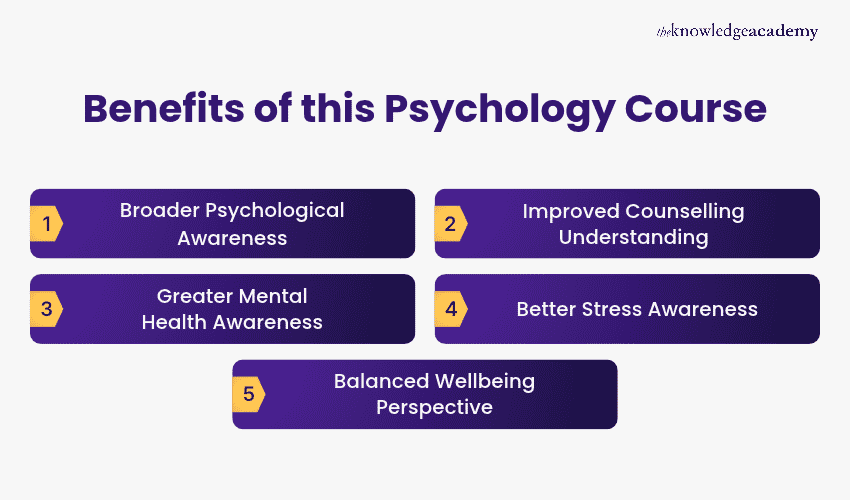
Benefits of this Psychology Course

This Psychology Course helps delegates use psychological knowledge to develop a broader understanding of behaviour, mental health, counselling, and wellbeing. Key benefits include:

Benefits of the Psychology Course shown in five numbered boxes, covering counselling, mental health, and stress awareness

  • Broader Psychological Awareness: Interpret behaviour through key psychological perspectives.
  • Improved Counselling Understanding: Distinguish established counselling and therapy approaches.
  • Greater Mental Health Awareness: Recognise psychological disorders and treatment approaches.
  • Better Stress Awareness: Understand stressors, stress regulation, and social support.
  • Balanced Wellbeing Perspective: Consider both psychological struggles and individual strengths.

Show moredown

What’s Included in this Psychology Course?

  • World-Class Training Sessions from Experienced Instructors
  • Psychology Course Certificate
  • Digital Delegate Pack

Show moredown

Online Instructor-led (1 days)

Online Self-paced (8 hours)

Positive Psychology Course​ Outline

Module 1: What is Positive Psychology and Why is it Important?

  • History of Positive Psychology
  • Core Positive Psychology Theories and Concepts
  • What Positive Psychology is Not?
  • Applications of Positive Psychology

Module 2: Intersection of Positive Psychology and the Practice of Counselling and Psychotherapy

  • Conceptualisations and Outcome Expectations
  • Problems with the Current DSM Assessment System
  • Biases in Human Thinking
  • Lack of Information on the Strengths Perspective
  • Complete State Model of Mental Health
  • Psychometric Properties of the Outcome Questionnaire and Mental Health Continuum
  • Process of Positive Psychological Assessment
  • Culturally Sensitive Positive Psychological Assessment
  • Culturally Encompassing Data Gathering
  • Addressing Model of Cultural Assessment
  • Community Genogram
  • Selection and Interpretation of Culturally Appropriate Tests and Measures

Module 3: Positive Psychological Tests and Measures

  • Values in Action Inventory of Character Strengths
  • Clifton Strengths Finder
  • Positive and Negative Affect Schedule
  • Satisfaction with Life Scale
  • Fordyce Emotions Questionnaire
  • Steen Happiness Index/Authentic Happiness Inventory
  • Hope Scale
  • Personal Growth Initiative Scale
  • Providing Assessment Feedback
  • Power of Labels and Naming
  • Positive Effects of Labelling

Module 4: Positive Psychological Interventions

  • Positive Psychological Models of Therapy
  • Positive Psychology Exercises
  • Note on Using Positive Psychological Interventions and Exercises

Module 5: Deciding Upon and Carrying Out a Positive Psychology-Infused Treatment Plan

  • General Guidelines for Developing Positive
  • Psychological Treatment Plan
  • Complete Mental Health or Flourishing
  • Incomplete Mental Health or Languishing
  • Incomplete Mental Illness or Struggling
  • Complete Mental Illness or Floundering
  • Challenges Associated with Implementing
  • Positive Psychological Interventions

Show moredown

Who Should Attend this Positive Psychology Course?

This Positive Psychology Training Course is suitable for professionals who want to strengthen their understanding of strengths-based approaches, wellbeing, assessment, and positive psychological interventions. It can particularly benefit:

  • Healthcare Professionals
  • Mental Health Professionals
  • Counsellors
  • Therapists
  • Human Resource Professionals
  • Educational Professionals
  • Public Service Professionals
  • People Development Professionals

Prerequisites for the Positive Psychology Course

There are no formal prerequisites to attend this Positive Psychology Training. However, a basic understanding of psychology, mental health, or counselling concepts can be beneficial for delegates.

Positive Psychology Course Overview

Positive Psychology Training introduces delegates to a strengths-based approach to understanding mental health, wellbeing, and human flourishing. It explores how Positive Psychology principles can complement counselling and psychotherapy by focusing on strengths, positive functioning, and wellbeing outcomes.

Delegates develop skills in interpreting positive psychological assessments, considering cultural factors, and reviewing wellbeing measures. They also strengthen their ability to evaluate strengths-based approaches and positive psychology exercises.

This 1-Day course by The Knowledge Academy enables delegates to apply Positive Psychology concepts when considering assessment and wellbeing-focused support. They will be better equipped to interpret wellbeing information, select suitable approaches, and contribute to more informed planning across counselling and related settings.

Positive Psychology Course Objectives

  • To understand key positive psychology theories, concepts, and applications
  • To explore strengths-based perspectives and approaches to mental health
  • To examine positive psychological assessment and culturally sensitive approaches
  • To understand key positive psychology tests and wellbeing measures
  • To explore positive psychological interventions and exercises
  • To understand approaches to positive psychology-informed treatment planning

Learning Outcomes of this Positive Psychology Course

Upon completing this Positive Psychology Training, delegates will understand key Positive Psychology theories, strengths-based assessment, psychological tests and measures, and positive psychological interventions. They will also understand culturally sensitive assessment approaches and how positive psychology principles can inform treatment planning and support wellbeing and flourishing.

Benefits of this Positive Psychology Course

This Positive Psychology Course helps delegates understand how positive psychology concepts can support wellbeing-focused practice and continued professional development. Key Benefits of this course are:

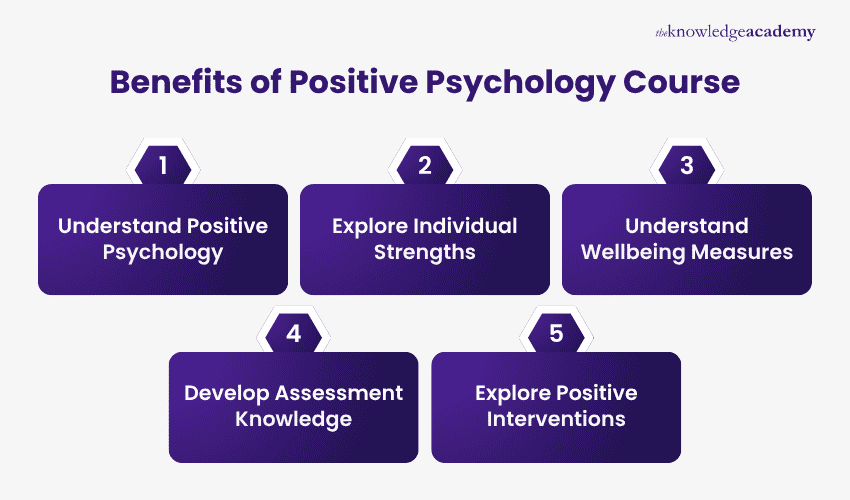
Positive Psychology Course benefits: explore strengths, wellbeing measures, assessment skill and positive interventions

  • Understand Positive Psychology: Develop knowledge of its history, core theories, concepts, and practical applications.
  • Explore Individual Strengths: Understand strengths-based perspectives and established measures used to explore character strengths.
  • Understand Wellbeing Measures: Explore measures relating to affect, life satisfaction, happiness, hope, and personal growth.
  • Develop Assessment Knowledge: Learn about positive psychological assessment, culturally sensitive approaches, and appropriate tests and measures.
  • Explore Positive Interventions: Understand positive psychology exercises, intervention models, and approaches to supporting wellbeing and flourishing.

Show moredown

What’s Included in this Positive Psychology Training Course?

  • World-Class Training Sessions from Experienced Instructors
  • Positive Psychology Training Certificate  
  • Digital Delegate Pack

Show moredown

Online Instructor-led (1 days)

Online Self-paced (8 hours)

Psychology of Behaviour at Work Training​ Course Outline

Module 1: Introduction to Psychological of Behaviour at Work

  • What is Organisational or Work Psychology?
  • Assumptions and Premises of Work Psychology
  • What Work Psychologists Do?
  • Professional Accreditation
  • Terminological Differences
  • Management Science, Work Psychology, and Common Sense
  • Knowledge About Occupational Psychology
  • Evolutionary Psychology in Business
  • Theories, Laws, and Models in Work Psychology
  • Direction of Causality

Module 2: Vocational Choice, Organisational Selection, and Socialisation

  • Vocational Choice and Guidance
  • Career Typology
  • Theories in Vocational Psychology
  • Recruitment
  • Person–Job Fit
  • Expectancy Theory and Occupational Choice
  • Personnel Selection
  • Job Analysis
  • Organisational Choice
  • Organisational Socialisation

Module 3: Personality and Individual Differences

  • Approaches to Personality and Individual Differences at Work
  • Personality Testing at Work
  • Trait Theories of Organisational Behaviour
  • Concepts of Style and Preference
  • Biodata Method
  • Emotional Intelligence at Work
  • Self-Esteem at Work
  • Why Personality Traits May Not Predict Behaviour at Work?

Module 4: Work-Related Attitudes, Values, and Perceptions

  • Do Work Attitudes Predict Behaviour at Work?
  • Theories of Reasoned Action and Planned Behaviour
  • Work-Related Belief Systems
  • Social Values and Work
  • Perceiving Others at Work

Module 5: Organisational Structure, Change, and Development

  • Uptake of Innovation
  • Teleworking
  • Organisational Charts
  • Departmentalisation and Kinds of Departments
  • Centralisation Versus Decentralisation
  • Big Versus Small: Over Versus Understaffing
  • Consequences of a Poor Structure
  • Organisational Change
  • Factors Associated with Organisational Change
  • Characteristics of the Change Situation
  • Reactions to Change
  • Organisation Development

Show moredown

Who Should Attend this Psychology of Behaviour at Work Training Course? 

This Psychology of Behaviour at Work Training Course is designed for individuals seeking to gain a comprehensive understanding of how psychological principles influence behaviour within a workplace environment. This course is particularly beneficial for professionals such as:

  • Managers
  • Supervisors
  • Team Leads
  • Human Resources Personnel
  • Business Owners
  • Organisational Development Professionals
  • Consultants

Prerequisites of the Psychology of Behaviour at Work Training Course

There are no formal prerequisites to attend this Psychology of Behaviour at Work Training Course. However, an interest in workplace behaviour, organisational psychology, and people management will help delegates engage effectively with the course content.

Psychology of Behaviour at Work Training Course Overview

Psychology of Behaviour at Work Training introduces delegates to how psychological principles can be used to understand behaviour, decision-making, and individual differences within organisations. It explores how people interact with roles, workplace structures, selection processes, and organisational change.

Delegates develop skills in comparing psychological theories, interpreting workplace attitudes and individual differences, examining selection approaches, and assessing how organisational structures and change can influence behaviour. They also strengthen their understanding of how psychological concepts relate to occupational choices and workplace decisions.

This 1-Day course by The Knowledge Academy enables delegates to apply work psychology concepts when considering recruitment, behaviour, individual differences, and organisational change. They will be better equipped to interpret workplace factors and make more informed people-related decisions.

Psychology of Behaviour at Work Training Course Objectives

  • To understand key principles, theories, and models of work psychology
  • To explore vocational choice, recruitment, selection, and person-job fit
  • To examine personality and individual differences in workplace behaviour
  • To understand how attitudes, values, beliefs, and perceptions influence work behaviour
  • To explore organisational structure and its impact on workplace behaviour
  • To understand employee reactions to organisational change and development

Learning Outcomes of this Psychology of Behaviour at Work Training

Upon completing this course, delegates will understand key work psychology concepts relating to recruitment, personality, attitudes, values, perception, organisational structure, and change. They will be better equipped to interpret workplace behaviour and apply psychological perspectives to people-related and organisational decisions.

Show moredown

What’s Included in this Psychology of Behaviour at Work Training Course?

  • World-Class Training Sessions from Experienced Instructors
  • Psychology of Behaviour at Work Training Certificate
  • Digital Delegate Pack

Show moredown

Online Instructor-led (1 days)

Online Self-paced (8 hours)

Psychology of Personal Growth Training​ Course Outline

Module 1: Psychology Basics

  • What is Psychology?
  • Types of Psychology
  • Uses of Psychology
  • Impact of Psychology
  • Potential Pitfalls

Module 2: Personality Psychology

  • What is Personality Psychology?
  • Theories
  • How is Personality Tested?
  • Personality Disorders

Module 3: Understanding Personal Development

  • Understanding Personal Growth and Development
  • How Personal Development Links to Psychology?
  • Different Areas of Personal Development
  • Sources of Personal Development

Module 4: Self-Concept

  • Introduction to Self-Concept
  • Components of Self-Concept
  • How does It Develop?
  • Can It Be Changed?
  • Other Theories

Module 5: Self-Awareness

  • Self-Awareness
    • Emergence
    • Development
  • Types of Self-Awareness
  • Self-Consciousness

Module 6: Self-Esteem

  • Introduction to Self-Esteem
  • Importance
  • Theories
  • Causes
  • Self-Esteem
    • Healthy
    • Low
    • Excessive
  • How to Improve?

Module 7: Stress Management

  • What is Stress?
  • Signs
  • Identifying
  • Causes
  • Types
  • Impacts
  • Treatment
  • Coping

Module 8: Explore Emotions

  • Emotions and Their Working
  • Ways to Better Understand Emotions
  • Worksheets to Develop Skills
  • Understand Children’s Emotions

Show moredown

Who Should Attend this Psychology of Personal Growth Training Course?

This Psychology of Personal Growth Training Course is suitable for professionals who want to deepen their understanding of personal development, self-awareness, behaviour, stress, and emotional responses. The following professionals can benefit from this course:

  • Life Coaches
  • Counsellors
  • Social Workers
  • Human Resource Managers
  • Healthcare Professionals
  • Teachers
  • Psychologists
  • Managers

Prerequisites for the Psychology of Personal Growth Training Course

There are no formal prerequisites to attend this Psychology of Personal Growth Training Course. However, an interest in self-awareness, personal development, and psychological concepts will help delegates engage effectively with the course content.

Psychology of Personal Growth Training Course Overview

Psychology of Personal Growth Training introduces delegates to how psychological concepts can support greater self-understanding and personal development. It covers personality, self-awareness, stress management, and emotions, exploring how these areas influence individual growth and behaviour.

Delegates develop skills in reflecting on self-concept, recognising patterns in self-awareness and self-esteem, identifying sources and signs of stress, and understanding emotional responses. They also strengthen their ability to relate psychological concepts to their own development.

This 1-Day course by The Knowledge Academy enables delegates to apply personal growth concepts across everyday situations. They will be better equipped to reflect on their behaviour, understand emotional and stress-related responses, and identify areas for continued personal development.

Psychology of Personal Growth Training Course Objectives

  • To understand key psychological concepts related to personal growth
  • To explore personality theories and approaches to personality assessment
  • To understand self-concept and how it develops and changes
  • To examine self-awareness and different forms of self-consciousness
  • To understand self-esteem, its influences, and approaches to improvement
  • To recognise stress, its causes, impacts, and coping approaches
  • To explore emotions and approaches for developing greater emotional understanding

Learning Outcomes of this Psychology of Personal Growth Training

Upon completing this course, delegates will be able to reflect on personal behaviour, recognise factors that influence self-concept and self-esteem, and identify common stress and emotional responses. They will also be better equipped to apply greater self-awareness when identifying practical areas for continued personal development.

Show moredown

What’s Included in this Psychology of Personal Growth Training Course?

  • World-Class Training Sessions from Experienced Instructors  
  • Psychology of Personal Growth Training Certificate
  • Digital Delegate Pack   

Show moredown

Online Instructor-led (1 days)

Online Self-paced (8 hours)

Social Psychology Training​ Course Outline

Module 1: Introduction to Social Psychology

  • What is Social Psychology?
  • Methodological Issues
  • Research Ethics
  • Theoretical Issues

Module 2: Social Cognition and Social Thinking

  • Social Psychology and Cognition
  • Forming Impressions of Other People
  • Social Schemas and Categories
  • Schema Use and Development
  • Social Encoding
  • Person Memory

Module 3: Attribution and Social Explanation

  • Social Explanation
  • Basic Attribution Processes
  • Extensions of Attribution Theory
  • Applications of Attribution Theory
  • Biases in Attribution

Module 4: Self and Identity

  • Individual Vs Collective Self
  • Self-Awareness
  • Self-Knowledge
  • Selves and Identities
  • Social Identity and Personal Identity
  • Self-Motives

Module 5: Attitudes

  • Structure and Function of Attitudes
  • Predict Behaviour
  • Forming Attitudes
  • Concepts Related to Attitudes
  • Measuring Attitudes

Module 6: Social Influence

  • Types of Social Influence
  • Conformity
  • Minority Influence and Social Change

Module 7: People in Groups

  • What is a Group?
  • Effect of the Group on Individual Performance
  • Group Socialisation
  • Group Cohesiveness
  • Group Structure

Module 8: Leadership and Decision Making

  • Leadership
  • Group Decision Making

Show moredown

Who Should Attend this Social Psychology Training Course?

This Social Psychology Training Course is suitable for professionals who want to better understand how people think, behave, and interact within social and group settings. The following professionals can benefit from this course:

  • Human Resources Managers
  • Marketing Professionals
  • Social Workers
  • Educators
  • Psychologists
  • Researchers
  • Public Relations Specialists
  • Community Organisers

Prerequisites for the Social Psychology Training Course

There are no formal prerequisites to attend this Social Psychology Training Course. However, an interest in human behaviour, social interaction, and group dynamics will help delegates engage effectively with the course content.

Introduction to Social Psychology Training Overview

Social Psychology Training introduces delegates to how social factors influence thoughts, behaviour, identity, and interactions. It covers social cognition, attribution, attitudes, social influence, group behaviour, leadership, and decision-making.

Delegates develop skills in interpreting social behaviour, comparing attribution processes, examining attitudes and identity, and understanding how conformity, group structure, and social influence affect individual and collective behaviour. They also strengthen their understanding of leadership and group decision-making.

This 1-Day course by The Knowledge Academy enables delegates to apply social psychology concepts when examining behaviour across social and professional settings. They will be better equipped to interpret interpersonal and group behaviour and understand the factors that influence social decisions and interactions.

Introduction to Social Psychology Course Objectives

  • To understand foundational concepts, theories, and methods in social psychology
  • To explore social cognition, impression formation, and attribution processes
  • To understand self, identity, attitudes, and social influence
  • To examine how groups affect individual behaviour and performance
  • To understand conformity, group socialisation, cohesiveness, and structure
  • To explore leadership and group decision-making within social contexts

Learning Outcomes of this Social Psychology Training

Upon completing this Social Psychology Training, delegates will understand key concepts relating to social cognition, attribution, identity, attitudes, social influence, group behaviour, leadership, and decision-making. They will be better equipped to interpret social behaviour and apply psychological perspectives when examining interactions and group processes.

Show moredown

What’s Included in this Social Psychology Training Course?

  • World-Class Training Sessions from Experienced Instructors
  • Social Psychology Certificate
  • Digital Delegate Pack

Show moredown

Online Instructor-led (1 days)

Online Self-paced (8 hours)

Introduction to Psychology of Personality​ Course Outline

Module 1: Introducing to the Psychology of Personality

  • Definition and Key Concepts
  • Major Theoretical Perspectives on Personality
  • Disciplines of Psychology

Module 2: Personality Assessment and Measurement

  • Self-Report Measures of Personality
  • Behavioral Observation and Interviews
  • Projective Tests

Module 3: Personality and Psychological Phenomena

  • Emotion and Personality
  • Cognition and Personality
  • Behaviour and Personality

Module 4: Personality Development

  • Biological and Environmental Factors in Personality Development
  • Childhood Experiences and Personality Formation
  • Theories of Adult Personality Development

Module 5: Personality and Psychological Disorders

  • Personality Disorders and their Diagnosis
  • Role of Personality in Psychopathology
  • Personality-Based Treatments

Show moredown

Who Should Attend this Introduction to Psychology of Personality Course? 

This Introduction to Psychology of Personality Course is suitable for individuals looking to build foundational knowledge of personality theories, assessment methods, and psychological disorders. The following professionals can benefit from this course:

  • Counsellors
  • Therapists
  • Psychologists
  • Human Resources Personnel
  • Social and Mental Health Workers
  • Teachers
  • Speech and Language Therapists

Prerequisites for the Introduction to Psychology of Personality Course

There are no formal prerequisites to attend this Introduction to Psychology of Personality Course. However, an interest in personality psychology, human behaviour, and individual differences will help delegates engage effectively with the course content.

Introduction to Psychology of Personality Course Overview

Introduction to Psychology of Personality helps delegates understand how personality develops, differs between individuals, and influences psychological functioning. It covers major personality theories, assessment approaches, and the relationship between personality and psychological disorders.

Delegates develop skills in comparing personality theories, examining assessment methods, and understanding links between personality, emotion, cognition, and behaviour. They also explore factors that influence personality development and psychological functioning.

This 1-Day course by The Knowledge Academy enables delegates to apply personality psychology concepts when examining behaviour, and psychological functioning. They will be better equipped to compare assessment approaches, and understand how personality-related factors can affect behaviour and mental health.

Introduction to Psychology of Personality Course Objectives

  • To understand foundational theories and concepts in personality psychology
  • To examine different personality assessment and measurement methods
  • To explore the relationship between personality, emotion, cognition, and behaviour
  • To understand biological and environmental influences on personality development
  • To examine childhood and adult personality development
  • To understand personality disorders, diagnosis, psychopathology, and personality-based treatments

Learning Outcomes of this Psychology of Personality Course

Upon completing this Introduction to Psychology of Personality Course, delegates will understand major personality theories, assessment approaches, developmental influences, and the relationship between personality and psychological disorders. They will be better equipped to compare personality concepts and interpret how personality relates to emotion, cognition, behaviour, and psychological functioning.

Show moredown

What’s Included in this Introduction to Psychology of Personality Course?

  • World-Class Training Sessions from Experienced Instructors
  • Introduction to Psychology of Personality Certificate
  • Digital Delegate Pack

Show moredown

Online Instructor-led (1 days)

Online Self-paced (8 hours)

Mental Capacity Training Course Outline

Module 1: Mental Capacity – Definitions and Principles

  • What is Mental Capacity?
  • Mental Capacity Act
  • Code of Practice
  • What is the Need of the Mental Capacity Act?
  • Five Core Principles of the Mental Capacity Act
  • What is a Lack of Capacity?
  • Who is Affected by the Mental Capacity Act?

Module 2: Assessing Capacity

  • What Initiates an Assessment?
  • What to Ask When Assessing Capacity?
  • Assessing Capacity in Relation to Different Types of Decisions
  • Assessing Capacity in Practice
  • What Kind of Help Does Someone Need to Make a Decision?
  • Legal Tests Under Common Law and Other Legislation
  • Excluded Decisions
  • What Type of Records Needs to be Kept?

Module 3: Making Decisions and Acting in Someone's Best Interests

  • Best Interests Decisions and Acts
  • Acts Related to Care and Treatment
  • Who is the Decision Maker in Health and Social Care Services?

Module 4: Restraint and Lasting Powers of Attorney (LPA)

  • Limitations on Restraint
  • What is a Lasting Power of Attorney?
  • When is an LPA Valid?
  • Who Can be an Attorney?
  • Powers and Limitations of LPAs
  • Enduring Powers of Attorney

Module 5: Dispute Resolving

  • Code of Practice

Module 6: Court of Protection and Deputies

  • What is the Court of Protection?
  • What is a Court-Appointed Deputy?

Module 7: Advance Decisions to Refuse Treatment

  • Advance Decisions
  • When are Advance Decisions Valid and Applicable?

Module 8: Independent Mental Capacity Advocates and Research

  • Duties of an IMCA

Module 9: Protection

  • Protecting Vulnerable Adults
  • New Criminal Offences of Ill-Treatment or Wilful Neglect
  • Public Guardian
  • Court of Protection Visitors

Module 10: Children and Young People

  • Young People Under the Age of 16
  • Young People Aged 16 and 17

Module 11: Sharing Information

  • Releasing Information

Module 12: How Will the Mental Capacity Act Change Practice?

  • Some Expectations from Users and Carers

Show moredown

Who Should Attend this Mental Capacity Training Course?

This Mental Capacity Training Course is suitable for professionals who support individuals with decision-making, care, safeguarding, or capacity-related needs. The following professionals can benefit from this course:

  • Healthcare Professionals
  • Social Workers
  • Mental Health Practitioners
  • Legal Professionals
  • Care Managers
  • Support Workers
  • Safeguarding Officers
  • Advocacy Professionals

Prerequisites for the Mental Capacity Training

There are no formal prerequisites to attend this Mental Capacity Training Course. However, an interest in capacity assessment, safeguarding, and decision-making responsibilities will help delegates engage effectively with the course content.

Mental Capacity Training Course Overview

Mental Capacity Training helps delegates understand how mental capacity is assessed and how decisions should be supported when an individual may be unable to make them independently. It covers the Mental Capacity Act, best-interest decision-making, legal responsibilities, safeguarding, and related decision-making processes.

Delegates develop skills in understanding when capacity assessments are required, identifying relevant decision-making considerations, supporting individuals to make decisions, and applying best-interest principles. They also strengthen their understanding of record-keeping, legal responsibilities, and information-sharing requirements.

This 1-Day course by The Knowledge Academy enables delegates to apply mental capacity principles more confidently within relevant professional settings. They will be better equipped to support lawful decision-making, recognise key responsibilities, and respond appropriately when capacity concerns arise.

Mental Capacity Training Course Objectives

  • To understand the legal framework and core principles of the Mental Capacity Act
  • To understand how capacity is assessed for specific decisions
  • To explore best-interest decision-making and related responsibilities
  • To understand restraint, Lasting Powers of Attorney, and advance decisions
  • To examine the roles of IMCAs, the Court of Protection, and deputies 
  • To understand safeguarding, information sharing, and decision-making for children and young people

Learning Outcomes of this Mental Capacity Training

Upon completing this Mental Capacity Training, delegates will be able to recognise when capacity considerations arise, support appropriate decision-making, and apply best-interest principles within relevant professional settings. They will also be better equipped to understand key legal responsibilities, safeguarding requirements, and when additional professional or legal input may be needed.

Show moredown

What’s Included in this Mental Capacity Training Course?

  • World-Class Training Sessions from Experienced Instructors 
  • Mental Capacity Training Certificate   
  • Digital Delegate Pack

Show moredown

Online Instructor-led (1 days)

Online Self-paced (8 hours)

Handle Violence and Aggression at Workplace Course Outline

Module 1: Violence and Aggression Overview

  • Violence and Aggression Definition
  • Different Forms that Aggression can Take
  • Assailant Classification
  • Aggression within Healthcare
  • Incidence of Violence and Aggression in Healthcare Setting
  • Violence and Aggression Effects on Staff
  • Impact Factors

Module 2: Aggression Theories

  • Biological Aggression Theories
  • Psychosocial Aggression Theories
  • Cognitive Theory
  • Hostile and Instrumental Aggression
  • Role of Anger

Module 3: Handling Violence and Aggression: Risk Reduction and Prevention

  • Responding to Violence and Aggression
  • Safe Systems of Work
  • Audit
  • Consulting Staff
  • Focus on Individual Risk Assessment
  • Risk Management
  • Prevention
  • Reporting
  • Environmental Factors
  • Effective Teamwork
  • Protective Work Control Systems

Module 4: Handling an Aggressive Incident

  • Recognising the Risk of Violence
  • Identifying Cues that Warn of Imminent Aggression
  • Immediate Response
  • Assault Cycle
  • Intervening
  • Answering an Aggressive Person
  • Talking to an Aggressive Person: Non-Verbal Communication
  • Boundaries
  • Body Zones
  • Further Responses to an Aggressive Person

Module 5: Staff support

  • Post-Incident Support
  • Coping Ways
  • Responding to Violence and Aggression
  • Following an Attack
  • Clinical Supervision
  • Stress and Psychological Burnout
  • Staff Support: Education and Development

Module 6: Special Considerations: Care in the Community

  • Working in the Community
  • Use of a 'Buddy System'
  • Use of Mobile Phones
  • Hand Alarms
  • Visiting by Car
  • Transporting Clients
  • Visiting a Person's Home
  • Animals
  • Organisational Factors

Module 7: Special Considerations: Gender, Violence, Health and Healthcare

  • Introduction
  • General Facts and Figures
  • Nature/Nurture
  • Feminism, Masculinities and Power
  • Violence and Abuse
  • Principles of Conduct
  • Women's Health
  • Children's Health
  • Malestreaming Services
  • Violence in the Healthcare Setting
  • Training and Development

Module 8: Special Considerations: Legal Issues

  • Legislation
  • Criminal Law
  • Case or Common Law
  • Civil Law
  • Restraint of a Patient or Person
  • Breach of the Peace
  • Sex Discrimination Act 1975 and the Race Relations Act 1976
  • Public Order Act 1986
  • Protection from Harassment Act 1997
  • Health and Safety Legislation
  • Zero Tolerance
  • Mental Capacity Act 2005
  • Crime and Disorder Act 1998

Show moredown

Who Should Attend this Handle Violence and Aggression at Workplace Course? 

This Handle Violence and Aggression at Workplace Training is suitable for professionals who may encounter aggressive behaviour or violence in their roles and want to strengthen prevention, risk awareness, and response skills. The following professionals can benefit from this course:

  • Human Resources Managers
  • Security Personnel
  • Healthcare Workers
  • Social Workers
  • Customer Service Representatives
  • Teachers and Educators
  • Law Enforcement Officers
  • Facility Managers

Prerequisites for the Handle Violence and Aggression at Workplace Course 

There are no formal prerequisites to attend this Handle Violence and Aggression at Workplace Training. However, an interest in workplace safety, risk reduction, and managing aggressive behaviour will help delegates engage effectively with the course content.

Handle Violence and Aggression at Workplace Course Overview

Handle Violence and Aggression at Workplace Training helps delegates understand how workplace violence and aggression can arise, and how appropriate responses can support safer working environments. It covers prevention, communication, incident response, staff support, and relevant legal considerations.

Delegates develop skills in recognising risks, identifying warning cues, applying suitable responses, communicating with aggressive individuals, and supporting risk reduction measures. They also strengthen their understanding of reporting, staff support, and safer working practices.

This 1-Day course by The Knowledge Academy enables delegates to apply practical approaches for preventing and responding to workplace violence and aggression. They will be better equipped to recognise risks, respond appropriately to aggressive incidents, and support safer workplace practices.

Handle Violence and Aggression at Workplace Course Objectives

  • To understand the forms, causes, and effects of workplace violence and aggression
  • To recognise risk factors and warning signs of aggressive behaviour
  • To understand approaches for risk reduction, prevention, and reporting
  • To develop appropriate communication and response techniques for aggressive incidents
  • To understand post-incident support and staff wellbeing considerations
  • To explore relevant legal responsibilities and safer working practices

Learning Outcomes of this Handle Violence and Aggression at Workplace Course

Upon completing this course, delegates will be able to recognise warning signs, identify workplace risks, and apply appropriate approaches when responding to violence and aggression. They will also be better equipped to communicate effectively during incidents, support post-incident responses, and contribute to safer working practices.

Show moredown

What’s Included in this Handle Violence and Aggression at Workplace Course?

  • World-Class Training Sessions from Experienced Instructors
  • Handle Violence and Aggression at Workplace Training Certificate
  • Digital Delegate Pack

Show moredown

Online Instructor-led (1 days)

Online Self-paced (8 hours)

Prevention Psychology Training​ Course Outline

Module 1: Introduction

  • What is Prevention?
  • Why is Prevention Important?
  • Positive Psychology
  • Guidelines for Prevention in Psychology

Module 2: Prevention Theories for Behaviour Change

  • Transtheoretical Model of Behaviour Change
  • Theory of Reasoned Action and Planned Behaviour
  • Health Belief Model
  • Motivational Interviewing

Module 3: Protective Factors: Promoting Strengths and Building Positive Behaviours

  • Protective and Risk Factors
  • Enhancing Systemic Protective Factors
  • Positive Psychology

Module 4: Prevention Applications in Community and Medical Settings

  • Better Beginnings, Better Futures
  • Community-Based Prevention for Older Adults
  • Prevention Interventions with Medically Referred Patients

Module 5: Prevention Ethics, Education, and Funding

  • Prevention Ethics
  • Education and Training
  • What is Funding?

Show moredown

Who Should Attend this Prevention Psychology Training Course?

This Prevention Psychology Training Course is suitable for professionals looking to understand prevention principles, behaviour-change theories, protective factors, and prevention approaches across community and health-related settings. The following professionals can benefit from this course:

  • Mental Health Counselors
  • Social Workers
  • Public Health Educators
  • School Psychologists
  • Community Health Workers
  • Psychiatrists
  • Substance Abuse Counselors
  • Behavioral Health Specialists

Prerequisites for the Prevention Psychology Training Course

There are no formal prerequisites to attend this Prevention Psychology Training Course. However, an interest in prevention, behaviour change, mental health, or community wellbeing will help delegates engage effectively with the course content.

Prevention Psychology Training Course Overview

Prevention Psychology Training introduces delegates to how psychological principles can be used to reduce risks, strengthen protective factors, and encourage positive behaviour change. It covers prevention frameworks, behaviour-change theories, health-related applications, and ethical considerations.

Delegates develop skills in comparing behaviour-change models, identifying protective and risk factors, and understanding how prevention approaches can be applied across different populations and settings. They also strengthen their knowledge of ethical and practical considerations in prevention work.

This 1-Day course by The Knowledge Academy enables delegates to apply prevention psychology concepts across relevant professional settings. They will be better equipped to interpret prevention approaches, consider behavioural influences, and support informed prevention planning.

Prevention Psychology Training Course Objectives

  • To understand key concepts and principles of prevention psychology
  • To explore major behaviour-change theories used in prevention
  • To identify protective and risk factors linked to positive behaviour
  • To examine prevention approaches across community and medical settings
  • To understand ethical considerations in prevention psychology
  • To explore the role of education, training, and funding in prevention initiatives

Learning Outcomes of this Prevention Psychology Training

Upon completing this Prevention Psychology Training, delegates will understand key prevention principles, behaviour-change theories, protective and risk factors, and prevention approaches across community and medical settings. They will be better equipped to interpret prevention strategies and consider ethical, educational, and practical factors when supporting prevention initiatives.

Show moredown

What’s Included in this Prevention Psychology Training Course?

  • World-Class Training Sessions from Experienced Instructors
  • Prevention Psychology Training Certificate
  • Digital Delegate Pack

Show moredown

Online Instructor-led (1 days)

Online Self-paced (8 hours)

Psychological Skills Training for Human Wellness Training​ Course Outline

Module 1: Human Wellness

  • Concept of Human Wellness
  • Factors of Human Wellness
  • Emotional Wellness

Module 2: Managing Psychic Energy

  • Concept of Psychic Energy
  • Managing the Psychic Energy
  • Relationship between Skill and Challenge
  • Flow: An Optimum Psychic Energy

Module 3: Mental Imagery

  • Concept of Imagery
  • Types of Imagery
  • PST through Imagery
  • Developing an Imagery Training Programme

Module 4: Motivation for Performance Enhancement

  • Nature of Motivation
  • Characteristics of Motivation
  • Intrinsic and Extrinsic Motivation
  • Need Hierarchy Model of Motivation

Module 5: Goal Setting

  • Defining Goals
  • Goal Setting and Performance
  • Common Problems in Setting Goals
  • Guidelines for Goal Setting

Show moredown

Who Should Attend this Psychological Skills Training for Human Wellness Course?

This Psychological Skills Training for Human Wellness Course is suitable for professionals who want to strengthen their understanding of wellbeing, motivation, focus, and performance-related psychological skills. The following professionals can benefit from this course:

  • Mental Health Professionals
  • Social Workers
  • Healthcare Providers
  • Educators
  • Coaches
  • Human Resources Specialists
  • Occupational Therapists
  • Life Coaches

Prerequisites for the Psychological Skills Training for Human Wellness

There are no formal prerequisites for the Psychological Skills Training for Human Wellness Course. However, an interest in psychological skills, human wellness, motivation, and personal development will help delegates engage effectively with the course content.

Psychological Skills Training for Human Wellness Course Overview

Psychological Skills Training for Human Wellness introduces delegates to psychological approaches that can support wellbeing, motivation, focus, and performance. It covers emotional wellness, psychic energy, mental imagery, motivation, flow, and structured goal setting.

Delegates develop skills in understanding wellness factors, using mental imagery, managing psychic energy, recognising motivational influences, and setting structured goals. They also strengthen their understanding of how psychological skills can support focused performance.

This 1-Day course by The Knowledge Academy enables delegates to apply psychological skills across personal and professional settings. They will be better equipped to use imagery, motivation, flow, and goal-setting approaches to support wellbeing and performance.

Psychological Skills Training for Human Wellness Course Objectives

  • To understand key concepts and factors related to human wellness
  • To explore emotional wellness and the management of psychic energy
  • To understand flow and the relationship between skill and challenge
  • To develop knowledge of mental imagery and imagery-based psychological skills
  • To understand intrinsic and extrinsic motivation and major motivational concepts
  • To apply structured goal-setting principles to support performance and development

Learning Outcomes of this Psychological Skills Training for Human Wellness Course

Upon completing this Psychological Skills Training for Human Wellness Course, delegates will understand key concepts relating to wellness, psychic energy, mental imagery, motivation, and goal setting. They will be better equipped to apply these psychological skills to support personal wellbeing, focused performance, and continued development.

Show moredown

What’s Included in this Psychological Skills Training for Human Wellness Course?

  • World-Class Training Sessions from Experienced Instructors
  • Psychological Skills Training for Human Wellness Training Certificate
  • Digital Delegate Pack

Show moredown

Online Instructor-led (1 days)

Online Self-paced (8 hours)

Child Psychology Course Outline

Module 1: Concept, Nature, and Importance of Child Psychology

  • What is Child Psychology?
  • Child Psychology and Development
  • Prescientific Period in Child Psychology
  • Modern Period in Child Psychology
  • Learning Theory
  • Cognitive Developmental Theory

Module 2: Principles of Development

  • Types of Change
  • Principles of Development
  • Early Experience and Critical Period
  • Factors Affecting Development and Intelligence
  • Maturation and Learning
  • Cultural Influence on Human Development

Module 3: Emotional Development

  • Development of Emotion
  • Maturation and Hearing
  • Characteristics of Childhood Emotion
  • Common Emotional Patterns
  • Behaviour Problems

Module 4: Social Development

  • Socialisation Process
  • Factors Influencing Social Development
  • Family Influences on Human Development
  • Family Role in Human Development

Module 5: Intelligence and Creativity Development

  • Development of Intelligence
  • Factors Affecting Intelligence
  • Measurement of Intelligence
  • Uses of Intelligence Tests
  • Characteristics of a Creative Child
  • Growth of Creativity
  • Creativity and Human Development

Module 6: Moral Development

  • Stages of Moral Development
  • Development of Moral Concepts
  • Factors Influencing Moral Development

Module 7: Methods for Studying Child Behaviour and Development

  • Biographical Method
  • Controlled Observations
  • Behaviour Ratings
  • Experimental Method
  • Clinical Method
  • Differential Method
  • Cross Section Vs Longitudinal Approaches

Show moredown

Who Should Attend this Child Psychology Course?

This Child Psychology Course is suitable for professionals who want to strengthen their understanding of child development, behaviour, and psychological growth. It is particularly relevant to professionals working across education, childcare, social care, and family support, including: 

  • Educators
  • Teaching Assistants
  • Childcare Workers
  • Social Workers
  • School Counsellors
  • Youth Workers
  • Family Therapists
  • Child Development Practitioners

Prerequisites for the Child Psychology Course

There are no formal prerequisites to attend this course. However, a basic understanding of child development or childcare would be beneficial for delegates.

Child Psychology Course Overview

Child Psychology Training introduces delegates to how children develop emotionally, socially, intellectually, creatively, and morally across different stages of growth. It covers developmental principles, learning and cognitive theories, and the factors that can influence behaviour and development.

Delegates develop skills in interpreting developmental patterns, recognising factors that influence emotional and social growth, and understanding how culture and maturation affect children. They also strengthen their understanding of methods used to study child behaviour and development.

This 1-Day course by The Knowledge Academy enables delegates to apply child psychology concepts when examining behaviour and learning. They will be better equipped to understand behavioural patterns, and relate psychological principles to relevant education, care, and support settings.

Child Psychology Course Objectives

  • To understand key concepts, theories, and principles of child psychology
  • To explore factors influencing child development, maturation, and learning
  • To understand emotional development and common childhood emotional patterns
  • To examine social development, socialisation, and family influences
  • To understand intelligence, creativity, and moral development in children
  • To explore methods used to study child behaviour and development

Learning Outcomes of this Child Psychology Course

Upon completing this course, delegates will understand key theories and principles relating to children’s emotional, social, intellectual, creative, and moral development. They will also understand factors influencing development and methods used to study child behaviour and developmental processes.

Benefits of Completing this Child Psychology Course

This Child Psychology Training develops a deeper understanding of how children think, behave, learn, and develop. This knowledge is particularly valuable for professionals working with children across education, childcare, social care, and related settings. Key benefits include:

Child Psychology Course benefits: understand development, interpret behaviour, recognise influences and study behaviour.

  • Understand Child Development: Explore emotional, social, intellectual, creative, and moral development.
  • Interpret Behaviour: Develop greater insight into childhood emotions, behavioural patterns, and influencing factors.
  • Recognise Developmental Influences: Understand how learning, maturation, culture, and early experiences shape development.
  • Understand Family Influence: Explore the role of family and socialisation in children’s development.
  • Study Behaviour Effectively: Gain knowledge of observational, experimental, clinical, and other methods used to study child behaviour.

Career Paths After Completing this Child Psychology Course

This Child Psychology Course supports professional development in roles involving education, childcare, social care, and family support. The knowledge gained can complement existing qualifications and experience in roles such as:

  • Teaching Assistant: Support children’s learning, behaviour, and classroom development.
  • Childcare Worker: Assist with children’s emotional, social, and developmental needs.
  • Youth Worker: Support young people through developmental and social challenges.
  • Family Support Worker: Help families respond to children’s developmental and behavioural needs.
  • School Support Worker: Assist with student wellbeing, behaviour, and development.
  • Child Development Practitioner: Support activities related to children’s growth and development.

Show moredown

What’s Included in this Child Psychology Course?

  • World-Class Training Sessions from Experienced Instructors
  • Child Psychology Course Certificate
  • Digital Delegate Pack

Show moredown

Not sure which course to choose?

Speak to a training expert for advice if you are unsure of what course is right for you. Give us a call on +44 1344 203 999 or Enquire.

Overview of Mental Health Courses

Mental Health Courses by The Knowledge Academy are designed to equip individuals with the knowledge to recognise, understand, and manage mental health and wellbeing challenges. These courses cover stress management, resilience building, and mental health awareness, helping learners support themselves and others in both personal and professional settings.
 

Core Concepts in Mental Health Training Courses

Our Mental Health Training cover essential concepts of psychological resilience, emotional intelligence, and well-being. Below are the core concepts that are covered in our courses:

Core Concepts in Mental Health Training Courses


  • Emotional Awareness and Wellbeing: Professionals learn how to recognise and control their emotions to strengthen their personal and professional connections.
  • Stress and Mental Health Management: Gain hands-on practical skills for recognising, preventing, and reducing stress at workplaces.
  • Mindfulness and Focus: Practising mindfulness skills to improve focus, emotional stability, and clarity.
  • Positive Psychological and Behaviour: Learners discover strategies for implementing motivation, enthusiasm, and positive behaviour patterns in the workplace.
  • Conflict and Aggression Handling: Learn how to control aggression, reduce stress, and have polite conversations.
  • Counselling and Supportive Skills: Professionals upskill their listening and empathy skills to support coworkers or customers experiencing emotional or psychological difficulties.
     

Career Benefits of Mental Health Training Courses 

Mental Health Training Courses can support career development by strengthening knowledge of wellbeing, resilience, stress management, anxiety, and supportive workplace communication. These skills can complement existing responsibilities across people-focused roles. Key career benefits include: 

  • Stronger Workplace Communication: Build confidence in handling sensitive conversations with greater awareness and empathy. 
  • Improved People Support Skills: Strengthen the ability to recognise wellbeing concerns and respond appropriately in workplace settings. 
  • Greater Resilience at Work: Develop practical approaches for managing pressure, change, and challenging situations more effectively. 
  • Enhanced Management Capability: Support teams with a stronger understanding of stress, motivation, engagement, and workplace wellbeing. 
  • Broader Professional Development: Add valuable mental health and wellbeing knowledge that can support progression across HR, management, and people-focused roles. 
Show more blue-arrow

Mental Health Courses FAQs

Mental health refers to emotional, psychological, and social wellbeing and can influence how people think, feel, behave, and respond to everyday situations. Understanding mental health can help individuals recognise wellbeing needs and respond more appropriately to different personal and professional situations.

Yes, selected Mental Health Courses include awareness of anxiety, depression, and related psychological concerns. The exact level of coverage depends on the syllabus of the individual course selected.

Prerequisites vary depending on the individual Mental Health Course. Delegates should refer to the respective course page they are planning to take to know about any specific entry requirements before registering.

Yes, managers and HR professionals can benefit from this training across different delivery formats, with Online Mental Health Courses offering added flexibility for busy professionals. These courses help build awareness of workplace wellbeing concerns and support more appropriate responses within their professional roles.

These courses include structured training sessions and learning materials related to the selected subject. Certificates, resources, and other inclusions vary according to the individual course package.

The skills gained from these courses vary according to the chosen subject and learning objectives. Depending on the Mental Health Training Online Course, delegates can strengthen awareness, communication, stress-management, resilience, behavioural understanding, supportive interaction, and other people-focused capabilities.

Delegates can access their Mental Health Courses content materials through the MyTKA Training Portal, where training resources and learning materials are available in one convenient place. The portal provides easy access to course content, allowing delegates to review the materials as needed throughout their learning journey.

Yes, delegates receive a certificate upon completing the relevant Mental Health Courses. This certificate confirms successful course completion and can support continued professional development by demonstrating structured learning in the chosen subject area.

These Mental Health Courses are reviewed regularly to maintain relevance to current professional practices and subject developments. Updates are incorporated where appropriate to reflect evolving guidance, workplace needs, and developments within the relevant subject area.

Mental health awareness contributes to a positive work culture by encouraging greater understanding and more informed attitudes towards wellbeing. Our Mental Health Courses Online help professionals build this awareness while strengthening their ability to support respectful workplace interactions and respond appropriately to concerns.

Completing these courses can strengthen awareness, communication, and people-support skills across a range of professional settings. The Mental Health Certification can also support continued development by demonstrating structured learning in areas such as wellbeing, behaviour, and workplace interactions.

Yes, our Mental Health Courses are available through Online Instructor-led, Classroom, and Online Self-paced learning formats. We also offer Onsite Training for organisations looking to train their teams. These flexible options allow individuals and organisations to choose a learning format that suits their schedules and training requirements.

These Mental Health Courses are suitable for individuals whose work or development interests involve mental health, psychology, wellbeing, behaviour, or people support. The range allows delegates from different professional backgrounds to select training relevant to their responsibilities and goals.

Yes, The Knowledge Academy provides corporate Mental Health Courses tailored to organisational requirements. Training can be aligned with team roles, learning needs, organisational priorities, and suitable delivery arrangements.

Choosing the right Mental Health Course involves matching the course focus with your role, existing knowledge, and intended learning goal. You can review the relevant course pages for details on the syllabus, prerequisites, and delivery options, or contact our support team for further guidance.

Yes, these Mental Health Courses can help individuals strengthen their understanding of wellbeing, stress, resilience, and supportive coping approaches. They can provide practical knowledge that supports greater self-awareness and healthier responses to everyday challenges.

Yes, you can book these Mental Health Courses for someone else. For detailed information about booking requirements and available options, contact The Knowledge Academy’s customer support team.

Counselling course generally focus on supportive communication, listening, and helping individuals work through personal or emotional challenges, while psychology training explores behaviour, thought processes, and psychological principles more broadly. The exact focus depends on the course content and level of study.

Yes, these Mental Health Courses can support employee motivation and engagement by strengthening awareness of wellbeing, stress, resilience, and supportive workplace communication. This knowledge can help organisations create more understanding and supportive working environments.

Yes, Mental Health Training can be tailored to support an organisation’s specific workforce, wellbeing, and development needs. The content, delivery format, and training approach can be adapted to suit different teams and organisational requirements.

The Knowledge Academy stands out as a prestigious training provider known for its extensive course offerings, expert instructors, adaptable learning formats, and industry recognition. It's a dependable option for those seeking this certification.

The Knowledge Academy is one of the Leading global training provider for Mental Health Courses.

The training fees for Mental Health Courses in Senegal starts from $1995

Show more down

Why we're the go to training provider for you

icon

Best price in the industry

You won't find better value in the marketplace. If you do find a lower price, we will beat it.

icon

Trusted & Approved

Recognised by leading certification bodies, we deliver training you can trust.

icon

Many delivery methods

Flexible delivery methods are available depending on your learning style.

icon

High quality resources

Resources are included for a comprehensive learning experience.

barclays Logo
deloitte Logo
Thames Water Logo

"Really good course and well organised. Trainer was great with a sense of humour - his experience allowed a free flowing course, structured to help you gain as much information & relevant experience whilst helping prepare you for the exam"

Joshua Davies, Thames Water

santander logo
bmw Logo
Google Logo
cross

Exclusive Deals For Future Leaders!

friday-sale UP TO 60% OFF!

* WHO WILL BE FUNDING THE COURSE?

close

close

Thank you for your enquiry!

One of our training experts will be in touch shortly to go over your training requirements.

close

close

Press esc to close

close close

Back to course information

Thank you for your enquiry!

One of our training experts will be in touch shortly to go overy your training requirements.

close close

Thank you for your enquiry!

One of our training experts will be in touch shortly to go over your training requirements.