


 Top Rated Course

We may not have the course you’re looking for. If you enquire or give us a call on +65 6929 8747 and speak to our training experts, we may still be able to help with your training requirements.
What is Sales Analytics and Why is it Important for Businesses?
Charlotte Wilson 07 May 2026Sales Analytics means looking at your sales data, understanding it, and learning from it to improve your business. When we understand what Sales Analytics is, we get to know what things are selling well, who is buying them, and in what way more can be sold. This helps the sales team make smart decisions, saves time, and improves sales.

Training Outcomes Within Your Budget!
We ensure quality, budget-alignment, and timely delivery by our expert instructors.
Table of Contents
In today's time, sales are not just due to luck; they are due to data. Sales Analytics is a powerful tool that helps you understand your sales data. With this, you get to know what is selling, who is buying, and how more can be sold. By using this, you can make your sales strategy better and improve the results.
In this blog, we will explain in a simple way what Sales Analytics is and how it helps you to understand customer choices, act on future trends, and make smart decisions. If you want to grow your sales and grow your business, then this blog is perfect for you!
Table of Contents
1) What is Sales Analytics?
2) Benefits of Sales Analytics
3) 11 Key Sales Analytics Metrics to Track
4) Features to Look for in a Sales Analytics Tool
5) How to Choose a Sales Analytics Tool
6) Conclusion
What is Sales Analytics?
Sales Analytics refers to any technology and processes used to assemble sales data and analyse sales performance. Sales leaders leverage these metrics to set goals, improve internal processes, and accurately forecast future sales and revenue. The goal of Sales Analytics is to simplify the information available to you. It must help clearly understand the team’s performance, sales trends, and opportunities.
Sales Analytics doesn't just show you numbers. It makes you understand what those numbers mean. It helps you make smart decisions based on data rather than blindly guessing. You clearly understand which customers are important, which product is performing well, and where you are facing problems. It helps you work on your weak areas and improve your strong areas. In simple words, it turns sales data into a useful action plan that accelerates your growth.

Benefits of Using Sales Analytics
Sales Analytics offers numerous benefits to enhance business operations and decision-making processes. Here are some key advantages:
Identifying Trends:
Sales Analytics shows you what is going well and what could be the problem. For example, if a product is selling less every month, you understand that something is wrong. With the help of graphs and charts, everything is clearly visible to you.
Optimising sales strategies
Different products require different sales plans. Analytics tells which strategy is working and which is not. You can also see which team member is doing well and which needs training. This makes the whole team work better.
Making data-driven decisions
Analytics gives you live data, which helps you make fast and correct decisions. You can immediately see how the team is performing and where the problem is. For example, if someone is not able to close a sale, you can help him.
Master the skills of successful salespeople with our Sales Training. Start achieving better results today. Sign up now!
11 Key Sales Analytics Metrics to Track
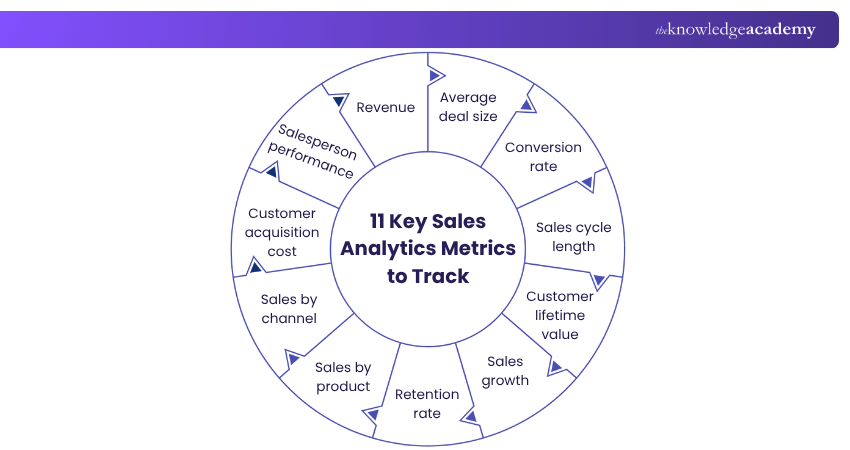
If you want to improve your sales, you need to track some important numbers. Below are 11 simple metrics that will help you understand and improve your sales. Let's start with the first metric - Revenue.
1) Revenue
Revenue means how much your business earns in a fixed time. This is the basic and most important metric that tells how your sales are performing overall.
2) Average Deal Size
This tells how much you earn on average from a single deal. This is calculated by dividing total revenue by total closed deals. If the average deal size is decreasing over time, then high-value customers are probably not coming. This can also help you understand how revenue can be increased by focusing on bigger deals.
3) Conversion Rate
The conversion rate tells how many people who show interest become actual customers. If this rate is low, then either the sales process is weak, or the wrong type of leads are coming. This can help you improve your sales quality.
4) Sales Cycle Length
This metric tells how much time it takes for a lead to become a customer. A short sales cycle means faster deals. If the cycle is too long, then the team may need better tools or support. This helps in setting planning and targets properly.
5) Customer Lifetime Value
Customer Lifetime Value or CLV tells how much a customer earns for your business over time. If CLV is low, you may be attracting the wrong customers. With this data, you can focus on valuable customers and build strong relationships with them.
6) Sales Growth
This is to see if your sales are growing over time. This helps you understand whether the effect of new strategies is positive or not. Simple formula: (New Revenue − Old Revenue) ÷ Old Revenue × 100.
7) Retention Rate
This metric tells how many customers come back or continue the service. If retention is high, then people are happy with your service. If it is low, then it is important to understand what problem they are facing.
8) Sales by Product
It is important to see the sales of different products. This tells which product is a hit and which is slow. You can improve weak products or change the marketing strategy.
9) Sales by Channel
This metric shows how many sales are coming from which sales channel like website, social media, Amazon, etc. This lets you know in which channel you should invest more.
10) Customer Acquisition Cost
This tells you how much money you are spending to acquire a new customer. If the cost is high, then the marketing or sales strategy will have to be improved. CAC = Total Marketing + Sales Cost ÷ New Customers.
11) Salesperson Performance
The performance of every sales representative is different. By looking at conversion rate, deal size, and sales growth, you can understand who is doing well and who can improve with help or training.
Master the art of saying the right thing at the right time! Start your Sales Negotiation Training and win more deals.
Key Features to Look for in Sales Analytics Tools
If you are thinking of buying a Sales Analytics tool, then it should have some important features that can make the work of your team easy and fast. The points given below will tell you what is important in a good tool. Let's start with Charts and Graphs.
Charts and graphs
A good Sales Analytics tool gives you simple visuals like charts and graphs. This helps the sales team understand immediately how sales are going. Everyone has a different style of understanding, and visuals are quick to understand.
Integration with CRM
CRM, or Customer Relationship Management, collects a lot of sales information. If the analytics tool is connected to CRM, viewing and using the data becomes easier. The sales team gets everything in one place without wasting time.
Contextual insights
Just seeing the data is not enough. The tool is beneficial only when you tell the meaning behind the data. For example, the tool suggests which deal to focus on or how the future forecast looks. These insights make your team smarter.
One consolidated view
The sales team has less time. If they have to go to different places to see the data, then the work becomes slow. A tool is needed where everything metrics, deals, and updates can be found on a single screen. This makes the work fast and smooth.
AI-powered insights
AI-based tools give you smart suggestions like which customer is important or which deal should be worked on. You can also test how changes will affect close rate and revenue. This strengthens both planning and decision-making.
Confused about sales numbers? Learn to read and use them smartly — Join our Sales Analytics Course today!
How to Choose a Sales Analytics Tool
There are lots of Sales Analytics tools available in the market right now, but not every tool is perfect for your business. Below are some important points that will help you choose the right tool so that your work is both easy and smart.
1) Data requirements
First of all, decide what type of data you want to track, like customer behavior, sales team performance, or website traffic. Not every tool is made for every type of data. So, choose a tool that can track data for your business goals.
2) Integration
You may already be using some tools like CRM, email marketing, or lead generation platforms. Your analytics tool should connect easily with them. If the tool is integration-friendly, then all the data will come in one place, and work will be fast without coding or manual work.
3) User-friendliness
Not every team member is a tech expert. So, choose a tool that is simple to look at and use. If the tool is complicated, people will not use it, and your investment will be wasted. It is very important to have a clear design and easy dashboard.
4) Reporting and visualization
You need a tool that creates easy-to-read reports and colorful graphs. Charts make it easy to understand data. If you can create custom reports and trends are clearly visible in them, then making decisions becomes fast.
5) Cost
Some tools seem cheap initially, but later, there are hidden charges like setup fees, training fees, or user-based pricing. As your team grows, the monthly cost of the tool can also increase. That is why it is important to understand the entire costing structure before purchasing a tool.
6) Customer support
Sometimes, there can be issues while setting up new tools or during daily use. Choose a tool whose customer support is quickly available on chat, email, or call. If there is an issue, then the solution should be available immediately; otherwise, work stops.
7) Scalability
Maybe today, your team is small, but tomorrow, your business will be on a high level. The tool should be such that it can easily handle more data, more users, and complex reports. If the tool is not scalable, then you will have to change the tool again in the future.
Conclusion
Today, sales aren't just about guesswork. They're about data. Sales Analytics shows you clearly what's working and what needs to be changed. This allows you to make smart decisions, improve your team's performance, and earn more revenue. Just choose the right tool, track the important metrics, and watch your sales results grow slowly.
Master the art of crafting persuasive online content and sales pitches through our detailed Online Sales Training – Register now!
Frequently Asked Questions
Why is Sales Analytics important?

Sales Analytics is important because it tells you how your sales team is working and how your product or service is performing. You understand which customers are more valuable, which deals are going well, and where you are facing problems. This helps you improve your strategy, improve your team, and increase your business profit.
How to Track Sales Analytics?
To track Sales Analytics, you need a tool that takes data from your CRM or sales system and displays it in easy charts, graphs, and reports. You should track a few important metrics like revenue, conversion rate, average deal size, and customer value. When all this data is on a single dashboard, you can quickly understand what's working and what needs to be improved. Nowadays, AI-powered tools are also available that give you smart suggestions.
What are the Other Resources and Offers Provided by The Knowledge Academy?
The Knowledge Academy takes global learning to new heights, offering over 30,000 online courses across 490+ locations in 220 countries. This expansive reach ensures accessibility and convenience for learners worldwide.
Alongside our diverse Online Course Catalogue, encompassing 19 major categories, we go the extra mile by providing a plethora of free educational Online Resources like News updates, Blogs, videos, webinars, and interview questions. Tailoring learning experiences further, professionals can maximise value with customisable Course Bundles of TKA.
What is The Knowledge Pass, and How Does it Work?
The Knowledge Academy’s Knowledge Pass, a prepaid voucher, adds another layer of flexibility, allowing course bookings over a 12-month period. Join us on a journey where education knows no bounds.
What are the Related Courses and Blogs Provided by The Knowledge Academy?
The Knowledge Academy offers various Sales Training Courses, including the Sales Analytics Training Course, and the Sales Management Training Course. These courses cater to different skill levels, providing comprehensive insights into Sentiment Analysis.
Our Business Skills Blogs cover a range of topics related to Business Development, offering valuable resources, best practices, and industry insights. Whether you are a beginner or looking to advance your Business skills, The Knowledge Academy's diverse courses and informative blogs have got you covered.

Charlotte Wilson


Soft Skills and Business Training Manager
Charlotte Wilson is an expert in soft skills development, with over 14 years of experience helping individuals and teams improve communication, productivity and emotional intelligence in the workplace. Her training content is focused on enhancing interpersonal effectiveness and fostering positive, collaborative environments across all levels of an organisation.
View Detail
Upcoming Business Skills Resources Batches & Dates
Date
 Online Sales Training
Online Sales Training
Fri 17th Jul 2026
Online Sales Training
Fri 25th Sep 2026

 If you wish to make any changes to your course, please


