


 Top Rated Course

We may not have the course you’re looking for. If you enquire or give us a call on +65 6929 8747 and speak to our training experts, we may still be able to help with your training requirements.
What is Attention Mechanism? Meaning and Uses in AI
The Knowledge Academy 25 April 2026Attention Mechanism helps models focus on the most relevant parts of input data, improving performance in tasks like translation and text generation. It lets models weigh important information more heavily, improving understanding. This leads to more accurate results in AI tasks like summarisation and question answering.

Training Outcomes Within Your Budget!
We ensure quality, budget-alignment, and timely delivery by our expert instructors.
Table of Contents
Ever scrolled through your social media feed and noticed how your eyes automatically stop at the posts that matter most to you? That’s your brain filtering the noise and focusing on what’s important. Artificial Intelligence aims to do the same with something called the Attention Mechanism. It acts like a spotlight, guiding machines to focus only on the information that truly matters.
By teaching machines to “pay attention,” we give them the ability to highlight the most relevant information, making tasks like translation, summarisation, or even image captioning smarter and more accurate. In this blog, we’ll break down what an Attention Mechanism is, why it matters, how it works, the different types and its role in transformers.
Table of Contents
1) What is an Attention Mechanism?
2) Why are Attention Mechanisms Important?
3) How Attention Mechanisms Work?
4) Different Types of Attention Mechanisms
5) Role of Attention Mechanisms in Transformer Architectures
6) Attention Mechanism Use Cases
7) Evolution and Advancements in Attention Mechanisms
8) Conclusion
What is an Attention Mechanism?
Attention Mechanism is a method that helps a computer focus on the most important parts of the information it receives. Instead of giving equal value to everything, it picks out the useful details and ignores the rest, just like how people pay attention to certain things and block out distractions.
For example, if a computer is asked to translate a sentence, it doesn’t look at all the words equally. Instead, it focuses more on the words that carry meaning and less on the ones that don’t add much. This makes the translation clearer and more accurate, similar to how you pick out the main idea in a conversation.
Why are Attention Mechanisms Important?
Attention Mechanisms are very important because it helps computers work better and smarter. Here are some of the key benefits:
1) Better Understanding: Helps computers focus on the right information for clearer results.
2) Work Faster: Quickly ignores unimportant details, saving time and effort.
3) Better Results: Improves tasks like translation, summarisation, and image recognition.
4) Handle Lots of Data: Selects the most important parts from large information sets.
5) Used Everywhere: Powers tools like voice assistants, video captions, and smart apps.
6) Higher Accuracy: Models with attention perform better than those without.
Learn how to clean and prepare raw text data effectively with our Natural Language Processing (NLP) Fundamentals with Python Course - Join now!
How Attention Mechanisms Work?
Let’s try to understand how Attention Mechanisms works in simple steps:

1) Find What’s Important: Attention helps the computer know which parts of the input are important and which parts are to be ignored.
2) Change Input: First, the computer breaks the input into small pieces called tokens. Each token is changed into a list of numbers called a vector.
3) Check Similarity: Then, the computer looks at how close these numbers are and gives scores called attention scores.
4) Make Weights: The scores are changed into weights between zero and one. Zero means ignore, one means focus fully. All weights add up to one.
5) Use Weights: Finally, the computer uses these weights to focus more on important parts when making choices.
Different Types of Attention Mechanisms
There are different kinds of Attention Mechanisms. Each one is made for a different job. Here are some important types:

1) Self-attention Mechanism
Self-attention helps the computer look at every word in a sentence and represent it as numbers. It then compares the words to see which ones matter most, allowing the computer to understand the full sentence more clearly.
2) Scaled Dot-product Attention
This uses simple math with numbers to find what is important. It works fast and helps the computer. The computer checks how two things are closely related. Then it pays more attention to the important ones.
3) Multi-head Attention
Multi-head attention allows the computer to look at different parts of the data at the same time. Each “head” views the data in a slightly different way, and when combined, they give a deeper and clearer understanding.
4) Location-based Attention
Location-based attention is mainly used for images. The computer scans different areas of a picture and focuses on the most important spots. This helps it recognise objects or generate accurate descriptions of what is shown in the image.
Acquire the skills to evaluate code quality and perform debugging with our Deep Learning with TensorFlow Training - Join now!
Role of Attention Mechanisms in Transformer Architectures
Transformers are powerful models that changed how machines process language and data. Attention is at the core of these models, guiding how they read, connect, and generate information. Here’s how attention plays its role in transformers:
1) Positional Encoding for Word Order
Transformers see all words at once, so they need a way to know the order of words in a sentence. Positional encoding adds special numbers to each word, showing its place in the sequence. This helps the model read words in the right order and understand sentence structure.
2) Self-attention to Link Words
Self-attention lets each word look at other words in the sentence to understand meaning better. For example, in “The cat sat on the mat,” the word “sat” looks at both “cat” and “mat” to make sense. This linking helps the model learn how words relate to one another.
3) Multi-head Attention for Deeper Understanding
Instead of looking at words in just one way, transformers use multi-head attention to see different perspectives at the same time. Each “head” focuses on a unique aspect, such as subject, object, or context. Combining them gives the model a fuller and clearer understanding of the sentence.
4) Generating Output with Attention
After analysing the words, the model uses attention to decide the best next word to generate. It reviews all the information it has processed so far and chooses the most likely option. This step ensures the output forms sentences that are meaningful and grammatically correct.
Acquire hands-on experience in implementing Deep Learning models with our Deep Learning Course – Join now!
Attention Mechanism Use Cases
Attention Mechanism is used in many areas. Here are some simple examples:
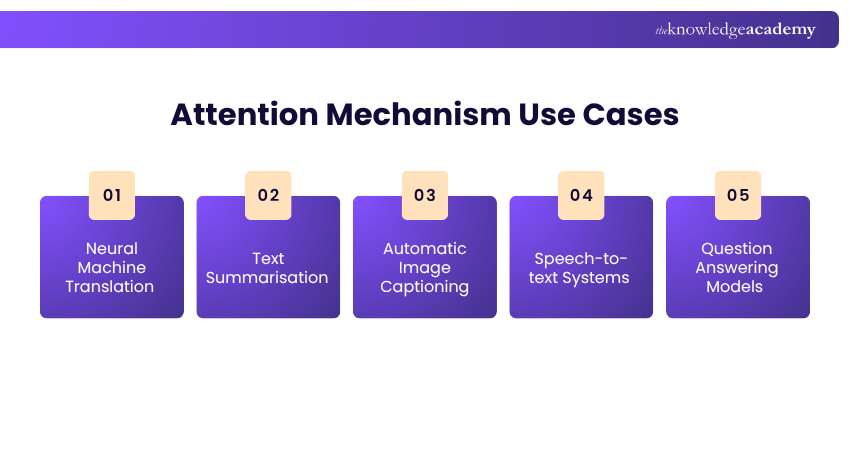
1) Neural Machine Translation
Attention helps the computer look at the right words when changing from one language to another. It finds important words to make good translations. This helps the computer translate better.
Example: When translating “I love apples” to Spanish, attention helps the computer know that “apples” means “manzanas” and keeps the sentence correct.
2) Text Summarisation
Attention helps the computer find the main parts of a long story or text. It uses those parts to make a short summary. This way, you get the important ideas fast.
Example: From a long news article about the weather, attention helps the computer write a short summary like “It will rain tomorrow.”
3) Automatic Image Captioning
Attention helps the computer look at important parts of a picture. It uses those parts to say what is in the picture. This helps the computer write good sentences about the picture.
Example: For a photo of a dog playing, attention helps the computer say, “A dog is playing with a ball.”
4) Speech-to-text Systems
Attention helps the computer listen to the sounds in speech. It finds it important to write the right words. This makes speech-to-text work better.
Example: When you say “Hello, how are you?”, attention helps the computer write the exact sentence.
5) Question Answering Models
Attention helps the computer find the important parts in a question and the text. It uses those parts to find the right answer. This helps the computer answer questions well.
Example: If you ask, “What is the capital of France?”, attention helps the computer find “Paris” as the answer in the text.
Evolution and Advancements in Attention Mechanisms
Attention Mechanisms have improved a lot over time. Here are some evolutions and advancements in Attention Mechanisms:
1) Sparse Attention Techniques
Scientists drew attention to this by teaching models to focus only on some important parts, not everything. This helps computers work faster and use less power. It means the computer does not waste time on unimportant details.
2) Memory-augmented Architectures
Some models now have extra memory to remember and use information better. This helps when the task needs thinking and remembering things for a long time. The extra memory helps the model solve harder problems.
3) Cross-modal Attention Models
When computers get different kinds of data, like pictures and words, cross-modal attention helps them understand how these different types connect. This helps with jobs like writing captions for images.
Conclusion
Attention Mechanism is a powerful tool that helps AI models focus on the most relevant information, improving accuracy and efficiency. It plays a crucial role in many modern technologies, like language translation and image recognition. As Attention Mechanisms continue to expand, they will drive even smarter and more capable AI systems. It will reshape the future of Artificial Intelligence and transform how machines understand data.
Learn about AI application areas and related individual fields within AI. Join our Artificial Intelligence & Machine Learning Training now!
Frequently Asked Questions
What is the Attention Mechanism of the Brain?

The brain’s Attention Mechanism helps us focus on what matters and filter out distractions. For instance, when speaking to a friend in a noisy room, it enables you to hear their voice clearly and understand better.
What is the Mechanism of Self-attention?
Self-attention allows a computer to examine all words in a sentence, find connections, and highlight important ones. This process helps it understand the meaning more clearly and produce accurate results when handling language tasks.
What are the Other Resources and Offers Provided by The Knowledge Academy?
The Knowledge Academy takes global learning to new heights, offering over 3,000+ online courses across 490+ locations in 190+ countries. This expansive reach ensures accessibility and convenience for learners worldwide.
Alongside our diverse Online Course Catalogue, encompassing 17 major categories, we go the extra mile by providing a plethora of free educational Online Resources like Blogs, eBooks, Interview Questions and Videos. Tailoring learning experiences further, professionals can unlock greater value through a wide range of special discounts, seasonal deals, and Exclusive Offers.
What is The Knowledge Pass, and How Does it Work?
The Knowledge Academy’s Knowledge Pass, a prepaid voucher, adds another layer of flexibility, allowing course bookings over a 12-month period. Join us on a journey where education knows no bounds.
What are the Related Courses and Blogs Provided by The Knowledge Academy?
The Knowledge Academy offers various Artificial Intelligence & Machine Learning Courses, including the Machine Learning Course, Deep Learning Course, and the Natural Language Processing (NLP) Fundamentals with Python Training. These courses cater to different skill levels, providing comprehensive insights into Chain of Thought Prompting.
Our Data, Analytics & AI Blogs cover a range of topics related to Attention Mechanism, offering valuable resources, best practices, and industry insights. Whether you are a beginner or looking to advance your Machine Learning skills, The Knowledge Academy's diverse courses and informative blogs have got you covered.

The Knowledge Academy


Global Training Provider
The Knowledge Academy is a world-leading provider of professional training courses, offering globally recognised qualifications across a wide range of subjects. With expert trainers, up-to-date course material, and flexible learning options, we aim to empower professionals and organisations to achieve their goals through continuous learning.

Upcoming Data, Analytics & AI Resources Batches & Dates
Date
 Machine Learning Course
Machine Learning Course
Fri 28th Aug 2026
Machine Learning Course
Fri 4th Dec 2026

 If you wish to make any changes to your course, please


