


 Top Rated Course

We may not have the course you’re looking for. If you enquire or give us a call on +46 850282424 and speak to our training experts, we may still be able to help with your training requirements.
What is Cloud Orchestration and Why Is It Important?
Richard Harris 22 April 2026Cloud Orchestration is the automated management coordination and organisation of cloud services resources and workloads to optimise operations and efficiency. With the use of cloud automation platforms, businesses boost efficiency, control costs, and maintain reliable performance across hybrid or multi-cloud environments.

Training Outcomes Within Your Budget!
We ensure quality, budget-alignment, and timely delivery by our expert instructors.
Table of Contents
Understanding Cloud Orchestration can feel a bit like watching a conductor lead a perfectly timed symphony. Every service, process, and resource knows exactly when to step in, when to pause, and how to work in harmony. In a world where businesses rely on countless cloud tools, this coordination isn’t just helpful, it’s essential.
Think of Cloud Orchestration as the backstage mastermind that eliminates manual effort, reduces errors, and keeps everything running smoothly. Whether you’re scaling applications, automating workflows, or speeding up deployments, orchestration makes your cloud ecosystem smarter and more efficient without the chaos.
Table of Contents
1) What is Cloud Orchestration?
2) The Importance of Cloud Orchestration
3) Key Features of Cloud Orchestration
4) Benefits of Cloud Orchestration
5) Challenges of Cloud Orchestration
6) What are Cloud Orchestration Models?
7) Difference Between Cloud Orchestration and Cloud Automation
8) Conclusion
What is Cloud Orchestration?
Cloud Orchestration is the automation and coordination of multiple cloud processes, such as provisioning, configuration, scaling, and networking and putting them into a unified, policy driven workflow. This makes seamless management of infrastructure and services across cloud environments, making sure that resources are being deployed and applied in consistent, reliable manner.
The Importance of Cloud Orchestration
Cloud Orchestration plays a key role in managing cloud environments, helping them remain scalable, automated, and efficient. Below are some important reasons why Cloud Orchestration matters:
1) Handles Complexity
Modern cloud architecture includes microservices, containerisation, hybrid clouds, and edge deployments. All of these is coordinated with the help of Cloud Orchestration, moving parts in a unified way.
2) Reduces Errors and Maintain Consistency
Cloud Orchestration enforces workflows and policies, ensuring tasks like provisioning, network configuration, or scaling happen in the right order. This helps to maintain accuracy, consistency and reduce the risk of errors.
3) Improves Efficiency
By combining multiple automated tasks into a single workflow, such as deploying virtual machines and setting up storage, it frees up teams from routine mode of work to focus more on innovation.
4) Brings Policy-driven Governance
Cloud Orchestration systems embed business rules, security constraints, cost controls and compliance checks into workflows. So, as cloud keeps scaling, it remains in adherence to organisational policies.
5) Supports Hybrid and Multi-cloud Environments
In organisations, where multiple cloud providers are utilised, Cloud Orchestration provides a unified view to allow define workflows that span across environments. This eliminates silos and ensures smooth operations and workflows across clouds.
Key Features of Cloud Orchestration
The main features that define an effective Cloud Orchestration are mentioned below:
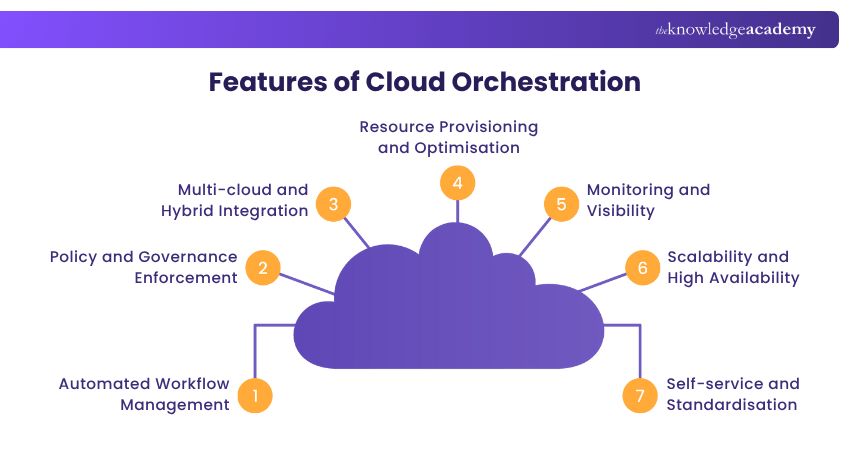
1) Automated Workflow Management
Cloud Orchestration combines multiple cloud tasks, such as provisioning, scaling, and networking, into a single automated workflow. This reduces manual effort, minimises errors, and ensures smooth and consistent operations.
2) Policy and Governance Enforcement
It ensures compliance with security, cost, and access policies across all automated processes, example who can deploy what, under which conditions. This helps organisations maintain consistent standards and avoid misconfigurations.
3) Multi-cloud and Hybrid Integration
Cloud Orchestration does seamless work across various cloud providers and on-premises environments for a unified management. This helps organisations to utilise the best services from different platforms.
4) Resource Provisioning and Optimisation
Cloud Orchestration can automatically allocate, and scale computing, storage, and network resource based on the demand. This improves performance as well as ensure cost-efficient usage by avoiding over or under-provisioning.
5) Monitoring and Visibility
Monitoring and visibility are optimised through the integration of Cloud Orchestration, as it provides real-time insights into workflows, performance, and resource utilisation to improve efficiency.
6) Scalability and High Availability
Cloud Orchestration is responsible for maintaining consistency in performance and keeps reliability even when workloads increase or environments expand.
7) Self-service and Standardisation
It enables teams to deploy approved resources or applications using predefined templates. This reduces manual work, lowers the chance of errors, and ensures standardised deployments across the organisation.
Advance your cloud career with AI for Cloud Professionals Training- Sign up now!
Benefits of Cloud Orchestration
Cloud Orchestration offers advantages that enhance the efficiency, scalability, and security of cloud-based environments. Some of them include:

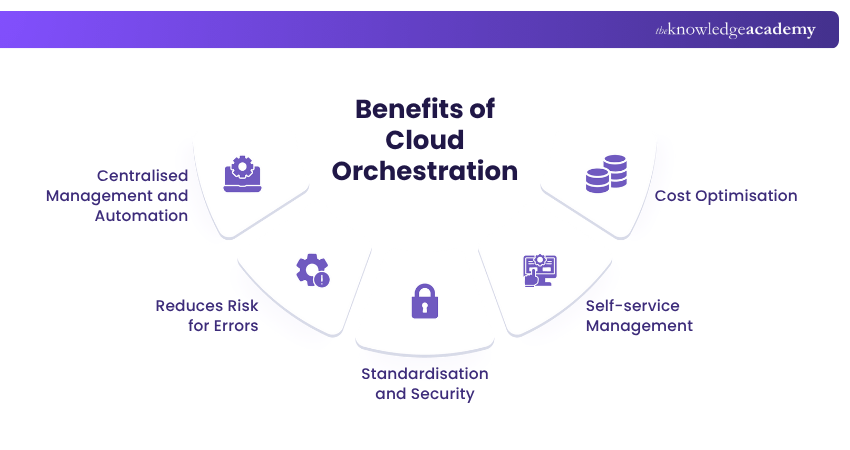
1) Centralised Management and Automation
Cloud Orchestration enables automation of complex systems, services, and middleware through a unified interface. This allows users to define and manage the lifecycle of applications and infrastructure, reducing the need for manual intervention.
2) Reduces the Risk for Errors
By automating tasks, Cloud Orchestration minimises the risk of human errors that can occur during manual processes. Through standardised workflows, it ensures consistency and reliability across cloud operations.
3) Standardisation and Security
Cloud Orchestration helps to standardise templates and enforce security practices, offering visibility and control over cloud resources and its costs. This protects against issues like VM sprawl and makes sure components are correctly configured.
4) Self-service Management
By integrating Cloud Orchestration, it helps to support self-service models, allowing users to request and deploy resources without IT intervention. This boosts efficiency in delivery of services and reduces bottlenecks in resource provisioning.
5) Cost Optimisation
By basing automated scaling on demand, it helps to prevent over-provisioning leading to a more efficient resource utilisation. This is beneficial for resource management to reduce operational expenses and improve efficiency in cost.
Challenges of Cloud Orchestration
Amidst the benefits of Cloud Orchestration, organisations can encounter challenges during the time of implementation and operation. Some of them are discussed below:
1) Setup and Management Complexity
The implementation of Cloud Orchestration is intricate, especially in larger environments. It requires specialised knowledge in cloud infrastructure, automation and security. It is necessary for that individual to be skilled in cloud architecture DevOps, or cloud automation.
2) Security Risk and Misconfigurations
While Cloud Orchestration offers security features, but misconfigurations in the orchestration layer can create significant security risks. For instance, if roles, permissions or access are not set correct, unauthorised users might gain access to private and sensitive data, resulting in cyberattack.
3) Limited Control Over Infrastructure
By utilising Cloud Orchestration that is not hosted on the premise of an organisation's server can limit the ability to customise infrastructure. Organisations can become dependent on the features and limitations of the cloud service provider.
4) Tooling Challenges
Cloud Orchestration tools, at times, present challenges for organisations. For instance, while open-source orchestration tools offer flexibility, they are prone to inconsistencies and bugs, requiring frequent updates and troubleshooting.
Learn efficient infrastructure for seamless and scalable deployment with our Terraform Training - Join now!
What are Cloud Orchestration Models?
Cloud Orchestration models define how various cloud services are structured, managed, and delivered to end-users. It is important to understand these models, some of the prominent ones are discussed below:
1) Software as a Service (Saas)
In the Saas model, cloud providers deliver software applications over the internet. Users access these applications through web browser without managing underlying infrastructure. For example, Google Workspace, Microsoft 365.
2) Platform as a Service (PaaS)
PaaS provides a platform allowing customers to develop, run, and manage applications without dealing with the infrastructure. It offers more control over applications while abstracting the hardware and software layers.
3) Infrastructure as a Service (IaaS)
IaaS delivers virtualised computing resources over the internet. It provides most control to users, enabling them to manage operating systems, applications, and storage. For example, Amazon Web Services (AWS), Microsoft Azure.
4) Private Cloud
A private cloud is a cloud infrastructure operate solely for a single organisation. It can be managed internally or by a third party. This model often offers enhanced security and control but requires significant investments and maintenance.
5) Public Cloud
Here, services and infrastructure are provided off-site over the internet by third-party providers. The resources are shared among multiple tenants, offering scalability, and cost efficiency. For example, Google Cloud Platform, Amazon Web Services (AWS).
6) Hybrid Cloud
A hybrid cloud combines private and public cloud model, allowing data and applications to be shared in between then. This gives flexibility and optimisation of infrastructure, security and regulatory compliances.
7) Multi-cloud
This involves using multiple cloud computing services from different providers. Organisations adopt the multi-cloud model to prevent vendor lock-in, enhance redundancy, and optimise performance.
Difference Between Cloud Orchestration and Cloud Automation
Cloud Automation handles single tasks like provisioning VMs or deploying apps. Cloud Orchestration links those tasks into one smooth workflow, managing dependencies and full process execution. In short, automation does tasks; orchestration organises them.
Here’s a quick comparison to show the difference:

Conclusion
Cloud Orchestration is a vital tool for the management of complex cloud-based environments, automating workflows, and ensures a seamless integration of unified workflow across services. By coordinating tasks, enforcing policies, and optimising resources, it enables organisations to enhance efficiency, scalability, and reliability in their cloud operations.
Kickstart your cloud journey with our AWS Technical Essentials Training- Join now!
Frequently Asked Questions
What is an Example of Cloud Orchestration?

An example of Cloud Orchestration is deploying a multi-tier web application with the use of a tool like VMware vRealise Automation. It automates provisioning of servers, configuring networks, ad deploying applications in a coordinated workflow, ensuring all components work seamlessly in a unified manner across the cloud environment.
What is Orchestration in AWS?
In AWS, orchestrations mean to automate and coordinate cloud resources and services to streamline workflows. With tools, such as AWS CloudFormation and AWS Step Functions allowing users to provision infrastructure, configure services, and manage dependencies, automated sequences run efficiently and consistently.
What are the Other Resources and Offers Provided by The Knowledge Academy?
The Knowledge Academy takes global learning to new heights, offering over 3,000+ online courses across 490+ locations in 190+ countries. This expansive reach ensures accessibility and convenience for learners worldwide.
Alongside our diverse Online Course Catalogue, encompassing 17 major categories, we go the extra mile by providing a plethora of free educational Online Resources like Blogs, eBooks, Interview Questions and Videos. Tailoring learning experiences further, professionals can unlock greater value through a wide range of special discounts, seasonal deals, and Exclusive Offers.
What is The Knowledge Pass, and How Does it Work?
The Knowledge Academy’s Knowledge Pass, a prepaid voucher, adds another layer of flexibility, allowing course bookings over a 12-month period. Join us on a journey where education knows no bounds.
What are the Related Courses and Blogs Provided by The Knowledge Academy?
The Knowledge Academy offers various Cloud Computing Training, including Cloud Computing Training, Terraform Training, and Certified Artificial Intelligence (AI) for Cloud Professionals Training. These courses cater to different skill levels, providing comprehensive insights into Container Orchestration.
Our Cloud Computing Blogs cover a range of topics related to Cloud Orchestration, offering valuable resources, best practices, and industry insights. Whether you are a beginner or looking to advance your Cloud Computing skills, The Knowledge Academy's diverse courses and informative blogs have got you covered.

Richard Harris


Senior Full Stack Developer and Technology Educator
Richard Harris is a highly experienced full-stack developer with deep expertise in both frontend and backend technologies. Over his 12-year career, he has built scalable web applications for startups, enterprises and government organisations. Richard’s writing combines technical depth with clear explanations, ideal for developers looking to grow in modern frameworks and tools.

Upcoming Cloud Computing Resources Batches & Dates
Date
 Cloud Computing Training
Cloud Computing Training
Thu 13th Aug 2026
Cloud Computing Training
Thu 3rd Dec 2026

 If you wish to make any changes to your course, please


