


 Top Rated Course

We may not have the course you’re looking for. If you enquire or give us a call on +46 850282424 and speak to our training experts, we may still be able to help with your training requirements.
What is Statistical Process Control (SPC): Optimise Your Workflow
William Brown 21 February 2026Statistical Process Control (SPC) uses data-based methods to monitor processes, maintain stability, reduce defects, and improve overall quality. It helps teams detect variation early and take timely corrective action. As a result, organisations achieve consistent performance and deliver more reliable outcomes.

Training Outcomes Within Your Budget!
We ensure quality, budget-alignment, and timely delivery by our expert instructors.
Table of Contents
Have you ever wondered how organisations consistently produce high-quality products while avoiding costly mistakes? In fast-moving industries, even small process variations can lead to defects, delays, and wasted resources. This is where Statistical Process Control (SPC) becomes essential. By using data to monitor performance in real time, SPC helps organisations detect problems early and maintain consistent, reliable results.
Instead of relying only on final inspections, SPC focuses on controlling the process itself. It helps teams understand variation, prevent defects, and improve efficiency. In this blog, you will explore what Statistical Process Control is, how it works, and why it is essential for modern quality management.
Table of Contents
1) Introduction to Statistical Process Control (SPC)
2) Types of Process Variations
3) Steps to Implement SPC Charts
4) How to Use Statistical Process Control Effectively?
5) Statistical Process Control Tools
6) Benefits of Statistical Process Control
7) Drawbacks of Statistical Process Control
8) SQC Versus SPC
9) Conclusion
Introduction to Statistical Process Control (SPC)
Statistical Process Control (SPC) is a data-driven quality method that uses statistical tools, especially control charts, to monitor and manage processes in real time. It helps organisations track performance continuously and ensure production runs smoothly and consistently.
SPC also helps distinguish between normal process variation (common causes) and unusual problems (special causes). By identifying these differences early, organisations can reduce defects, improve consistency, and maintain efficient, high-quality production.

History of Statistical Process Control
Statistical Process Control (SPC) was developed in 1924 by Walter A. Shewhart at Bell Laboratories. He introduced control charts to monitor processes and identify variation, shifting quality management from product inspection to process control. During World War II, SPC was widely used in the United States to maintain manufacturing quality.
After the war, Dr. W. Edwards Deming promoted SPC as part of data-driven quality improvement. Japanese industries adopted and refined these methods, achieving major quality gains. Today, SPC is widely used worldwide and supports modern quality initiatives such as Six Sigma.
Types of Process Variations
In SPC, producers measure the consistency of a process in creating a product with proper characteristics and dimensions. They choose an aspect of the product, such as length, collect data on a subset of products and then plot the data onto a control chart, which calculates its average value and control limits. A process can have two kinds of variations, as detailed below:
1) Special Cause Variation
This results from a specific external event, such as an operator error or a machine malfunction. These variations are unpredictable and indicate a point of instability in a process. When a control chart shows special cause variance, a process measure is out of control. Producers can conduct SPC through control chart analysis, identifying special cause variations and removing them to ensure their production processes are efficient and repeatable.
2) Common Cause Variation
Random variations are inherent in all processes. A common cause variation is predictable and part of a process's normal stability. It indicates process potential or how effectively it can function when eliminating special cause variation.
Struggling to understand efficiency gaps in business processes? Sign up for our Business Process Mapping Training now!
Steps to Implement SPC Charts
SPC charts are used to study changes in the process over time. All the process data are plotted in time order. The main components of an SPC chart are:
1) Central Line (CL) for the average/p>
2) Lower Control Line (LCL) for the lower control unit
3) Upper Control Line (UCL) for the upper control unit
Below, you will find the step-by-step process for constructing an effective SPC chart:
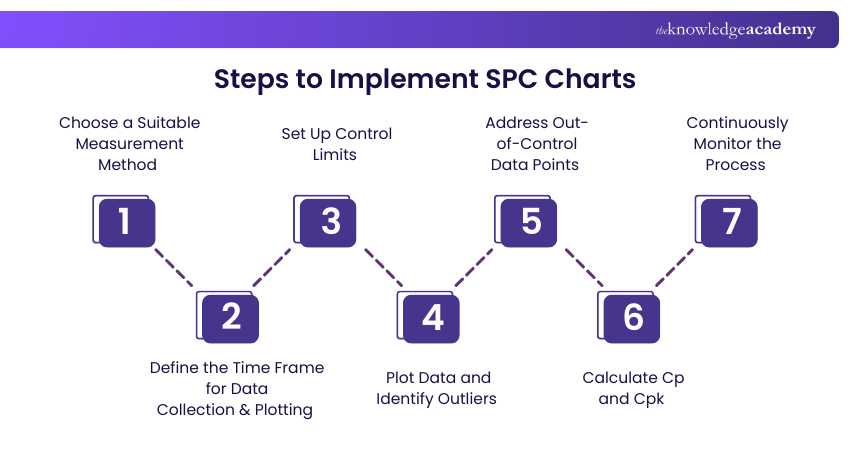
Step 1: Choose a Suitable Measurement Method
The first step involves deciding the data type to collect - variable or attribute. It's highly advisable to use variable data wherever possible as it delivers a higher quality of information. Once the data type is decided on, you can select the appropriate control chart for your data.
Step 2: Define the Time Frame for Data Collection and Plotting
Since SPC charts measure changes in data over time, you must maintain a frequency and period for collecting and plotting it. For instance, making an SPC chart every day or every alternate week can help you see whether your process is reliable or whether you'll be able to meet quality standards in time.
Step 3: Set Up Control Limits
The next step involves establishing the control units. Here's how you can calculate them:
a) Calculate the standard deviation (σ) of the sample data/p>
b) To calculate UCL,
UCL = average + 3 x σ
c) To calculate LCL,

LCL = average - 3 x σ

Step 4: Plot Data and Identify Outliers
After setting control limits, it's time to plot the data points on the SPC chart. Once they are plotted, you will see patterns in them. Recognising these patterns is the key to finding the root cause of special causes.
Step 5: Address Out-of-Control Data Points
Whenever data points are found outside the control limits, they must be marked on the chart, and the cause must be investigated. Additionally, you must document what was investigated, the cause that resulted in it being out of control, and the necessary steps to control it. A corrective action matrix can be used to identify responsibilities and establish target dates to track the actions taken.
Step 6: Calculate Cp and Cpk
This step involves determining whether the process can meet specifications by calculating Cp (capability) and Cpk (performance).
Cp is calculated as follows:

Cpk is calculated as follows:

Where
a) X = process average
b) LSL = Lower Specification Limit
c) USL = Upper Specification Limit
d) σest = Process Standard Deviation
Step 7: Continuously Monitor the Process
The final step is continually monitoring the process and updating the SPC chart. Regular monitoring can provide proactive rather than reactive responses when it may be too late or costly.
How to Use Statistical Process Control Effectively?
SPC techniques help organisations monitor processes, detect variation, and prevent defects. To use it effectively, teams collect accurate data, monitor performance with control charts, and analyse results to maintain stability. The key steps of statistical control are explained below:
Collecting and Recording Data
Collect data from key process characteristics, such as product measurements or equipment readings. Record it regularly and plot it on appropriate control charts based on data type. Accurate and consistent data ensures effective monitoring.
Control Charts
Control charts track process performance over time. They display averages, variation, and control limits based on actual data. If values stay within the limits, the process is stable. Points outside the limits signal potential issues that require investigation.
Analysing the Data
Review chart patterns to identify causes of variation. Normal variation occurs within control limits, while unusual patterns or points outside limits indicate special causes such as equipment faults or process shifts. Investigate and correct these to keep the process stable.
Statistical Process Control Tools
In total, 14 quality control tools are utilised in Statistical Process Control, divided into seven primary quality control tools and seven supplemental tools. Let's explore SPC tools in detail below:
1) Primary Quality Control Tools
The tools under this category are:
a) Cause-and-effect Diagrams: Also known as the fishbone diagram, these diagrams identify numerous causes of any problem. The diagrams look like a fishbone, stretching each bone into smaller branches that delve deeper into each cause.
b) Check Sheets: These are simple, ready-to-use forms for collecting and analysing data. They are especially useful for data that is repeatedly observed and collected by the same person or in the same location.
c) Histograms: Histograms resemble bar charts and are graphs that showcase frequency distributions, making them ideal for numbered data.
d) Pareto Charts: These are bar graphs representing frequency and cost. They are particularly useful in measuring problem frequency and showcase the 80/20 Pareto principle: addressing 20% of the processes will resolve 80% of the problems.
e) Scatter Diagrams: Also called an X-Y graph, scatter diagrams ideally work best when paired with numerical data.
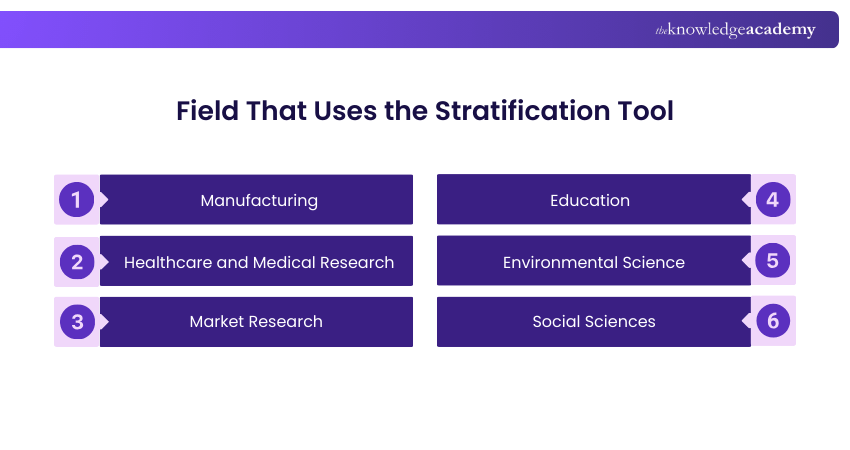
f) Stratification: It's a tool for separating data that simplifies pattern identification. It sorts people, objects, and related data into specific groups or layers. It's perfect for data from diverse sources.
g) Control Charts: These are among the most popular and oldest statistical process tools.
Master the core principles of Business Analysis methodologies in our Certified Business Analyst Professional (CBA-PRO) Course - Register now!
2) Additional Supplemental Tools
Here are some supplemental tools that help in Statistical Process Control:
a) Defect Maps: These maps visualise and track a product’s defects, focusing on flaws and physical locations. Each defect is identified on the map.
b) Events Logs: These standardised records document key software and hardware events.
c) Process Flowcharts: These form a snapshot of the steps in a process, showcased in the order they occur.
d) Progress Centers: Progress centres are centralised locations, allowing businesses to monitor progress and collect data.
e) Randomisation: Randomisation involves using chance to assign manufacturing units to a treatment group.
f) Sample Size Determination: This tool determines the number of events or individuals needed to be included in the Statistical Analysis.
Understand the practical applications of Statistics in various industries with our Statistics Course – Join now!
Benefits of Statistical Process Control
There are various benefits of SPC, as it:
a) Minimises Waste and Rework: Reduces material wastage, costly rework, and inefficiencies by identifying defects early in production.
b) Provides Facts to Catalyse Decision-making: Offers accurate, data-driven insights that help businesses make strategic, informed, and timely decisions effectively.
c) Boosts Productivity: Enhances operational efficiency by streamlining processes, reducing errors, and optimising resources for maximum output.
d) Improves Product Quality: Ensures consistent product standards by detecting variations early, maintaining uniformity, and meeting customer expectations efficiently.
e) Aligns Process Capabilities with Product Needs: Matches production processes with required specifications, improving consistency, efficiency, and overall product performance reliability.
f) Maintains Control Through Constant Process Monitoring: Enables proactive adjustments by continuously tracking production, preventing defects, and improving overall quality management.
g) Makes the Procedure More Efficient: Reduces process variations, minimises delays, optimises resources, and ensures a smooth, uninterrupted production workflow.
h) Increases Product Dependability: Ensures high reliability, consistent quality, customer satisfaction, and brand trust by maintaining strict process control standards.
Drawbacks of Statistical Process Control
Despite its numerous benefits, there are some significant drawbacks of Statistical Process Control to watch out for:
1) Time Requirements: While Statistical Process Control emphasises early detection, implementing the system in a manufacturing setup can take a long time. Monitoring and filling out charts can also be time-consuming.
2) Cost Considerations: SCP is expensive. It requires companies to sign contracts with service providers and invest in training resources and materials.
3) Quality Measurements: While Statistical Process Control detects non-conformance in the process protocol, it doesn't say how many products may have been defective until that point.
SQC Versus SPC
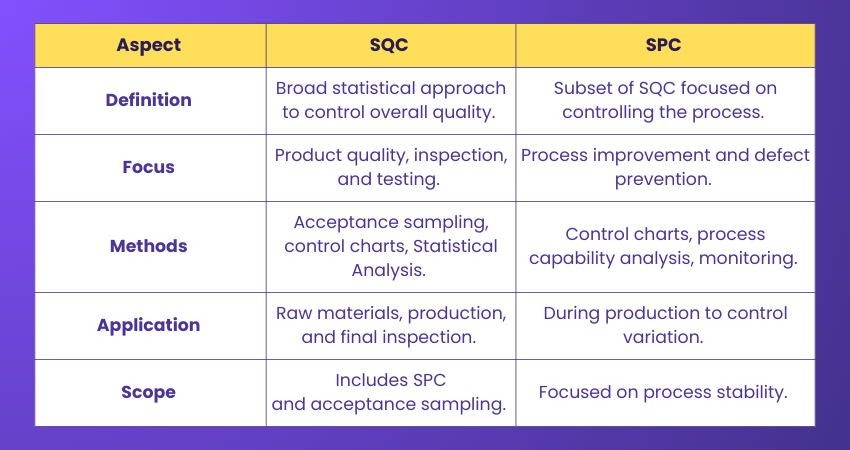
Statistical Quality Control (SQC) and Statistical Process Control are both methodologies used in quality management, but they have distinct focuses and applications. Here is the difference between SQC Versus SPC:
Conclusion
Statistical Process Control empowers organisations to move beyond inspection and take control of quality at its source. By using data to monitor performance, reduce variation, and prevent defects, SPC builds more reliable processes, better products, and stronger operational efficiency. It is a practical step towards continuous improvement and long-term success.
Fulfil your dream of becoming a proficient Business Analyst through our comprehensive Business Analyst Courses - sign up now!
Frequently Asked Questions
How to Tell if a Process is Out of Control?

A process is out of control when data shows unusual variations, such as points outside control limits, patterns or trends, or sudden shifts. These signals indicate issues like machine faults, material changes, or human errors, requiring corrective action to maintain consistency and quality.
Why is SPC Required?
SPC is essential for maintaining quality and efficiency in manufacturing. It helps detect variations early, reduces defects, minimises waste, and improves process stability. By continuously monitoring data, SPC enables proactive decision-making, ensuring products meet standards while enhancing productivity and reducing production costs.
What are the Other Resources and Offers Provided by The Knowledge Academy?
The Knowledge Academy takes global learning to new heights, offering over 3,000+ online courses across 490+ locations in 190+ countries. This expansive reach ensures accessibility and convenience for learners worldwide.
Alongside our diverse Online Course Catalogue, encompassing 19 major categories, we go the extra mile by providing a plethora of free educational Online Resources like Blogs, eBooks, Interview Questions and Videos. Tailoring learning experiences further, professionals can unlock greater value through a wide range of special discounts, seasonal deals, and Exclusive Offers.
What is The Knowledge Pass, and How Does it Work?
The Knowledge Academy’s Knowledge Pass, a prepaid voucher, adds another layer of flexibility, allowing course bookings over a 12-month period. Join us on a journey where education knows no bounds.
What are the Related Courses and Blogs Provided by The Knowledge Academy?
The Knowledge Academy offers various Business Analyst Courses, including the Statistical Process Control Training, Statistics Course, and the Business Analyst Fundamentals Training. These courses cater to different skill levels, providing comprehensive insights into What is Statistics.
Our Business Analysis Blogs cover a range of topics related to Statistical Process Control, offering valuable resources, best practices, and industry insights. Whether you are a beginner or looking to advance your Business Analysis skills, The Knowledge Academy's diverse courses and informative blogs have got you covered.

William Brown


Senior Business Analyst and Strategic Advisor
William Brown is a senior business analyst with over 15 years of experience driving process improvement and strategic transformation in complex business environments. He specialises in analysing operations, gathering requirements and delivering insights that support effective decision making. William’s practical approach helps bridge the gap between business goals and technical solutions.
View Detail
Upcoming Business Analysis Resources Batches & Dates
Date
 Statistical Process Control Training
Statistical Process Control Training
Fri 24th Jul 2026
Statistical Process Control Training
Fri 20th Nov 2026

 If you wish to make any changes to your course, please


