


 Top Rated Course

We may not have the course you’re looking for. If you enquire or give us a call on +46 850282424 and speak to our training experts, we may still be able to help with your training requirements.
An Introduction to Software Testing Documentation
Richard Harris 16 May 2026Step into the world of An Introduction to Software Testing Documentation. Gain insights into the fundamental concepts behind Software Testing Documentation and understand its role in the software development process. Explore various types of Software Testing documents and how they contribute to software quality. Read more to learn!

Training Outcomes Within Your Budget!
We ensure quality, budget-alignment, and timely delivery by our expert instructors.
Table of Contents
The faintest ink is more powerful than the strongest memory – this Chinese proverb perfectly encapsulates the Software Testing Documentation process. Keeping a record of every bug found and change made during testing helps keep the stakeholders informed as and when required.
During a Software Development Life Cycle (SDLC), it is important to keep track of all the test cases, user scenarios, and detected bugs. Thus, having a clear log of the testing activities is the mark of successful Documentation in Software Testing. Want to know how you can keep track of the SDLC? Read this blog to understand the process of Software Testing Documentation in detail, alongside its goals, benefits and drawbacks.
Table of Contents
1) What is Software Testing Documentation?
2) What are the types of Software Testing documents?
3) What is the objective of a Software Testing Documentation?
4) Benefits and drawbacks of Software Testing Documentation
5) Conclusion
What is Software Testing Documentation?
Software Testing Documentation is the process of documenting the following:
a) The techniques used for testing
b) The bugs found
c) Errors fixed
d) The methods used to fix them
e) The changes made to the code while removing the errors
Test Documentation in Software Testing should ideally be done before performing the tests or while testing the software. It is usually observed that projects that have all the documents have a high level of maturity.
Careful and meticulous Documentation in Software Testing can save an organisation an immense amount of time and money. Conducting Documentation Testing shows the importance of clients and processes to individuals and organisations.
Moreover, producing a thorough document which notes all the relevant changes and provides information to Testers and Developers on all the errors and the methods used to fix them. The presence of proper documentation is one of the foremost criteria for giant brands like Microsoft, Apple, Oracle and Google before releasing products to the market.
Newer and smaller companies usually argue about Test Documentation being an optional process as it adds additional costs to the development process without adding any real value during SDLC. However, Documentation Testing should precede, accompany, and finalise any testing being done as it reduces unforeseen issues in the future and also provides proper documentation for the users. For deeper insights into this concept, explore Software Testing Interview Questions and Answers for industry best practices.

What are the Types of Software Testing Documents?
There are numerous test documents, and each of them meets a wide variety of standards. The most common type of Test Documentation contains approaches that will be taken to test a particular software system and will define different facets of the testing process. The different types of Test Documentation depend on the organisation, product, and customer. Here are the most common types of Test Documentation used in Software Testing:

1)Test Scenarios
It is a document that defines the different Permutations and Combinations used in testing an application. It also defines the exact number of test cases dependent on each other for testing. Generally, test scenarios can be one-line statements that ensure end-to-end testing of all process flows.
2) Test Case
These are in-depth documents containing step-by-step instructions to test an application. It comprises all the navigation steps, inputs and scenarios that an application needs to be tested for.
Test cases are written to track the process while testing software. It usually includes Test Scenario vs Test Case ID, product module, product version, revision history, purpose, assumptions, pre-conditions, steps, expected outcomes, actual outcomes, and post-conditions.
3) Test Plan
It is a document that contains every bit of information about the testing activities. Typically, the Quality Assurance Manager or Team Lead will be responsible for writing this document with comprehensive details on components, including the following:
a) Objectives
b) Scope
c) Approach
d) Test environments
e) Test methodology
f) Template
g) Role and responsibility
h) Effort estimation
i) Entry and exit criteria
j) Schedule
k) Tools
l) Defect tracking
m) Test Deliverable
n) Assumption
o) Risk
p) Mitigation plan or Contingency plan
4) Requirement Traceability Matrix (RTM)
The Requirement Traceability Matrix (RTM) is a document which ensures that all the test cases have been covered. The RTM is usually in tabular form and must be created before the test execution process to verify that a test case for every specific requirement is included in testing. In the RTM, every entry has its custom ID, allowing team members and stakeholders to track the progress of any and all tasks individually.
5) Test Strategy
The test strategy is a high-level document outlining the full approach to product testing and is used to verify the different levels of test to be executed for the product. The document also keeps track of the various techniques to be used for each module to be tested. Crucially, once the Project Manager approves of the test strategy, that document cannot be modified by the Testers or the Quality Assessment (QA) team unless there are exceptional circumstances.
6) Test Data
It is the pre-existing data collected by Testers before the test is executed and is used during the implementation of a test case. The test data is stored in a spreadsheet format and entered manually while performing a particular test case. The test data is used to check for the expected results before testing and match it later with the actual testing outcomes to verify the scalability.
7) Bug Report
The bug report is a document with a summary of all the bugs detected during the testing process. The bug report is of immense importance to both Developers and Test Engineers as it facilitates easy tracking of defects, reporting them and changing their statuses once the bugs are fixed successfully. Having a documented report of all the flaws in a software system avoids repetitive testing in the future.
8) Test Execution Report
The QA Test Leads prepare the test execution report once the testing execution process is done. The test contains information like the modules, the number of written test cases, executed, pass, fail, and their percentage.
It also has a summary report defining the consistancy of the product and separate spreadsheets for each respective module's results. It also contains the cost of defect detection, test suite efficiency, testing efficiency, etc.
Build strong testing foundations and boost career confidence with ISTQB Software Testing Foundation Course today!
What is the Objective of a Software Testing Documentation?
Software Testing Documentation for any software application is done with the following goals in mind:
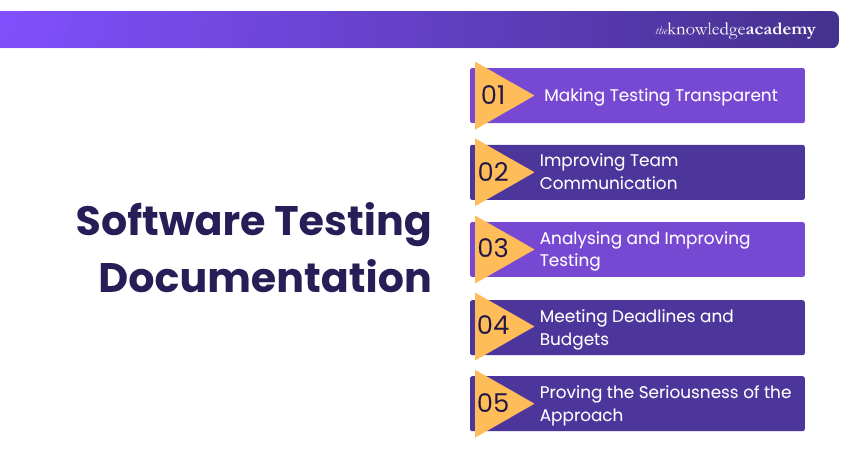
1) Making Testing Transparent - Documentation testing maintains a record of every aspect of testing and makes customers aware of work done and its results.
2) Improving Team Communication - Having a single record of all the processes conducted during testing greatly reduces communication errors. Having a common reference document limits all the redundant calls made to obtain relevant information.
3) Analysing and Improving Testing - When every test being conducted has been properly documented, it is easy to analyse their effectiveness and use cases for each software application.
4) Meeting Deadlines and Budgets - Having proper documentation immensely reduces the risk of unexpected problems, and the cost of solving these issues also becomes much lower. A well-written and documented test helps discover, fix, and describe the bugs upfront and is cheaper for the organisation in every sense.
5) Proving the Seriousness of the Approach – Proper Testing Documentation demonstrates how much value the team places on application security, stability, and speed. Inculcating best practices shows attention paid by the team to minute but significant aspects of the process.
Ready for quality assurance success? Grab the Software Testing Quality Assurance PDF now!
Benefits and Drawbacks of Software Testing Documentation
The benefits of Software Testing Documentation have been listed below:
1) It provides clarity on the quality of methods and objectives of Software Testing.
2) It maintains high levels of internal coordination when a software application is made available for customers to use.
3) It ensures clarity about the stability of tasks and performance.
4) It prevents the repetition of tasks, as every test conducted on the software has been documented.
5) Thorough documentation helps avoid delays and provides early feedback during the planning cycle.
6) It creates objective benchmarks and evidence to evaluate the performance of the testing and QA system.
7) Every test value used during testing is available in the documents and, therefore, allows for easy verification in the future.
However, the process of Software Testing Documentation comes with its own set of drawbacks, too. Some of these are:
1) The entire process is a bit tedious and time-consuming as every modification requested by the customer must be parallelly reflected in the document.
2) There are times when the cost of producing and maintaining the document exceeds the entire product cost.
If you are looking to further your career in Software Testing, look no further than our ISTQB Certified Tester Advanced Level Test Management Course - Join now!
Conclusion
Testing is a crucial aspect of Software Development, and maintaining high-quality Software Testing Documentation serves as a roadmap for future testing while ensuring quality assurance goals are met. Test documentation, including resources like the Software Testing Projects PDF, may vary from project to project. However, its quality remains uncompromised, providing numerous benefits to the company, its employees, and customers.
Learn to run efficient Automated Tests with our Software Testing Automation Course and gain insights about web and mobile testing!
Frequently Asked Questions
What is the Difference Between a Test Case and a Test Script?

A test case outlines what to test, including inputs, conditions, and expected results, focusing on validating functionality. A test script provides step-by-step instructions or code to execute the test, often used for automation and precise execution.
How Can You Improve Software Testing Documentation?
Improve software testing documentation by keeping it clear, concise, and consistently updated to reflect changes in requirements and processes. Use standard templates, include relevant details, and ensure collaboration among teams to maintain accuracy and usability.
What are the Other Resources and Offers Provided by The Knowledge Academy?
The Knowledge Academy takes global learning to new heights, offering over 3,000+ online courses across 490+ locations in 190+ countries. This expansive reach ensures accessibility and convenience for learners worldwide.
Alongside our diverse Online Course Catalogue, encompassing 17 major categories, we go the extra mile by providing a plethora of free educational Online Resources like Blogs, eBooks, Interview Questions and Videos. Tailoring learning experiences further, professionals can unlock greater value through a wide range of special discounts, seasonal deals, and Exclusive Offers.
What is The Knowledge Pass, and How Does it Work?
The Knowledge Academy’s Knowledge Pass, a prepaid voucher, adds another layer of flexibility, allowing course bookings over a 12-month period. Join us on a journey where education knows no bounds.
What are the Related Courses and Blogs Provided by The Knowledge Academy?
The Knowledge Academy offers various Software Testing Courses, including the ISTQB Software Testing Foundation Course, ISTQB Advanced Level Test Analyst Course, and Certified Software Testing Professional (CSTP) Course. These courses cater to different skill levels, providing comprehensive insights into Black Box Testing.
Our Business Analysis Blogs cover a range of topics related to Software Testing Documentation, offering valuable resources, best practices, and industry insights. Whether you are a beginner or looking to advance your Software Testing skills, The Knowledge Academy's diverse courses and informative blogs have got you covered.

Richard Harris


Senior Full Stack Developer and Technology Educator
Richard Harris is a highly experienced full-stack developer with deep expertise in both frontend and backend technologies. Over his 12-year career, he has built scalable web applications for startups, enterprises and government organisations. Richard’s writing combines technical depth with clear explanations, ideal for developers looking to grow in modern frameworks and tools.

Upcoming Business Analysis Resources Batches & Dates
Date
 ISTQB Software Testing Foundation
ISTQB Software Testing Foundation
Mon 6th Jul 2026
ISTQB Software Testing Foundation
Mon 3rd Aug 2026
ISTQB Software Testing Foundation
Tue 1st Sep 2026
ISTQB Software Testing Foundation
Mon 14th Sep 2026
ISTQB Software Testing Foundation
Mon 28th Sep 2026
ISTQB Software Testing Foundation
Mon 12th Oct 2026
ISTQB Software Testing Foundation
Mon 26th Oct 2026
ISTQB Software Testing Foundation
Mon 9th Nov 2026
ISTQB Software Testing Foundation
Mon 23rd Nov 2026
ISTQB Software Testing Foundation
Mon 7th Dec 2026
ISTQB Software Testing Foundation
Mon 21st Dec 2026

 If you wish to make any changes to your course, please


