


 Top Rated Course

We may not have the course you’re looking for. If you enquire or give us a call on +40 316317743 and speak to our training experts, we may still be able to help with your training requirements.
What is Credit: Everything You Need to Know
Olivia Taylor 27 April 2026Credit lets you borrow money or access goods now and repay later, often with interest, while also reflecting your borrowing and repayment history. Lenders use this information to evaluate your financial reliability and repayment behaviour. A strong Credit profile also helps you secure loans more easily and at better interest rates.

Training Outcomes Within Your Budget!
We ensure quality, budget-alignment, and timely delivery by our expert instructors.
Table of Contents
Related Courses
Imagine your car breaks down on the way to work, and the repair costs more than your savings, with no cash to spare. Credit steps in, helping you fix the problem fast and deal with the cost later. From car trouble to emergencies, Credit helps you handle life’s surprises without delay.
In this blog, we’ll explain What is Credit, how it works, and why it matters for everyday needs like emergencies or big purchases. We’ll cover your Credit score, how it’s calculated, the types of Credit, why Credit is important and simple ways to improve it for a stronger financial future.
Table of Contents
1) What is Credit?
2) What is a Credit Report?
3) How Does Credit Work?
4)) Your Credit Score: How It's Calculated
5) Types of Credit
6) Who Provides Credit?
7) Tips for Managing Credit
8) Why is Credit Important?
9) How Can You Improve Your Credit?
10) Conclusion
What is Credit?
Credit is a formal agreement where a borrower receives money, goods, or services and agrees to repay them later, usually with interest. It also reflects a person’s or organisation’s financial reliability, showing how responsibly they manage loans and payments. Maintaining good Credit helps individuals secure loans, such as mortgages, and access better interest rates.
Credit also has a meaning in accounting, where it refers to a bookkeeping entry that increases liabilities or income or reduces assets. Credit scores play a crucial role in assessing borrower risk, as lenders use them to make lending decisions. A higher Credit score indicates stronger Creditworthiness, while a lower score can limit access to affordable borrowing options.
Key Takeaways:
1) Credit allows borrowers to receive value now and repay it later, usually with interest
2) A good Credit history improves loan approval chances and interest rates
3) In accounting, Credit increases liabilities or income and reduces assets
4) Credit scores assess risk, typically ranging from 300 to 850
5) Revolving Credit, like Credit cards, allows repeated borrowing within a limit
What is a Credit Report?
A Credit report is a list that shows how you have used money. It tells if you borrowed money, made payments on time, or missed any payments. Banks, landlords, and some jobs may check your Credit report to see if they can trust you with money. It also helps create your Credit score.
What is a Credit Score?
A Credit score is in between 300 and 850. It shows how good you are at paying back the money you borrowed. A higher number means you are better at handling money.
Lenders look at your Credit score to decide if they should give you a loan or a Credit card. Your score comes from your Credit score. The two main ways to get this score are called the Fair Isaac Corporation (FICO®) Score and the VantageScore®. Most banks use the FICO® Score.
Here’s what the FICO® Score numbers mean:
1) 800–850: Excellent
2) 740–799: Very Good
3) 670–739: Good
4) 580–669: Okay
5) 300–579: Poor
A higher score means it’s easier to get loans, pay less interest, and be trusted with money.
How Does Credit Work?
Credit follows a structured process, beginning with an application and continuing through borrowing, repayment, and its impact on your Credit score. Understanding each stage helps you manage Credit responsibly and make informed financial decisions. Let’s explore how Credit works step by step:
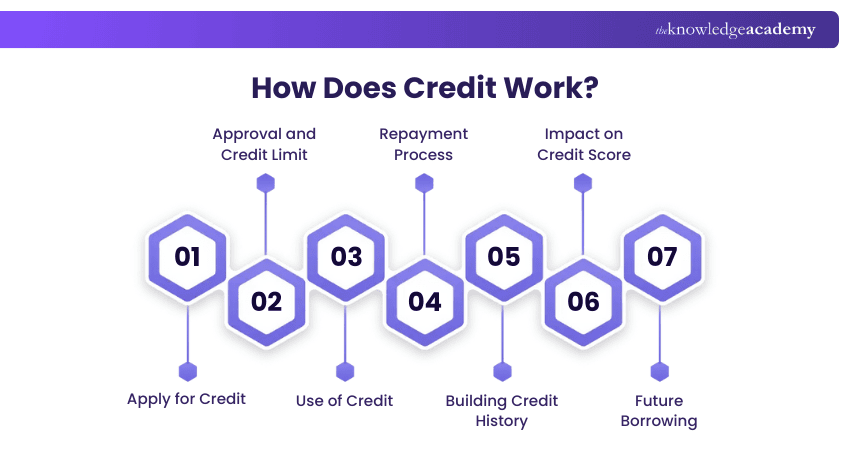
1) Apply for Credit: You apply for a loan, a Credit card, or a Credit line from a lender. They review your Credit report and score to assess eligibility, risk, and repayment ability.
2) Approval and Credit Limit: If approved, the lender sets a Credit limit or loan amount. This defines the maximum amount you can borrow or the total funds you receive.
3) Use of Credit: You use Credit to pay for purchases or expenses. Credit cards support daily spending, while loans provide lump sums for larger financial needs or long-term goals.
4) Repayment Process: You repay the borrowed amount through regular instalments. Payments usually include the principal amount, interest charges, and any applicable fees outlined in the Credit agreement.
5) Building Credit History: Your repayment behaviour is recorded in your Credit report. Consistent, on-time payments strengthen your Credit history, while missed or late payments can damage it.
6) Impact on Credit Score: Your Credit score is affected by payment history, Credit utilisation, length of Credit history, Credit types, and new applications, helping lenders evaluate your financial reliability.
7) Future Borrowing: A strong Credit profile makes future borrowing easier and often more affordable. In contrast, a poor Credit record can limit access to loans and result in higher interest rates and borrowing costs.
Attain knowledge of how subsidiary ledgers support a general ledger control account. Join our Cash Cycle Management Training now!
Your Credit Score: How It's Calculated
Your Credit score is a three-digit number from 300 to 800 that lenders use to determine if you are a reliable borrower. Your Credit score is calculated using five essential factors:
1) Your payment history
2) Your Credit usage
3) Length of your Credit history
4) Your Credit mix
5) Whether you've recently applied for a new Credit
If you have a high Credit score, you can have good Credit; if you have a low Credit score, you could take various steps to improve it. However, Improving Your Credit Score to gain the most competitive loan rates can take months or years.
Types of Credit
Credit, a cornerstone of the modern financial system, manifests in diverse forms to cater to different needs and financial circumstances. Understanding the numerous types of Credit is vital for individuals seeking to navigate the intricate landscape of borrowing and lending.

1) Credit Cards
A Credit card can be the ideal flexible option for spreading the cost of bigger purchases, accessing cash in an emergency, or helping you consolidate debts. You can use a Credit card online, in retail stores, and at compatible cash machines worldwide. Knowing that different interest rates and fees might apply to individual transaction types is helpful.
2) Mortgages
A Mortgage is a loan designed to help you purchase a property against which the loan is secured. Mortgage terms can be as extensive as 40 years, with variable and fixed interest rates available. You may need a deposit to apply for a mortgage. However, it's important to remember that you could lose your home if you can't keep up with your repayments. When preparing for your mortgage application, Mortgage Interview Questions can help you understand your financial situation better, ensuring you're fully aware of the responsibilities before committing.
Consider the following:
a) On repayment mortgages, you’ll pay more towards interest at the beginning and pay less as you reduce the balance over the mortgage term.
b) On interest-only mortgages, your monthly payments can be lower, but you are not reducing your balance during the mortgage term, and you must repay the full amount at the end.
3) Personal Loans
A personal loan could be a predictable and reliable way to borrow as it provides a fixed borrowing amount and repayment terms of one to seven years. At the end of your loan term, your balance will be repaid in full as long as you’ve made the required payments. If your interest rates are fixed, your payments will be as well. Additionally, personal loans are available with variable rates, meaning your payment amount could go up or down. You must check the product details carefully.
Optimise your finances by signing up for our Introduction to Credit Control Course now!
4) Store Cards and Credit
Some retail brands provide Credit, allowing you to make purchases at one individual brand or store. Some may offer tailored benefits and loyalty rewards. As with other Credit products, fees, interest, and various other charges may apply, and you must make regular repayments. However, these mustn't be confused with cards solely used to collect loyalty points.
5) Car Finance
Before purchasing a car from a dealership, it’s worth exploring all the financing options:
a) On a Hire Purchase (HP) plan, you must make fixed monthly payments over one to five years. You will own the car outright at the end of your agreement, with no mileage limits.
b) Personal Contract Purchase (PCP) plans provide lower monthly payments over one to four years. At the end of the agreement, you can exchange, return, or pay a lump sum to own the car. Just be aware that return conditions and mileage may apply.
6) ‘Buy Now Pay Later’
Companies like PayPal and Clearpay give you the option of making online purchases now and paying in instalments over the next few weeks or months. This service can be offered with no fees, interest, or impact on your Credit score as long as you keep up with your payments. This is ideal for short-term borrowing. If you miss a payment, charges and fees may apply, which could be similar to the concepts discussed in Letter of Credit Interview Questions, where understanding payment terms and conditions is crucial.
7) Overdrafts
This type of Credit is attached to your current account, which is best used as a short-term safety net. Using an arranged overdraft carefully can boost your Credit score by:
a) Limiting how much you use it.
b) Paying it off regularly.
c) Staying within your overdraft limit.
The opposite is true in the case of poor Overdraft Management. Even though some building societies and banks will let you use an unarranged overdraft, your Credit score may be negatively impacted if you do.
8) Unsecured Borrowing
In addition to traditional borrowing methods, you might come across options like PayPal Credit when shopping online. These can help you spread the cost of larger purchases over several months. However, as with any form of Credit, including those involving the Parties Involved in a Letter of Credit, you must stay on top of repayments to avoid negatively affecting your Credit score.
9) Student Loans
Although often provided at low interest rates, a student loan still qualifies as a form of debt, which can impact your Credit eligibility and score until it’s repaid in full. As with other types of Credit, missing a student loan payment can affect your Credit score
Who Provides Credit?
Credit is offered by various financial institutions and organisations, not just one source. Each provider offers different types of Credit based on purpose, eligibility, and risk. Below are the main sources of Credit for individuals and businesses.
1) Banks: Offer loans, Credit cards, overdrafts, and Credit lines for individuals and businesses.
2) Credit Unions: Member-owned institutions providing loans, often with lower interest rates.
3) Non-banking Financial Companies (NBFCs): Provide personal, business, and consumer loans outside traditional banking systems.
4) Microfinance Institutions (MFIs): Offer small loans to low-income individuals and rural communities.
5) Government Programmes: Provide subsidised loans for education, housing, agriculture, and small businesses.
6) Retailers and Businesses: Offer Credit through instalment plans and store Credit cards.
7) Peer-to-peer (P2P) Platforms: Connect borrowers with individual lenders online.
8) International Financial Institutions: Provide Credit to governments for development projects.
Tips for Managing Credit
Using Credit responsibly is essential to maintain financial stability and avoid unnecessary debt. Smart Credit management not only improves your Credit score but also helps you make better financial decisions. Here are some practical tips to manage Credit effectively:
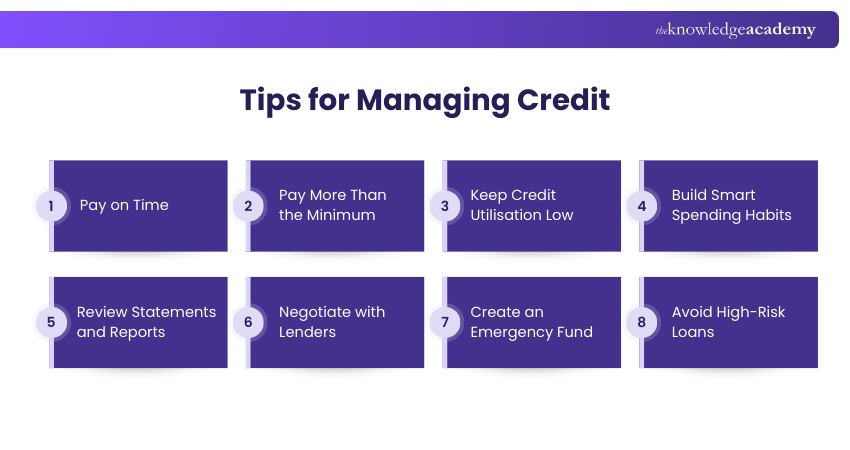
1) Pay on Time:
Pay bills before the due date to avoid penalties and protect your Credit score. Use reminders or automatic payments to stay consistent.
2) Pay More Than the Minimum:
Paying only the minimum increases debt and interest. Try to pay the full balance or more than the minimum whenever possible.
3) Keep Credit Utilisation Low:
Use less than 30% of your Credit limit to maintain a healthy score. For example, with a ₹1,00,000 limit, keep usage below ₹30,000.
4) Build Smart Spending Habits:
Track expenses, follow a budget, and avoid impulsive purchases. Remember, Credit is not free money.
5) Review Statements and Reports:
Check monthly statements for errors and review your Credit report annually to identify issues early.
6) Negotiate with Lenders:
Request lower interest rates if you have a good repayment record or consider consolidating multiple debts.
7) Create an Emergency Fund:
Regular savings reduce reliance on Credit during unexpected expenses and financial stress.
8) Avoid High-Risk Loans:
Avoid unregulated lenders and high-interest loans. Choose reliable institutions like banks, NBFCs, or Credit unions.
Learn the structure, process, and types of Credit used in global trade with our Letter of Credit Course – Register now!
Why is Credit Important?
Credit is important when you want to borrow money for big things like a car or a house. But it also affects everyday things like renting, getting a job, or setting up bills.
1) Getting Credit: A good Credit score helps you get loans or Credit cards more easily, often with lower interest.
2) Renting a Home: Landlords may check your Credit. If it’s low, you might pay more or need a co-signer.
3) Buying a House: You need good Credit to get a mortgage and better loan rates.
4) Insurance: Some companies use your Credit to set your home or car insurance price.
5) Utilities: Companies may check Credit before giving services. Low Credit may mean paying a deposit.
6) Jobs: Some employers check Credit history during hiring (not the score), but not all places allow this.
How Can You Improve Your Credit?
To make your Credit better, try not to use too much of your Credit limit. Keep your spending low. Always pay your bills on time. Also, don’t open many new Credit accounts. These small steps can help your Credit score go up over time.
Conclusion
Understanding What is Credit can help you make smart money choices. Good Credit makes it easier to borrow, rent a home or even get a job. By paying on time and using Credit wisely, you can make a strong Credit history. Start small, stay consistent, and watch your financial options grow with better Credit every single day and beyond.
Understand risk management strategies to safeguard financial integrity. Join our Accounting and Finance Policies Course now!
Frequently Asked Questions
What is a Credit Limit?

A Credit limit is the highest amount of money a lender, like a Credit card company, lets you borrow. Once you reach this limit, you can’t spend more until you pay back some of what you owe. This rule also applies to things like "buy now, pay later" or line of Credit loans.
What is a Letter of Credit?
A Letter of Credit is sent by a bank that guarantees the seller will receive the entire due amount from a buyer by a specific agreed-upon date. The bank is on the hook for the money if the buyer fails to do so.
What are the Other Resources and Offers Provided by The Knowledge Academy?
The Knowledge Academy takes global learning to new heights, offering over 3,000+ online courses across 490+ locations in 190+ countries. This expansive reach ensures accessibility and convenience for learners worldwide.
Alongside our diverse Online Course Catalogue, encompassing 17 major categories, we go the extra mile by providing a plethora of free educational Online Resources like Blogs, eBooks, Interview Questions and Videos. Tailoring learning experiences further, professionals can unlock greater value through a wide range of special discounts, seasonal deals, and Exclusive Offers.
What is The Knowledge Pass, and How Does it Work?
The Knowledge Academy’s Knowledge Pass, a prepaid voucher, adds another layer of flexibility, allowing course bookings over a 12-month period. Join us on a journey where education knows no bounds.
What are the Related Courses and Blogs Provided by The Knowledge Academy?
The Knowledge Academy offers various Accounting Courses, including the Introduction to Credit Control Training, Cash Flow Management Course, and the Letter of Credit Course. These courses cater to different skill levels, providing comprehensive insights into Payback Period.
Our Accounting and Finance Blogs cover a range of topics related to Credit, offering valuable resources, best practices, and industry insights. Whether you are a beginner or looking to advance your Accounting and Finance skills, The Knowledge Academy's diverse courses and informative blogs have got you covered.

Olivia Taylor


Chartered Accountant and Financial Training Specialist
Olivia Taylor is a qualified chartered accountant with over a decade of experience in financial management, auditing and corporate reporting. Having worked with leading firms in both the public and private sectors, Olivia brings clarity to complex financial topics. Her writing focuses on helping professionals build confidence in key areas of accounting, compliance and financial planning.
View Detail
Upcoming Accounting and Finance Resources Batches & Dates
Date
 Finance for Non Financial Managers
Finance for Non Financial Managers
Fri 10th Jul 2026
Finance for Non Financial Managers
Fri 9th Oct 2026

 If you wish to make any changes to your course, please


