AAT Level 2 Certificate in Accounting

accredited by

Our AAT course is accredited by AAT

Online Self-paced (8 hours)

Introduction to Bookkeeping Course Outline

GLH: 65

Module 1: Understand How to Set Up Bookkeeping Systems

  • Purpose of Business Documents
  • Purpose of Business Documents:
    • Role of the Books of Prime Entry
    • Role of the Cash Book and Petty Cash Book
    • Ledgers
    • Purpose of the Trial Balance
    • Purpose of Financial Statements
    • Importance of Ensuring That Bookkeeping Transactions Are Entered Accurately
    • Digital Systems Can Import Transactions from a Number of Sources
    • Benefits and Drawbacks of Using Digital Bookkeeping Systems
  • Create and Use Coding Systems
    • Different Types of Code
    • Where to Use Codes
    • Create Codes
  • Set Bookkeeping Systems
    • Dual Effect of Transaction, i.e. Debits and Credits
    • Accounting Equation (Calculation of Assets, Liabilities and Capital)
    • Classify the Items

Module 2: Process Customer Transactions

  • Calculate Invoice and Credit Note Amounts
    • Documents to Be Used
    • Difference Between Discounts Offered
    • How Discounts are Shown on Invoices
    • How to Use Credit Notes to Adjust for PPD And How PPD is Recorded Once Taken
    • Calculate Invoice Amounts
    • Calculate Credit Note Amounts
  • Enter Customer Invoices and Credit Notes into Books of Prime Entry
    • Books of Prime Entry
    • Columns Within Books of Prime Entry
    • Calculate Amounts
    • Make Entries in Books of Prime Entry
    • Total Columns in Books of Prime Entry
  • Process Receipts from Customers
    • The Records and Documents to Use
    • Identify Discrepancies
    • Calculate Amounts Due from Customers Including PPD
    • Allocate Amounts Correctly

Module 3: Process Supplier Transactions

  • Check the Accuracy of Supplier Invoices and Credit Notes
    • Documents to Use
    • Difference Between Discounts Offered
    • How Discounts Are Shown on Invoices?
    • How to Use Credit Notes to Adjust for PPD and How PPD is Recorded Once Taken?
    • Identify Discrepancies That May be Found
  • Enter Purchase Supplier Invoices and Credit Notes into Books of Prime Entry
    • Books of Prime Entry
    • Columns Within Books of Prime Entry
    • Calculate Amounts from Net and Total Figures
    • Make Entries in Books of Prime Entry
    • Total Columns in Books of Prime Entry
  • Process Payments to Suppliers
    • Records and Documents to Use
    • Information to Take into Account
    • Identify Discrepancies Between the Supplier’s Statement of Account and The Supplier Account
    • Calculate Payments Due to Suppliers, Including PPD
    • Allocate Amounts Correctly

Module 4: Process Receipts and Payments

  • Enter Receipts and Payments into an Analysed Cash Book
    • Format of the Cash Book
    • Documents to Use
    • Calculate Amounts from Net and Total Figures
    • Make Entries in the Cash Book
  • Enter Receipts and Payments into an Analysed Petty Cash Book
    • Format of the Petty Cash Book
    • Documents to Use
    • Calculate Amounts from Net and Total Figures
    • Make Entries in The Petty Cash Book
  • Total and Balance the Cash Book and Petty Cash Book
  • Process Recurring Receipts and Payments

Module 5: Process Transactions into the Ledger Accounts

  • Transfer Data from the Books of Prime Entry to the Ledgers
  • Total and Balance Ledger Accounts

Show moredown

Who Should Attend This Introduction to Bookkeeping Course?

This course is designed for individuals seeking a recognised qualification in bookkeeping as part of the AAT Level 2 Certificate in Accounting. It is particularly suitable for those aiming for roles such as:

  • Accounts Assistant
  • Finance Trainee
  • Bookkeeping Clerk
  • Purchase Ledger Clerk
  • Payroll Assistant
  • Office Support Staff handling accounts

Prerequisites of the Introduction to Bookkeeping Course

There are no formal prerequisites for this course. It is open to beginners, though basic numeracy and an interest in finance will be beneficial.

Introduction to Bookkeeping Course Overview

The Introduction to Bookkeeping provides learners with the fundamental skills required for accurate financial record-keeping. It introduces double-entry bookkeeping principles, helping learners understand how transactions are recorded and maintained.

This 65-hour training is a practical entry point into accounting, giving learners the confidence to handle simple bookkeeping duties and build a foundation for further study. Delegates gain knowledge through structured lessons and real-world examples, ensuring both conceptual understanding and practical application.

Completing this course prepares learners for progression within the full AAT Level 2 Certificate in Accounting and supports entry into finance roles. It also acts as a stepping stone to advanced bookkeeping and accounting qualifications.

Introduction to Bookkeeping Course Objectives

  • To understand the basics of double-entry bookkeeping
  • To record and maintain simple financial transactions
  • To develop practical skills in ledger and account preparation
  • To gain confidence in applying bookkeeping principles
  • To prepare for further AAT accounting and bookkeeping qualifications

Show moredown

What’s Included in This Introduction to Bookkeeping Course?

  • World-Class Training Sessions from Experienced Instructors
  • Course Completion Certificate
  • Digital Delegate Pack

Show moredown

accredited by

Our AAT course is accredited by AAT

Online Self-paced (8 hours)

Principles of Bookkeeping Controls Course Outline

GLH: 50

Module 1: Use Control Accounts

  • Produce Control Accounts
    • Purpose of the Receivables and Payables Ledger Control Accounts
    • Purpose of the VAT Control Account
    • Prepare Control Accounts
    • Total and Balance Control Accounts
  • Reconcile Control Accounts
    • Reasons for Reconciling the Receivables and Payables Ledger Control Accounts
    • Total the Balances of the Individual Receivables and Payables Ledger Accounts
    • Identify Discrepancies Between the Receivables and Payables Ledger
    • Reconcile Control Accounts
    • Identify Reasons for Discrepancies Between the Receivables and Payables Ledger

Module 2: Reconcile A Bank Statement with the Cash Book

  • Payment Methods
    • Different Payment Methods
    • Different Payment Methods Affect the Bank Balance in Different Ways
  • Use the Bank Statement to Update the Cash Book
    • Reasons for Reconciling the Bank Statement with the Cash Book
    • Items That Can Cause Differences Between Bank Statements and the Cash Book
    • Update the Cash Book Using the Bank Statement
    • Total and Balance the Cash Book
  • Complete Bank Reconciliation Statements
    • Complete Bank Reconciliation Statements Using

Module 3: Use the Journal

  • Produce Journal Entries to Record Bookkeeping Transactions
    • Purpose of the Journal as a Book of Prime Entry
    • How the Journal Is Used to Record
    • Process Journal Entries to the General Ledger Accounts
    • Record Opening Entries
    • Record Entries to Write off Irrecoverable Debts
    • Record Entries for Payroll Transactions
  • Produce Journal Entries to Correct Errors not Disclosed by The Trial Balance
    • Difference Between Errors Disclosed and not Disclosed by the Trial Balance
    • Types of Errors not Disclosed By the Trial Balance
    • Correct Errors Using the Journal
  • Produce Journal Entries to Correct Errors Disclosed by the Trial Balance
    • Purpose of a Suspense Account
    • Open a Suspense Account
    • Correct Errors and Clear the Suspense Account Using the Journal

Module 4: Produce Trial Balances

  • Extract an Initial Trial Balance
    • How to Use the General Ledger to Extract Balances
    • Column to Use in the Trial Balance
    • Transfer Balances to The Initial Trial Balance
    • Total and Balance the Initial Trial Balance
  • Redraft the Trial Balance Following Adjustments
    • Recalculate the Balance of a General Ledger Account
    • Complete a Trial Balance from Adjusted and Unadjusted Balances
    • Balance the Adjusted Trial Balance: Total Debit and Credit Columns

Show moredown

Who should attend the Principles of Bookkeeping Controls Course?

This course is designed for individuals progressing within the AAT Level 2 Certificate in Accounting and seeking to build on their bookkeeping knowledge. It is particularly useful for those in roles such as:

  • Accounts Assistant
  • Finance Clerk
  • Payroll Administrator
  • Purchase Ledger Clerk
  • Sales Ledger Clerk
  • Junior Accountant

Prerequisites of the Principles of Bookkeeping Controls Course

There are no strict prerequisites for this course. However, completion of the Introduction to Bookkeeping or prior knowledge of double-entry bookkeeping is recommended to ensure learners are prepared.

Principles of Bookkeeping Controls Course Overview

The Principles of Bookkeeping Controls Course develops learners’ understanding of key bookkeeping control processes. It introduces principles such as control accounts, bank reconciliations, and the use of the journal in accounting.

This 50-hour training course equips learners with the ability to ensure accuracy and compliance in financial records. Through practical examples and structured learning, delegates gain confidence in applying bookkeeping controls effectively in workplace scenarios.

Completing this course supports learners in progressing further within the AAT Level 2 Certificate in Accounting and lays the groundwork for more advanced studies in accounting and finance.

Principles of Bookkeeping Controls Course Objectives

  • To understand and apply bookkeeping control processes
  • To learn how to use journals, control accounts, and bank reconciliations
  • To ensure accuracy in financial record-keeping
  • To develop confidence in handling practical accounting tasks
  • To prepare for progression to higher-level AAT studies

Show moredown

What’s Included in this Principles of Bookkeeping Controls Course?

  • World-Class Training Sessions from Experienced Instructors
  • Course Completion Certificate
  • Digital Delegate Pack

Show moredown

accredited by

Our AAT course is accredited by AAT

Online Self-paced (8 hours)

Principles of Costing Course Outline

GLH: 50

Module 1: Understand the Cost Recording System Within an Organisation

  • Collection and Classification of Costs in Different Types of Organisations
    • How Costs are Collected in Different Organisations
    • How Elements of Cost are Classified
    • How Costs are Classified by Nature
    • How Costs are Classified by Behaviour
    • Difference Between Product Costs and Period Costs
  • Costing Techniques Used in Organisations
    • How Product Cost Is Determined
    • Inventory Valuation Methods
    • Labour Costing Method
    • Overhead Absorption Methods
  • Relationships Between Costing and Financial Accounting Systems Within Organisations
    • Costing and Financial Accounting Systems Within an Organisation
    • How Each System Uses Costs
  • Sources of Information on Income and Expenditure
    • How Historic Cost Is Used for Accounting and Cost Reporting
    • How Costing Systems Use Actual or Budgeted Costs to Determine Unit/Job/Batch Costs
    • How Budgeted and Actual Costs Are Useful for Planning and Control Purposes
  • Differences Between Cost, Profit and Investment Centres
    • Differences Between Cost, Revenue, Profit and Investment Centres
    • Use of Different Centres In Different Organisations
  • Classification and Recording of Labour And Overheads
    • How Costs Are Classified by Element, Nature, Behaviour And Function
    • How Costs Are Coded Using Numeric, Alphabetic and Alphanumeric Coding Systems
    • Different Costs Included in A Manufacturing Account
    • How A Manufacturing Account Is Constructed

Module 2: Use Cost Recording Techniques

  • Calculate Cost of Inventory Issues and Inventory Valuations
    • Costs issues of Inventory for Management Accounting Purposes Using FIFO, AVCO and LIFO
    • Calculate Closing Values of Inventory Using FIFO, AVCO and LIFO
    • Analyse And Report on Inventory Control Policy Compliance Including Buffer Stocks and Reorder Quantities and Timings
  • Calculate Labour Payments
    • Calculate Labour Payments
  • Calculate Overhead Absorption Rates
    • Calculate Overhead Absorption Rates to Arrive at Unit Cost
  • Use Cost Behaviour To Calculate Total and Unit Costs
    • Understand That Variable Costs Per Unit Remain the Same at Different Levels of Output but Fixed Costs Per Unit Will Change
    • Total Cost Per Unit Will Also Change as It May Be Made Up of Fixed, Variable, Semi-Variable and Stepped Costs
    • Calculate Total and Unit Costs at Different Levels of Output
    • Recognise Changes in Different Costs as Output Levels Change
  • Calculate the Costs of a Product
    • How Direct Cost is a Component of Product Cost
    • Different Treatment of Product Costs and Period Costs
    • Components
    • Calculate Product Costs
    • Calculate Costs of Products in Manufacturing Organisations:
    • Calculate Costs of Products in Service Organisations

Module 3: Provide Information on Actual and Budgeted Costs and Income

  • Actual and Budgeted Costs and Income
    • How Budgets Are Used for Short-Term Planning and Control
    • Different Types of Budget
    • How to Determine if a Variable Is Adverse or Favourable for Budgeted Costs and Income
    • Prepare Budgets for Single Product Organisations
    • Calculate Variances Between Actual and Budgeted Costs and Income
    • Calculate Variances as a Percentage of Budgeted Costs and Income
  • Exception Reporting to Identify Significant Variances
    • Identify Significant Variances According to an Organisation's Policy
    • Analyse and Report on the Potential Causes of Variances
    • Analyse and Report on the Potential Effects of Variances
    • Report Variance Analysis to Relevant Manager

Module 4: Use Tools and Techniques to Support Cost Calculations

  • Enter and Format Data
  • Enter Data into Specified Cells
  • Format Cells
  • Format Numbers
  • Copy and Paste Cells
  • Insert Rows and Columns
  • Use Formulas to Support Cost Calculations
  • Use Basic Formulas

Show moredown

Who should attend this Principles of Costing Course?

This course is designed for learners progressing through the AAT Level 2 Certificate in Accounting who want to strengthen their knowledge of costing. It is particularly useful for those in roles such as:

  • Accounts Assistant
  • Finance Administrator
  • Costing Clerk
  • Purchase Ledger Clerk
  • Trainee Accountant
  • Office Support Staff in finance

Prerequisites of the Principles of Costing Course

There are no strict prerequisites. However, completing earlier AAT Level 2 modules such as Introduction to Bookkeeping or Principles of Bookkeeping Controls, or having basic accounting knowledge, is recommended.

Principles of Costing Course Overview

The Principles of Costing course introduces learners to fundamental costing principles used in business. It focuses on understanding cost classification, recording costs, and using cost information to support management decisions.

This 50-hour training provides learners with the confidence to work with different costing methods and contribute to financial planning within organisations. It combines theory with practical examples to ensure learners can apply costing principles in real workplace scenarios.

Completing this course supports learners in progressing within the AAT Level 2 Certificate in Accounting and prepares them for advanced studies in management accounting.

Principles of Costing Course Objectives

  • To understand basic costing principles and terminology
  • To learn how to record and analyse cost information
  • To classify costs for different business purposes
  • To develop confidence in preparing simple cost reports
  • To build a foundation for advanced management accounting modules

Show moredown

What’s Included in this Principles of Costing Course?

  • World-Class Training Sessions from Experienced Instructors
  • Course Completion Certificate
  • Digital Delegate Pack

Show moredown

accredited by

Our AAT course is accredited by AAT

Online Self-paced (8 hours)

The Business Environment Course Outline

GLH: 90

Module 1: Understand the Principles of Contract Law

  • Different Classifications of Law
    • Principles
  • Main Sources of Law
    • Development of Law by the Courts, Tribunals and Parliament
  • Key Features of Contracts
    • Meaning of Invitation to Treat, Offer and Termination
    • Meaning and Consequences of Acceptance
    • Meaning of and the Need for Consideration
    • Capacity and Legality (Valid, Void, Voidable Contracts)
    • Meaning of Discharge of Contract
  • Remedies Available for Breach of Contract
    • Consequences of Being in Breach of Contract Through

Module 2: Understand the External Business Environment

  • Economic Environment
    • Micro-Economic Environment
    • The Profit Motive of Business
    • Businesses Face Uncertainty and Risk
    • Businesses Operate in a Global Business Environment
  • Government Control of the Economy
    • How Government Controls the Economy
    • Key Principles of an Effective Tax System
    • How Government Raises Finances Through the Tax System?
    • Impact of Government on Interest Rates, Levels of Employment and Consumer Spending
  • Competitive Environment
    • How the Competitive Global Market May Affect A Business
    • How Changes in Exchange Rates May Change Business Costs
    • Uncertainty and Risks Faced by Business in the Global Market
    • Benefits and Disadvantages to a Business of Trading Internationally

Module 3: Understand Key Principles of Corporate Social Responsibility (CSR), Ethics and Sustainable

  • Corporate Social Responsibilities of a Business
    • Objective of CSR
    • Involvement of Internal and External Stakeholders
    • How CSR Responsibilities change Over Time
  • Sustainability and the Environment
    • Responsibility of Business with Respect to Sustainability
    • Principles of Triple Bottom Line Reporting
    • There May Be a Trade-Off Between Sustainability and Profit
    • How Businesses Respond to Changes in the Environment?
  • Fundamental Principles of Ethics for Accounting Technicians
  • Need to Act Ethically

Module 4: Understand the Impact of Setting Up Different Types of Business Entities

  • Models of Business Ownership
    • Entity Concept
    • Different Legal Structures That Businesses Adopt:
    • Ownership of a Business Can Be Separate from the Management and Control of The Business
    • Types of Tax Applicable
    • Concept of Limited Liability and Its Effect
    • Key Features of Each Legal Structure
  • The Legal Administration of a Business
    • Sole Traders and Limited Companies
  • Business Formation
    • How are Sole Traders, Partnerships (Including LLPs), and Limited Companies?
    • Benefits and Limitations of Using ‘Off the Shelf’ Companies
    • Why Some Companies May Use Pre-Incorporation Contracts
    • Implications of Business Name

Module 5: Understand the Finance Function Within an Organisation

  • Different Functions of a Business
    • The Role of the Finance Function
    • Role of the Finance Function
    • Relationship and Interaction Between Finance and Other Functions of a Business
    • How Processes Within the Finance Function May Be Outsourced?
  • How the Finance Team Contributes to The Success of an Organization

Module 6: Produce Work in Appropriate Formats and Communicate Effectively

  • Sources of Information
    • Difference Between Valid and Invalid Sources of Information
    • Difference Between Primary and Secondary Sources
    • Benefits of Obtaining Information from More Than One Source
    • Importance of Recognising Sources When Producing Information
    • Choose Information for a Specific Purpose
  • Communicate Information
    • Importance of Effective Notetaking and Documenting Key Pieces of Information
    • Features of Business Communications
    • Influence and Impact of Inappropriate Social Media Postings
    • Consequences of Inappropriate Information Sharing
    • Produce Written Communication Using Acceptable Business Language
    • Recognise the Impact and Consequences
  • Plan Workload to Meet the Needs of the Organization

Module 7: Understand the Importance of Information to Business Operations

  • The Role of Information in the Work of the Finance Function
    • Importance of Providing Useful Information
    • Characteristics of Useful Information
    • Use of Digital Technologies for Financial Data Collection, Processing, and Disseminating Information
    • Information and Documentation Received by the Finance Function
    • Information and Documentation Produced by the Finance Function
  • The Importance of Data and Information Security
    • Why It Is Important to Ensure the Security of Data and Information
    • Why It Is Important to Maintain Privacy and Confidentiality
    • Implications for The Organisation If Data and Information are Not Secure
    • How Data and Information Is Retained Securely
    • Importance of Cybersecurity

Show moredown

Who Should Attend This Business Environment Course?

This course is designed for individuals seeking a recognised qualification in the Business Environment as part of the AAT Level 2 Certificate in Accounting. It is particularly useful for those in roles such as:

  • Aspiring Managers and Team Leaders
  • Business Graduates
  • Entrepreneurs and Start-Up Founders
  • Professionals seeking career advancement in business roles
  • Individuals preparing for business-related qualifications

Prerequisites of The Business Environment Course

There are no formal prerequisites to attend this course. It is open to all learners with an interest in developing their knowledge of business operations and environments.

The Business Environment Course Overview

The Business Environment Course is designed to provide learners with a strong foundation in understanding the structures, functions, and dynamics that shape modern businesses. In today’s competitive marketplace, having a clear grasp of the external and internal factors influencing organisations is essential for professional growth and decision-making.

This 90-hour training by The Knowledge Academy introduces a wide range of concepts, including business types, regulatory frameworks, stakeholder management, corporate governance, and the global business environment. Delegates will learn how to analyse business challenges, apply strategic thinking, and align organisational practices with external influences to support long-term success.

Aspiring Managers, Business Graduates, entrepreneurs, and professionals across industries should consider the course a priority. It equips individuals with the knowledge to evaluate market trends, assess organisational structures, and understand how economic, social, and technological factors impact business operations.

The Business Environment Course Objectives

  • To understand the internal and external factors shaping business operations
  • To explore organisational structures, governance, and stakeholder roles
  • To analyse the impact of economic, legal, and political frameworks on business
  • To evaluate the influence of social, cultural, and technological changes
  • To examine sustainability practices and environmental responsibilities
  • To assess global business challenges and opportunities for growth

After completing this course, delegates will gain a certificate demonstrating their knowledge of the business environment. This recognition will enhance employability and open opportunities in diverse business sectors.

Show moredown

What’s Included in This Business Environment Course?

  • World-Class Training Sessions from Experienced Instructors
  • Course Completion Certificate
  • Digital Delegate Pack

Show moredown

Not sure which course to choose?

Speak to a training expert for advice if you are unsure of what course is right for you. Give us a call on +44 20 4538 6376 or Enquire.

Core Concepts Covered in AAT Level 2 Certificate in Accounting

The Knowledge Academy’s AAT Level 2 Certificate in Accounting covers essential financial and business fundamentals that prepare learners for practical accounting work. The key concepts include:

  • Introduction to Bookkeeping: Learners will understand manual and digital bookkeeping systems, the books of prime entry, ledger accounts and trial balances.
  • Principles of Bookkeeping Controls: Professionals gain knowledge of control accounts, journals, bank reconciliations and error correction in accounting records.
  • Principles of Costing: Learning how costs are collected, classified and used in decision-making, including budgeting and cost behaviour.
  • The Business Environment: Learners explore how legal, ethical, economic, and organisational factors influence business operations and the finance function.
     

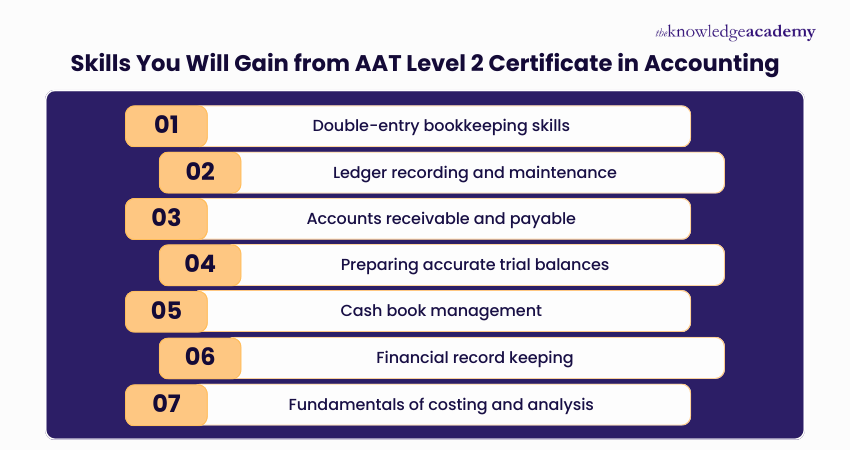
Skills You Will Gain from AAT Level 2 Certificate in Accounting

The Knowledge Academy’s AAT Level 2 Certificate in Accounting equips you with practical skills that are directly applicable to entry-level accounting and finance roles. The skills you will gain include:

Skills You Will Gain from Our AAT Level 2 Certificate in Accounting

  • Double-entry bookkeeping skills: Develop the ability to record financial transactions accurately using debits and credits while maintaining core ledgers.
  • Ledger recording and maintenance: Develop the ability to update, balance and maintain key ledgers that support accurate financial reporting.
  • Accounts receivable and payable: Learn to handle customer and supplier transactions, issue and record invoices and support smooth cash flow.
  • Preparing accurate trial balances: Develop the skills needed to produce a trial balance and identify discrepancies that must be corrected.
  • Cash book management: Gain skills in recording cash movements, updating cash books and managing petty cash accurately.
  • Financial record keeping: Learn to match entries, update records and complete basic bank and ledger reconciliations to maintain clear and accurate financial information.
  • Fundamentals of costing and analysis: Understand how to capture, classify and analyse simple costs that support everyday accounting decisions.
Show more blue-arrow

AAT Level 2 Certificate in Accounting FAQs

It is an entry-level qualification that provides knowledge of bookkeeping, costing, and financial administration, preparing learners for a career in accounting.

The prerequisites for the AAT Level 2 Certificate in Accounting Courses are based on the course specifications and the target group of professionals it serves. Check the respective course page of the course that you are planning to take to know about its prerequisites.

Yes, after completing the courses you will receive a certificate of completion to validate your achievement and demonstrate your proficiency in the course material.

It provides the technical and practical skills needed for entry-level finance roles and prepares learners for higher-level AAT qualifications. At The Knowledge Academy, one of the best training providers, we help learners build strong foundations for accounting careers.

Yes, The Knowledge Academy offers support via phone & email before attending, during, and after the course. Our customer support team is available to assist and promptly resolve any issues you may encounter.

If you are unable to access your AAT Level 2 Certificate in Accounting Courses, contact the support team via email or phone for assistance. At The Knowledge Academy, as a global training provider, we ensure prompt support to resolve any access or technical issues.  

This course is ideal for beginners, school leavers, career changers, and professionals looking to gain foundational accounting knowledge. At The Knowledge Academy, as a trusted training provider, we support learners from diverse backgrounds.

The course covers bookkeeping transactions, controls, costing techniques, and using accounting software to manage financial data effectively. At The Knowledge Academy, one of the global training providers, we ensure practical and industry-relevant learning. 

After completing this qualification, you can pursue roles such as Accounts Assistant, Junior Bookkeeper, or Finance Administrator. At The Knowledge Academy, one of the top training providers, we help learners progress into these entry-level roles. 

Yes, this qualification provides a pathway to advanced AAT levels, enabling learners to further develop their accounting knowledge and career prospects.

The Knowledge Academy stands out as a prestigious training provider known for its extensive course offerings, expert instructors, adaptable learning formats, and industry recognition. It's a dependable option for those seeking this certification.

The Knowledge Academy is one of the Leading global training provider for AAT Level 2 Certificate in Accounting.

The training fees for AAT Level 2 Certificate in Accounting in Qatar starts from $

Show more down

Why we're the go to training provider for you

icon

Best price in the industry

You won't find better value in the marketplace. If you do find a lower price, we will beat it.

icon

Trusted & Approved

Recognised by leading certification bodies, we deliver training you can trust.

icon

Many delivery methods

Flexible delivery methods are available depending on your learning style.

icon

High quality resources

Resources are included for a comprehensive learning experience.

barclays Logo
deloitte Logo
Thames Water Logo

"Really good course and well organised. Trainer was great with a sense of humour - his experience allowed a free flowing course, structured to help you gain as much information & relevant experience whilst helping prepare you for the exam"

Joshua Davies, Thames Water

santander logo
bmw Logo
Google Logo

Looking for more information on AAT Level 2 Certificate in Accounting

cross

Upgrade Your Skills. Save More Today.

superSale Unlock up to 40% off today!

WHO WILL BE FUNDING THE COURSE?

close

close

Thank you for your enquiry!

One of our training experts will be in touch shortly to go over your training requirements.

close

close

Press esc to close

close close

Back to course information

Thank you for your enquiry!

One of our training experts will be in touch shortly to go overy your training requirements.

close close

Thank you for your enquiry!

One of our training experts will be in touch shortly to go over your training requirements.