


 Top Rated Course

We may not have the course you’re looking for. If you enquire or give us a call on +48 221041849 and speak to our training experts, we may still be able to help with your training requirements.
What is Social Facilitation? A Complete Guide
The Knowledge Academy 25 November 2025Discover What is Social Facilitation with this exclusive blog. Discover how individuals perform differently and unlock the various factors influencing behaviour. You can also explore the psychological phenomenon of Social Facilitation and how it influences individual performance in various social settings. Read on to learn more!

Training Outcomes Within Your Budget!
We ensure quality, budget-alignment, and timely delivery by our expert instructors.
Table of Contents
Have you ever found yourself performing differently when others are watching? Perhaps excelling at a task you're skilled at or stumbling over your words when under scrutiny? Social Facilitation lies at the heart of these intriguing dynamics. But do you know What is Social Facilitation and how the presence of others can influence our performance in various situations?
In this blog, we will discover What is Social Facilitation, how we can use it to increase our performance and when it can cause adverse effects.
Table of Contents
1) Social Facilitation – an overview
2) History and origin
3) Different types of Social Facilitation
4) Factors affecting Social Facilitation
5) Various theories on Social Facilitation
6) Other theories aligning with Social Facilitation
7) Examples of Social Facilitation
8) Conclusion
Social Facilitation – an overview
We often encounter a situation where we have to perform a task, either in front of a group or among people. While completing that task, we feel that we are more efficient when performing among people; rather than when no one is around us. That’s the answer to the question, What Is Social Facilitation?
Whenever we are around people, we tend to work faster with minimum errors. This real presence around us stimulates alertness and increases self-presentation, fear of getting a low evaluation, and other factors that affect our work directly. This is how we define Social Facilitation. For those interested in exploring more about Social Facilitation, Facilitation books often provide a detailed understanding of the psychology behind group dynamics and how they influence individual performance.
It’s common for individuals to mix up Social Inhibition with Social Facilitation. The former suggests that certain people work more efficiently and make fewer mistakes when they are alone, particularly when time is of the essence. On the other hand, Social Facilitation and Social Inhibition are two psychological concepts that demonstrate how social environments can either enhance or hinder performance, depending on the task and individual.
History and origin
The Social Facilitation definition was given by Norman Triplett in 1898 when he published his paper talking about the effects surroundings can have on a person. He first observed the effect of this phenomenon while cycling. He saw that whenever cyclists were cycling together, they started racing with each other. On the other hand, when the same riders were cycling alone and tried beating the time of another rider, they were comparatively slower.
Another test he took as an example turned out to be somewhat different. To figure out What is Social Facilitation, he asked 40 children to work with a fishing reel. He found through this research that about half of the children performed better when doing the task with the group. While a quarter of those children managed the same efficiency and the other quarter’s performances declined. Such conflicts in behaviours were seen in other studies too.
Later, in 1996, Robert Zajonc came up with the conclusion to Norman’s theory that “Dominant Response” could explain these conflicting behaviours. It means that people are more likely to behave a certain way in the presence of a given stimulus.
Based on this approach, he concluded that if a task comes naturally to a person or they hold experience of it, the presence of other people enhances the person’s performance. But if the task requires a lot of complexity, or the person is just a beginner, they experience a reverse effect of Social Facilitation.
Master your craft and advance your career with our Industry Training – register today and become the expert you were meant to be!
Different types of Social Facilitation
Now that we understand What is Social Facilitation, let’s understand how it is classified. The basic classification occurs on the type of surroundings that brings the effect of this phenomenon. So, let's have a brief look at them:
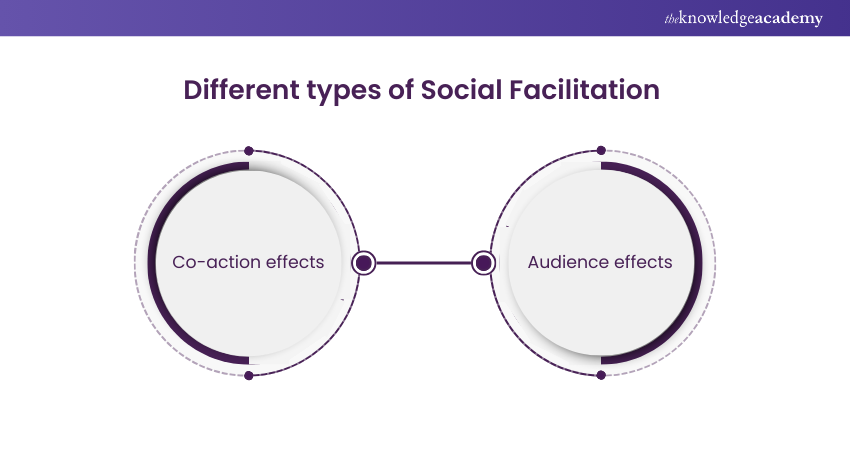
Co-action effects
Co-action effects can be seen when you find a person surrounded by people performing similar tasks. Here factors like self-presentation theory and feedback loop model play a vital role in enhancing the person’s performance.
Self-presentation theory states that a person will work more attentively when performing the same task as others in order to create a good impression. While in the feedback loop theory, the person tries to become more self-aware and commit fewer mistakes when surrounded by others.
Audience effects
Facilitator Interview Questions often assess a candidate's understanding of audience effects, which occur when a person performs a task in front of an audience. Factors like an adrenaline rush and heightened alertness play a crucial role in this phenomenon. For instance, a trained musician may perform significantly better when playing before an audience.
Boost productivity with Facilitation Skills today!
Factors affecting Social Facilitation
Now, let us discuss a few crucial factors that play an important role and help us define Social Facilitation:
1) Psychological factors: Getting great results matters a lot for some people when performing in front of a crowd or among their peers. This stimulation affects their work psychologically. If they crave the stimulation more, they tend to become more attentive, focused and self-aware. And if the results do not affect them, then they work on the same efficiency.
2) Cognitive factors: Cognitive factors include distraction-conflict and attention. They say that some people have the quality to excel among people while others bring better results when left alone. Some people might get distracted or too nervous in a crowd, and others might excel based on this factor.
3) Affective factors: Factors like anxiety and stress come under affective factors. Being anxious can be rewarding for some people, while it might become the reason of low efficiency for others. Affective factors determine if self-presentation helps a person increase their performance or harms their work.
Master the art of product innovation and leadership with our Product Management Training – join us now!
Various theories on Social Facilitation
Explore our blog for more Facilitation Tips and learn how to enhance your team’s collaboration and performance.
We have already discussed how Social Facilitation can cause changes in a person’s perspective and psychology. Let us further discuss some of its theories:
1) Social Orientation Theory: Social Orientation Theory states that people with positive outlook thrive under Social Facilitation. But people who generally have a negative outlook towards life and can be easily demotivated mostly find a decrease in their performance.
2) Capacity Model: The Capacity Model explains about how a person needs different levels of memory while working on different things. People working on something easy requires less memory compared to those working on something harder. Therefore, Social Facilitation works positively when the task is relatively easier.
3) Evaluation Apprehension Hypothesis: The Evaluation Apprehension Hypothesis states that the fear of negative evaluation causes a person to be more attentive and productive. When more people are evaluated together, the entire team has a higher chance of increasing their performance rather than if they were evaluated individually.
4) Feedback Loop Model: The Feedback Loop Model explains the importance of working while others observe us. When under observation, we never behave exactly like we would if we were alone; instead, we try not to commit mistakes and work more conscientiously.
Other theories aligning with Social Facilitation
Social Facilitation can be productive for one and a demotivating factor for another. Let us understand other theories align with it to have a better understanding of these factors:
1) Yerkes-Dodson Law: Yerkes-Dodson Law states the difference between easy and difficult tasks and how it interferes with Social Facilitation. In a nutshell, if the task is easier, the person will see a growth in performance with Social Facilitation. On the contrary, if the task is much more complex, the person will have the reverse effect of Social Facilitation.
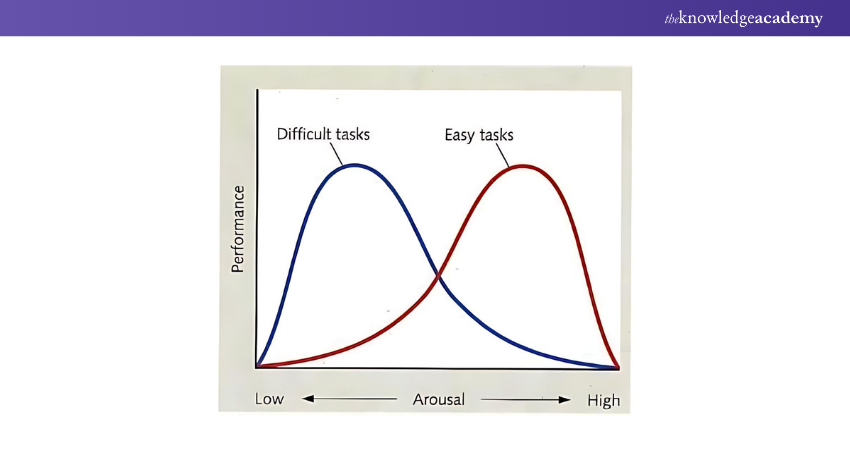
If you compare the amount of arousal with the level of performance and plot a graph, you will find the shape upside-down (U). This graph indicates a clear difference between easy tasks and complex tasks, and this factor affects overall performance.
2) Social Loafing: Social Loafing is a different aspect of Social Facilitation that talks about a situation where all team members are doing a task inefficiently. Social Loafing occurs when every member is less productive than they would be if they were working alone.
Sometimes, the bad social dynamic of the group can be a major factor in causing Social-Loafing. In this case, every member in the group wants to give their responsibility to someone else, causing a lack of motivation and low team spirit. The worse effects of Social-Loafing are the process being delayed and additional labour added to the group.
Examples of Social Facilitation
Let us discuss a few Social Facilitation examples to understand how it has an impact on our daily lives:
1) Co-action effects in the library: When a group of students are studying in a library, we can generally witness Social Facilitation increasing the efficiency of understanding the concepts. Although students gain more knowledge through this process, sometimes, a few students might get distracted, and face reversed effects.
2) Performing simple tasks: When it comes to performing simple tasks, dominant responses may lead to Social Facilitation. Tasks like jogging with friends, cycling and playing a sport increase performance with Social Facilitation.
3) Co-action effects decreasing performance: As discussed earlier, not everyone has a positive effect because of Social Facilitation. For example, if a person fears speaking in public, the anxiety brought by Social Facilitation will only make the matter worse.
Conclusion
We hope that the blog answered, What is Social Facilitation, and how this phenomenon can be advantageous if utilised carefully, or disadvantageous if disregarded. For novices, the key is to hone their abilities in solitude before stepping into the public eye. Conversely, seasoned professionals can strategically employ Social Facilitation to enhance their productivity.
Become a leader in managing tomorrow's spaces - join our Facilities Management Training and transform your future!
Frequently Asked Questions
How Social Facilitation can improve your performance?

Social Facilitation enhances performance through the presence of others. Whether it's in sports or work, the presence of an audience or colleagues can increase arousal, motivation, and focus. Positive social interactions can boost confidence, leading to improved productivity and efficiency, ultimately elevating overall performance levels.
What is the effect of social facilitation on those performing a difficult task?
Social Facilitation can significantly impact individuals performing difficult tasks. In some cases, it can enhance performance due to heightened arousal and motivation in the presence of others. However, it may also induce anxiety, leading to decreased performance for complex or unfamiliar tasks.
What are the other resources and offers provided by The Knowledge Academy?
The Knowledge Academy takes global learning to new heights, offering over 3,000 online courses across 490+ locations in 190+ countries. This expansive reach ensures accessibility and convenience for learners worldwide.
Alongside our diverse Online Course Catalogue, encompassing 19 major categories, we go the extra mile by providing a plethora of free educational Online Resources like Blogs, eBooks, Interview Questions and Videos. Tailoring learning experiences further, professionals can unlock greater value through a wide range of special discounts, seasonal deals, and Exclusive Offers.
What is the Knowledge Pass, and how does it work?
The Knowledge Academy’s Knowledge Pass, a prepaid voucher, adds another layer of flexibility, allowing course bookings over a 12-month period. Join us on a journey where education knows no bounds.
What are related courses and blogs provided by The Knowledge Academy?
The Knowledge Academy offers various Industry Trainings, including the Facilitation Skills Training, Facilities Management Training, and Product Management Training. These courses cater to different skill levels, providing comprehensive insights into Democratic Leadership.
Our Business Skills Blogs cover a range of topics related to Social Facilitation, offering valuable resources, best practices, and industry insights. Whether you are a beginner or looking to advance your Business skills, The Knowledge Academy's diverse courses and informative blogs have got you covered.

The Knowledge Academy


Global Training Provider
The Knowledge Academy is a world-leading provider of professional training courses, offering globally recognised qualifications across a wide range of subjects. With expert trainers, up-to-date course material, and flexible learning options, we aim to empower professionals and organisations to achieve their goals through continuous learning.

Upcoming Business Skills Resources Batches & Dates
Date
 Facilitation Skills Training
Facilitation Skills Training
Fri 20th Mar 2026
Facilitation Skills Training
Fri 22nd May 2026
Facilitation Skills Training
Fri 24th Jul 2026
Facilitation Skills Training
Fri 25th Sep 2026
Facilitation Skills Training
Fri 20th Nov 2026

 If you wish to make any changes to your course, please


